
Manezinho Araújo (Cabo de Santo Agostinho PE 1910 - São Paulo SP 1993)
Painter, printmaker, screen printer, singer and composer.
Manuel Araújo moved to Recife in 1916 and attended the Escola de Comércio de Pernambuco in the 1920s. He devoted himself to music from the 1930s, composing and singing emboladas and recording about a hundred of them. He began painting in 1950, self-taught. In 1957, living in Rio de Janeiro, he gave up his music career and opened a restaurant serving typical Northeastern food, devoting himself at the same time to business and to painting. In 1963, his first solo exhibition took place in São Paulo, at Galeria Astréia and, two years later, another solo show was held at Galeria Capela. In Rio de Janeiro he published the album of screen prints Meu Brasil [My Brazil], 1968, with a presentation by Aldemir Martins (1922 - 2006).
Critical Commentary
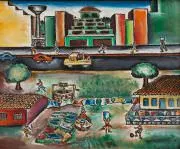
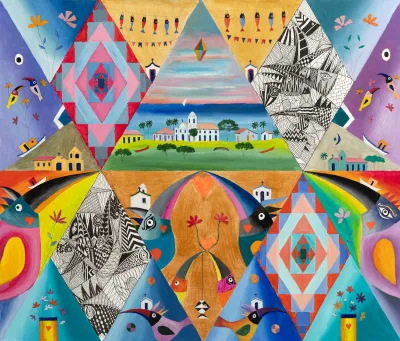
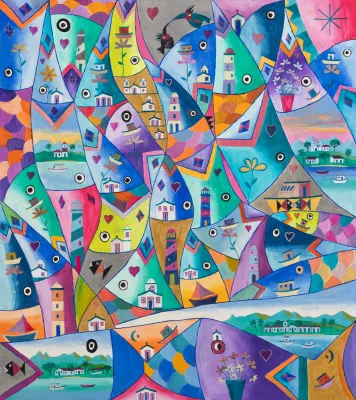
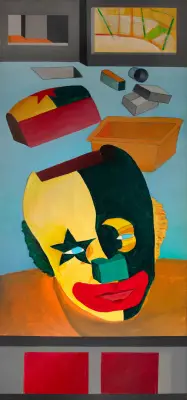
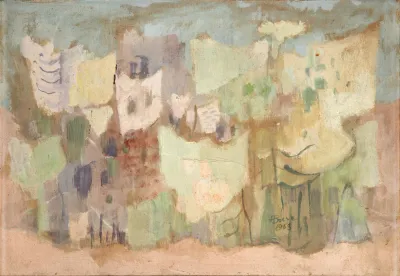
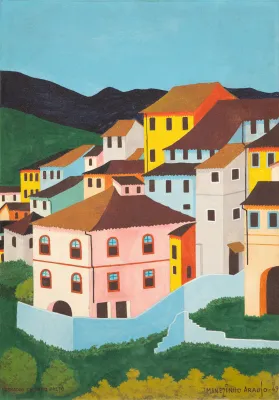
There are three recurring characteristics in Manezinho Araújo's painting: first, the presence of well-defined compositional lines, clearly drawn; second, the marked cadence, the rhythmic distribution of elements across the surface of the painting; third, the choice of themes linked to the popular universe: the harvest, religion, the market, the favela. Take, for example, Favela Iluminada [Illuminated Favela], 1978: the canvas displays from end to end a strong diagonal line running from the lower left corner to the upper right corner. Representing the steep slope of the hill over which the favela spreads, this diagonal also organizes the painting in a concise and effective way. One half is covered by a dense, homogeneous blue, the other is filled with small geometric shacks built from rectangles, rhombuses and triangles. In this way, Araújo uses two devices to increase the sense of separation between the two planes: the lack of distinction in the blue plane (sky) as opposed to the distinction among the geometric elements (favela), and a dark shade of blue, which reinforces the impression of depth, in contrast with the shacks painted in brighter tones, which intensify the sense of volume and make the favela "leap" closer to the surface of the picture. The viewer's eyes are led to travel rhythmically across the façades of the shacks, distributed over the canvas in an irregular yet rhythmic way - the lower rows form three organized horizontals that break up in the upper half when they meet the diagonal of the hill.
Source: Itaú Cultural