
Karl Ernst Papf (Dresden, Germany, 1833 – São Paulo, SP, 1910)
Karl Ernst Papf was born in Dresden, Germany, in 1833. Around From 1850, he joined the Dresden Academy of Painting, where he received artistic training. In 1867, he was hired by the firm Albert Henschel & cia., by the German photographer Albert Henschel (1827–1882), and immigrated to Brazil, initially establishing himself in Recife, Pernambuco.
In Brazil, he stood out for the production of photopaintings, oil portraits performed with based on photographs, a genre widespread in the 19th century. Henschel's establishment prospered and was renamed Photographia Allemã, expanding its activities through branches in Salvador, Rio de Janeiro and São Paulo.
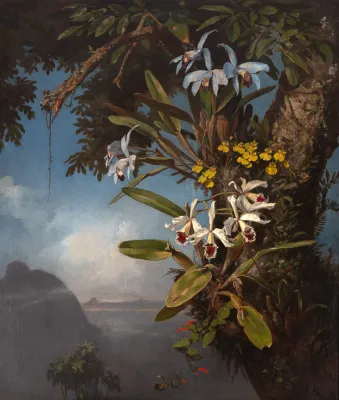
In 1877, Papf moved to Rio de Janeiro. January, then capital of the Empire, and, in the following year, settled in Niterói. In parallel with the commercial production of portraits, he dedicated himself to the painting of landscapes and still lifes, with special interest in the representation of orchids.
In 1880, he moved to Petrópolis, where, in 1885, He inaugurated the Photographia Papf studio, in partnership with his son, Jorge Henrique Papf (1863–1920). Throughout his career, he made custom portraits for members of the Brazilian Imperial Family, which contributed to consolidate his reputation as a portraitist. and Crafts, in Rio de Janeiro, in 1882, and the 4th General Exhibition of Fine Arts, in 1897. In 1886, he received a gold medal at the 1st Industrial and Artistic Exhibition of Petrópolis. 1899, moved to São Paulo, where he worked for the photography branch of Germany and later established his own business. His son, Jorge Henrique Papf, remained in Petrópolis and took over the direction of the Family Studio.
The importance of his production was resumed in retrospective studies and exhibitions carried out throughout the 20th century. In 1980, his work was the subject of retrospectives at the Imperial Museum, in Petrópolis, and at the Pinacoteca do Estado de São Paulo, in addition to an exhibition dedicated to the artist at Pinakotheke, in Rio de Janeiro.
Critical Comment
Karl Ernst Papf initially stood out as a painter of portraits made from photographs, known as photopaintings. In the 19th century, this genre represented a relatively more accessible alternative to portraits painted directly from the model. Photography, retouched and colored by hand, was especially sought after by members of the urban and commercial petty bourgeoisie, interested in perpetuating its image and preserving the family memory.
According to historian and art critic Carlos Roberto Maciel Levy, author of an important A study on the artist, the intense professional activity and the commercial success of PAPF would have contributed to his work being neglected by the historiography of Brazilian art. The recognition achieved during his life therefore did not translate into an equally expressive presence in later studies.
The critic Gonzaga Duque (1863–1911) in The Brazilian Art, published in 1888, already observed the contrast between the PAPF popularity among its contemporaries and the uncertainties regarding the quality of certain portraits. His criticism, although ironic, constitutes a relevant record of the artist's reception in his own time.
The reassessment promoted by Carlos Roberto Maciel Levy expanded the understanding of Papf's contribution to Brazilian painting, especially in the field of landscape. In works such as Praia do Cavalão (1878), the artist demonstrates mastery of the traditional principles of European landscaping, learned during his training in Germany, while developing a particular observation of Brazilian nature.
For Levy, PAPF is not limited to reproducing the models of his academic training. Its individual and open approach to artistic transformations allows it to overcome these references and represent Brazilian vegetation with its own sensitivity. In this way, its landscape production reveals an authorial dimension that goes beyond its recognized activity as a portraitist and photographer.
Papf's trajectory thus highlights the relationship between art and market in the 19th century, as well as the difficulties of recognition faced by artists whose commercial production overlaps, in the Historical memory, the quality and diversity of his work.
Bibliographic notes
¹ LEVY, Carlos Roberto Maciel. Karl Ernst Papf 1833–1910. Rio de Janeiro: Pinakhoteke, 1980.
² DUQUE, Luiz Gonzaga. Brazilian art: painting and sculpture. Rio de Janeiro: H. Lombaerts & C., 1888, p. 201–202.
Criticism
"There was a time, lost in the mists of our past, but already removed, in which E. Papf was the favorite portraitist of the Brazilians. I know the causes that influenced this sympathia. Some say, certainly the less warned, that it was due to the similarity of the portraits with the portrayed, the similarity that the brushes of Mr. Papf could very easily, but it does not seem very satisfying to me. similar reason for, I confess, many portraits I saw signed by this painter, who were aroused by doubts about the resemblance to the origins".
Gonzaga Duque
duke, Gonzaga. Brazilian art: painting and sculpture. Rio de Janeiro: H. Lombaerts & C., 1888.
"The São Paulo branch of Alberto Henschel's Atelier, photographer of the Imperial House, announced 'oil portraits' and in this he was assisted by a great painter who was Ernesto Papf, artist who even recently deserved studies and retrospective exposition, as his skill and merits were not limited to photographic reproduction, because he also knew how to perform good portraits taken from the natural. Henschel".
Carlos Eugênio Marcondes de Moura
LEMOS, Carlos Alberto Cerqueira; AMARAL, Aracy; BERNARDET, Jean-Claude. almost innocent portraits. São Paulo: Nobel, 1983. p. 55.
Corps
Museum of Modern Art - Rio de Janeiro RJ
Collective exhibitions
1882 - Rio de Janeiro RJ - Exhibition of the Propaganda Society of Fine Arts, at the Imperial Liceu de Artes e Ofícios
1884 - Rio de Janeiro RJ - Collective, at Elegant Glace
1886 - Petrópolis RJ - 1st Industrial and Artistic Exhibition of Petrópolis, at Palácio de Cristal - Medal of Gold
1890 - Petrópolis RJ - Collective, at the headquarters of Photographia Papf
1897 - Rio de Janeiro RJ - 4th General Exhibition of Fine Arts, at Enba
1905 - Petrópolis RJ - Exhibition of Fine Arts of the Clube de Petrópolis
Posthumous exhibitions
1946 - São Paulo SP - 12th Salão Paulista de Belas Artes, at Galeria Prestes Maia
1957 - Petrópolis RJ - Retrospective, at the Princess Palace
1980 - Petrópolis RJ - Retrospective, at the Imperial Museum
1980 - Rio de Janeiro RJ - Exhibition Karl Ernest Papf, 1833-1910, Pinakotheke
1980 - Rio de Janeiro RJ - Retrospective, at the Art Gallery Collection
1980 - São Paulo SP - The Brazilian landscape: 1650-1976, at Paço das Artes
1980 - São Paulo SP - Retrospective, at the Pinacoteca do Estado
1984 - São Paulo SP - Tradition and rupture: synthesis of Brazilian art and culture, at the Bienal Foundation
1989 - Rio de Janeiro RJ - Rio de Janeiro by Machado de Assis, at CCBB
1992 - Rio de Janeiro RJ - Nature: Four centuries of art in Brazil, at CCBB
1999 - Rio de Janeiro RJ - Brazil rediscovered, in the Imperial Palace
2000 - São Paulo SP - Brasiliana Collection, at the Pinacoteca do Estado
2001 - Belém PA - German photographers in 19th century Brazil, at the Belém Museum of Art
2001 - Rio de Janeiro RJ - German photographers in 19th century Brazil, At the Goethe Institute
2002 - Niterói RJ - Brazilian art on paper: 19th and 20th centuries, at Solar do Jambeiro
Source: Itaú Cultural