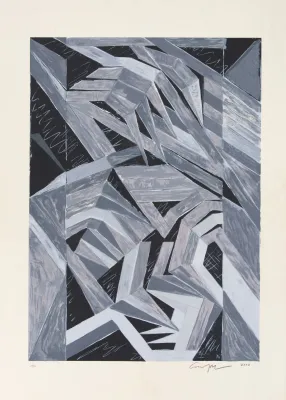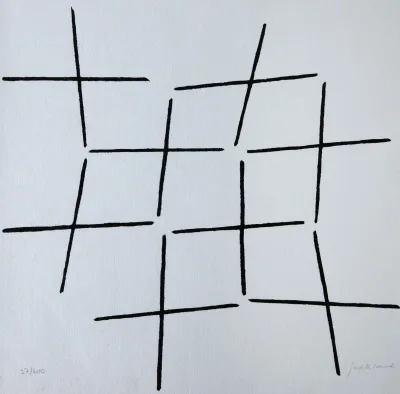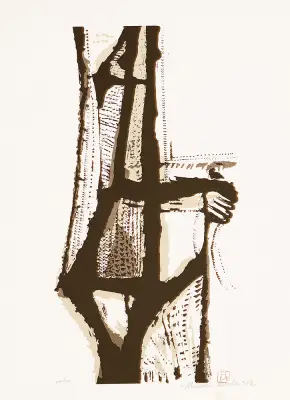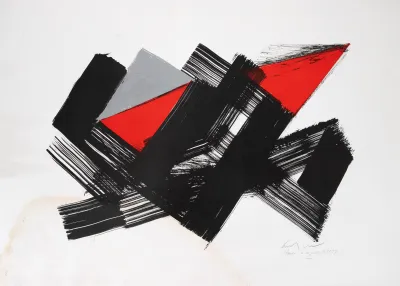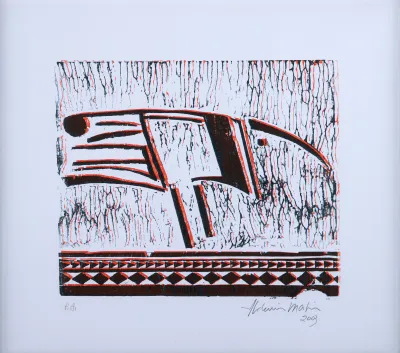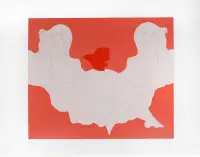

José Luis Cuevas (Mexico City, Mexico 1934 - idem 2017)
José Luis Cuevas was a draftsman, painter, printmaker, sculptor, illustrator and writer, one of the most important and controversial Mexican artists of the 20th century. A central figure of the movement known as the Generación de la Ruptura [Rupture Generation], he broke with the then-dominant tradition of Mexican muralism, proposing a more personal, introspective and critical approach to human reality.
He grew up in a modest environment, linked to his family's paper and pencil factory. Still in childhood, he began studying art at the Escuela Nacional de Pintura y Escultura "La Esmeralda" [National School of Painting and Sculpture], studies interrupted in 1946 by rheumatic fever that kept him bedridden for two years. During that period, he developed printmaking techniques under the guidance of Lola Cueto and began a self-taught path that would strongly influence his artistic language.
At 14, he refused to return to school and rented a small studio on Donceles Street, showing from early on an independent and provocative attitude. He illustrated newspapers and books and even taught art history, despite having no formal training. A defining episode in his formation was his visit to the La Castañeda psychiatric hospital, where he drew patients — experiences that shaped the dark and disturbing character of his work.
He was one of the first artists to openly criticize Mexican muralism, led by Diego Rivera, José Clemente Orozco and David Alfaro Siqueiros. He denounced its ideological instrumentalization by the State, calling it "la cortina de nopal" (the cactus curtain). In texts such as the controversial Carta a Siqueiros [Letter to Siqueiros], he defended individual freedom and subjectivity as the foundations of artistic creation.
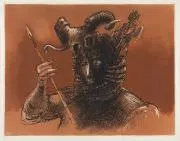
His stance made him a symbol of the modernization of the visual arts in Mexico and placed him in the international postwar context, alongside names such as Francis Bacon, with whom he kept in contact. His work is marked by the grotesque, by visceral expressionism and by an obsessive representation of human decay. He depicted deformed bodies, isolated figures, prostitutes, madmen, tyrants and corpses, rejecting the classical ideal of beauty to expose the suffering and marginality of modern existence.
He considered that his art reflected solitude, incommunicability and human vulnerability. Influenced by Goya, Kafka, Quevedo, Dostoevsky and the Marquis de Sade, his work carried strong literary and philosophical references linked to introspection and decadence.
A striking feature of his career was his constant production of self-portraits, interpreted by some as excessive vanity. Cuevas, however, saw in them an existential investigation and a record of himself. For decades, he photographed himself daily, consolidating his image as a public figure in Mexico.
In 1992, the José Luis Cuevas Museum was inaugurated in Mexico City, in the former convent of Santa Inés. The space houses a vast collection of works by the artist and other representatives of the Rupture Generation, becoming a cultural and architectural landmark of the capital.
Controversial, irreverent and eccentric, he went into self-exile in France between 1976 and 1979, accumulated disputes with artists such as Rufino Tamayo and José Chávez Morado and claimed to suffer persecution from critics and publishers. He attributed his "forced ostracism" to a plot by the Mexican cultural milieu, which reinforced his image as an outsider. He was described by some as narcissistic and paranoid; by others, as a solitary genius.
Despite the controversies, he remained active until the end of his life, creating, exhibiting and writing. He published columns such as Cuevario, as well as books, illustrated letters and critical texts.
Solo Exhibitions
1953 - Mexico City, Mexico - Solo, at Galería Prisse
1954 - Washington, DC, USA - Exhibition at the Pan American Union (OAS)
1955 - Havana, Cuba - Solo, at Galería de la Habana
1956 - Caracas, Venezuela - Solo, at Galería de Arte Nacional
1957 - New York, USA - Solo, at Pan American Union Gallery
1961 - Buenos Aires, Argentina - Solo, at Museo Nacional de Bellas Artes
1967 - Paris, France - Solo, at Galerie Claude Bernard
1970 - Rome, Italy - Solo, at Galleria d'Arte Moderna
1974 - Tokyo, Japan - Solo, at Tokyo Gallery
1981 - Mexico City, Mexico - "Señales de vida" ["Signs of Life"], at Museo de Arte Moderno
1984 - Madrid, Spain - Solo, at Círculo de Bellas Artes
1987 - Bogotá, Colombia - Solo, at Museo de Arte Moderno
1992 - Mexico City, Mexico - Opening of the José Luis Cuevas Museum with a permanent exhibition
1995 - Mexico City, Mexico - Talavera mural in the Zona Rosa
2006 - Colima, Mexico - Installation of the sculpture "Figura Obscena" [Obscene Figure]
2008 - Mexico City, Mexico - Retrospective at the Museo del Palacio de Bellas Artes
2010 - Mérida, Mexico - Solo, at Museo MACAY