
Jorge Guinle (Nova York, Estados Unidos 1947 - Rio de Janeiro 1987)
Jorge Guinle was a painter, draftsman and printmaker. He moved with his family to Brazil in the year of his birth and remained in Rio de Janeiro until 1955. From 1955 to 1962, accompanying his mother, he lived in Paris and then in New York, where he stayed until 1965. In France, he began studying painting on his own, while visiting museums and art galleries, a practice he continued after moving to the United States. Contact with works by both old masters and contemporary artists was decisive in his formation. He was particularly influenced by the work of the French painter Henri Matisse (1869-1954) and by action painting and American Pop Art.
From 1965 to 1974, he lived in Rio de Janeiro, also spending periods in London and Paris, a city to which he returned in 1974, settling there for another three years. In 1977, he moved back to Rio de Janeiro, where his work gained growing recognition. In the 1980s, he began taking part in the country's main art exhibitions. His production, concentrated in the last seven years of his life, was devoted above all to painting, standing out for its vigor and its complex references to modern and contemporary art movements.
Jorge Guinle was an important champion of the revaluation of painting, especially within the group of young artists known as the Geração 80 [80s Generation]. He took part in the exhibition Como Vai Você, Geração 80? [How Are You, 80s Generation?], held at the Escola de Artes Visuais do Parque Lage (EAV/Parque Lage), in Rio de Janeiro, in 1984, wrote a text for the special issue of the magazine Módulo devoted to that show, and took part in several exhibitions and events organized by these artists, as well as writing about his own works.
Critical Commentary
Jorge Guinle spent much of his life between Paris and New York, where he came to know works of action painting and Pop Art that were decisive in his formation. He settled in Brazil in 1977. In the following years, the climate of political opening in the country favored artistic expression, and Guinle resumed his career, begun in the mid-1960s, with renewed energy. His trajectory was very brief: he worked for seven years, in which he produced striking works. Between 1980 and 1982, he interviewed important Brazilian artists for the nationally circulated magazine Interview, such as Hélio Oiticica (1937 - 1980), Rubens Gerchman (1942 - 2008), Antonio Dias (1944 - 2018), Lygia Clark (1920 - 1988), Cildo Meireles (1948) and Mira Schendel (1919 - 1988), among others.
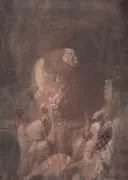
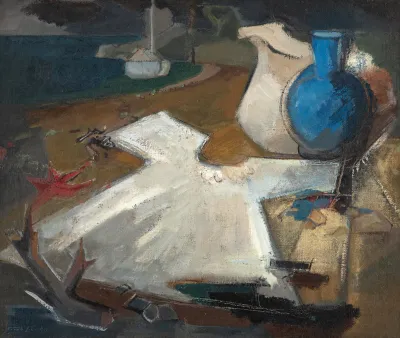
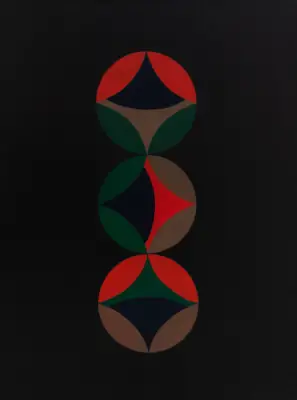
A born colorist, Guinle attributed his discovery of painting to his contact with works by the French painter Henri Matisse (1869 - 1954), especially Woman Reading against a Black Background (1939). He works with abstract art, in which he uses gesture and maintains a constant dialogue with Abstract Expressionist artists, especially Jackson Pollock (1912 - 1956), Willem de Kooning (1904 - 1997) and Franz Kline (1910 - 1962). He uses large canvases with vast areas of color, in which the eye lets itself be carried by the rhythm of the brushstrokes. In canvases such as Operação Plástica [Plastic Operation] (1980) he reveals his admiration for Henri Matisse, as also in the picture Cobertas Coarctadas (1981), which features the chromatic range of the French master, exemplified in Landscape at Collioure (1905).
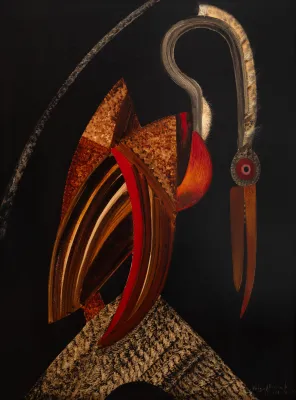
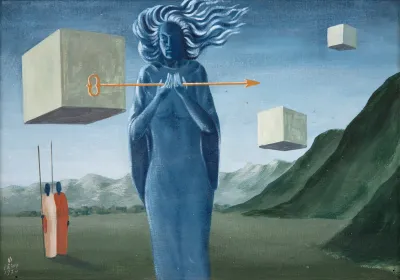
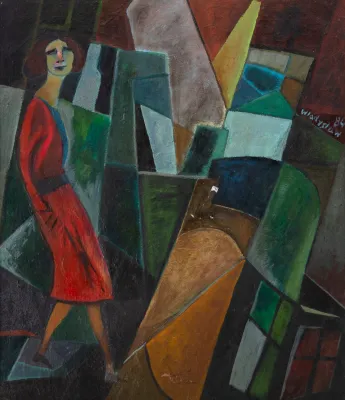
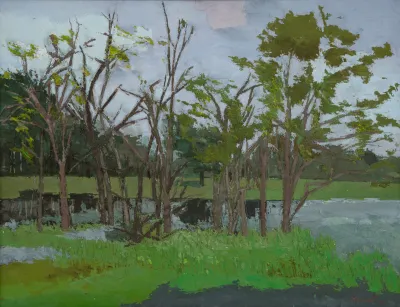
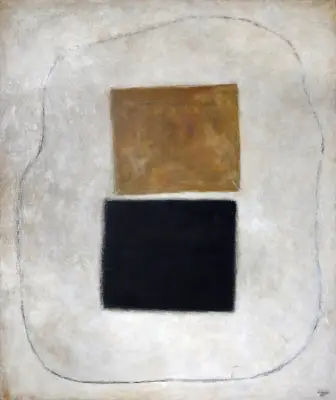
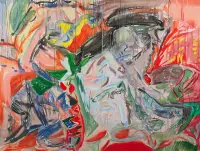
His works oscillate between figuration and abstraction. In Galicíneo Galhardeado (1982) he depicts real or imaginary beings. In others he suggests landscapes, as in Copacabana Me Engana [Copacabana Fools Me] or Passarela [Catwalk] (both from 1983). Sexta-Feira [Friday] (1985) shows an ordering will, with well-delineated areas, defined contours, and cutouts of patterns related to the backgrounds of works by Paul Klee (1879 - 1940) or Bram van Velde (1895 - 1981). In Paisagem Infinita [Infinite Landscape] (1985), on the other hand, he creates a whirlwind of chromatic impressions. The nuances of color, of great luminous pulse, are achieved through gesture. The picture Subida ao Céu [Ascent to Heaven] (1986) verges on total abstraction. The support is filled almost with a single rhythm; the visual effect recalls those achieved by Pollock, for example in Eyes in the Heat (1946).
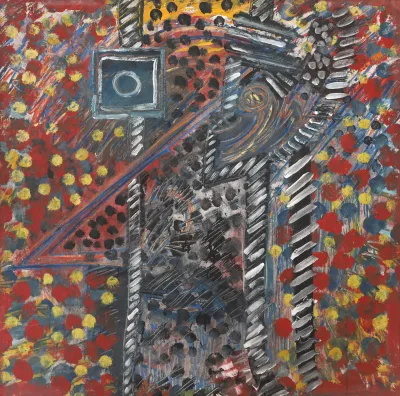
In the opinion of the scholar Christina Bach, a change occurs in the artist's works in 1986 and 1987, moving away from the experimental anxiety of the previous period. Cavalo de Troia [Trojan Horse], Pau-Brasil [Brazilwood] and As Vogais [The Vowels] (all from 1986) present large planes of softer colors, obtained through diluted paints, and reveal an introspective character. The use of translucent and shimmering colors recalls works by De Kooning, such as Palisade (1957) or Suburb in Havana (1958). The pictures Ulisses [Ulysses] or Cabeça de Pescador [Fisherman's Head] (both from 1987) show a less feverish gesture, subtler tones and a more rhythmic distribution of elements. Guinle combines the vigor he gives these canvases with a delicate, almost ethereal quality of color and execution. Owing to the abundance of yellows, often punctuated by vivid reds, a sunny atmosphere predominates in some pictures. In works such as Iasmin and O Corpo [The Body] (both from 1987) the paints liquefy, become light and reveal great emotional density.
Throughout his career, the artist took part in several national exhibitions, among them Como Vai Você, Geração 80?, held at the Escola de Artes Visuais do Parque Lage - EAV/Parque Lage, Rio de Janeiro, in 1984. Made up of a group of young artists who became known as the Geração 80, their works relate to a research into and revaluation of painting techniques, in contrast to the conceptual strands of Brazilian art in the 1970s. Guinle's important role as a champion of this new generation stands out: he wrote a critical text for the exhibition catalogue, took part in several group events and initiatives promoted by the artists, and wrote about their works.
Critiques
"These canvases demand a furious yet extremely cultivated gaze, with a vast modern memory. The operation is dizzying, exhausting, and engages a physical gaze, ready to feel the palpitations of the matter, the energy of the gestures, the artist's different and divergent decisions - the abrupt attacks, the obsessive maneuvers, the various moods that each canvas seems literally to exhale. There is no way to take them in from an ideal point of view: they must be experienced through the pores of the painting. (...)
Before these canvases we relive the basic dilemma, the aporia, of contemporary art - all the freedom, all the availability imaginable, yet operating in a closed territory, in the cloister of Art and Culture. Installation, happening, object, sculpture or painting, whatever the support, the question imposes itself with the same urgency: how to make art exist in the contemporary world? And, of course, it is not a matter of some vague desire to change the world, but rather, first and decisively, of being in the world itself. That is why, in more than one sense, the dialogue of Jorge Guinle's canvases is not only with modern languages but also with the institutional reality of these languages, not only with painting but with everything that has happened to it. Interiorized, introjected into his ironic drama, are both the brilliant adventure of modern art and its sad institutional end, both the art world and art in the world. Only all this is lived as painting, and never as commentary on visual clichés.
Thus, in the same trance, the gaze must follow as best it can the locked planes, the different textures, the apparent arbitrariness of the colors, and finally adhere to this heterogeneity, while recognizing the history that unfolds there. (...) Anyone who fails to find Picasso and Matisse, Pollock and De Kooning there, or is not familiar with Pop, will miss the work. It is on this historical reality that his anguish and his humor bear, to the exact extent that, up to a point, all of Jorge Guinle's painting is a kind of parody of the freedom to paint (...)".
Ronaldo Brito
BRITO, Ronaldo. Paroxismos de pintura. In: GUINLE, Jorge. Jorge Guinle. São Paulo: Galeria Luisa Strina, 1984. p. [3-6].
"(...) It is at the opening of the 1980s that Jorge Guinle's work takes on the body, the soul and the élan that still define it today. Typical of a postmodern stance, he made painting - at once energetic and controlled, spontaneous in appearance and willful at its base - his field of immersion and commentary. What is immediately volcanic there is an instrument of tactics. For he is not interested in covering canvas after canvas with simple disordered gestures, born of an unconscious fury, of an energy whose cause and target are unknown. He does not deconstruct out of nameless impulse; on the contrary, he problematizes painting in the very act of painting. All the liberating vivacity of his neo-expressionism carries a powerful dose of calculation. It is a ritual of anthropophagy: the art of the past passed, with the greatest care, through the cauldron of the art of now. Stubborn digestion".
Roberto Pontual
PONTUAL, Roberto. Jorge Guinle. In: _______. Entre dois séculos: arte brasileira do século XX na coleção Gilberto Chateaubriand. Rio de Janeiro: Editora JB, 1987. p. 517.
"Jorge's activity was a constant absorbing/giving back that pervaded his relationship with the world: the result, in the end, was the reencounter with painting, his painting, always in the form of an uncontained explosion. Gestural, nervous, vibrant, generous and capable of descending to details that resist any quicker glance. And also careless, at times, insofar as carelessness means deliberately ignoring the possibilities of technique (rather limited, in fact), the better to unveil the mysteries (these unlimited) of painting itself: there are few canvases without the odd craquelure or the odd film wrinkled by excess medium. But with this, Jorge progressively expanded his possibilities, as few artists of his generation knew how to do".
Reynaldo Roels Jr.
ROELS JÚNIOR, Reynaldo. [Texto de apresentação]. In: GUINLE, Jorge. Jorge Guinle: l'heure bleue. Rio de Janeiro: Galeria Anna Maria Niemeyer, 1989. p. [7].
"(...) It is necessary to stress the special poetic concentration that protected Jorge Guinle from mistaken contagions: the artist was not naive. Early on he toured the great international collections - Matisse and Picasso, Pollock and De Kooning were his avowed childhood heroes. The painter knew how to distill their teachings and, more than that, converted them into his own substance.
Thus, to engage with his work is to undertake a significant cultural elucidation: the most diverse kinds of expressionism, the most varied species of abstraction, Fauvism and its descendants, Cubism and its countless revivals, among so many other historical references, must necessarily be consulted. We will be asked to settle confrontations and conspiracies, even ancient ones. What is certain is that only with time, dwelling at length in this painter's enormous rectangles, will it be possible to see the scope of a production born full of intelligent indications: they are 'turns of painting'.
Moreover, the artist was omnivorous (...). And it becomes evident that everything and everyone communicates. In Jorge Guinle, one need only look: Matisse's lyricism adds to Picasso's determination; De Kooning's anguish mingles with Bram van Velde's melancholy; Andy Warhol's cynicism attaches to Pollock's existential suffering. One can spend hours searching his planes for references from Cézanne to Pop. The artist was never intimidated by any of these masters. On the contrary, he encouraged dormant colloquies, stubborn in restoring themselves at the end of the century that hosted the greatest artistic epiphanies".
Christina Bach
BACH, Christina. Jorge Guinle: energia solar. In: ______. Jorge Guinle. Apresentação Ronaldo Brito. São Paulo: Cosac & Naify, 2001. p. 18-19.
Testimonials
"My iconography is abstract. It is an iconography of art history and not an identified iconography, like that of the German and Italian neo-expressionists, or even of Schnabel, who, even when using an image, reduces its function to zero. At this point I think the paths of the new school and of my painting diverge. At the same time, there is a conservative and historicist dialogue between my work and theirs, in the use of canvas and oil paint, traditional materials par excellence. There is also a dialogue between my works and the followers of the new school, in the notion of choosing an already given and directed style; in a heterogeneity that would deny the unity of thought that creates the homogeneous sublime. In my case, for emotional and aesthetic reasons, there is a mixture of gestural Abstract Expressionism, of De Kooning and Matisse, even an automatist Surrealism. But each appropriation of a style, of an initial thought, is diverted from the original purpose of the chosen school precisely by the inclusion of another school that would be its negation.
For example, the decorative, Matissean joie de vivre side of the colors would be negated by the rhythmically exacerbated construction of Abstract Expressionism. On the other hand, the tragedy of this same abstractionist brushstroke is negated by the optimism of the color and by the comic ambiguity of the operation. The possibility and pleasure of always widening and nourishing these contradictions form the basis of my artistic praxis. The sublime could arise precisely in this critique of the already embalmed and obsolete sublime, on this narrow frontier where it is born and disappears".
Jorge Guinle
GUINLE, Jorge. [A pintura contra a parede]. In: BIENAL INTERNACIONAL DE SÃO PAULO, 17., 1983, São Paulo, SP. Catálogo geral. São Paulo: Fundação Bienal de São Paulo, 1983. p. 201. [Trecho final do texto publicado originalmente no cartaz da exposição Jorge Guinle. Rio de Janeiro: Espaço ABC, MAM/RJ, 1982].
"The emotion I feel when the canvas is finished is very strong. It is an incredible emotion that I have never confessed. A total emotion, of harmony with the world, of happiness. A very strong emotion of return to the past and to all past memories. A sense of the comedy of life's things, as in a Zen moment, where you see all the absurdity but find it funny. A total security before the world, a happiness, a calm, a feeling of peace.
When I carry a canvas from one place to another, I hold it with special affection, feeling its roughness, its stretcher. Instead of meditating, I paint. That is how I find my satori: total peace with the world, where opposites unite".
Jorge Guinle
GUINLE, Jorge. [Depoimento]. In: ______. Jorge Guinle: l'heure bleue. Rio de Janeiro: Galeria Anna Maria Niemeyer, 1989. p. [13]. [Texto escrito em setembro de 1986].
Solo Exhibitions
1973 - Rio de Janeiro RJ - Solo, at Galeria Grupo B
1980 - Rio de Janeiro RJ - 14 Erotic Paintings, at Galeria Anna Maria Niemeyer
1980 - Rio de Janeiro RJ - Oblique Memory, at Galeria Andrea Sigaud
1981 - Belo Horizonte MG - Derangements, at Parnaso Galeria de Arte
1981 - Brasília DF - Derangements, at Galeria Jorge Souza
1982 - São Paulo SP - Diacritical Steps, at Galeria Luisa Strina
1982 - Rio de Janeiro RJ - Solo, at MAM/RJ. Espaço ABC
1983 - Niterói RJ - Pacemaker, at Galeria de Arte da UFF
1984 - São Paulo SP - Solo, at Galeria Luisa Strina
1985 - Rio de Janeiro RJ - Solo, at Galeria do CCCM
1985 - Munich (Germany) - Solo, at Galeria Irene Maeder
1985 - Rio de Janeiro RJ - Solo, at Galeria Saramenha
1986 - São Paulo SP - Solo, at Galeria Luisa Strina
1986 - Vitória ES - Solo, at Galeria Usina
Group Exhibitions
1965 - Rio de Janeiro RJ - Group show, at Galeria do Hotel Copacabana Palace
1978 - Rio de Janeiro RJ - 1st National Visual Arts Salon, at MNBA
1979 - Rio de Janeiro RJ - 2nd National Visual Arts Salon, at MAM/RJ
1980 - Rio de Janeiro RJ - 6th The Face and the Work, at Galeria Ibeu Copacabana
1981 - Rio de Janeiro RJ - 4th National Visual Arts Salon, at MAM/RJ
1982 - Rio de Janeiro RJ - 5th National Visual Arts Salon, at MAM/RJ
1982 - Rio de Janeiro RJ - Between the Stain and the Figure, at MAM/RJ
1983 - Belo Horizonte MG - Art Today, at Fundação Clóvis Salgado. Palácio das Artes
1983 - Rio de Janeiro RJ - 13 Artists/13 Works, at Thomas Cohn Arte Contemporânea
1983 - Rio de Janeiro RJ - 6th National Visual Arts Salon, at MAM/RJ
1983 - São Paulo SP - 17th Bienal Internacional de São Paulo, at Fundação Bienal
1984 - Curitiba PR - Simões de Assis Galeria de Arte: Inaugural Exhibition, at Simões de Assis Galeria de Arte
1984 - Fortaleza CE - 7th National Visual Arts Salon
1984 - Niterói RJ - 1st Current Brazilian Art, at Galeria de Arte da UFF
1984 - Rio de Janeiro RJ - 7th National Visual Arts Salon, at MAM/RJ
1984 - Rio de Janeiro RJ - Como Vai Você, Geração 80? [How Are You, 80s Generation?], at EAV/Parque Lage
1984 - Rio de Janeiro RJ - Long Live Painting, at Petite Galerie
1985 - Rio de Janeiro RJ - 8th National Visual Arts Salon, at MAM/RJ - foreign travel prize
1985 - São Paulo SP - 18th Bienal Internacional de São Paulo, at Fundação Bienal
1985 - São Paulo SP - Group show, at Galeria Subdistrito
1985 - Vitória ES - 3 Fugitives, at Ufes. Galeria de Arte e Pesquisa
1986 - Rio de Janeiro RJ - Four Pictures, at CCCM
1986 - Rio de Janeiro RJ - Occupied Territory, at EAV/Parque Lage
1986 - Rio de Janeiro RJ - Transavantgarde and National Cultures, at MAM/RJ
1986 - São Paulo SP - 4th São Paulo Contemporary Art Salon, at Fundação Bienal
1987 - Rio de Janeiro RJ - Hallucinated Gesture, at Rio Design Center
Posthumous Exhibitions
1987 - Rio de Janeiro RJ - The Blue Hour, at CCCM. Grande Galeria
1987 - Rio de Janeiro RJ - To the Collector: Tribute to Gilberto Chateaubriand, at MAM/RJ
1988 - São Paulo SP - Jorge Guinle: Blue Phase - Unseen Works, at Galeria de Arte São Paulo
1989 - Rio de Janeiro RJ - Jorge Guinle: l'heure bleue, at Galeria Anna Maria Niemeyer
1989 - São Paulo SP - 20th Bienal Internacional de São Paulo, at Fundação Bienal
1989 - São Paulo SP - Gesture and Structure, at Gabinete de Arte Raquel Arnaud
1990 - Campo Grande MS - Solo, at Galeria de Arte Contemporânea
1990 - Los Angeles (United States) - Brazil Projects '90, at Municipal Art Gallery
1990 - São Paulo SP - Brazil Projects '90, at Masp
1991 - Monterrey (Mexico) - Mito y Magia en América: los ochenta, at Museo de Arte Contemporáneo de Monterrey
1991 - Rio de Janeiro RJ - 10 Years: Centro Cultural Cândido Mendes Collection, at MAM/RJ
1991 - Rio de Janeiro RJ - BR/80: Brazilian Painting of the 1980s, at Fundação Casa França-Brasil
1991 - Rio de Janeiro RJ - Solo, at Itaugaleria
1991 - Rio de Janeiro RJ - Solo, at MAM/RJ
1992 - Rio de Janeiro RJ - 1st On the Way to Niterói: João Sattamini Collection, at Paço Imperial
1992 - Rio de Janeiro RJ - Brazilian Contemporary Art, at EAV/Parque Lage
1992 - Rio de Janeiro RJ - Differences, at MNBA
1992 - Rio de Janeiro RJ - Solo, at Museu da República
1992 - São Paulo SP - Solo, at Gabinete de Arte Raquel Arnaud
1993 - Niterói RJ - 2nd On the Way to Niterói: João Sattamini Collection, at MAC/Niterói
1993 - Rio de Janeiro RJ - Emblems of the Body: The Nude in Brazilian Modern Art, at CCBB
1993 - Washington (United States) - Brazil: Images of the 1980s and 90s, at Art Museum of the Americas
1994 - Poços de Caldas MG - Unibanco Collection: Exhibition Celebrating Unibanco's 70th Anniversary, at Casa de Cultura
1994 - Rio de Janeiro RJ - Brazil: Images of the 1980s and 90s, at MAM/RJ
1994 - São Paulo SP - Bienal Brasil Século XX, at Fundação Bienal
1994 - São Paulo SP - Brazil: Images of the 1980s and 90s, at Casa das Rosas
1995 - Rio de Janeiro RJ - Unibanco Collection: Exhibition Celebrating Unibanco's 70th Anniversary, at MAM/RJ
1995 - São Paulo SP - The 1980s: The Stage of Diversity, at Galeria de Arte do Sesi
1996 - Rio de Janeiro RJ - The Scream, at MNBA
1996 - Rio de Janeiro RJ - Erotic Journey: From Figure to Abstraction, at UERJ. Galeria Candido Portinari
1997 - Curitiba PR - The Contemporary Art of Printmaking, at Museu Metropolitano de Arte de Curitiba
1997 - Niterói RJ - Jorge Guinle: Works from the João Leão Sattamini Collection, at MAC/Niterói
1998 - Belo Horizonte MG - Solo, at Pace Arte Galeria
1998 - Goiânia GO - The 1980s, at Galeria de Arte Marina Potrich
1998 - Niterói RJ - Mirror of the Biennial, at MAC/Niterói
1998 - São Paulo SP - Highlights of the Unibanco Collection, at Instituto Moreira Salles
1998 - São Paulo SP - The Modern and the Contemporary in Brazilian Art: Gilberto Chateaubriand Collection - MAM/RJ, at Masp
1999 - Vila Velha ES - Jorge Guinle: Marcio Espindula Collection, at Museu Ferroviário Vale do Rio Doce
1999 - Vitória ES - Solo, at Galeria Pedro Nolasco
2000 - Curitiba PR - Jorge Guinle: Drawings, at Galeria Casa da Imagem
2000 - Niterói RJ - Paintings in the João Sattamini Collection, at MAC/Niterói
2000 - São Paulo SP - Brasil + 500 Rediscovery Exhibition, at Fundação Bienal
2000 - São Paulo SP - Jorge Guinle: Drawings, at Gabinete de Arte Raquel Arnaud
2001 - Rio de Janeiro RJ - Brazilian Watercolor, at Centro Cultural Light
2001 - Rio de Janeiro RJ - The Spirit of Our Time, at MAM/RJ
2001 - São Paulo SP - The Spirit of Our Time, at MAM/SP
2002 - Niterói RJ - Sattamini Collection: Moderns and Contemporaries, at MAC/Niterói
2002 - Porto Alegre RS - Violence and Passion, at Santander Cultural
2002 - Rio de Janeiro RJ - 1st Rio Contemporary Art Exhibition, at MAM/RJ
2002 - Rio de Janeiro RJ - Paths of the Contemporary 1952-2002, at Paço Imperial
2002 - Rio de Janeiro RJ - Selection from the UCAM Art Collection, at CCCM
2002 - São Paulo SP - 28 (+) Painting, at Espaço Virgílio
2002 - São Paulo SP - Map of Now: Recent Brazilian Art in the João Sattamini Collection of the Museu de Arte Contemporânea de Niterói, at Instituto Tomie Ohtake
2002 - São Paulo SP - Paralela, at a warehouse on Avenida Matarazzo, 530
2003 - São Paulo SP - 2080, at MAM/SP
2003 - São Paulo SP - Marcantonio Vilaça - Contemporary Passport, at MAC/USP
2004 - Rio de Janeiro RJ - The Century of a Brazilian: Roberto Marinho Collection, at Paço Imperial
2004 - Rio de Janeiro RJ - Where Are You, 80s Generation?, at CCBB
2004 - São Paulo SP - The Biennials: A Look at Brazilian Production, at Galeria Bergamin
2005 - São Paulo SP - The Century of a Brazilian: Roberto Marinho Collection, at MAM/SP
2007 - Belo Horizonte MG - Collection Group Show, at Galeria Murilo Castro
2007 - São Paulo SP - Itaú Contemporâneo: Art in Brazil 1981-2006, at Itaú Cultural
2008 - Porto Alegre RS - Jorge Guinle - Beautiful Chaos, at Fundação Iberê Camargo
2009 - São Paulo SP - Jorge Guinle - Beautiful Chaos, at MAM/SP
Source: Itaú Cultural