João Timótheo da Costa (Rio de Janeiro RJ 1879 - Idem 1932)
Pintor, Decorator, Recorder.
In 1894, he began his artistic learning at the Casa da Moedé of the Rio de Janeiro, where he meets the director Enes de Souza, who becomes his protector. At the same time, he enrolled at the National School of Fine Arts - ENBA, where he studies drawing with Bérard, painting with Rodolfo Amoedo and attends classes with a live model taught by Zeferino da Costa. part in 1910 for Paris. He works with the group of Brazilian artists hired by the government to carry out the decoration of the Brazilian pavilion at the international exhibition of Turin, which took place in this Italian city in 1911. Fluminense Futebol Clube alone, finishing the order of this work alone in 1924. In 1925, it executed five vaulted panels for the ornamentation of the Noble Hall of the Chamber of Deputies, current Legislative Assembly of the State of Rio de Janeiro and in this same year it performs more A series of decorative panels for the Copacabana Palace salon. Having participated in several editions of the National Salon of Fine Arts, he received the small gold medal in 1926. In 1930 he was admitted to the Asylums Hospício, in the city of Rio de Janeiro, where he died two years later.
Commentary Critic
João Timótheo da Costa is from a humble family. He has worked, since 15 years, as an apprentice at the Casa da Moeda of Rio de Janeiro, an institution that employs and encourages other young artists, including his brother Arthur Timótheo da Costa, Rodolfo Chambelland and Eugênio Latour. At the same time, he enrolled at the National School of Fine Arts - ENBA, where he studies drawing with Bérard, the discipline of Vivo Modelo with Zeferino da Costa and painting with Rodolfo Amoedo. In 1910, he was part of the group of Brazilian artists who in the city of Paris are responsible for the decoration of the pavilion of the Turin exhibition, in Italy, held the following year. This work allows him to visit the European museums, where he meets impressionist and divisionist works, in addition to the decorative paintings by the French artist Puvis de Chavannes (1824 - 1898), which mark his career.
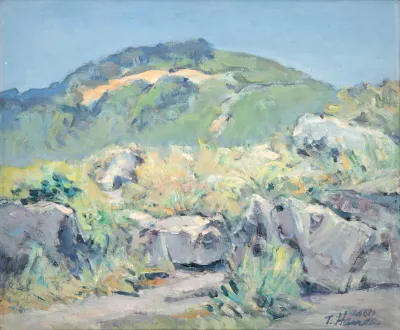
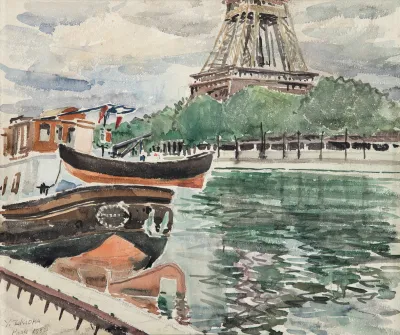
structures the compositions through the color, in wide brushstrokes, where the artist's gesture is perceived. Works the colors with both the spatula and the brush, obtaining strong pastes. Its paintings, especially the marines, stand out for their subtle, very controlled luminosity. In Porto (1920) it reveals sensitivity in the use of color, its brushstroke suggests volumes and distances, and explores the game between solid forms (boats, buildings) and its colorful reflections in the water. In some works, it approaches the photographic framework, such as in Recanto de Atelier (1926) or Portal (s.d.). In a portrait of Artur (s.d.) he represents his brother outdoors painting, with great formal simplification. The figure of the portrayed seems cut from the background, in which nature is only suggested in loose brush strokes. The paintings of João Timótheo present affinities with those carried out by their brother, in the themes and also in the invoice, but they reveal, in relation to this, a tendency to give paints the spontaneity values of the sketch.
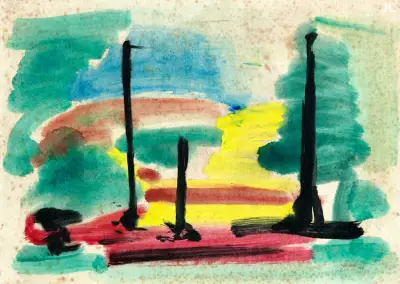
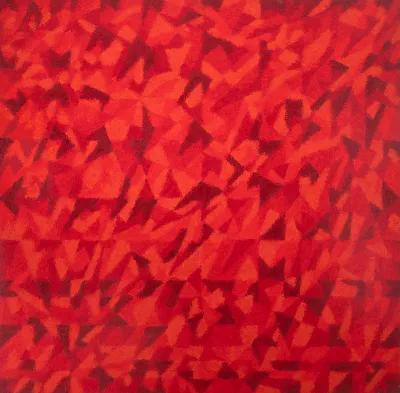
Overcoming the difficulties faced For so many black painters or black descent, João Timótheo receives several orders for decorative paintings. In the decorations it uses the principle of fragmented colors and the juxtaposition of colors, inspired by Georges Seurat (1859 - 1891). The rhythmic use of the lines and palette of relegated tones reveals the appreciation of the work of Puvis de Chavannes. Some of his decorative paintings were not preserved.
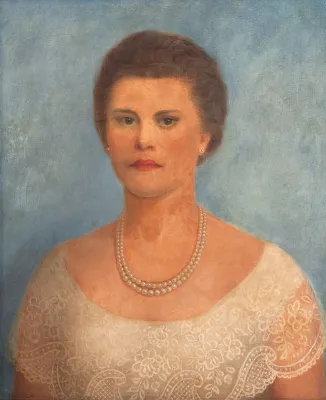
The insanity of his brother, who died prematurely in 1920, and the death of his daughter, at the age of 6, cause hard blows to the artist, from whom he never fully recovers, and dies, as The brother, in the asylum, in 1932. Working at the beginning of the 20th century, his work reveals, like that of other contemporary artists, the eclectic atmosphere caused by the late impact of aesthetic trends such as Impressionism and post-impressionism. The production of João Timótheo presents great artistic quality, and covers all genres of painting: portraits, historical painting, scenes of customs and above all landscapes, which have a particularly poetic meaning.
Acerves
Pinacoteca collection of the State of São Paulo/Brazil - São Paulo SP
Carlos Costa Pinto Museum Foundation - Salvador BA
Fundação Casa de Rui Barbosa - Rio de Janeiro RJ
National Museum of Fine Arts - MNBA - Rio de Janeiro RJ
Critiques
"João Timotheo da Costa was an exceptional artist. His painting impresses with the certainty of the line, the solidity of the construction. He knows how to see and performs consciously. Carlos Rubens
Rubens, Carlos. small history of the visual arts in Brazil. São Paulo: Nacional, 1941.
"The painter João Timotheo usually traces the guideline of his existence within the motto of art for art, even though the sentimental affection of his spirit, without him realizing it, Divert him, constantly, from this fair measure and direction. And we say without him realizing it because, deep down, Mr. João Timotheo would like to be like that, although contrary to the one who scrutinizes his intimacy by appearing as nature has formed him, Little modified by social factors. Truly this beautiful artist, who sometimes seeks to seem skeptical, is, in fact, a man who lives by the heart, who has been consecrated in his youth, to the effective cult of his brother and today he has white hair, by the longing for his daughter. Morais, a very different individuality from what is judged, and this difference is constituted by a certain sum of beauty, which makes him a dear artist - among his art companions, it is a temperament where there are incongruities, in the high sense of the expression. He is sincere in the exposition of his thought, sometimes careless, but incapable of felonizing."
angione Costa
primos paintings in Brazil. Francisco Acquarone; A. de Queiroz Vieira. 2. Ed. Rio de Janeiro, S. Ed. , 1942.
Collective exhibitions
1905 - Rio de Janeiro RJ - 12th General Exhibition of Fine Arts, at Enba
1906 - Rio de Janeiro RJ - 13th General Exhibition of Fine Arts, at ENBA - Honorable Mention
1907 - Rio de Janeiro RJ - 14th General Exhibition of Fine Arts, at Enba - Menção Honorable
1908 - Rio de Janeiro RJ - 15th General Exhibition of Fine Arts, at ENBA
1911 - Turin (Italy) - International Turin Exhibition
1912 - Rio de Janeiro RJ - 19th General Exhibition of Fine Arts, at Enba
1913 - Rio de Janeiro RJ - 20th General Exhibition of Fine Arts, at Enba
1918 - Rio de Janeiro RJ - 25th General Exhibition of Fine Arts, ENBA
1919 - Rio de Janeiro RJ - 26th General Exhibition of Fine Arts, at Enba
1919 - Rio de Janeiro RJ - Carioca Exhibition of Engraving and Strong Water
1920 - Rio de Janeiro RJ - 27th General Exhibition of Fine Arts, at ENBA
1921 - Rio de Janeiro RJ - 28th General Exhibition of Fine Arts, at Enba
1923 - Rio de Janeiro RJ - 30th General Exhibition of Fine Arts, ENBA
1926 - Rio de Janeiro RJ - 33rd General Exhibition of Fine Arts, at Enba
1926 - Rio de Janeiro RJ - Autumn Salon - Gold Medal
1927 - Rio de Janeiro RJ - 34th General Exhibition of Fine Arts, at Enba
1928 - Rio de Janeiro RJ - 35th General Exhibition of Fine Arts, at Enba
1929 - Rio de Janeiro RJ - 36th General Exhibition of Fine Arts, in the ENBA
Posthumous exhibitions
1979 - Rio de Janeiro RJ - Brazilian and European 19th century paintings, at Maurício Pontual Art Gallery
1983 - São Paulo SP - History of Brazilian painting in the century XIX, at the Paço das Artes
1988 - São Paulo SP - The Afro-Brazilian Hand, at MAM/SP
1989 - Fortaleza CE - Brazilian art from the 19th and 20th centuries in the Ceará collections, at the Unifor Cultural Space
1993 - São Paulo SP - Black painters of the 19th century, at the Pinacoteca do Estado
2000 - São Paulo SP - Brazil + 500 Rediscovery Exhibition, at the Biennial Foundation
2012 - São Paulo SP - OS Two brothers João and Arthur Timótheo da Costa: Brazilian pre-modernists, Afro Brasil Museum
Source: Itaú Cultural