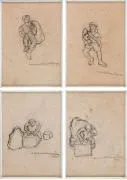
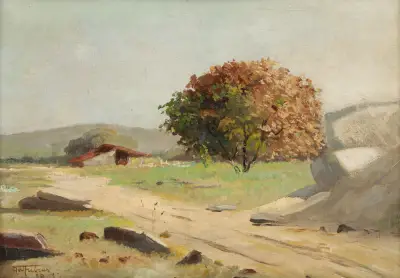
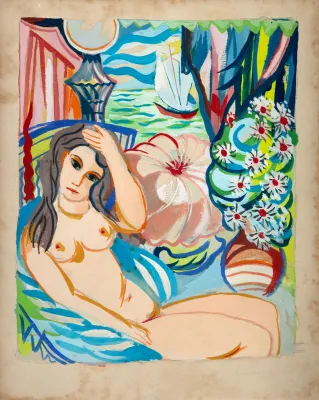
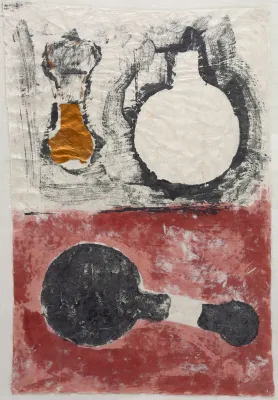
Jean-Baptiste Debret (Paris, França 1768 - idem 1848)
Painter, draftsman, printmaker, teacher, decorator, set designer.
He attended the Academy of Fine Arts in Paris between 1785 and 1789 as a student of Jacques-Louis David (1748 - 1825), his cousin and the leader of French Neoclassicism. He studied fortifications at the École des Ponts et Chaussées [School of Bridges and Roads, later the École Polytechnique], where he became a drawing teacher. In 1798, he assisted the architects Percier and Fontaine in decorating buildings. Around 1806, he worked as a painter at the court of Napoleon (1769 - 1821). After the emperor's fall and the death of his only son, Debret decided to join the French Artistic Mission, which came to Brazil in 1816. He settled in Rio de Janeiro and, from 1817, taught painting in his studio, where his students included Simplício de Sá (1785 - 1839). In 1818, he collaborated on the public decorations for the acclamation of Dom João VI (1767 - 1826) in Rio de Janeiro. Around 1825, he made etchings, which are in the Print Section of the Biblioteca Nacional in Rio de Janeiro. From 1826 to 1831, he was professor of history painting at the Academia Imperial de Belas Artes - Aiba [Imperial Academy of Fine Arts], an activity he alternated with trips to various cities in the country, where he depicted local human types, customs and landscapes. At the Aiba his students included Porto Alegre (1806 - 1879) and August Müller (1815 - ca. 1883). In 1829, he organized the Exposição da Classe de Pintura Histórica da Imperial Academia das Bellas Artes [Exhibition of the History Painting Class of the Imperial Academy of Fine Arts], the first public art exhibition in Brazil. He left the country in 1831 and returned to Paris with his disciple Porto Alegre. Between 1834 and 1839, he published the book Viagem Pitoresca e Histórica ao Brasil [Picturesque and Historical Voyage to Brazil], in three volumes, illustrated with lithographs based on the watercolors he made from his studies and observations.
Critical Commentary
Jean-Baptiste Debret studied at the Academy of Fine Arts in Paris between 1785 and 1789. A student of the French painter Jacques-Louis David (1748 - 1825), he was therefore trained within Neoclassical ideals. A history painter, he worked with respected architects on the ornamentation of public and private buildings. Around 1806 he was a painter at the court of Napoleon.
He joined the French Artistic Mission, which came to Brazil in 1816 with the primary aim of promoting art education in the country. In his studio he taught painting, and his students included, among others, Porto Alegre (1806 - 1879), August Müller (1815 - ca. 1883) and Simplício de Sá (1785 - 1839). In 1818, with the architect Grandjean de Montigny (1776 - 1850), he carried out the ornamentation of the streets of Rio de Janeiro for the acclamation of Dom João VI (1767 - 1826). At the Academia Imperial de Belas Artes - Aiba, from 1826, he taught history painting. At the same time, he visited various cities in the country, depicting their landscapes and customs. In 1829 he organized the Exhibition of the Academy's History Painting Class, important as the first public art exhibition in Brazil, which gave rise to the Exposições Gerais [General Exhibitions], with official prizes.
He worked as a court painter, depicting illustrious events and official scenes; he proved to be a draftsman attentive to Brazilian social issues. He identified with his role as illustrator and documentarist of contemporary events. Most of his canvases seem to have been intended for engraving; Debret and the court were aware of the importance of the circulation of prints for spreading the image of the State. According to the historian Luciano Migliaccio, for this reason Debret's painting is, in part, an attentive description of court ceremonial, in a modest format suited to easy understanding, as is the case, for example, with the paintings Aclamação de Dom João VI [Acclamation of Dom João VI] (ca. 1822) and Chegada da Imperatriz Leopoldina [Arrival of Empress Leopoldina] (1818). In the painting Coroação de Dom Pedro I [Coronation of Dom Pedro I] (1822), modeled on David's painting, the artist gives the work a civic character and is concerned with the need to create a political imaginary.
Debret returned to France in 1831. Some of the watercolors made in Brazil, lithographed, illustrate the work Viagem Pitoresca e Histórica ao Brasil, published between 1834 and 1839. The book, in three volumes, deals with the forests and the "savages", agricultural activities, slave labor and also political and cultural events. The artist's documentary concern stands out, as he depicts typical scenes of activities and customs in Rio de Janeiro, seeking to draw a social panorama of the city. He presents many aspects related to slave labor, sometimes accentuating the more expansive side of social relations, sometimes exposing exhausting work, such as that of porters and sugar-mill workers. He shows the work of the negros de ganho [enslaved people hired out for wages] who roamed the city streets providing various kinds of services.
The historian Rodrigo Naves points to the artist's difficulty in transposing Neoclassical ideas to Brazil, owing to factors such as the character of the monarchy established and the question of slavery in the country. For the author, the drawings made for the Viagem Pitoresca reveal the artist's effort to deal with the dilemma created by the conflict between his Neoclassical training and Brazilian reality.
In the watercolors, made with agility, the artist seems to feel more at ease and reveals his technical mastery: they show spontaneous, light and harmonious color. According to Rodrigo Naves, in some watercolors the way the workers are represented gives their bodies a vulnerable appearance. There is also strong ambiguity in the clothing: layered, loose, somewhat frayed and coarse, the clothes of the Black figures bear no relation to the tradition of drapery. In the representation of Debret's characters, the fabrics transmit to the bodies their lack of consistency.
In the prints, the ambiguous situations of society are revealed through the closeness between the figures and their surroundings; the contours are lightly marked, and a grayish medium brings bodies and space together, as in Lavadeiras à Beira-Rio [Washerwomen at the Riverside] (Viagem Pitoresca). In the lithographs, the subtlety of the gray creates a kind of binder that unifies the scenes. In the illustrations of the Viagem Pitoresca, through the fragility of the forms and the pressure that the characters suffer from space, the artist expresses the ambiguity of Brazilian society. After returning to Paris, the artist resumed contact with Neoclassical colleagues, returning to linearism, incisive forms and accentuated gesture.
Critiques
"In a large house in Catumbi he set up his easel and prepared paints and brushes for a productivity that did not cease while he remained in Brazil, whether as a painter or as the draftsman of keen sensitivity and observation that he proved to be. If as a painter he let himself be carried away by the pomp of the Court, extolling its events, including in portraits of figures identified by their hierarchical uniforms, as a draftsman he was much more inspired, knowing how, or being able, to see life far from the pedantry of official settings. (...) The facets of the painter and the draftsman were quite distinct in Debret. If the painter could not go beyond the narrow limits imposed by the rigors of the court, encouraging a lukewarm and insipid art based on the most sterilizing academicism, the draftsman was brilliant and showed himself a shrewd and intelligent observer, capable of seeing with his eyes and judging with a conscience that must have seemed inconvenient to the prejudiced official behavior."
Quirino Campofiorito
CAMPOFIORITO, Quirino. Os artistas da missão francesa. In: ___. História da pintura brasileira no século XIX. Rio de Janeiro: Pinakotheke, 1983. p. 56-57.
"The official art of a Debret - a relative of Jacques-Louis David (1748 - 1825), whom he is said to have accompanied to Rome when the great artist painted the Oath of the Horatii - has a solemn aspect and a sometimes strong chromaticism, using reds, of a Neoclassicism peculiar to a group of artists of Napoleonic France and also to English portraiture, in the former of which Gros (1771 - 1835) had so distinguished himself. The paintings of European battles made by Debret and kept at the Museum of Versailles are nevertheless of weak pictorial expression. The Coronation, in lighter colors, presents somewhat stiffened figures. It is in the Brazilian watercolors recording a popular, ethnographic and exotic world that Debret reveals the best phase of his painting, freed from officialism and inclined to exercise itself freely in one of the strands of pre-Romanticism and Romanticism: the search for the exotic. He then balanced light, diluted colors with a loose and spontaneous drawing, intelligently penetrating certain values of everyday life, anthropology and nature, even when treated descriptively, on the surface. It is this position of Debret's contradictions as a painter that places him symbolically at the opening of the full Brazilian 19th century."
Mário Barata
BARATA, Mário. Século XIX transição e início do século XX. In: ZANINI, Walter (Org.). História geral da arte no Brasil. São Paulo: Instituto Walther Moreira Salles: Fundação Djalma Guimarães, 1983. v. 1, p. 386.
"Debret's pictorial and graphic work, although of primordial importance for the iconography of colonial and imperial Brazil, does not arouse much interest in the strictly stylistic domain. The approximately 150 plates of the three volumes of the Voyage (1834 - 1839), as well as the not infrequent oils by the painter that have been preserved, show an art devoid of all introspection, a dispersive curiosity about the other, which rarely escapes the extremely cold record of the chronicle. Likewise, the academic painter's landscape recipe, the silvery waterfall, the play of light on rocks of conventionally picturesque shapes, the studied 'freshness' of the green, etc. bring to mind reminiscences of the art of, for example, a Jean Pillement (1728 - 1808) or a Jean-Baptiste Lallemand (1710 - 1803), though the grace, the complicity between culture and nature, and the lightness that give the petits maîtres of the French 18th century all their charm have already disappeared."
Pietro Maria Bardi
JEAN-Baptiste Debret. In: O BRASIL pintado por mestres nacionais e estrangeiros: séculos XVII-XX. São Paulo: MASP, 1987. p. 8.
"Debret seeks an impersonal point of view, a precept of history painting, in which he had been trained with Jacques-Louis David. He relates to the subjects he records, positioning himself as a narrator before the reality of the facts. Presence in loco always provides a certificate of truth. It is for no other reason that Debret refers to his own notes and drawings as 'historical and cosmographic documents'. Debret's picturesque voyage is proposed from the point of view of the French Artistic Mission in Brazil, regarded as a correspondent of the Academy of Fine Arts of the Institut de France. It therefore conveys a civilizing project of cultural extension.
(...) Debret's attention is not directed toward constructing an idea of nature, nor toward recognizing natural riches, nor a humanity in a natural state. Debret focuses attention on the general state of society, seeking to grasp it through an understanding of the transformation of nature into culture, of the natural into the civilized. The conception derives from the French Enlightenment, with the added interest in the particularities of peoples."
Ana Maria de Moraes Belluzzo
BELLUZZO, Ana Maria de Moraes. A viagem pitoresca de Debret. In: _______. O Brasil dos viajantes. São Paulo: Metalivros; Salvador: Fundação Emílio Odebrecht, 1994. v. 3, p. 82-83. Volume 3: A construção da paisagem.
"Jean-Baptiste Debret was the first foreign painter to realize what was artificial and misleading in simply applying a pre-established formal system - Neoclassicism, for example - to the representation of Brazilian reality.
(...) There is no doubt that Debret had a marked documentary concern. Few aspects of the city of Rio de Janeiro escaped his observation, not to mention a good number of drawings relating to southern Brazil and Indigenous scenes and landscapes, more or less truthful. The daily life of slaves and free men, of poor whites and aristocrats, royal festivities, geographical landmarks, monuments, fruits, plants and animals received his close attention. However, a significant portion of his drawings - especially those involving the activities of the negros de ganho in Rio de Janeiro - has, so to speak, an extra dimension that gives a new reality to the scenes and objects represented. In these watercolors Debret incorporates a social dynamic typical of Rio de Janeiro, and only a point of view that goes beyond the purely documentary aspect can reveal how much this formal change in his work will provide not only artistic gains but also a better understanding of life in the colony."
Rodrigo Naves
NAVES, Rodrigo. Debret, o neoclassicismo e a escravidão. In: _______. A forma difícil: ensaios sobre arte brasileira. São Paulo: Ática, 1996. p. 44-45.
"Qualified for the role of Court set designer for being a disciple of David, a great organizer of public ceremonies, and for having collaborated with Percier and Fontaine, Debret was asked to document the first events in the history of the new State. In Brazil, the French painter identified completely with his role as illustrator and documentarist of contemporary events. From his arrival, it seems, he began to describe with his pencil the natural, social and ethnographic reality of the country.
As a history painter, he portrayed contemporary events, but only after Independence did he attempt monumental painting, while most of his canvases, and even the portraits that remain, seem intended for engraving. Both Debret and the Court were aware of the importance of the circulation of prints for spreading the image of the new State.
For this reason, the Frenchman's painting in the time of the pragmatic Dom João VI was largely an attentive and meticulous description of the ceremonial and events of the Court, in a modest format suited to easy understanding.
One need only think of Aclamação de D. João VI, Chegada da Grã-Duquesa Leopoldina or Partida das Tropas para o Uruguay, which are also chronicles of Court life. After Independence, Debret would likewise know how to transform himself into the official commemorative painter of the new State, elaborating its iconography and determining the character of Brazilian history painting."
Luciano Migliaccio
MIGLIACCIO, Luciano. O século XIX. In: MOSTRA DO REDESCOBRIMENTO, 2000, São Paulo. Arte do século XIX. São Paulo: Fundação Bienal de São Paulo: Associação Brasil 500 anos Artes Visuais, 2000. p. 51-52.
Collections
Museu de Arte de São Paulo Assis Chateaubriand - Masp - São Paulo SP
Museu Nacional de Belas Artes - MNBA - Rio de Janeiro RJ
Museus Castro Maya - IPHAN/MinC - Rio de Janeiro RJ
Group Exhibitions
1798 - Paris (France) - Salão de Paris [Paris Salon] - 2nd prize
1806 - Paris (France) - Salão [Salon], at Instituto da França - honorable mention
1808 - Paris (France) - Salão de Paris [Paris Salon], at Instituto da França
1814 - Paris (France) - Salão de Paris [Paris Salon]
1829 - Rio de Janeiro RJ - 1ª Exposição da Classe de Pintura Histórica da Imperial Academia das Bellas Artes [1st Exhibition of the History Painting Class of the Imperial Academy of Fine Arts], at Aiba
1830 - Rio de Janeiro RJ - 2ª Exposição da Classe de Pintura Histórica da Imperial Academia das Bellas Artes [2nd Exhibition of the History Painting Class of the Imperial Academy of Fine Arts], at Aiba
Posthumous Exhibitions
1859 - Rio de Janeiro RJ - 13ª Exposição Geral de Belas Artes [13th General Fine Arts Exhibition], at Aiba
1860 - Rio de Janeiro RJ - 14ª Exposição Geral de Belas Artes [14th General Fine Arts Exhibition], at Aiba
1884 - Rio de Janeiro RJ - 26ª Exposição Geral de Belas Artes [26th General Fine Arts Exhibition], at Aiba
1953 - São Paulo SP - 2ª Bienal Internacional de São Paulo [2nd São Paulo International Biennial], at Pavilhão dos Estados
1981 - Rio de Janeiro RJ - Universo do Carnaval: imagens e reflexões [The Universe of Carnival: Images and Reflections], at Acervo Galeria de Arte
1983 - Recife PE - 50 Anos de Casa-Grande & Senzala [50 Years of The Masters and the Slaves], at Fundação Joaquim Nabuco. Administração Central
1984 - Aracaju SE - 50 Anos de Casa-Grande & Senzala [50 Years of The Masters and the Slaves]
1984 - Brasília DF - 50 Anos de Casa-Grande & Senzala [50 Years of The Masters and the Slaves]
1984 - Lisbon (Portugal) - 50 Anos de Casa-Grande & Senzala [50 Years of The Masters and the Slaves], at Museu Gulbenkian da Fundação Calouste Gulbenkian
1984 - Salvador BA - 50 Anos de Casa-Grande & Senzala [50 Years of The Masters and the Slaves]
1984 - São Paulo SP - J. B. Debret: aquarelas [J. B. Debret: Watercolors], at Museu da Casa Brasileira
1984 - São Paulo SP - Tradição e Ruptura: síntese de arte e cultura brasileiras [Tradition and Rupture: A Synthesis of Brazilian Art and Culture], at Fundação Bienal
1984 - Vitória ES - 50 Anos de Casa-Grande & Senzala [50 Years of The Masters and the Slaves]
1986 - Curitiba PR - Tradição/Contradição [Tradition/Contradiction], at MAC/PR
1987 - São Paulo SP - O Brasil Pintado por Mestres Nacionais e Estrangeiros: séculos XVIII - XX [Brazil Painted by Brazilian and Foreign Masters: 18th - 20th Centuries], at Masp
1989 - Stockholm (Sweden) - Art in Latin America: the modern era 1820 - 1980, at Moderna Museet
1989 - London (England) - Art in Latin America: the modern era 1820 - 1980, at Hayward Gallery
1989 - Paris (France) - La Révolution Française et l'Europe, at Grand Palais
1990 - Curitiba PR - 9ª A Litografia no Paraná [9th Lithography in Paraná], at Museu Guido Viaro
1990 - Madrid (Spain) - Art in Latin America: the modern era 1820 - 1980, at Palacio de Velázquez
1990 - Rio de Janeiro RJ - Missão Artística Francesa e Pintores Viajantes: França-Brasil no século XIX [French Artistic Mission and Traveling Painters: France-Brazil in the 19th Century], at Fundação Casa França-Brasil
1992 - Rio de Janeiro RJ - Natureza: quatro séculos de arte no Brasil [Nature: Four Centuries of Art in Brazil], at CCBB
1992 - Zurich (Switzerland) - Brasilien: Entdeckung und Selbstentdeckung [Brazil: Discovery and Self-Discovery], at Kunsthaus Zürich
1994 - Lisbon (Portugal) - Rio de Janeiro: capital d'além-mar [Rio de Janeiro: Overseas Capital], at Museu Rafael Bordalo Pinheiro
1994 - Rio de Janeiro RJ - Rio de Janeiro: capital d'além-mar [Rio de Janeiro: Overseas Capital], at CCBB
1994 - São Paulo SP - Debret: aquarelas do Brasil [Debret: Watercolors of Brazil], at Casa das Rosas
1994 - São Paulo SP - O Brasil dos Viajantes [The Travelers' Brazil], at Masp
1995 - Lisbon (Portugal) - O Brasil dos Viajantes [The Travelers' Brazil], at Centro Cultural de Belém
1996 - London (England) - Brazil Through European Eyes, at Christie's
1998 - Brasília DF - Brasileiro que nem Eu, que nem Quem? [Brazilian Like Me, Like Whom?], at Ministério das Relações Exteriores
1998 - São Paulo SP - Iconografia Paulistana em Coleções Particulares [São Paulo Iconography in Private Collections], at Museu da Casa Brasileira
1999 - Rio de Janeiro RJ - O Brasil Redescoberto [Brazil Rediscovered], at Paço Imperial
1999 - São Paulo SP - Brasileiro que nem Eu, que nem Quem? [Brazilian Like Me, Like Whom?], at MAB/Faap. Salão Cultural
2000 - Porto Alegre RS - De Frans Post a Eliseu Visconti: acervo Museu Nacional de Belas Artes - RJ [From Frans Post to Eliseu Visconti: Museu Nacional de Belas Artes - RJ Collection], at Margs
2000 - Rio de Janeiro RJ - Viagens Tropicais [Tropical Journeys], at Instituto Moreira Salles
2000 - Rio de Janeiro RJ - Visões do Rio na Coleção Geyer [Views of Rio in the Geyer Collection], at CCBB
2000 - São Paulo SP - Brasil + 500 Mostra do Redescobrimento [Brazil + 500 Rediscovery Exhibition], at Fundação Bienal
2000 - São Paulo SP - Brasil Sobre Papel: matizes e vivências [Brazil on Paper: Shades and Experiences], at Espaço de Artes Unicid
2000 - São Paulo SP - Coleção Brasiliana [Brasiliana Collection], at Pinacoteca do Estado
2000 - São Paulo SP - O Café [Coffee], at Banco Real
2000 - São Paulo SP - Rio de Janeiro 1825-1826 e Outros Destaques do Highcliffe Álbum [Rio de Janeiro 1825-1826 and Other Highlights from the Highcliffe Album], at Instituto Moreira Salles
2001 - Rio de Janeiro RJ - Aquarela Brasileira [Brazilian Watercolor], at Centro Cultural Light
2002 - São Paulo SP - Imagem e Identidade: um olhar sobre a história na coleção do Museu de Belas Artes [Image and Identity: A Look at History in the Museu de Belas Artes Collection], at Instituto Cultural Banco Santos
2003 - São Paulo SP - Vistas do Brasil: Coleção Brasiliana [Views of Brazil: Brasiliana Collection], at Pinacoteca do Estado
2004 - Rio de Janeiro RJ - Missão Artística Francesa e as origens da coleção do Museu Nacional de Belas Artes [The French Artistic Mission and the Origins of the Museu Nacional de Belas Artes Collection], at MNBA
Source: Itaú Cultural