Jadir Freire (Salvador BA 1957 / Salvador BA 1994)
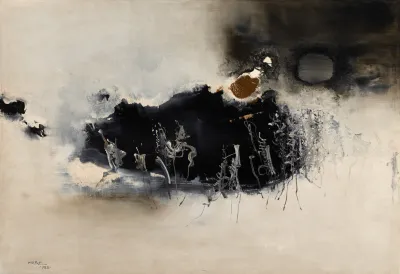
Jadir Freire was a painter, draftsman and professor, with a production marked by the combination of figuration, abstraction, graphics, color and experimentation. Born in Salvador, Bahia, in 1957, he moved to Rio de Janeiro in 1979, where he developed his artistic trajectory during a period of important transformations in Brazilian art. His painting presents human figures, spots, lines, signs, letters and numbers, organized in compositions that transit between representation and abstraction.
His formation passed through different areas of the arts. He studied Communication and Expression at Senac and Art Education at Uni-Rio. He also studied drawing and painting with Maria Tereza Vieira, ceramics with Márcia Mena and woodcut with Júlio César Rayon. Throughout his career, he maintained a close relationship between drawing and painting, exploring different techniques and supports.
Jadir Freire participated in exhibitions in Brazil and abroad and was related to the artistic environment of the so-called Geração 80. His production was also associated with the new figuration and graphics, especially for the use of simplified figures, signs, inscriptions, spots and lines. Between 1984 and 1985, it received important awards in Brazilian salons. He participated in the 5th Cali Biennial, the 21st São Paulo International Biennial and the 5th Havana Biennial. He lived between Rio de Janeiro and Frankfurt, Germany, around 1989, an experience that also left marks on his production.
Formation and first years
Jadir Freire moved to Rio de Janeiro in 1979 and began to develop his artistic training in an environment marked by the renewal of visual languages. He studied communication and expression at Senac and Arts Education at Uni-Rio, expanding his knowledge beyond painting.
Practical training also took place through contact with different teachers. He studied drawing and painting with Maria Tereza Vieira, ceramics with Márcia Mena and woodcut with Júlio César Rayon. This diversity of experiences helped the artist to develop a production in which drawing, painting, engraving and experimentation of materials remained related.
Contact with Maria Tereza Vieira was particularly important for her training in Rio de Janeiro. During the 1980s, Jadir Freire approached the artistic environment that developed in the city and began to participate in salons, exhibitions and activities related to contemporary production.
In addition to producing, he also acted as a teacher. There are records of artists who studied painting with Jadir Freire during the 1980s, demonstrating that their activity was not limited to individual production. Teaching was part of his performance in the artistic environment and contributed to the training of other artists.
Jadir Freire and the 80th generation
In the first half of the 1980s, Jadir Freire began to participate in exhibitions that brought together a new generation of Brazilian artists. In 1984, he joined Como Vai Você, Geração 80?, held at the School of Visual Arts of Parque Lage, in Rio de Janeiro. in the intense use of color and in different possibilities of experimentation. The presence of Jadir Freire in this context put his production in direct contact with one of the main generations of Brazilian painting of the 1980s.
His participation in the 80th generation, however, does not mean that his production can be summarized in this movement. Jadir Freire developed an individual research, in which drawing, figure, graphics and painting were combined in a particular way.
The artist's work presents characteristics that also allow it to bring it closer to the new figuration. The Museum of Arts of Goiânia relates its production to this aspect and highlights the presence of “compositions with graffitied figures”. The classification helps to understand how Jadir Freire used recognizable elements, especially human figures, inside surfaces filled with lines, signs and spots. Jadir Freire. His characters, however, are not represented in a naturalistic way. The body often appears simplified, fragmented or transformed into a kind of graphic signal.
The figures coexist with spots, doodles, lines and geometric shapes, creating a surface in which different elements overlap. The character is no longer necessarily the center of the composition and starts to integrate a wider visual structure.
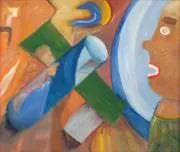
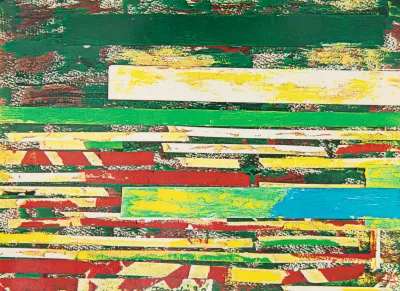
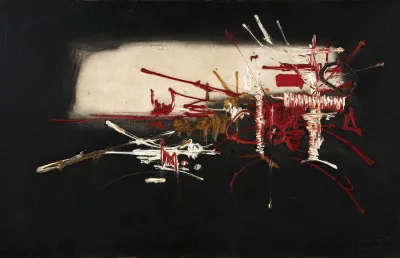
Graphism is one of the most characteristic aspects of this language. Jadir Freire used spontaneous lines, inscriptions, symbols and schematic shapes, bringing certain paintings closer to the visual energy found in the graffiti. of layers of images, simplified figures, stains, doodles and gestures. This approach helps to understand the freedom with which the artist worked on the surface of the painting, although his work cannot be classified simply as urban art. Lines and inscriptions do not just work as details, but participate in the construction of the image and establish relationships with the figures and color areas. Even in large paintings, the trace remains evident, functioning as an element of construction and organization of the image.
His training in drawing and painting contributed to this characteristic. Throughout his career, the artist produced works on paper and canvas, using different techniques, including acrylic, oil and watercolor.
The drawing does not appear only as a preparatory stage for painting. In many works, it constitutes the very language of the work. Lines, contours, scribbles and signs can take on the same visual weight as the color and painted areas.
This feature allows you to observe a continuity between your drawings and paintings. Figures can appear recognizably in one work and approach abstraction in another, without a rigid separation between these two possibilities.
Letters, numbers and writing
The writing also became part of the visual language of Jadir Freire. Letters, numbers and strings appear in different jobs, often without the intention of conveying a conventional textual message.
The word starts to function as an image. Isolated letters, numbers and repetitions of characters create rhythm, movement and texture on the surface. Writing thus ceases to belong only to the field of communication and starts to participate in the composition.
Between the works carried out in the early 1990s, they are untitled to B C D E F H I 3578, 8910 and iaiaiaieie1e..., examples of the artist's interest in this relationship between language and painting.
In these works, the characters can be observed both by their meaning and by the graphic appearance. Repetition and sequence transform writing into a kind of drawing, establishing a relationship between word, sign and image.
This procedure reinforces the experimental character of its production and shows how everyday elements could be incorporated into the painting without necessarily following a conventional narrative.
Color and painting
Color plays an important role in the construction of his works. Jadir Freire used vibrant and contrasting colors, but he also explored softer, more transparent and overlapping areas.
The tones are not just for filling in figures. They participate in the construction of pictorial space, establishing relationships between different planes, lines and shapes.
In their paintings, spots and color areas can function as fields on which figures, inscriptions and traits appear. The surface becomes, in this way, a space of experimentation in which different procedures coexist.
The apparent spontaneity of some compositions does not mean lack of organization. The arrangement of figures, signs and chromatic areas establishes internal relationships that maintain the unity of the work.
Between Rio de Janeiro and Frankfurt
From the second half of the 1980s, the career of Jadir Freire acquired an international dimension. The artist began to present works in different countries and established a closer relationship with Europe.
Around 1989, he lived between Frankfurt, Germany, and Rio de Janeiro. The German experience integrated its artistic trajectory and also appears related to works carried out in this period.
The reference to Frankfurt can be found directly in works produced later, such as Frankfurt – 91/JF. The presence of the city in the production demonstrates that the international experience was not limited to the exhibition circuit, but also entered the universe of the artist's references.
During this period, Jadir Freire kept his research on figure, drawing and graphics, while expanding the circulation of his work in galleries. and European institutions.
An international artist
Jadir Freire presented works in countries such as Germany, Portugal, Belgium, France, the United States, Italy, Spain, Colombia and Cuba. de Janeiro, São Paulo, Brasília, Salvador, Frankfurt, Bremen, Santo Tirso, Lisbon, Brussels, Chicago, Porto, Paris and Berlin. Frankfurt. He also presented works at Galeria Arte e Fato, in Porto Alegre, and at the Bahia Art Office, in Salvador.
In 1990, he exhibited at Galeria Montesanti Roesler, in São Paulo, in El Patio, in Bremen, and at the A5 gallery, in Santo Tirso, Portugal. The following year, he performed at the Roman Theater Galeria de Arte, in Lisbon, at the Galerie Nicole Jeanssean, Brussels, and at the Anna Maria Niemeyer Gallery, in Rio de Janeiro. in São Paulo, and exhibited at Bertoncini Gallery, in Chicago, and at the Atlântica Gallery, in Porto. In 1993, he held exhibitions at the Galerie Gaymu Inter Art, in Paris, and at the Galerie Lang in Berlin.
The international circulation achieved in a few years demonstrates the dimension that his career had acquired before his death.
Awards and Salons
Jadir Freire participated in important Brazilian salons during the 1980s. Its production received institutional recognition in a period of consolidation of contemporary Brazilian painting.
In 1984, it received the Acquisition Award in the Brazilian Art Salon. The following year, he received the Painting Award at the Carioca Art Salon and the Acquisition Award at the 13th Salão de Arte Contemporânea de Santo André. received during this period demonstrate that their production was not restricted to the gallery circuit. The artist's work also found space in salons and exhibitions aimed at contemporary production.
Bienais
Jadir Freire's trajectory included participation in important international events. In 1986, he participated in the 5th Cali Biennial, Colombia.
In 1991, he joined the 21st International Biennial of São Paulo, presenting an untitled work carried out that year. Participation took place at a time of increasing international circulation of his work.
In 1994, he participated in the 5th Bienal de Havana, in Cuba. The presence at this biennial took place in the last year of his life and represents one of the final moments of his artistic trajectory.
The Havana Biennial
In the 5th Bienal de Havana, the production of Jadir Freire was observed from of the freedom of the gesture, the intensity of the color and the internal organization of the compositions.
The critic Marcus de Lontra Costa highlighted the relationships present in his work between the popular and the erudite, between sensitivity and intelligence and between everyday experience and the artistic universe.
This reading helps to understand an important feature of his paintings. Although some works present a spontaneous appearance, marked by free lines, spots and overlaps, there is an internal organization responsible for establishing relationships between the different elements.
The freedom of the line, therefore, does not eliminate the structure of the composition. Gesture, color and figure are articulated within a carefully constructed surface.
Jadir Freire as a teacher
Parallically in the artistic career, Jadir Freire acted as a teacher. His teaching activity was related to the artistic environment of Rio de Janeiro and the training of other artists.
There are records of artists who studied painting with Jadir Freire in 1986, indicating that his role as an educator was part of his professional trajectory. It also expands the understanding of its role in the artistic environment of the 1980s. In addition to participating in exhibitions and salons, Jadir Freire was involved in the transmission of drawing and painting knowledge to a new generation. From 1990, Jadir Freire continued to produce and participate in exhibitions in Brazil and abroad.
In this period, he carried out works that show his interest in letters, numbers, figures and graphics. Works such as Prova, Untitled, 8910 E A B C D E F H I 3578 demonstrate the continuity of research on the limits between drawing, writing and painting.
The international experience also remained present, as the reference to Frankfurt demonstrates in works carried out in 1991.
Even with a relatively short trajectory, its production reached galleries, collections, halls and biennials in different countries.
Death and legacy
Jadir Freire died in Salvador, in 1994, aged 37. His death interrupted a career that had achieved recognition in Brazil and abroad.
Despite his short trajectory, he left a significant production for the study of Brazilian painting from the 1980s and 1990s. His participation in the 80th generation, in the national halls and in International biennials demonstrates the dimension achieved by his work.
His work remained present in exhibitions after his death. The continuity of its circulation demonstrates the interest of institutions, collectors and researchers for a production that occupies a particular position in contemporary Brazilian art.
Posthetic exhibitions
After his death, Jadir Freire participated in exhibitions that contributed to the preservation and the resumption of his production.
In 1995, his works were part of perverse childhood: fables on memory and time. In 1999, he participated in 100 plastic artists from Bahia.
In 2002, he was present in Caminhos do Contemporânea: 1952/2002 and, between 2002 and 2003, in Treasures of the Contemporary: Caixa.
Between 2004 and 2005, his works were presented in Where Are You, Geração 80?, an exhibition dedicated to the artistic generation in which he participated.
In 2014, works by Jadir Freire integrated the art That remains, exhibition related to the Chagas Freitas collection. The presence in this collection demonstrates the interest of collectors for their production even during the period in which the artist was active.
Art Market
Jadir Freire's production remains present in the Brazilian art market, with paintings and drawings offered at auctions and exhibitions.
Among the well-known works are The Subtle Man – Blue, from 1991, untitled, from 1991, an opera singer, from 1988, in addition to different paintings and paperwork performed during the decades of 1980 and 1990.
The market records also allow us to observe the variety of techniques employed by the artist, including acrylic, oil and watercolor, in addition to work on paper and canvas.
These records must be analyzed in Set with catalogs of exhibitions, collections and institutional sources, especially since the market documentation does not always present biographical or chronological information with the same level of precision as the museological sources. In the production of Jadir Freire, a visual energy close to graffiti, highlighting the presence of different layers of images, elementary figures, stains, scribbles and gestures. His reading contributes to understanding the importance of graphics in the artist's production and the way in which apparently spontaneous elements were incorporated into the composition. that brings together the production of Jadir Freire from a painting in which the human figure and the free line coexist on the same surface.
In the reading of Marcus de Lontra Costa about his participation in the Havana Biennial, the artist's work establishes relationships between the popular and the erudite, sensitivity and intelligence and everyday experience and artistic creation. The critic also draws attention to the freedom of the gesture, the strength of color and the internal organization of the compositions.
These interpretations allow us to observe that the production of Jadir Freire is not limited to a single classification. Generation 80, new figuration, graphics and gestural expression are useful references to contextualize his work, but his painting presents a combination of these elements. particular place in contemporary Brazilian art from the 1980s and early 1990s. His painting brings together figurative and abstract elements without establishing a rigid division between them.
The human figure, drawing, graphics, writing and color are used as components of the same language. Characters can be reduced to signs, while letters and numbers assume functions close to those of the drawing.
His painting also demonstrates a constant relationship between spontaneity and organization. The free stroke and the spots create an appearance of movement, but the composition maintains internal relationships between its different elements.
The diversity of techniques and supports reinforces this experimental character. The artist worked with painting, drawing and other forms of expression, exploring different possibilities for the construction of the image.
The participation in the 80th generation put Jadir Freire in one of the main contexts of renewal of Brazilian painting of his period. His trajectory, however, exceeded the limits of this movement, reaching galleries, collections, salons and international biennials.
Between figures, letters, numbers, spots and lines, Jadir Freire developed his own language, marked by the freedom of drawing and the pictorial experimentation. Its production remains relevant to understand the diversity of Brazilian art produced between the 1980s and 1990s.