
Galileo Emendabili (Ancona, Italy 1898 - São Paulo SP 1974)
Galileo Emendabili was an Italian-Brazilian sculptor responsible for numerous funerary sculptures and important public monuments in the city of São Paulo, such as the Obelisco Mausoléu dos Heróis de 32 [Obelisk Mausoleum of the Heroes of 1932], the Monumento a Luiz Pereira Barreto [Monument to Luiz Pereira Barreto] and the Monumento a Ramos de Azevedo [Monument to Ramos de Azevedo].
In 1915, he enrolled in the special sculpture course at the Royal Academy of Fine Arts of Urbino, Italy, where he studied with Domenico Jollo. He later attended the studio of Arturo Dazzi (1881 - 1966) in Rome, where he came into contact with works by Ivan Meštrović (1883 - 1962), Arturo Martini (1889 - 1947) and Adolfo Wildt (1868 - 1931).
In 1921, he executed the tomb monument of the republican Giuseppe Melon in Ancona, Italy. He arrived in Brazil in 1923 and settled in São Paulo, where he began working as a woodcarver at the Liceu de Artes e Ofícios de São Paulo (Laosp) [São Paulo School of Arts and Crafts].
In 1925, he won first prize in the International Competition for the Monumento a Pereira Barreto, inaugurated in 1928 in Praça Marechal Deodoro. The following year, he won the competition for the Monumento a Ramos de Azevedo, inaugurated in 1934 and now installed at the Cidade Universitária [University City], as well as the competition for the Monumento aos Heróis Constitucionalistas de 1932 [Monument to the Constitutionalist Heroes of 1932], known as the Obelisk, in Ibirapuera.
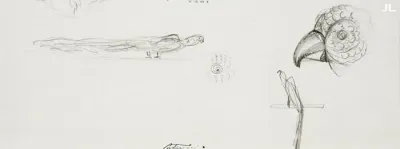
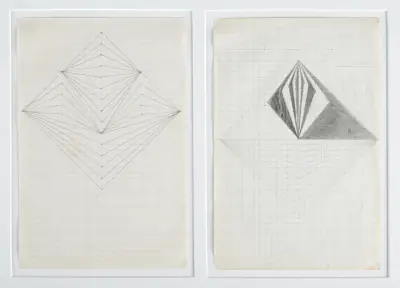
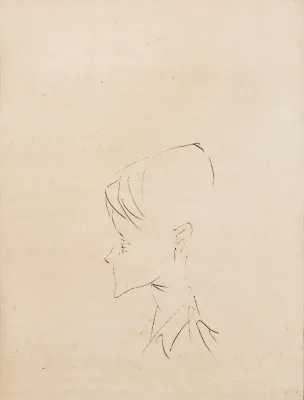
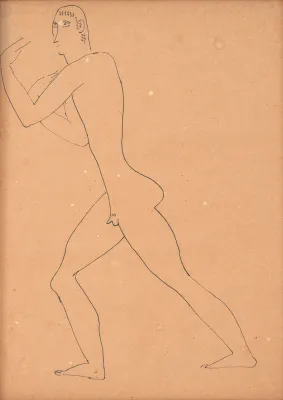
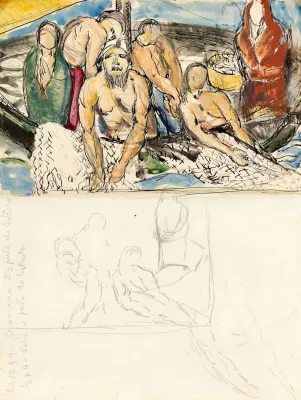
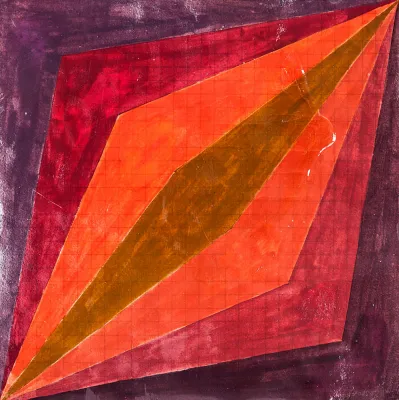
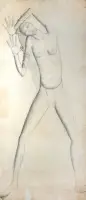
He also produced funerary monuments for the São Paulo, Consolação and Araçá cemeteries. In the 1960s, he began working in drawing, watercolor and ceramics.
In 1982, Italian Radio and Television (RAI) produced the video Ancona - San Paolo Solo Andata [Ancona - São Paulo One Way] about his career. In 1997, the book Monumento a Ramos de Azevedo: Do Concurso ao Exílio [Monument to Ramos de Azevedo: From the Competition to Exile], edited by the art historian and critic Annateresa Fabris, was published alongside an exhibition on the history of the monument held at the Pinacoteca do Estado de São Paulo (Pesp).
Critical Commentary
Galileo Emendabili produced an extensive body of work in São Paulo, the city where he arrived in 1923. In 1929, he won the international competition to create the Monumento a Ramos de Azevedo, now at the Cidade Universitária. In this classically conceived work, he presents a realistically treated statue of the architect, associating his image with allegorical figures symbolizing the sciences and the arts and, finally, progress, represented by a large group at the top of the monument made up of a winged horse and the figures of Genius and Victory. In 1934, the sculptor created one of his most famous works, the Monumento aos Heróis Constitucionalistas de 1932, located in Ibirapuera Park. Shaped as an obelisk, it features several high-relief panels of great formal synthesis and striking expressiveness, as well as mosaics designed by the artist himself.
Emendabili produced numerous funerary monuments for cemeteries in São Paulo, such as Ausência [Absence], 1944, Paternidade [Paternity] and Porta Místico-Profana [Mystic-Profane Door], both from 1948. For the art historian Tadeu Chiarelli, in these works the sculptor engages in a dialogue with the Italian Novecento, especially with the poetics of Mario Sironi (1885 - 1961), in recovering the aesthetic values of the Italian Renaissance and reviving its decorative and monumental tradition.
Critiques
"Galileo Emendabili is a 'virtuoso' of sculpture, who made his presence very clearly felt in São Paulo through works that are, many of them, true masterpieces. A sculptor of purely classical training, he reached his fullness as an artist without making concessions to the fashions in vogue, instead opening his own path.
Aware of the integration of sculpture into the great principles that inform architecture, Galileo Emendabili masterfully chiseled matter.
The lightness of his composition, his refined synthesis, his harmonious balance in relation to the whole, and his perfect conception of sculpture within that whole - these virtues make Emendabili a sculptor who will remain forever in the history of the visual arts for his remarkable artistic value. Emendabili gives us a beautiful image of grandeur".
Sergio Milliet
MILLIET, Sergio. O Cinzel de Emendabili. In: GALILEO Emendabili. São Paulo: Instituto Italiano di Cultura, MASP, 1987. p. 92.
"The interest in his work (...) lies not only in its public presence and the undeniable propriety of its sculptural qualities but also in the fact that it can be thought of as the structuring of a specific poetics, based on the absorption of influences typical of the European and international sculptural debate at the turn of the century and in the first decades of the 20th century. I am referring to the clash between a concept of sculpture based on the revaluation of the 'classical' ideals of art and one geared toward a sculptural praxis that broke with those traditional postulates of the language in question. Attempting from the outset to situate Emendabili's work within this universe, one can say that the Italian sculptor developed his entire oeuvre toward the restoration of the most traditional concepts of sculpture. However, the restorative sense of Emendabili's statuary is by no means academic, tending toward the crystallization of established concepts and effects. If it does not develop from the institutionalized modern tradition - Rodin, Brancusi, Arp, etc. -, it nonetheless carries the contamination of formal devices that are also significant for a broader understanding of this century's sculpture. At first, Emendabili's work could be placed within another tradition, perhaps less prestigious, but no less significant. I am referring to the return-to-order tradition in this century's sculpture which, starting from the theories and artistic production of the German sculptor Adolf Hildebrand, would pass - with due adaptations - through Maillol, Mestrovic, Wildt, Barlach, Wotruba on the international level, and, on the Brazilian scene, through Victor Brecheret, Bruno Giorgi, Ernesto de Fiori and others. Within this tradition, Galileo Emendabili would develop an extremely singular body of work, full of moments in which the artist would very happily achieve the synthesis between form and content so desired by the artists of this century".
Tadeu Chiarelli
CHIARELLI, Tadeu. A obra de Galileo Emendabili: síntese e superação de influências. In: FABRIS, Annateresa (org.) Monumento a Ramos de Azevedo: do concurso ao exílio. Campinas: Mercado das Letras, 1997. p. 65-66.
Testimonials
"I was always a loner. (...) I had neither the inclination nor the taste for social life. But, from my contact with the ideals and ideas defended in 1922, I could no longer understand a monument as a simple base with a doll on top. The most important thing in sculpture is moving from analysis to synthesis. (...) What is the use of seeing a trophy with lots of ornaments? What matters is a stripped-down trophy. For that, the caustic soda of 1922 was truly necessary, an authentic aesthetic revolution with fruitful and lasting consequences".
Galileo Emendabili
GALILEO Emendabili. São Paulo: Instituto Italiano di Cultura, MASP, 1987. p. 16.
"Look, my friend, art is like religion. There are always different opinions. Everyone who professes a religion holds it to be true [...]. The same happens in art. Although many artists profess different schools, all of them ultimately strive to make art what it is: an intentional expression of human sensibility. I will add more. In every school there are talented artists and untalented artists. The names that time sifts out and keeps are those who, above the theories imposed by the schools, were deeply human, were essentially individuals and, therefore, creators. The main purpose of art is to create. Whoever creates is consecrated. That is why I say that, although I have no pretensions to an apotheotic consecration, within the old forms I sought to do something personal. Being original is not being extravagant. It is, above all, being personal".
Galileo Emendabili - 1929
ZIMMERMANN, Silvana Brunelli. A Obra Escultórica de Galileo Emendabili: uma contribuição para o meio artístico paulistano. Dissertação (Mestrado em Artes) - Departamento de Artes Plásticas da Escola de Comunicação e Artes da Universidade de São Paulo - ECA/USP. 2000. p. 5.
Solo Exhibitions
1923 - São Paulo SP - Solo, at the Casa Excelsior
1971 - São Paulo SP - Solo, at the Assembleia Legislativa do Estado de São Paulo
1972 - São Paulo SP - 50 Anos de Arte no Brasil: esculturas, arquitetura e desenhos [50 Years of Art in Brazil: Sculptures, Architecture and Drawings], at Paço das Artes
Posthumous Exhibitions
1974 - São Paulo SP - Tempo dos Modernistas [Time of the Modernists], at Masp
1982 - São Paulo SP - Um Século de Escultura no Brasil [A Century of Sculpture in Brazil], at Masp
1987 - São Paulo SP - Galileo Emendabili: escultura e desenho [Galileo Emendabili: Sculpture and Drawing], at Espaço Cultural José Duarte Aguiar e Ricardo Camargo
1987 - São Paulo SP - Galileo Emendabili: retrospectiva [Galileo Emendabili: Retrospective], at Masp
1994 - São Paulo SP - Bienal Brasil Século XX [20th-Century Brazil Biennial], at Fundação Bienal
1997 - São Paulo SP - Monumento a Ramos de Azevedo: do concurso ao exílio [Monument to Ramos de Azevedo: From the Competition to Exile], at Pinacoteca do Estado
1997 - São Paulo SP - Tridimensionalidade na Arte Brasileira do Século XX [Three-Dimensionality in 20th-Century Brazilian Art], at Itaú Cultural
1998 - Belo Horizonte MG - Tridimensionalidade na Arte Brasileira do Século XX [Three-Dimensionality in 20th-Century Brazilian Art], at Itaú Cultural
1998 - Brasília DF - Tridimensionalidade na Arte Brasileira do Século XX [Three-Dimensionality in 20th-Century Brazilian Art], at Galeria Itaú Cultural
1998 - Penápolis SP - Tridimensionalidade na Arte Brasileira do Século XX [Three-Dimensionality in 20th-Century Brazilian Art], at Galeria Itaú Cultural
1999 - Ancona (Italy) - Galileo Emendabili: uno scultore emigrante nell'Ancona del primo Novecento, at Sale del Lazzaretto Vanvitelliano
2000 - São Paulo SP - A Figura Humana na Coleção Itaú [The Human Figure in the Itaú Collection], at Itaú Cultural
Source: Itaú Cultural