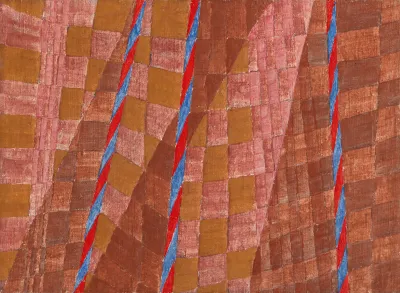
Franz Weissmann (Knittelfeld, Austria 1911- Rio de Janeiro, RJ 2005)
Franz Weissmann was a sculptor, draftsman, painter and teacher. He arrived in Brazil in 1921. In Rio de Janeiro, between 1939 and 1941, he attended courses in architecture, sculpture, painting and drawing at the National School of Fine Arts (ENBA). From 1942 to 1944, he studied drawing, sculpture, modeling and foundry with August Zamoyski (1893-1970). In 1945, he moved to Belo Horizonte, where he taught private classes in drawing and sculpture. Three years later, he was invited by Guignard (1896-1962) to teach sculpture at the Park School, later called Guignard School.
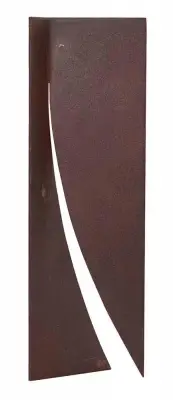
Initially, he developed a work focused on figurativeism. From the 1950s onwards, it gradually started to elaborate constructivist works, with the appreciation of geometric shapes, subjected to cuts and folds, using iron plates, steel wires and aluminum in lintel or leaf. In 1955, he joined the Frente group. The following year, he returned to reside in Rio de Janeiro and participated in the National Exhibition of Concrete Art, in 1957. He was one of the founders of the Neoconcreto Group, in 1959. That same year, he traveled to Europe and the Far East, returning to Brazil in 1965.
In the 1960s, he presented the series Massados, made in Europe with zinc or aluminum plates worked with a hammer, club and sharp instruments, temporarily approaching informalism. Subsequently, it re-aligned with the constructive strands. In the 1970s, he received the award for best sculptor from the São Paulo Association of Art Critics (APCA), participated in the International Biennial of Outdoor Sculpture, in Antwerp, Belgium, and the Venice Biennale. He made monumental sculptures for public spaces in several Brazilian cities, such as Praça da Sé, in São Paulo, at Parque da Catacumba, Rio de Janeiro, and at Palácio das Artes, in Belo Horizonte. 1921, Franz Weissmann arrives in Brazil with his family, and settles in the interior of São Paulo. In 1927 he moved to the capital, where he teaches Portuguese to foreigners and comes into contact with the visual arts in visits to exhibitions. In 1929 the family moved to Rio de Janeiro. Despite attending the preparatory course for the Polytechnic School, following his vocation as a child, he decided to join the National School of Fine Arts (ENBA), in Rio de Janeiro, in 1939. academic. He dropped out of school in 1941 and started studying in the free studio of the Polish sculptor August Zamoyski (1893-1970) between 1942 and 1943, with whom he learns the traditional techniques of sculpture.
Between the end of 1944 and the beginning of 1945, as a form of "voluntary retreat" to free himself from "academic weight", Weissmann moves to Belo Horizonte, the city where his brother Karl has lived since 1932. He continues to work with sculptures and drawings figuratives, which tend to increase simplification. In 1946, he was invited to hold an exhibition, which would be his first solo, in the ENBA Students Directory, in Rio de Janeiro. In 1948, at the invitation of Guignard (1896-1962), he began to teach live model, modeling and sculpture at the first school of modern art in the capital of Minas Gerais, the Parque School, where he remains until 1956. Amilcar de Castro (1920-2002), Farnese de Andrade (1926 - 1996) and Mary Vieira (1927-2001).
In an incessant search for the essence of the figure, the artist performs Sculptures of increasingly geometric shapes, in which the hollow space already appears as a defining element. In the course of his career, the "active empty" - as the artist usually calls such spaces -, become an obsession. It is from the game between the plane and its articulations with the hollow element that the three-dimensionality open to the world of Weissmann's sculptures is born. In 1951, he carried out his first constructive experiences, which culminated in the work Cubo Vazado (1951). The work, one of the first Brazilian constructive sculptures, is rejected by the jury of the 1st International Biennial of São Paulo, the same edition in which Max Bill's tripartite unit (1948/1949) (1908-1994) is awarded, encouraging the development of constructivism among us.
Abandons the figuration around 1954, the year in which he wins several competitions for projects for public sculptures. Of these, only the Monument to Freedom of Expression of Thought, commissioned by the Association of Emissions of São Paulo, sponsored by the Brazilian Press Association (ABI), is built at Quinta da Boa Vista, in Rio de Janeiro. The monument was destroyed in 1962, due to "urban reforms" in the place where it was located. In more than 50 years of production, Weissmann has consolidated itself as one of the main creators of public sculptures in Brazil. On this aspect of his work, he declares: "When they ask me to make a public sculpture to be placed in a certain place, I study the place for my work to work in relation to the environment. [...] My job is to communicate with the public, with the people, and the best way to communicate and also to educate the people is to put Art in the streets".
Still in the 1950s, back in Rio de Janeiro, he participated in the exhibitions of the Grupo Frente and the Biennials and signed the Neoconcreto Manifesto (1959). Experiments with steel wires in the series of "linear sculptures" and with modular shapes, eliminating any type of base for sculpture. In 1957, the Minas Gerais police decided to transform the studio that they kept in the basement of the Municipal Park School into a chain, throwing away without the artist's presence all the studies carried out during the years in Belo Horizonte. As a result, almost all of Weissmann's work from the 1940s and 1950s was destroyed.
In 1958, the artist receives the award for travel abroad with the work Torre in the 8th National Salon of Modern Art (SNAM). The following year, he left with his family for Europe, where he remained until the end of 1964. During this period he returned to Brazil only once and travels to the East in order to get to know Oriental philosophy better. Despite visiting several European countries, it is established most of the time in Spain. For some time Weissmann lives in Irún, a fishing village where the Basque sculptor friend Jorge Oteiza (1908-2003) lives. The works carried out in this period, known as kneaded, momentarily abandon the geometric construction, being pointed out by critics as an "expressive interregnum" in their research, in which the concern with materiality takes the foreground. 1965 and the following year he returned to his experiments with geometric and modular shapes. In 1967, he presented Arapuca at the 9th International Biennial of São Paulo, a piece in which color, as a determining element of the sculpture space, is present for the first time. From then on, sculptures without color application will be rare. Over time, Franz Weissmann remains faithful to his creation process: he never draws the piece to be built, he prefers to work directly on the material, cutting and folding his small models with his hands, later enlarged in a metallurgical body.
Source: Itau cultural