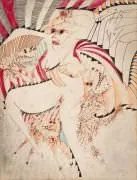
Flávio Motta (São Paulo SP 1923 - idem 2016)
Teacher, art historian, draftsman and painter.
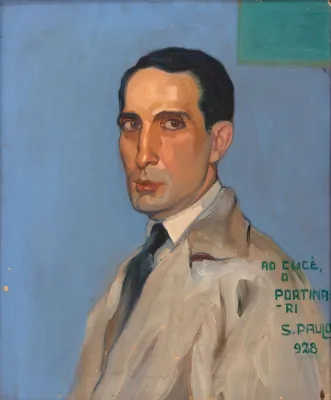
In the late 1930s, Flávio Lichtenfelds Motta began drawing and making sculptures in the studio of the sculptor José Cucê, then president of the Sindicato dos Artistas Plásticos [Visual Artists' Union], and met several artists. In the following decade, he frequented the studios of Joaquim Figueira, Mário Zanini, Raphael Galvez and Sylvio Alves, among others. He shared a studio on Avenida São João with Raphael Galvez, Sylvio Alves and Odetto Guersoni. He graduated in philosophy from the Faculdade de Filosofia da Universidade de São Paulo - USP. He began teaching art history. In 1949, with the artists Bonadei, Nelson Nóbrega, Alfredo Volpi, Waldemar da Costa and Waldemar Amarante, he created the short-lived Escola Livre de Artes Plásticas [Free School of Visual Arts]. In the late 1950s, he created the teacher training course at the Museu de Arte de São Paulo Assis Chateaubriand - Masp, which was later transferred to the Fundação Armando Álvares Penteado - Faap. He became a professor of art history and aesthetics in the history department of the Faculdade de Arquitetura e Urbanismo da Universidade de São Paulo - FAU/USP [University of São Paulo School of Architecture and Urbanism], where he assisted the architect and professor Vilanova Artigas in reformulating the curriculum. He took an active part in the political debate involving the FAU/USP architects and published texts on art history. In 1965, he exhibited paintings at Masp and drawings at Galeria Goeldi, Rio de Janeiro. In 1967, at the corner of Rua Augusta and Avenida Brasil, São Paulo, he made an intervention with Nelson Leirner in which they displayed regional and football flags. They were repressed by the police, but repeated the intervention in Rio de Janeiro with other artists. In 1973, Flávio exhibited at the Grupo B gallery, Rio de Janeiro. In 1975, he won the art-communication prize from the Associação Paulista dos Críticos de Arte - APCA [São Paulo Association of Art Critics] for the panels made at the Elevado Costa e Silva. He died on July 8, 2016, in the city of São Paulo.
Critical Commentary
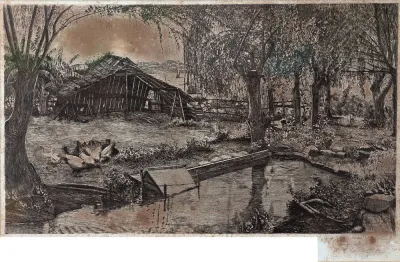
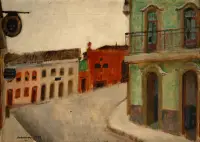
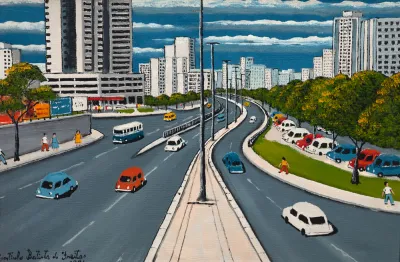
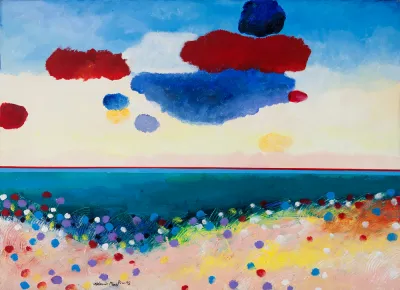
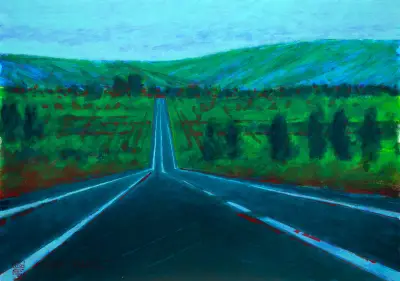
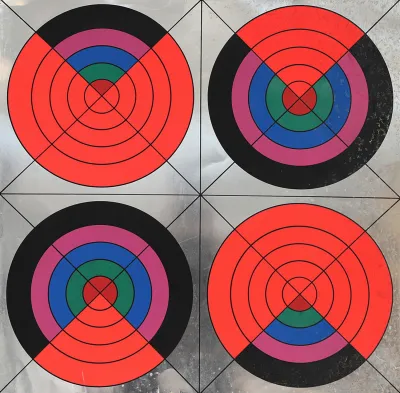
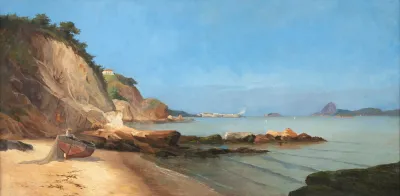
Flávio Motta began by painting portraits and outdoor landscapes featuring rural themes such as pastures, small houses, cattle, trees and streams. His production from this period is close to the landscapes of Raphael Galvez (1907 - 1998) and Francisco Rebolo (1902 - 1980), among others. The brushstroke is free and the line is barely marked. The color is applied in patches and the tones are subdued. In these paintings, the concern with the palette does not allow his drawing to find its best expression: not everything is convincing in the proportions, and the color is very uniform.
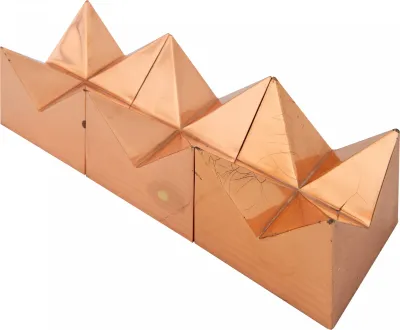
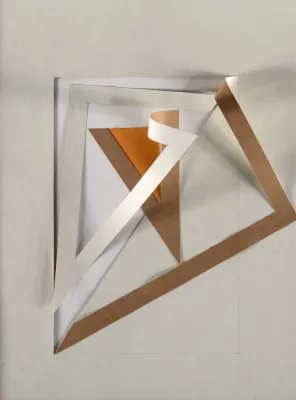
It is in the drawings, when he emphasizes pure line, that he stands out. In Redondo Quadrado [Round Square], from 1941, the forms are swapped: nature (trees, for example) is square and human production (houses, for example) is round. We find the irony and the very particular use of line, at once precise and ironic, that we see in later works, such as the sketchbooks Aluno sem Perspectiva Procura Ponto de Fuga [Student without Perspective Seeks Vanishing Point] and Homem sem Perspectiva Encontra Ponto de Fuga [Man without Perspective Finds Vanishing Point] and drawings such as O Gato - Sem Dúvida [The Cat - No Doubt], from the 1970s. As the historian Ana Maria Belluzzo observes, Motta pursues the straight line and the curve with the humor of Alexander Calder (1898 - 1976) and the sincerity of Paul Klee (1879 - 1940)1.
His affinity with line and drawing certainly helped lead him to teach at FAU/USP, since architecture is not related to color and filling, but to design and the constructive act of making. The importance of making for the artist was already evident at the time of the Escola Livre de Artes Plásticas. He believed that art cannot be taught in the traditional sense of the term and therefore wanted students to learn to solve problems in practice, with a minimum of theorizing. At FAU/USP, he became linked to Vilanova Artigas (1915 - 1985) and took part in the reform of teaching, bringing new methods and interdisciplinarity to the curriculum.
He engaged in the political debates of the period. He sided with Vilanova Artigas, Oscar Niemeyer (1907 - 2012) and Paulo Mendes da Rocha (1928 - 2021), whose work he defended against the criticism of Sérgio Ferro (1938), Flávio Império (1935 - 1985) and Rodrigo Lefèvre (1938 - 1984). These condemned their professors' optimism and support for Brazilian developmentalism which, besides failing to achieve the desired social goals, was linked to the dictatorship. Motta defended an architecture and urbanism not based on presupposed developments, as he considered to be the case of Brasília.
In 1970, he made his position explicit by publishing two texts in which, on the one hand, he reaffirmed his commitment to the modern project of the 1940s and 1950s and, on the other, exalted the universal values of art2. Narrating the formation of Brazil in the text Introduzione al Brasile, he describes the coincidence between Brazilian industrial development and popular aspirations and recalls the advanced social legislation and the establishment of basic industry achieved during the Estado Novo. At the end, as a necessary counterpoint to this statement made at the height of the 1964 Military Coup, he asserts that, regardless of its functionality, Brasília demonstrates the political awareness present in the architect's training3. He defends Paulo Mendes da Rocha's design for the Brazilian pavilion at Expo '70, highlighting its humanist and transcendent character and emphasizing universal values, as if they were the way to deal with the country's immediate political reality without giving up political ideals.4
Motta's political and academic activity at FAU/USP is his main legacy. In his art history studies, he investigated the relationship between architecture, industrialization and society, taking an interest in Art Nouveau. His texts almost always deal with themes linked to modernism, such as A época do SPAM [The Era of SPAM], from 1953; an introduction to Mário de Andrade's Família Artística Paulista [São Paulo Artistic Family], from 1971; Paulo Mendes da Rocha, from 1967; and Trabalho de um Pintor: Portinari [Work of a Painter: Portinari], from 1972.
Notes
1 BELLUZZO, A. M., in Depoimentos sobre Flávio Motta, Caramelo, n. 6, p. 41-53, ago. 1993.
2 ALVES, A. A. A. Arquitetura e sociedade em São Paulo 1956 - 1968: projetos de Brasil moderno. 2003. 311 f. Dissertação (mestrado) - Faculdade de Arquitetura e Urbanismo da Universidade de São Paulo - FAU/USP, São Paulo. 2003, p. 172 ff.
3 MOTTA, F. L. Introduzione al Brasile. Zodiac. n. 6, p. 61-67, 1958/59.
4 MOTTA, F. L. Arquitetura brasileira para a Expo 70. Acrópole, São Paulo, n. 372, p. 25-26, abr. 1970.
Solo Exhibitions
1963 - São Paulo SP - Solo, at Galeria de Arte São Luís
1965 - São Paulo SP - Solo, at Masp
1965 - Rio de Janeiro RJ - Solo, at Galeria Goeldi
1967 - São Paulo SP - Bandeiras e Flâmulas [Flags and Pennants], at Galeria Atrium
1973 - Rio de Janeiro RJ - Solo, at Galeria Grupo B
1975 - Curitiba PR - Solo, at Teatro Guaíra
Group Exhibitions
1944 - São Paulo SP - 9º Salão do Sindicato dos Artistas Plásticos [9th Salon of the Visual Artists' Union], at Galeria Prestes Maia
1967 - São Paulo SP - Bandeiras na Praça [Flags in the Square], at the corner of Avenida Brasil and Rua Colômbia
1968 - Rio de Janeiro RJ - Bandeiras na Praça [Flags in the Square], at Praça General Osório
1976 - São Paulo SP - O Desenho Jovem dos Anos 40 [Young Drawing of the 1940s], at Pinacoteca do Estado
1977 - São Paulo SP - Os Grupos: a década de 40 [The Groups: The 1940s], at Museu Lasar Segall
1978 - São Paulo SP - A Arte e seus Processos: o papel como suporte [Art and Its Processes: Paper as Support], at Pinacoteca do Estado
1978 - São Paulo SP - Uma Amizade e Um Ateliê [A Friendship and a Studio], at Museu Lasar Segall
1979 - São Paulo SP - Volta à Figura: década de 60 [Return to the Figure: The 1960s], at Museu Lasar Segall
1979 - São Paulo SP - Matrizes, Filiais e Companhias [Headquarters, Branches and Companies], at Sesc
1982 - São Paulo SP - Marinhas e Ribeirinhas [Seascapes and Riverscapes], at Museu Lasar Segall
1985 - São Paulo SP - Tendências do Livro de Artista no Brasil [Trends of the Artist's Book in Brazil], at CCSP
1987 - São Paulo SP - A Trama do Gosto: um outro olhar sobre o cotidiano [The Fabric of Taste: Another Look at Everyday Life], at Fundação Bienal
1994 - Belo Horizonte MG - O Efêmero na Arte Brasileira: anos 60/70 [The Ephemeral in Brazilian Art: 1960s/70s]
1994 - Penápolis SP - O Efêmero na Arte Brasileira: anos 60/70 [The Ephemeral in Brazilian Art: 1960s/70s], at Galeria Itaú Cultural
1994 - São Paulo SP - O Efêmero na Arte Brasileira: anos 60/70 [The Ephemeral in Brazilian Art: 1960s/70s], at Itaú Cultural
1995 - São Paulo SP - 1st United Artists, at Casa das Rosas
1996 - Brasília DF - O Efêmero na Arte Brasileira: anos 60/70 [The Ephemeral in Brazilian Art: 1960s/70s], at Galeria Itaú Cultural
1996 - São Paulo SP - Ex Libris/Home Page, at Paço das Artes
2004 - São Paulo SP - Gabinete de Papel [Paper Cabinet], at CCSP
Source: Itaú Cultural