Eugênio de Proença Sigaud (Santo Antônio de Carangola1 RJ 1899 - Rio de Janeiro RJ 1979)
Pintor, recorder, graphic artist, illustrator, set designer, critic, teacher, architect and Poet.
She graduated in Agronomic Engineering in 1920, at the Belo Horizonte School of Agronomy. In 1921 he attended the Free Course of the National School of Fine Arts - ENBA, and is a student of Modesto Brocos. Later, in 1927, he joined the ENBA Architecture course, which concluded in 1932. Sigaud participates in the 38th National Salon of Fine Arts, organized in 1931 by the urban planner Lucio Costa, known as Salão Revolutionary for allowing the exhibition of the work of all those registered, causing the controversy that leads to the removal of the urban planner from the direction of the institution. Then Sigaud Forma, alongside Quirino Campofiorito, Milton Dacosta, Joaquim Tenreiro and José Pancetti, the Bernardelli Nucleus, in 1931. Movement of opposition to the conservatism reigning in ENBA, the group proposes, among other initiatives, the democratization of technical education and free access to art salons. In 1935, the group is expelled from the ENBA holds under pressure from academics, but remains united until the beginning of the following decade. Also in 1935 Sigaud joined the Portinari Group, an informal group that gathers around Candido Portinari, having as one of his main lines of action the mural painting. Sigaud becomes one of the main spokespersons for muralism by publishing, in the same year, the article Why Mural Painting is forgotten among us?, in the Jornal de Belas Artes. He is one of the Brazilian artists selected for the 1st International Biennial of São Paulo, in the Trianon Pavilion. At the invitation of his brother, Bishop Dom Geraldo Sigaud, designs and decorates the Metropolitan Cathedral of Jacarezinho, Paraná, between 1954 and 1957.
Critical comment
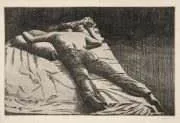
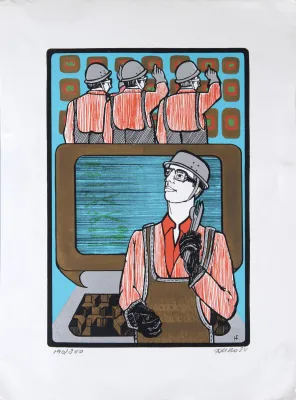
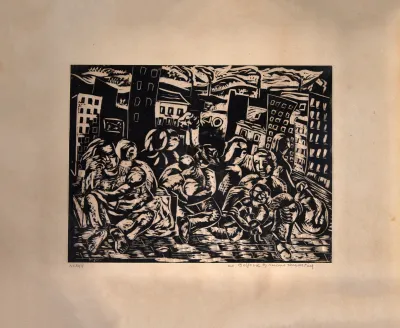
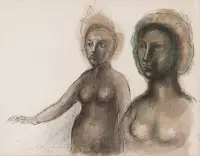
Known as the painter of the workers, Sigaud explores on his canvases, in an intense and militant way, the theme of the work, especially from the mid-1930s onwards. Explicit stance of defense of more popular forms of expression, such as mural painting. Anthological screens such as the Concrete Tower, 1936, and Work Accident, 1944, both belonging to the National Museum of Fine Arts - MNBA, correspond to the most intense phase of proletarian representation in its production and show how it not only brings the people to the scene Anonymous, but seeks to represent it in its productive context, in the midst of the constructions symbolized by vertiginous iron structures, scaffolding, ropes and other references to the daily life of construction sites. With the influence of Mexican muralism, Portinari's nationalism and marked by intense dialogue with Expressionism, Sigaud reinforces the dramatic character of the scenes through unusual angles, the deformation of the characters, the chromatic contrast and a very vertical and somewhat vertical composition. claustrophobic of the urban landscape.
"In my view, all art can compete to activate the political debate, thus improving, through indirect ways, the life of man", says Sigaud in an interview with Frederico Morais.¹ His political engagement is expressed not only in the election of the themes, but also in the participation in events such as the exhibition of plastic artists of the Communist Party, at the Student House, in 1945, and above all in the constant presence in the movements of the association of artists in defense of freedom of plastic expression and in the democratization of the teaching and exhibition of the arts, as is the case of the Bernardelli Nucleus, which helps to found in 1931.
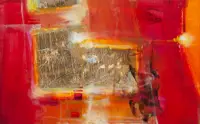
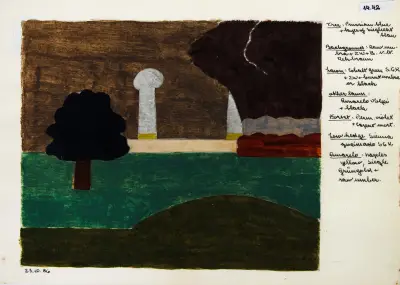
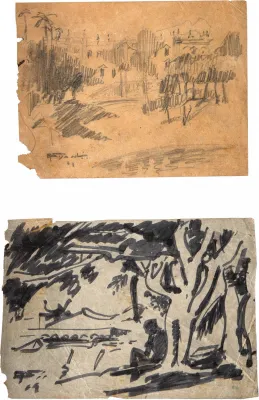
In addition to the work scenes, confessed to be influenced by his activity as an engineer and architect, Sigaud is dedicated to technical research, exploring a wide range of supports, materials and languages. In painting, for example, he experiments with various resources, going from the oil and watercolor ink to works with encaustic, tempera and fresco. In the field of mural painting, his most prominent work is the panel that he performs in the 1950s for the Cathedral of Jacarezinho, in Paraná, at the invitation of his brother, the bishop of a conservative tendency, Dom Geraldo de Proença Sigaud. In this work, performed together with a series of architectural modifications, the artist - who does not hesitate to reaffirm his condition as an atheist and communist - reconciles the representation of religious scenes with a kind of inventory of the local population, inserting in the work a series of portraits, of celebrities, popular and anonymous figures.
Notes
1 Since 1947 His name has been changed to Porciúncula and has been disconnected from the territory of Itaperuna.
2 The citation is reproduced in an article published soon after the artist's death. MORAIS, Frederick. work as a theme and norm of life. Rio de Janeiro, O Globo, 8 Aug. 1979.
Criticism
"Eugênio de Proença Sigaud's personality and work developed as if along a straight line, both following without deviation, always guided in a single direction, seeming to have a common determinant to direct them without doubt or inopportune ambitions. It is not believed that the reason for this journey was a conservative spirit. its existence. Only passing influences may have interfered, as it is common to see other artists of unattractable suitability. But if we take some works from their artistic initiation, when they attended the National School of Fine Arts and confront them with their mature production or the Final years When the painter's activity intensified, we will see that, in addition to the accumulation of technical experiences, the feeling that animates them, the marks of their inspiration, the human warmth of their plastic and aesthetic fervor continue absolutely the same. (...)"
Quirino Campofiorito
GONÇALVES, Luiz Felipe. Sigaud: The painter of the workers. Presentation Edson Motta. Quirino Campofiorito. s.l. by the author, C1981. Bibliography: p.125-127 Onomastic Index: p.132-136.
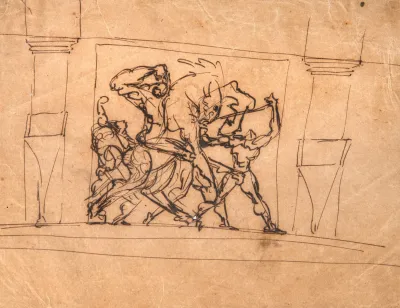
"Sigaud always started from a daily and immediate motive. At the same time, he enjoyed the fantasy of mythologies. But it is actually its forte, a dense reality of drama and material respect because its visual world is populated by the sweat of the simple, the wear of proletarian muscles, cranes and scaffolding, cement buckets and bricks. From this he extracted a rude poetry, a song hoarse by the cry of protest, a sad and wounded horizon of detached energy, the energy of the humble and forgotten. Sigaud gives a perfect demonstration of the great mastery of drawing, a high experience to be analyzed carefully in his artistic work. In times of social debacle, he was the celebrant of the worker, the apologist of the anonymous builder of our spaces. Unlike advertisements with beautiful women, cars and dandies, he gave us the stripped-down atmosphere of the skeletons of the spikes, the paraphernalia of the piers, illuminating the longshoreman and the mason of a magical and Greek dimension. As a person, as a presence, awakens and pulsating, he left us a timely warning".
Walmir Ayalla
GONÇALVES, Luiz Felipe. Sigaud: The Painter of Workers. Edson Motta. Quirino Campofiorito.s.l., edited by the author, 1981c. Bibliography: p.125-127 Name Index: p.132-136.
"From all The members of Núcleo Bernardelli, Eugênio Sigaud, was the only one who developed a clearly social theme. 'I've always extolled the anonymous worker, I've always denounced the life massacred by the system. I have always been aware of the social function of art. In my view, all art can compete to activate the political debate, thus improving, indirectly, the life of man', he told me, in an interview, shortly before he died. He was always expressionist: in the ostensible deformation of his figures, in the little charming theme of the urban working class, in the boldness of his works, in the wideness of the design, in the energy of the volumes, in short, in the virile, rude and crude style. It is not restricted to showing the worker in the scaffolding of the buildings under construction: he also shows them on the street, in the midst of traffic, in the mills, railways, bridges, shipyards and, then, passing from the city to the countryside, shows it in coffee plantations, muscular and strong, black, or on the coast, between salt and gravel."
Frederico Morais
MORAIS, Frederico. Júlio Bogoricin Imóveis, 1986c.
Individual exhibitions
1941 - Rio de Janeiro RJ - Individual, at Palace Hotel
1946 - Santiago (Chile) - Individual, at the University of Santiago de Chile
1947 - Buenos Aires (Argentina) - Individual, at Galeria Muller
1947 - Montevideo (Uruguay) - Individual, at the Institute of Culture uruguayo-brasileño
1948 - Rio de Janeiro RJ - Individual, at the IAB/RJ Gallery
1972 - Rio de Janeiro RJ - Homage to Sigaud, at the Galeria da Praça
1973 - São Paulo SP - Homage At the 50th anniversary of the artist's painting E. P. Sigaud, at The Gallery
1977 - Rio de Janeiro RJ - Individual, at Galeria B-75
Collective exhibitions
1923 - Rio de Janeiro RJ - 2nd Spring Salon
1923 - Rio de Janeiro RJ - Exhibition of the Brazilian Society of Fine Arts, at the Red Star Salon
1924 - Rio de Janeiro RJ - 31st General Exhibition of Fine Arts, at Enba
1925 - Rio de Janeiro RJ - 32nd General Exhibition of Fine Arts, at Enba
1926 - Rio de Janeiro RJ - 33rd General Exhibition of Fine Arts, at Enba
1926 - Rio de Janeiro RJ - Salão of the new
1927 - Rio de Janeiro RJ - 34th General Exhibition of Fine Arts, at Enba
1929 - Rio de Janeiro RJ - 36th General Exhibition of Fine Arts, at Enba
1930 - Rio de Janeiro RJ - 37th General Exhibition of Fine Arts, at Enba
1931 - Rio de Janeiro RJ - Revolutionary Hall, at Enba
1934 - Rio de Janeiro RJ - National Salon of Fine Arts, at Enba
1935 - Rio de Janeiro RJ - Show, at the Bernardelli Nucleus
1936 - Rio de Janeiro RJ - 42nd National Salon of Fine Arts, at the Instituto Previdência - Bronze Medal
1936 - Rio de Janeiro RJ - Show, at the Bernardelli
1937 - São Paulo SP - 5th Paulista Salon of Fine Arts
1938 - Rio de Janeiro RJ - Show, at the Bernardelli Nucleus
1939 - New York (United States) - Riverside Museum Exhibition - Honorable Mention
1939 - São Paulo SP - 6th Paulista Salon of Fine Arts
1940 - Porto Alegre RS - Hall of the Institute of Fine Arts - Bronze Medal
1940 - Porto Alegre RS - Bicentenário from Porto Alegre
1940 - Porto Alegre RS - 2nd Hall of the Institute of Fine Arts of Rio Grande do Sul
1941 - Rio de Janeiro RJ - Núcleo Bernardelli, at the Palace Hotel
1942 - Rio de Janeiro RJ - 48th National Salon of Fine Arts, at the MNBA - Silver Medal
1944 - Rio de Janeiro RJ - 50th National Salon of Fine Arts, at MNBA
1944 - Rio de Janeiro RJ - The child in art, MNBA
1944 - Rio de Janeiro RJ - Brazilian Landscape, at the Museum of the School of Fine Arts Dom João VI
1945 - Rio de Janeiro RJ - Plastic Artists of the Communist Party, at the Student House
1946 - Rio de Janeiro RJ - The painters go to the Escola do Povo, at Enba
1946 - Valparaíso (Chile) - Exhibition of the National Navigation Company
1948 - Cape Town (South Africa) - Contemporary exhibition of Brazilian artists at South African National Gallery
1948 - Rio de Janeiro RJ - Aspects of Rio, in the MNBA
1949 - Rio de Janeiro RJ - Watercolors, at MNBA
1950 - Rio de Janeiro RJ - A century of Brazilian painting: 1850-1950, at the MNBA
1951 - São Paulo SP - 1st São Paulo International Biennial, at the Trianon Pavilion
1952 - Rio de Janeiro RJ - 1st National Salon of Modern Art, at MAM/RJ
1953 - Rio de Janeiro RJ - 2nd National Salon of Modern Art, at the MNBA - Acquisition Award
1954 - Rio de Janeiro RJ - Black and White Salon, at the Palácio da Cultura
1955 - Rio de Janeiro RJ - Miniature Salon, at ABI
1956 - Rio de Janeiro RJ - 5th National Salon of Modern Art
1956 - Rio de Janeiro RJ - National Salon of Fine Arts
1958 - Rio de Janeiro RJ - Work on Art, at MNBA
1959 - Macaé RJ - 2nd Macaé Modern Art Festival
1961 - Rio de Janeiro RJ - Movement of Independent Modern Artists, at the headquarters of King of the Voice
1962 - Rio de Janeiro RJ - 11th National Salon of Modern Art
1967 - Rio de Janeiro RJ - 16th National Salon of Modern Art
1974 - Rio de Janeiro RJ - The sea, at the gallery Ibeu Copacabana
Posthumous exhibitions
1979 - São Paulo SP - Retrospective, at Espaço CHAP CHAP
1980 - Rio de Janeiro RJ - Drawings by Sigaud, at the Andréa Gallery Sigaud
1982 - Rio de Janeiro RJ - Universo do Futebol, at MAM/RJ
1982 - São Paulo SP - Exhibition Núcleo Bernardelli: Brazilian art in the 30s and 40s, at the Arte Galeria collection
1983 - Rio de Janeiro RJ - Brazilian self-portraits, at the Banerj Art Gallery
1984 - São Paulo SP - Tradition and Rupture: Brazilian Art and Culture Synthesis, at the Bienal Foundation
1985 - Rio de Janeiro RJ - 8th National Arts Salon Plasticas, at MAM/RJ
1985 - São Paulo SP - Sigaud 1899-1979: 60 years of graphic language, at the Chap Chap Cultural Space
1991 - Curitiba PR - Municipal Museum of Art: collection, at the museum Municipality of Art
1993 - Rio de Janeiro RJ - Brazil, 100 years of modern art, at the MNBA
1994 - São Paulo SP - Bienal Brasil Century 20th, at the Fundação Bienal
1996 - Rio de Janeiro RJ - Visions of Rio, at MAM/RJ
2000 - Rio de Janeiro RJ - When Brazil was modern: plastic arts in Rio de Janeiro from 1905 to 1960, at Paço Imperial
2000 - São Paulo SP - The Angels are back, at the Pinacoteca do Estado
2001 - Rio de Janeiro RJ - Brazilian Watercolor, at the Light Cultural Center
2002 - Rio de Janeiro RJ - Brazilian art in the Fadel collection: from the restlessness of the modern to Language autonomy, at CCBB
2002 - São Paulo SP - Brazilian art in the Fadel collection: from the restlessness of the modern to the autonomy of language, in the CCBB
2003 - Brasília DF - Brazilian art in the Fadel collection: from the restlessness From the modern to the autonomy of language, in the CCBB
2003 - Rio de Janeiro RJ - Treasures of Caixa: Brazilian modern art in the Caixa collection, in the Caixa Cultural Complex
2003 - São Paulo SP - Art and Society: a controversial relationship, in Itaú Cultural
2004 - Curitiba PR - The landscape of Paraná and its painters, at Casa Andrade Muricy
2004 - São Paulo SP - Paper Office, at CCSP
Source: Itaú Cultural