Estêvão Silva (Rio de Janeiro RJ ca.1844 - idem 1891)
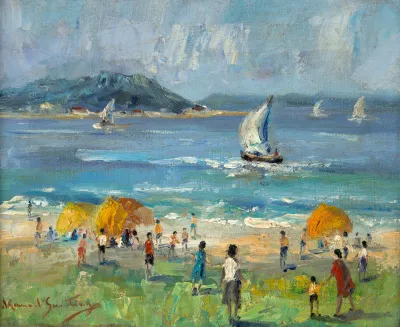
José Pancetti was a painter known mainly for his navies, although his work also includes landscapes, portraits, self-portraits and still lifes. Its navies, initially elaborated in an analytical way, with smooth strokes and beats organized in geometrical planes, without waves and without wind, became, over time, cleaner, approaching abstraction, reduced to sand, light and Mar.
From 11 to 16 years old, by decision of his father, Giuseppe Gianinni Pancetti lived in Italy, under the care of his uncle and grandparents. Before becoming a sailor, he worked as a carpenter's apprentice, in bicycle and war material factories. In 1919, he joined the Italian Merchant Navy, traveling for three months through the Mediterranean. The following year, he returned to Brazil and, in Santos, performed several functions, such as a textile worker, a goldsmith's assistant, a worker in the sewer network and a hotel janitor. In 1921, in São Paulo, he worked at the Beppe workshop, specialized in wall decoration, acting as a poster, wall painter and assistant to the painter Adolfo Fonzari. In 1922, he enlisted in the Brazilian Navy, where he remained until he was retired in 1946, in the rank of 2nd Lieutenant. In 1925, while serving in the battleship Minas Gerais, he made his first paintings. The following year, to progress in his career, he joined the painting of the "company of practitioners and specialists on deck" painters. In 1933, he joined the Bernardelli Nucleus, where he received guidance from Manoel Santiago, Edson Motta, Rescála and, mainly, from Polish painter Bruno Lechowski, acquiring technique and artistic maturity.
Critical Comment
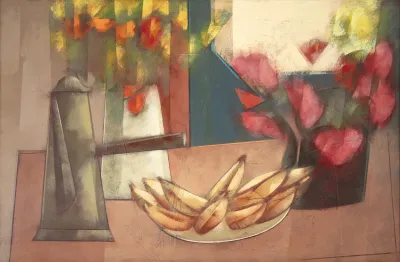
Estêvão Silva is the first prominent black painter formed by the Imperial Academy of Fine Arts - AIBA and, as several scholars point out, can be considered one of the best still life painters of the 19th century. His interest in the subject must have been motivated by the study with Agostinho da Motta (1824 - 1878), in AIBA. Silva predominantly paints fruits, such as grumixamas and jaboticabas, s.d., araçás, 1870 or still life, 1884.
The critic Gonzaga Duque (1863 - 1911) emphasizes the quality of the artist's compositions, carried out with prodigality of reds, yellows and greens, in which he manages to give the appearance of fidelity to the representation, giving to the canvas everything he sees and feels in nature. It seems impossible to him even "painting fruits better than they have painted Stephen. Their peaches are in the form, in the color, in the soft and golden fluff that coats them, true peaches".2
In the decade of 1880, Estêvão Silva lives with the members of the Grimm group, but without ever breaking his ties with Aiba. The artist also performs some portraits, such as that of the painter Castagneto (1851 - 1900), in 1880, and compositions of historical and religious themes, such as S. Pedro, S.D., A Caridade, s.d. and a sketch for the framework The Law of 28 September, s.d.
Notes
1 The fact is reported in detail by the art critic Laudelino Freire (1873 - 1937) and also in the Autobiography of Antônio Parreiras. See: FREIRE, Laudelino. A century of painting: notes for the history of painting in Brazil: from 1816-1916. Rio de Janeiro: Fontana, 1983; PARREIRAS, Antonio. Story of a painter told by himself: Brazil - France: 1881-1936. Presentation Athayde Parreiras. Niterói: Official Gazette, 1943.
2 DUQUE, Gonzaga. Brazilian art. Campinas: Mercado de Letras, 1995. (Art Collection: Essays and Documents). p. 219.
Criticism
"There is fidelity, reality is, and when the artist manages to deceive us perfectly, when he manages to pass on to the canvas what he sees and what he feels in nature, he has achieved everything. There is, however, in its ability, a small flaw - it is the way of making the shadows. Stephen carries them rudely, accusing, as is done in the academy, the projection of bodies. This results in a certain weight in the tonality. The same defect, although less pronounced, It can be noticed in the landscapes or in the marines performed by the brushes of Estêvão Silva".
Francisco Acquarone and A. de Queiroz Vieira
the primors of painting in Brazil. Francisco Acquarone; A. de Queiroz Vieira. 2. ed. Rio de Janeiro, s. ed. , 1942.
"It distinguished itself in the painting of fruits, deserving the following appreciation from the criticism of the time: 'It is really difficult and even seems impossible to paint fruits better than the ones that have painted Estêvão' (...) He was of restless and turbulent genius. At once, in the midst of a ceremony for the distribution of awards at the Academy, he got up and complained to D. Pedro II, present at the act, that he had been the victim of injustice not being awarded. to investigate the incident, after hearing him, punished him with the penalty of suspension of studies for one year".
Carlos Cavalcanti and Walmir Ayala
CAVALCANTI, Carlos; Ayala, Walmir, ed. Brazilian Dictionary of Plastic Artists. Presentation by Maria Alice Barroso. Brasília: MEC/INL, 1973-1980. (Specialized Dictionaries, 5).
Acerves
São Paulo State Pinacoteca Collection (São Paulo SP)
Mariano Procópio Museum (Juiz de Fora MG)
National Museum of Fine Arts - MNBA (Rio de Janeiro, RJ)
Collective exhibitions
1872 - Rio de Janeiro RJ - 22nd General Exhibition of Fine Arts, at AIBA
1876 - Rio de Janeiro RJ - 24th General Exhibition of Fine Arts, at AIBA
1879 - Rio de Janeiro RJ - 25th General Exhibition of Fine Arts, at AIBA - Silver Medal
1882 - Rio de Janeiro RJ - 1st Exhibition Promoted by the Sociedade Propagadora das Fine Artes, at the Sociedade Propagadora de Fine Artes
1884 - Rio de Janeiro RJ - 26th General Exhibition of Fine Arts, at AIBA - 2nd Gold Medal
1890 - Rio de Janeiro RJ - General Exhibition of Fine Arts, at ENBA - Acquisition Award
Posthumous exhibitions
1950 - Rio de Janeiro RJ - A century of Brazilian painting: 1850-1950, at MNBA
1979 - Rio de Janeiro RJ - Brazilian and European 19th century paintings, at Mauricio Pontual Art Gallery
1983 - São Paulo SP - History of Brazilian painting in the 19th century, at the Paço das Artes
1986 - São Paulo SP - 1988 show: A turn in the century, at the Pinacoteca do Estado
1988 - São Paulo SP - The Afro-Brazilian Hand, at MAM/SP
1993 - São Paulo SP - 19th century black painters, Pinacoteca do Estado
2000 - Porto Alegre RS - From Frans Post to Eliseu Visconti: Collection National Museum of Fine Arts - RJ, at Margs
2000 - Rio de Janeiro RJ - Brazil + 500 rediscovery show. Negro de Corpo e Alma, at Fundação Casa França-Brasil
2002 - São Paulo SP - Image and identity: a look at the history in the collection of the Museum of Fine Arts, at the Banco Santos Cultural Institute
Source: Itaú Cultural