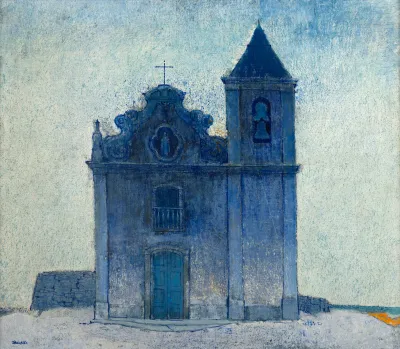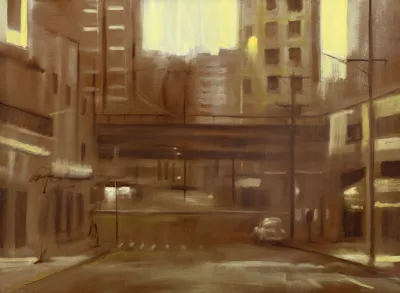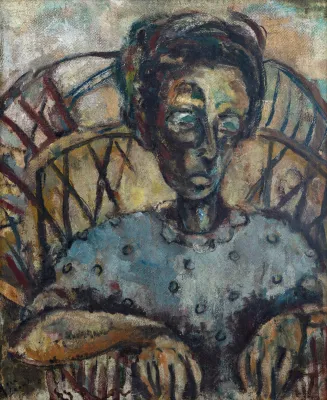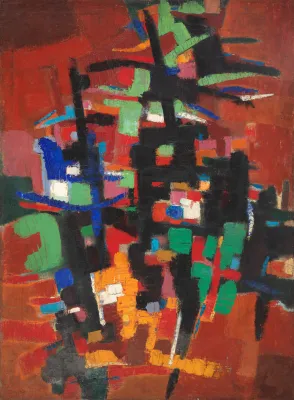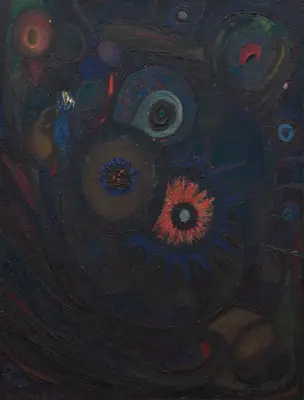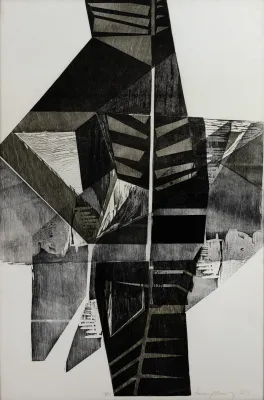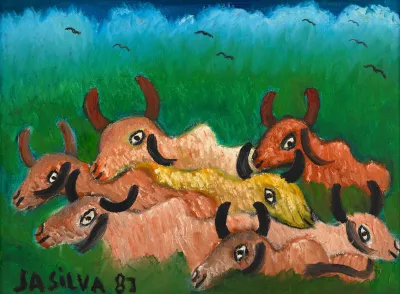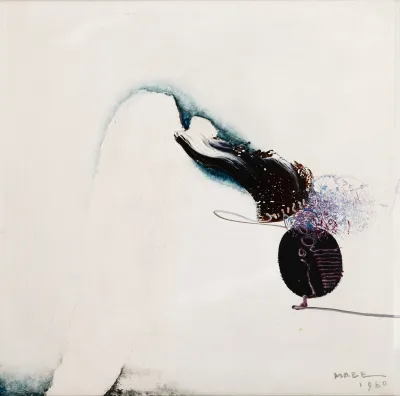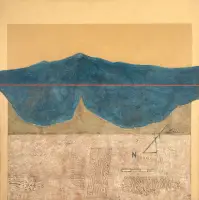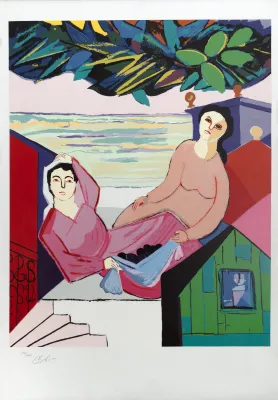
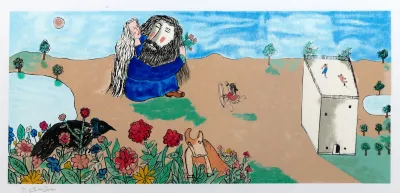
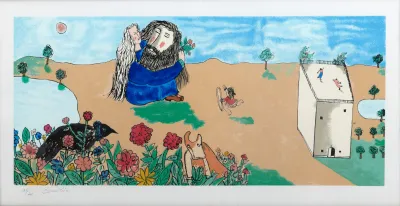
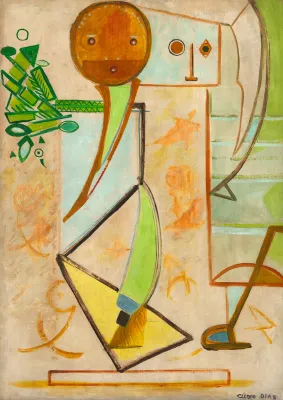
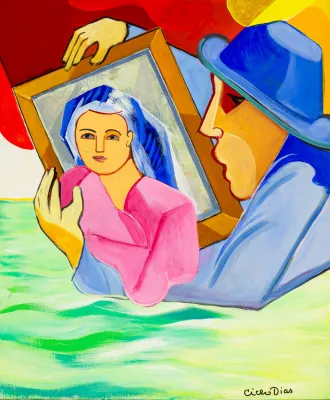
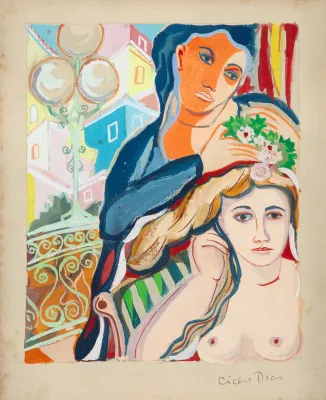
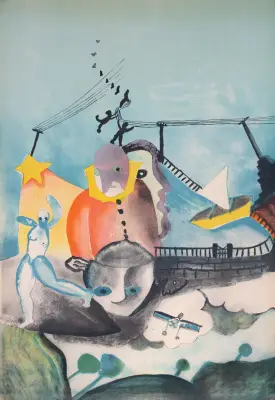
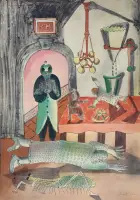
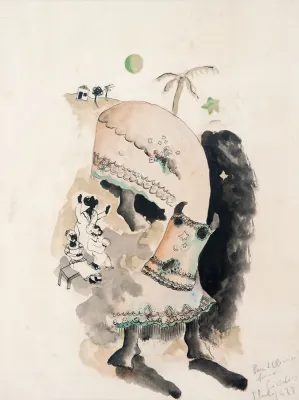

Cícero Dias (Escada PE 1907 / Paris France 2003)
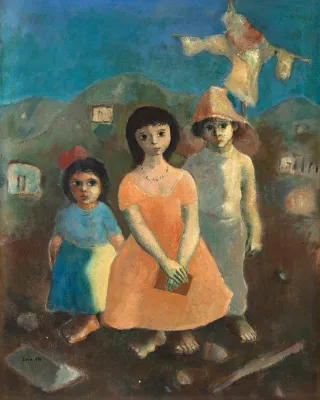
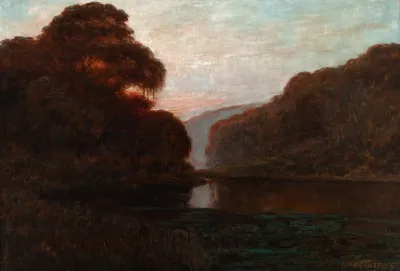
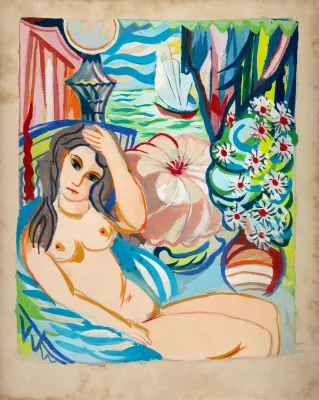
Cícero Dias was a painter, printmaker, draftsman, illustrator, set designer and teacher, recognized as one of the central names of modern Brazilian art. He began his drawing studies in his home state, Pernambuco. In 1920, he moved to Rio de Janeiro, where in 1925 he enrolled in the architecture and painting courses at the Escola Nacional de Belas Artes (Enba), which he did not complete.
In this period, he drew close to the modernist group and, in 1929, contributed to the Revista de Antropofagia. In 1931, at Enba's Salão Revolucionário, he exhibited the panel Eu Vi o Mundo… (I Saw the World…), a work that caused a stir both for its size and for its innovative subject matter. Cícero Dias began his artistic career in Recife and, from 1932, taught drawing in his studio in the city. In 1933, he illustrated Gilberto Freyre's (1900–1987) Casa-Grande & Senzala, reinforcing his ties to Brazilian cultural thought. In 1937, he was arrested in Recife after the proclamation of the Estado Novo.
Encouraged by Di Cavalcanti, he went to Paris, where he came into contact with Georges Braque, Henri Matisse, Fernand Léger and Pablo Picasso, with whom he became friends. In 1942, Cícero Dias was arrested by the Nazis and sent to Baden-Baden, Germany. Between 1943 and 1945, he lived in Lisbon as Cultural Attaché at the Brazilian Embassy, then returned to Paris, where he joined the abstract group Espace.
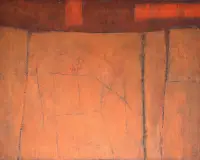
In 1948, Cícero Dias painted the mural in the building of the Pernambuco State Finance Department, considered the first abstract work of its kind in Latin America. In 1965, he was honored with a special room at the São Paulo International Biennial. In 1991, he inaugurated a 20-meter panel at the Brigadeiro station of the São Paulo Metro. In Rio de Janeiro, the Sala Cícero Dias was inaugurated at the Museu Nacional de Belas Artes (MNBA). In 1998, at the age of 91, he received the French National Order of Merit from the French government, an international recognition of his contribution to modern art.
The Problem
It was late 1928. A young man, appearing to be about twenty, timidly entered the office of Graça Aranha, then sixty, an established writer and member of the Brazilian Academy of Letters.
It was a meeting of two extremes. One had already achieved everything he had aspired to in life. The other, just starting his career, encountered every obstacle and difficulty along the way.
The young man explained his predicament to Graça Aranha. He had rebelled against the reactionary stance of the Escola Nacional de Belas Artes, which kept its students confined, preventing them from exploring paths outside traditional art.
He had broken with the school, resigning from it. Restless by nature, with a whirlwind of ideas spinning in his head, he had assembled a series of works in watercolor and oil that he intended to exhibit, only to find every door closed in a country still resistant to modern art.
The Right Friend
The young man we refer to was Cícero Dias, and it was no coincidence that, among so many prominent figures in Rio de Janeiro, he chose Graça Aranha (1868-1931) as his patron.
In 1922, the writer openly supported the Modern Art Week, creating a split within the almost monolithic Brazilian Academy of Letters and sparking a controversy not seen there for a long time.
Two groups of “immortals” clashed: one led by Graça Aranha, who sought to break with the past; the other, more entrenched in the old structure, was headed by the writer Coelho Neto (1864-1934). Both were from the Northeast, both from Maranhão, both wielding tremendous influence among their peers. These distinguished compatriots now found themselves at odds, each determined to pursue their positions to the utmost.
Then, in a historic session of the Academy in 1924, the fateful confrontation occurred. After fiery speeches and a sharp debate between them, in front of a large audience, a group of young people carried Coelho Neto on their shoulders, while another group did the same with Graça Aranha.
The First Time Was in an Asylum
And this is how things unfolded. Graça Aranha gave the young man a letter of introduction to ophthalmologist Dr. Moura Brasil (1846-1928), who had a vacant space at the Polyclinic, right across from the Cruzeiro Gallery.
However, Moura Brasil could not be reached, and a new letter was written, this time addressed to Dr. Juliano Moreira, who was delighted with the artwork presented to him and offered a solution somewhat outside conventional norms.
He explained that an international congress was taking place within the asylum, and if the young man had all his materials ready, he would authorize an exhibition there.
Thus, unexpectedly, Cícero Dias’s first modernist solo show took place inside an asylum, and the reactions that followed were nothing short of “madness.”
Just as Graça Aranha had experienced at the Academy, Cícero faced similar turmoil at the hospital. Outraged traditionalists protested against the exhibition, while European doctors attending the congress praised his work and encouraged him to continue.
In the end, there was a positive outcome. First, the scandal generated publicity and drew attention to Cícero Dias’s still-developing oeuvre. Second, as not everyone opposed him, he managed to sell a few paintings.
The People Are Not Surprised
Cícero Dias was born in Engenho Jundiá, in the municipality of Escada, 50 kilometers from Recife (PE), on March 5, 1907, and moved to Rio de Janeiro at an early age.
Enrolling at the National School of Fine Arts, he displayed from the outset a restless and capricious temperament. He began studying sculpture but soon abandoned it, turning to painting, a pursuit in which he also did not linger for long.
His main interest was experimenting with new trends, an approach that brought him into conflict with the Academy’s strict guidance. Requesting his dismissal, he began studying independently from 1928, and in that same year he held his first solo exhibition, under the circumstances already mentioned above.
In 1929, he returned to his homeland, holding an exhibition in Recife that caused the same scandal as in Rio de Janeiro. He then concluded that the problem lay in the major cultural centers, which nurtured prejudices and were thus reluctant to accept—or at least test—new proposals.
To prove his point, he staged three more exhibitions, this time in the interior of Pernambuco, where his work was received with far greater ease.
“The people are not surprised,” he concluded; it is the uneducated, the bourgeois, who are startled, but the common people are not.
Free as a Graffiti Artist
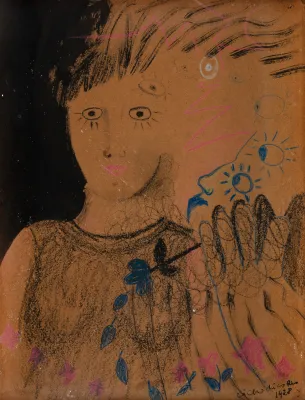
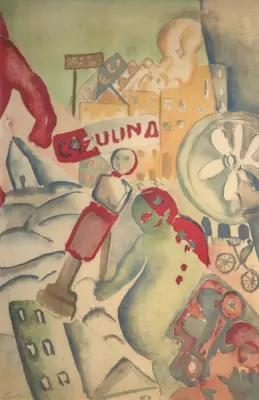
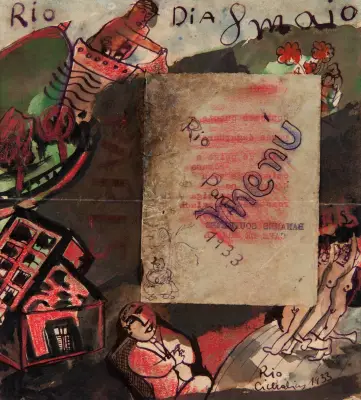
Freed from academic instruction, his art gained greater expressive liberty, seemingly without the meticulous care that orthodox painters typically devote to their canvases.
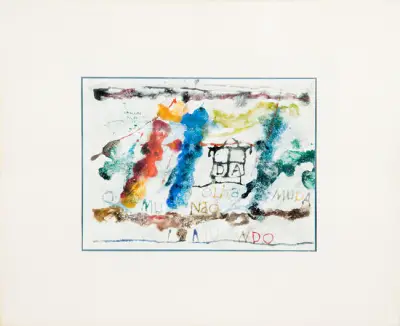
Cícero’s paintings, in the words of a critic, consisted of “loose and roughly constructed images (…) expressed in a language akin to that of the primitives, or that of children.”
With the onset of the Second Republic (1930–1945), architect Lúcio Costa (1902–1999) assumed the direction of the National School of Fine Arts and began a renewal process, which was resisted by other faculty, leading to a series of obstacles and ultimately his dismissal shortly thereafter.
But at least in 1931, Lúcio Costa was director and opened submissions for the annual Salon to all artistic trends, not just academic ones.
Cícero Dias seized the opportunity. He prepared a canvas over twenty meters long and, much like contemporary graffiti artists, painted upon it everything that came to his imagination—from everyday, childlike scenes to erotic ones.
It goes without saying that scandal ensued once again, this time with material damage, as large sections of the mural were destroyed, forcing him to restore it. Even after the most provocative scenes were removed, the panel still measured 17 meters in length.
A Citizen of the World
Having experienced, in 1930, a “taste of Paris” during a scholarship stay, he planned to move permanently to Europe.
In 1937 this idea resurfaced, as the Brazilian situation deteriorated with the establishment of the Estado Novo under Getúlio Vargas. In protest against this oppression, he traveled to Paris and shortly thereafter found employment in the diplomatic offices of Itamaraty.
It was a chance to kill two birds with one stone. While resolving his financial difficulties, he also found it easier to connect with modernists and learn about the cutting-edge developments taking place across Europe.
His stay did not last long. In 1940, with the escalation of World War II, he became a prisoner, and as soon as he was freed, he traveled to Portugal, where he remained until the end of the conflict.
Returning to France in 1945, he joined Groupe Espace, recently founded by a group of painters devoted to abstractionism, supported by the Galerie Denise René.
From then on, he made France his home, with frequent trips to Brazil and Portugal, as well as engagements in other countries where his works were exhibited.
A Mature Artist
If the 1930 journey offered him an initial encounter with European art, his second stay, beginning in 1937, allowed time for the consolidation of artistic trends.
The painter of the 1940s gradually detached himself from the image of a rough, almost naïve artist. From that point onward, he focused meticulously on the refinement of line and color, moving away from the role of a caboclo painter, oriented toward regional themes and popular painting.
This marked the emergence of the new and most significant phase of Cícero Dias, which brought him international acclaim. He was invited to participate in exhibitions in major art centers, including Italy, Denmark, Sweden, Finland, Belgium, and others.
He also maintained a strong presence at key events in France, Portugal, and Brazil, particularly in Rio de Janeiro, São Paulo, Salvador, and Recife.
Time passed, ideas evolved, and his work began to be received with enthusiasm in the same centers that had once overlooked him.
This is the price paid by pioneers. Some passed away before witnessing change. Others, like Cícero Dias, were fortunate to live long enough to reap the rewards of their pioneering efforts.
Critiques
"The violent and explosive color of Cícero Dias’s canvases does not stem merely from a desire to reproduce nature’s decorative manifestations; it is more than that. These colors are elemental to our land, our life, and our way of being and reacting to the surrounding environment. Hence, Cícero Dias, despite belonging to the School of Paris and the 'non-figurative' appearance of his art, is a strictly Brazilian painter. He did not need 'subject matter' or picturesque anecdotes to create an authentic art; pure emotion, transcending our Brazilian qualities, along with the systematic use of formal rhythms and deliberate chromatic relationships, sufficed. In this way, he proves that, like style, the authentic character of a work of art is independent of its 'motive'."
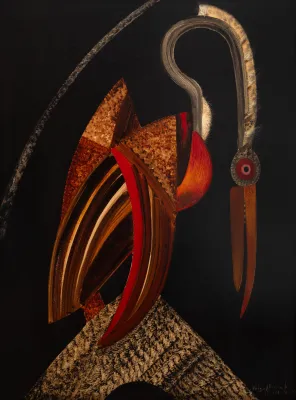
"Cícero Dias’s painting is intimately connected with our inner nature, while the external world is perceived through the artist’s spiritual gaze. This art remains anchored to the land, to the world of appearances, through the vitality generated by the dynamism of colors and forms. At times, it is the greens—evoking the plant kingdom—that break the harmony and enliven the canvas; these are different, tropical greens, reminiscent of palm trees and sugarcane fields. At other times, pure blues dominate, harmonizing with the sky; explosive, warm reds evoke the exuberance of tropical colors, the intensity of our emotions, and the heat of our atmosphere. Occasionally, amid the tangle of abstract forms, one can discern the mass of a tropical forest or, from an aerial view, the contours of a Brazilian landscape (see, for example, the painting Les Villes Jumelles). Indeed, almost all of Cícero Dias’s canvases suggest landscape—they could be described, we might say, as 'abstract landscapes.'"
Flávio de Aquino
DIAS, Cícero. Exposição Cícero Dias. Rio de Janeiro: MAM, 1952.
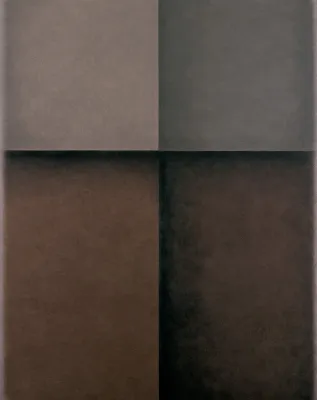
"Lyric abstraction found in Cícero Dias a pioneering representative among Brazilian painters. A resident of France since 1937, with a period spent in Lisbon during the war, his activity was divided between the tasks of an informal diplomat and the discipline of painting, guided toward a spontaneous and sensual abstraction that made him a well-known presence in Parisian geometric art circles. At that time, the shapes with wandering, nearly circular contours that filled his spaces did not exclude the rigor of composition. They were guided by sensitivity within the bounds of reason. His expression was intertwined with a chromatic code evocative of the northeastern Brazilian landscape. This phase, significant in the oeuvre of the Parisian-Pernambucan artist and lasting about ten years, gave way in the late 1950s to a duality—certainly less attuned to his own characteristics—that sought to bridge the concerns of abstract expressionism, then flourishing, with the closed geometric forms of his previous phase, while still reconsidering color. Later, in another turn, he would return to figurative work, which he had originally begun with, but without the same conviction."
Walter Zanini
ZANINI, Walter, org. História geral da arte no Brasil. Apresentação de Walther Moreira Salles. São Paulo: Instituto Walther Moreira Salles, Fundação Djalma Guimarães, 1983.
"It can be stated without hesitation that by the age of 20, Cícero Dias had already mastered his craft as a painter, in the academic sense of the word. From that point on, driven by a spirit of innovation, the artist sought his own path through the intricate web of currents and trends in twentieth-century European art. In this pursuit, one of Cícero’s defining traits becomes evident: his remarkable ability to assimilate and appropriate a wide range of artistic currents. Positioned at the forefront, his work stands alongside that of his European contemporaries. He practices fantastic art, striving to achieve a likeness to reality through countless approaches. Sometimes he treats his subjects with such precise detail that a photograph would seem approximate. At other times, he exaggerates contrasts of light and shadow to create dramatic and striking effects. Frequently, he alters the real appearance of objects, particularly the human body, aiming to pull the viewer from conventional modes of perception and guide them toward a more intense awareness of the visual world. This is especially evident in his treatment of the traditional theme of the female nude. (...) From 1934 onwards, he returned to Recife. His works show that the excessive excitement of his early years had become disciplined and controlled. During this period, rural landscapes alternated with urban scenes of Recife and Olinda, in a torrential and varied production. What impressed Cícero Dias was not the landscape itself, but its human elements. Beneath an apparent naivety, he displayed acute observation of Northeastern rural reality, coupled with the memory fidelity typical of primitive artists."
Janira Fainer Bastos
BASTOS, Janira Fainer. Cícero Dias: eu vi o mundo... ele começava no Recife. São Paulo, ECA/USP, [1985]. Master's Thesis.
"Unlike Ismael Nery, whose engagement with Surrealism in the late 1920s occurred through direct European encounters, the presence of surreal elements in the early work of the Pernambucan artist Cícero Dias stemmed from a different motivation, though not entirely disconnected from that international source then emerging and evolving. Driven by the Northeastern regionalism of the movement led by Gilberto Freyre in 1926, it reflected both the desire to align with the modernist currents in Brazil and the need to do so through a link to the artist's native region. This connection to his Northeastern roots was therefore fundamental in launching his work. Armed with the adult lyricism of returning to childhood, a nostalgia that bursts forth vividly—since time in the province moves slower than in the metropolis—it is Recife that surfaces in his watercolors from the late 1920s to the following decade. Upon returning to Paris after years of war spent in Lisbon, he engaged with abstraction. (...) Tropicality, in any case, brought Cícero Dias’ painting back, from the 1960s onward, to the early figurative limits, now marked by a denser color scheme (...)."
Roberto Pontual
PONTUAL, Roberto. Entre dois séculos: arte brasileira do século XX na coleção Gilberto Chateaubriand. Preface by Gilberto Allard Chateaubriand and Antônio Houaiss. Introduction by M. F. do Nascimento Brito. Rio de Janeiro: Jornal do Brasil, 1987.
"The pictorial elements demanded Cícero’s exclusive attention. He questioned the primacy of regionalism, or rather, understood its fullness solely through purely plastic means. (...) Cícero approached abstraction etymologically, as an extraction from the world. He observed things, seeking to purify them, to establish order in contingency and decline. He imposed necessary structures upon previous spontaneity. His encounter with Picasso introduced him to the Cubist discipline of the Paris School. Sinuous lines glide over a nearly Egyptian background, almost touching the merciless flatness of the canvas."
Nelson Aguilar
AGUILAR, Nelson. Cícero Dias: Poet in Paris. Galeria Revista de Arte, São Paulo, 1988, no. 9.
Interviews
Estado - Since your debut exhibition in 1928, critics have drawn comparisons to the Russian Chagall, for example, and placed you in different schools—figurative, abstract, surrealist. Can you define yourself once and for all?
Cícero Dias - I dislike labels. What connects me to Chagall is our shared roots in popular painting and the folkloric, cultural expressions of our respective lands. That’s why people say my paintings resemble Chagall’s and vice versa. However, when I truly began painting in the 1920s, there were no reproductions of Chagall or other avant-garde painters in Brazil. So what happened was simply a coincidence between me and Chagall.
Estado - Was the School of Fine Arts important for your aesthetics?
Dias - The school mattered technically, though the professors were very conservative. I never paid much attention to their debates about the rupture between modern and classical art. I don’t believe in rupture, only continuity. But regarding paint and color experimentation, I was ahead of the school—I had already been studying and mixing them back on the plantation.
Estado - What nourished your creativity in painting?
Dias - Early on, at the plantation school with my aunt, I drew and painted innocent subjects—trees, animals, houses—I didn’t delve into their essence. One day, however, standing at the school gate, I perceived the strength of the sugarcane fields, the richness and variety of their greens. Later, I discovered the other colors of the old bangüê, captured the musicality in the sway of a hammock and the moving wood of an ox cart.
(...)
Estado - What led you to change your style in Paris?
Dias - When I arrived in Paris in the 1930s, Surrealism dominated poetry and influenced other artistic expressions. I was struck by it. Later, with the evolution of the “schools,” abstract art emerged, grew in the post-war period, and I closely followed the phenomenon. On several occasions, I saw Picasso and Fernand Léger discuss abstract art. Seeing the excitement of so many artists with a century-long accumulation of painting knowledge, I entered the movement when instinct invited me.
(...)
Estado - In Lisbon, you truly began painting abstracts, married Raymonde, and returned to Paris in 1945 when France regained its freedom...
Dias - It was “the crossing of the line,” as critic Pierre Descargues put it in every sense… I was, in fact, deeply moved by Picasso’s appeal for my return, in the dedication of the copy he sent me of his play Le Plaisir attrapé par la queue. It read: “For Dias, whose presence in Paris is necessary.”
Estado - Do you ever regret having “crossed the line” in painting?
Dias - There is no regret, and therefore I feel no desire to return to figurative repetition. Geometric abstraction fulfills my spiritual side; one must recall the relationship St. Augustine already made between art and number. I am proud to say that my first abstract murals were created in Recife in 1948, and I felt perfectly in tune with the origins of my painting. Creation remains a mystery.
Estado - What would you like the collective memory to retain of your work?
Dias - The aroma of sugarcane molasses from the mill was the childhood memory that Joaquim Nabuco left imprinted in his magnificent literature. I would be happy if, when people look at my paintings depicting orchards or fragments of them, their sense of smell is awakened alongside their sight, so they can sense the fragrance of the fruits I painted."
Cícero Dias
DIAS, Cícero. "Pintura de Cícero Dias alimenta-se de música e poesia." O Estado de S. Paulo, São Paulo, 24/04/99. Caderno 2. (Interview with Napoleão Sabóia) (accessed 24/07/2001).
Solo Exhibitions
1928 - Escada PE - Solo
1928 - Rio de Janeiro RJ - Solo, at Salão da Politécnica
1928 - São Paulo SP - Cícero Dias: Watercolors, at the home of Dona Olívia Guedes Penteado
1929 - Escada PE - Solo
1938 - Paris (France) - Peintures de Cícero Dias, Galerie Jeanne Castel
1943 - Lisbon (Portugal) - Solo, at Salão Silva Porto
1943 - Porto (Portugal) - Solo, at Teatro Coliseu
1948 - Recife PE - Solo, at Faculdade de Direito do Recife
1948 - Rio de Janeiro RJ - Solo, at Enba
1949 - São Paulo SP - Cícero Dias: Abstract Paintings, at MAM/SP
1951 - Paris (France) - Solo, at Cahiers d'Art
1952 - Rio de Janeiro RJ - Solo, at MAM/RJ
1952 - São Paulo SP - Cícero Dias: Paintings, Drawings, and Ceramics, at MAM/SP
1959 - Recife PE - Cícero Dias: Retrospective 1926-1959
1959 - Salvador BA - Cícero Dias: Retrospective 1926-1959
1966 - Ixelles (Belgium) - Cícero Dias, at Musée d'Ixelles
1967 - Rio de Janeiro RJ - Solo, at the headquarters of Manchete magazine
1967 - São Paulo SP - Solo, at São Paulo Club
1970 - Recife PE - Solo, at Ranulpho Art Gallery
1972 - São Paulo SP - Solo, at Portal Art Gallery
1973 - Lisbon (Portugal) - Solo, at Galeria S. Mamede
1974 - São Paulo SP - Solo, at Portal Art Gallery
1975 - São Paulo SP - Solo, at Museu Lasar Segall
1976 - Recife PE - Solo, at Ranulpho Art Gallery
1978 - Le Havre (France) - Solo, at Musée de Beaux-Arts André Malraux
1982 - São Paulo SP - O Sol e o Sonho, at Ranulpho Art Gallery
1984 - São Paulo SP - Solo, at Ranulpho Art Gallery
1987 - Paris (France) - Retrospective, at Galerie Denise René
1988 - Belo Horizonte MG - Solo, at Gesto Gráfico Galeria
1988 - Brasília DF - Solo, at Performance Galeria
1988 - Paris (France) - Cícero Dias: Geometric Paintings, at Galerie Denise René
1988 - Porto Alegre RS - Solo, at Bolsa de Arte
1988 - Recife PE - Solo, at Artespaço Galeria de Arte
1988 - Rio de Janeiro RJ - Cícero Dias: Synthesis of Work – 60 Years of Painting, at Rio Design Center
1988 - Rio de Janeiro RJ - Solo, at Montesanti Galeria
1988 - Salvador BA - Solo, at Prova do Artista Escritório de Arte
1988 - São Paulo SP - Solo, at Dan Galeria
1988 - São Paulo SP - Solo, at Montesanti Galeria
1991 - Curitiba PR - Solo, at Simões de Assis Galeria de Arte
1993 - Rio de Janeiro RJ - Cícero Dias: The 1920s, at Copacabana Palace Hotel
1994 - Paris (France) - Images au Centre du Songe: Watercolors and Drawings from the 1920s, at Galerie Marwan Hoss
1995 - Fortaleza CE - Cícero Dias: Paintings and Drawings, at Multiarte
1996 - Paris (France) - I Saw the World… It Began in Recife, at UNESCO
1999 - São Paulo SP - Cícero Dias: Prints, at Casa da Fazenda
2002 - São Paulo SP - Solo, at Portal Art Gallery
2003 - São Paulo SP - Tribute to Cícero Dias, at MuBE
Group Exhibitions
1930 - New York (USA) - The First Representative Collection of Paintings by Brazilian Artists, at Nicholas Roerich Museum
1930 - São Paulo SP - Exhibition of a Modernist House
1931 - Rio de Janeiro RJ - Exhibition at the First Modernist House of Rio de Janeiro, Rua Toneleros
1931 - Rio de Janeiro RJ - Revolutionary Salon, at Enba
1933 - Rio de Janeiro RJ - 3rd Pró-Arte Salon
1934 - Rio de Janeiro RJ - 4th Pró-Arte Salon
1935 - Rio de Janeiro RJ - Social Art Exhibition, at Clube de Cultura Moderna
1937 - New York (USA) - 1st Brazilian Modern Art Exhibition, at Nicholas Roerich Museum
1937 - São Paulo SP - 1st May Salon, at Esplanada Hotel de São Paulo
1938 - São Paulo SP - 2nd May Salon, at Esplanada Hotel de São Paulo
1941 - São Paulo SP - 1st Art Salon of the National Industries Fair, at Parque da Água Branca
1944 - Lisbon (Portugal) - 8th Modern Art Exhibition
1944 - London (England) - Exhibition of Modern Brazilian Paintings, at Royal Academy of Arts
1944 - Norwich (England) - Exhibition of Modern Brazilian Paintings, at Norwich Castle and Museum
1945 - Bath (England) - Exhibition of Modern Brazilian Paintings, at Victory Art Gallery
1945 - Bristol (England) - Exhibition of Modern Brazilian Paintings, at Bristol City Museum & Art Gallery
1945 - Edinburgh (Scotland) - Exhibition of Modern Brazilian Paintings, at National Gallery
1945 - Glasgow (Scotland) - Exhibition of Modern Brazilian Paintings, at Kelvingrove Art Gallery
1945 - Lisbon (Portugal) - 9th Modern Art Exhibition
1945 - Manchester (England) - Exhibition of Modern Brazilian Paintings, at Manchester Art Gallery
1945 - Paris (France) - Group Exhibition, at Galerie Denise René
1946 - Paris (France) - UNESCO: Exposition Internationale d'Art Moderne, at Musée d'Art Moderne de la Ville de Paris
1947 - Paris (France) - Group Exhibition, at Galerie René Drouin
1947 - Paris (France) - Peintures Abstraites, at Galerie Denise René
1948 - Avignon (France) - Mural Art, at Palais des Papes
1948 - Recife PE - 4th Modern Art Salon
1949 - Buenos Aires (Argentina) - From Figurative to Abstract Art, at Instituto de Arte Moderno
1949 - Lyon (France) - The Great Currents of Contemporary Painting, at Musée de Lyon
1949 - São Paulo SP - From Figurativism to Abstraction, at MAM/SP
1950 - Brussels (Belgium) - Exposition Universelle et Internationale
1950 - Venice (Italy) - 25th Venice Biennale
1951 - Europe - 20 Artists of the École de Paris with the Klar Form Group
1951 - Paris (France) - The Painted Plate, at Galerie Christofle
1951 - Paris (France) - May Salon, at Musée d'Art Moderne de la Ville de Paris
1953 - Rome (Italy) - Italian and French Abstract Art, at Galleria Nazionale d'Arte Moderna
1953 - São Paulo SP - 2nd São Paulo International Biennial, at Pavilhão dos Estados
1954 - Goiânia GO - Exhibition of the National Congress of Intellectuals
1954 - São Paulo SP - Avant-Garde Artists of the École de Paris, at MAM/SP
1957 - Buenos Aires (Argentina) - Modern Art in Brazil, at Museo de Arte Moderno
1957 - Lima (Peru) - Modern Art in Brazil, at Museo de Arte de Lima
1957 - Rosario (Argentina) - Modern Art in Brazil, at Museo Municipal de Bellas Artes Juan B. Castagnino
1957 - Santiago (Chile) - Modern Art in Brazil, at Museo de Arte Contemporáneo
1958 - Brussels (Belgium) - Exposition Universelle et Internationale
1959 - Leverkusen (Germany) - First Group Exhibition of Brazilian Artists in Europe
1959 - Munich (Germany) - First Group Exhibition of Brazilian Artists in Europe, at Kunsthaus
1959 - Paris (France) - 15th May Salon, at Musée d'Art Moderne de la Ville de Paris
1959 - Vienna (Austria) - First Group Exhibition of Brazilian Artists in Europe
1960 - Hamburg (Germany) - First Group Exhibition of Brazilian Artists in Europe
1960 - Lisbon (Portugal) - First Group Exhibition of Brazilian Artists in Europe
1960 - Madrid (Spain) - First Group Exhibition of Brazilian Artists in Europe
1960 - Paris (France) - First Group Exhibition of Brazilian Artists in Europe
1960 - Recife PE - Contemporary Pernambucan Painters, at Federal University of Pernambuco, Center for Arts and Communication
1960 - Utrecht (Netherlands) - First Group Exhibition of Brazilian Artists in Europe
1960 - Washington (USA) - Art in Latin America Today: Brazil
1962 - Casablanca (Morocco) - Exhibition of Brazilian Artists
1962 - Paris (France) - Exposition d'Art Latino Americain à Paris, at Musée d'Art Moderne de la Ville de Paris
1962 - Rabat (Morocco) - Exhibition of Brazilian Artists
1962 - Tangier (Morocco) - Exhibition of Brazilian Artists
1963 - Campinas SP - Contemporary Painting and Sculpture, at Museu Carlos Gomes
1965 - São Paulo SP - 8th São Paulo International Biennial, at Fundação Bienal
1966 - Paris (France) - Group Exhibition, at Galeria Debret
1966 - São Paulo SP - Half a Century of New Art, at MAC/USP
1972 - São Paulo SP - The Week of '22: Antecedents and Consequences, at Masp
1972 - São Paulo SP - Art/Brazil/Today: 50 Years Later, at Galeria da Collectio
1974 - São Paulo SP - Time of the Modernists, at Masp
1975 - São Paulo SP - Modernism from 1917 to 1930, at Museu Lasar Segall
1976 - São Paulo SP - The Salons: of the Família Artística Paulista, the May Salon and the São Paulo Visual Artists' Union, at Museu Lasar Segall
1978 - Rio de Janeiro RJ - Four Decades of Brazilian Painting, at Jockey Club
1978 - São Paulo SP - The Biennials and Abstraction: The 1950s, at Museu Lasar Segall
1980 - Buenos Aires (Argentina) - Ochenta Años de Arte Brasileño, at Banco Itaú
1980 - Rio de Janeiro RJ - Tribute to Mário Pedrosa, at Galeria Jean Boghici
1982 - Bauru SP - 80 Years of Brazilian Art
1982 - Lisbon (Portugal) - Brazil: 60 Years of Modern Art – Gilberto Chateaubriand Collection, at Centro de Arte Moderna José de Azeredo Perdigão
1982 - London (England) - Brazil: 60 Years of Modern Art – Gilberto Chateaubriand Collection, at Barbican Art Gallery
1982 - Marília SP - 80 Years of Brazilian Art
1982 - Paris (France) - Paul Éluard and His Painter Friends, at Centro Georges Pompidou
1982 - Salvador BA - Brazilian Art from the Odorico Tavares Collection, at Museu Carlos Costa Pinto
1982 - São Paulo SP - 80 Years of Brazilian Art, at MAB/Faap
1982 - São Paulo SP - From Modernism to the Biennial, at MAM/SP
1983 - Belo Horizonte MG - 80 Years of Brazilian Art, at Fundação Clóvis Salgado. Palácio das Artes
1983 - Campinas SP - 80 Years of Brazilian Art, at MACC
1983 - Curitiba PR - 80 Years of Brazilian Art, at MAC/PR
1983 - Recife PE - 50 Years of Casa-Grande & Senzala, at Fundação Joaquim Nabuco
1983 - Ribeirão Preto SP - 80 Years of Brazilian Art
1983 - Santo André SP - 80 Years of Brazilian Art, at Prefeitura Municipal de Santo André (SP)
1984 - Aracaju SE - 50 Years of Casa-Grande & Senzala
1984 - Brasília DF - 50 Years of Casa-Grande & Senzala
1984 - Fortaleza CE - 7th National Visual Arts Salon
1984 - Lisbon (Portugal) - 50 Years of Casa-Grande & Senzala, at Museu Gulbenkian da Fundação Calouste Gulbenkian
1984 - Paris (France) - Electra: Electricity and Electronics in 20th-Century Art, at Musée d'Art Moderne de la Ville de Paris
1984 - Rio de Janeiro RJ - The 1931 Salon, at Funarte
1984 - Salvador BA - 50 Years of Casa-Grande & Senzala
1984 - São Paulo SP - Gilberto Chateaubriand Collection: Portrait and Self-Portrait of Brazilian Art, at MAM/SP
1984 - São Paulo SP - Tradition and Rupture: A Synthesis of Brazilian Art and Culture, at Fundação Bienal
1984 - Vitória ES - 50 Years of Casa-Grande & Senzala
1985 - Paris (France) - Another Art, An Art of Another Kind: The 1950s, at Galeria Artcurial
1985 - Rio de Janeiro RJ - Rio: The Surrealist Strand, at Galeria de Arte Banerj
1985 - Rio de Janeiro RJ - Six Decades of Modern Art: Roberto Marinho Collection, at Paço Imperial
1985 - São Paulo SP - 100 Itaú Works, at Masp
1985 - São Paulo SP - The Art of the Imaginary, at Galeria Encontro das Artes
1985 - São Paulo SP - Mothers and Flowers in the Vision of 33 Painters, at Ranulpho Galeria de Arte
1986 - Paris (France) - Los Americanos: peintres et sculpteurs d'Amerique Latine, at Galerie Centre d'Art Plastique Contemporaine
1986 - São Paulo SP - Time of Maturity, at Ranulpho Galeria de Arte
1987 - Paris (France) - Modernity: 20th-Century Brazilian Art, at Musée d'Art Moderne de la Ville de Paris
1987 - Rio de Janeiro RJ - To the Collector: Tribute to Gilberto Chateaubriand, at MAM/RJ
1987 - Rio de Janeiro RJ - Rio de Janeiro, February, March: From Modernism to the 1980s Generation, at Galeria de Arte Banerj
1987 - São Paulo SP - The Craft of Art: Painting, at Sesc
1988 - Rio de Janeiro RJ - 2nd Geometric Abstraction, at Funarte. Centro de Artes
1988 - Rio de Janeiro RJ - Hedonism: Gilberto Chateaubriand Collection, at Galeria Edifício Gilberto Chateaubriand
1988 - São Paulo SP - MAC 25 Years: Highlights of the Initial Collection, at MAC/USP
1988 - São Paulo SP - Modernity: 20th-Century Brazilian Art, at MAM/SP
1989 - Fortaleza CE - 19th- and 20th-Century Brazilian Art in Ceará Collections: Paintings and Drawings, at Espaço Cultural da Unifor
1989 - Lisbon (Portugal) - Six Decades of Brazilian Modern Art: Roberto Marinho Collection, at Fundação Calouste Gulbenkian. Centro de Arte Moderna José de Azeredo Perdigão
1989 - London (England) - Group Exhibition, at Redfern Gallery
1989 - Milan (Italy) - Denise René Presente, at Galeria del Naviglio
1989 - Paris (France) - FIAC – International Contemporary Art Fair
1989 - São Paulo SP - Color of Pernambuco, at Ranulpho Galeria de Arte
1989 - São Paulo SP - Thirty-Three Ways of Seeing the World, at Ranulpho Galeria de Arte
1990 - Compiègne (France) - Geometric Abstraction, at Centro Cultural de Compiègne
1990 - Paris (France) - FIAC – International Contemporary Art Fair
1990 - Paris (France) - Small Sizes, at Galeria Denise René
1990 - São Paulo SP - Fruits, Flowers and Colors, at Ranulpho Galeria de Arte
1991 - Madrid (Spain) - Arco/91
1991 - Paris (France) - FIAC – International Contemporary Art Fair
1991 - São Paulo SP - 21st São Paulo International Biennial, at Fundação Bienal
1991 - São Paulo SP - Music in Painting, at Ranulpho Galeria de Arte
1991 - São Paulo SP - Chico and the Animals, at Ranulpho Galeria de Arte
1992 - Paris (France) - Latin American Artists of the Twentieth Century, at Centre Georges Pompidou
1992 - Poços de Caldas MG - Brazilian Modern Art: Collection of the Museu de Arte Contemporânea da Universidade de São Paulo, at Casa de Cultura
1992 - Rio de Janeiro RJ - Nature: Four Centuries of Art in Brazil, at CCBB
1992 - Seville (Spain) - Latin American Artists of the Twentieth Century, at Estación Plaza de Armas
1992 - Zurich (Switzerland) - Brasilien: entdeckung und selbstentdeckung, at Kunsthaus Zürich
1993 - Cologne (Germany) - Latin American Artists of the Twentieth Century, at Kunsthalle Cologne
1993 - Maubeuge (France) - 1st Triennale des Amériques
1993 - New York (United States) - Latin American Artists of the Twentieth Century, at MoMA
1993 - Poços de Caldas MG - Mário de Andrade Collection: Modernism in 50 Works on Paper, at Casa da Cultura
1993 - Rio de Janeiro RJ - Brazil: 100 Years of Modern Art, at MNBA
1993 - Rio de Janeiro RJ - Emblems of the Body: The Nude in Modern Brazilian Art, at CCBB
1993 - São Paulo SP - 100 Masterpieces from the Mário de Andrade Collection: Painting and Sculpture, at IEB/USP
1993 - São Paulo SP - Brazilian Art in the World, a Trajectory: 24 Brazilian Artists, at Dan Galeria
1993 - São Paulo SP - Modern Drawing in Brazil: Gilberto Chateaubriand Collection, at Galeria de Arte do Sesi
1993 - São Paulo SP - Modernism at the Museu de Arte Brasileira: Painting, at MAB/Faap
1994 - Rio de Janeiro RJ - Modern Drawing in Brazil: Gilberto Chateaubriand Collection, at MAM/RJ
1994 - São Paulo SP - Brazilian Modern Art: A Selection from the Roberto Marinho Collection, at Masp
1994 - São Paulo SP - 20th Century Brazil Biennial, at Fundação Bienal
1994 - São Paulo SP - Memory of Freedom, at Pinacoteca do Estado
1996 - Rio de Janeiro RJ - Visions of Rio, at MAM/RJ
1996 - São Paulo SP - Brazilian Art: 50 Years of History in the MAC/USP Collection: 1920-1970, at MAC/USP
1997 - Belém PA - Arte Pará: Frontiers, at Museu do Estado do Pará
1997 - Curitiba PR - Casa Cor Sul, at Simões de Assis Galeria de Arte
1997 - Porto Alegre RS - Caixa Collection Exhibition, at Conjunto Cultural da Caixa
1997 - Porto Alegre RS - Parallel Exhibition, at Museu da Caixa Econômica Federal
1997 - São Paulo SP - Caixa Collection Exhibition, at Conjunto Cultural da Caixa
1997 - São Paulo SP - Great Names of Brazilian Painting, at Jo Slaviero Galeria de Arte
1998 - Brasília DF - Brazilian Like Me, Like Whom?, at Ministério das Relações Exteriores
1998 - Curitiba PR - Caixa Collection Exhibition, at Conjunto Cultural da Caixa
1998 - Rio de Janeiro RJ - Caixa Collection Exhibition, at Conjunto Cultural da Caixa
1998 - São Paulo SP - 5th Art and Antiques Salon, at Clube Paineiras do Morumbi
1998 - São Paulo SP - Constructive Art in Brazil: Adolpho Leirner Collection, at MAM/SP
1998 - São Paulo SP - MAM Bahia Collection: Paintings, at MAM/SP
1998 - São Paulo SP - The Modern and the Contemporary in Brazilian Art: Gilberto Chateaubriand Collection - MAM/RJ, at Masp
1999 - Curitiba PR - Highlights of Brazilian Painting, at Simões de Assis Galeria de Arte
1999 - Rio de Janeiro RJ - Constructive Art in Brazil: Adolpho Leirner Collection, at MAM/RJ
1999 - Rio de Janeiro RJ - Mostra Rio Gravura: Cícero Dias and João Câmara: Pernambucan Printmakers, at Versailles Galeria de Arte
1999 - Salvador BA - 60 Years of Brazilian Art, at Espaço Cultural da Caixa Econômica Federal
1999 - São Paulo SP - The Female Figure in the MAB Collection, at MAB/Faap
1999 - São Paulo SP - Brazilian Like Me, Like Whom?, at MAB/Faap. Cultural Hall
1999 - São Paulo SP - Works on Paper: From Modernism to Abstraction, at Dan Galeria
2000 - Brasília DF - Brazil Europe Exhibition: Encounters in the 20th Century, at Conjunto Cultural da Caixa
2000 - Lisbon (Portugal) - Brasil-brasis: Notable and Astonishing Things. Modernist Views, at Museu do Chiado
2000 - Lisbon (Portugal) - 20th Century: Art from Brazil, at Fundação Calouste Gulbenkian. Centro de Arte Moderna José de Azeredo Perdigão
2000 - Recife PE - Ateliê Pernambuco: Tribute to Bajado and the Mamam Collection, at Mamam
2000 - Rio de Janeiro RJ - When Brazil Was Modern: Visual Arts in Rio de Janeiro from 1905 to 1960, at Paço Imperial
2000 - São Paulo SP - The Female Figure in the MAB Collection, at MAB/Faap
2000 - São Paulo SP - Brazil + 500 Years Rediscovery Exhibition, at Fundação Bienal
2000 - São Paulo SP - Brazil on Paper: Hues and Experiences, at Espaço de Artes Unicid
2000 - Valencia (Spain) - De la Antropofagia a Brasília: Brasil 1920-1950, at IVAM. Centre Julio González
2001 - Brasília DF - Collections of Brazil, at CCBB
2001 - Rio de Janeiro RJ - Collection of Carioca Art, at Galeria de Arte Ipanema
2001 - Rio de Janeiro RJ - Brazilian Watercolor, at Centro Cultural Light
2001 - São Paulo SP - 30 Masters of Painting in Brazil, at Masp
2001 - São Paulo SP - 8th Art and Antiques Salon, at A Hebraica
2001 - São Paulo SP - Museu de Arte Brasileira: 40 Years, at MAB/Faap
2002 - Niterói RJ - Brazilian Art on Paper: 19th and 20th Centuries, at Solar do Jambeiro
2002 - Rio de Janeiro RJ - Brazilian Art in the Fadel Collection: From Modernist Restlessness to the Autonomy of Language, at CCBB
2002 - Rio de Janeiro RJ - Parallels: Brazilian Art of the Second Half of the 20th Century in Context, Colección Cisneros, at MAM/RJ
2002 - São Paulo SP - Brazilian Art in the Fadel Collection: From Modernist Restlessness to the Autonomy of Language, at CCBB
2002 - São Paulo SP - Contemporary Artists: ABCA Prize 2000/2001, at CCBB
2002 - São Paulo SP - From Anthropophagy to Brasília: Brazil 1920-1950, at MAB/Faap
2002 - São Paulo SP - Wild Mirror: Modern Art in Brazil in the First Half of the 20th Century, Nemirovsky Collection, at MAM/SP
2002 - São Paulo SP - Modernism: From the Week of '22 to Sérgio Milliet's Art Section, at CCSP
2002 - São Paulo SP - Parallels: Brazilian Art of the Second Half of the 20th Century in Context, Colección Cisneros, at MAM/SP
2003 - Rio de Janeiro RJ - Autonomy of Drawing, at MAM/RJ
Posthumous Exhibitions
2003 - Brasília DF - Brazilian Art in the Fadel Collection: From Modernist Restlessness to the Autonomy of Language, at CCBB
2003 - São Paulo SP - Living Memory: The Prints of Cícero Dias, at Galeria de Arte Portal
2003 - São Paulo SP - MAC USP 40 Years: Contemporary Interfaces, at MAC/USP
2003 - Rio de Janeiro RJ - Caixa Treasures: Brazilian Modern Art in the Caixa Collection, at Conjunto Cultural da Caixa
2003 - Rio de Janeiro RJ - Brazilian Art: From the 1930 Revolution to the Postwar Period, at MAM/RJ
2003 - Rio de Janeiro RJ - Art in Motion, at Espaço BNDES
2003 - Rio de Janeiro RJ - Brazilianart Project, at Almacén Galeria de Arte
2003 - Rio de Janeiro RJ - Order x Freedom, at MAM/RJ
2004 - Madrid (Spain) - Arco/2004, at Parque Ferial Juan Carlos I
2004 - São Paulo SP - Cícero Dias: The 1920s and 1930s, at MAB/Faap
Source: Itaú Cultural and texts by Paulo Victorino