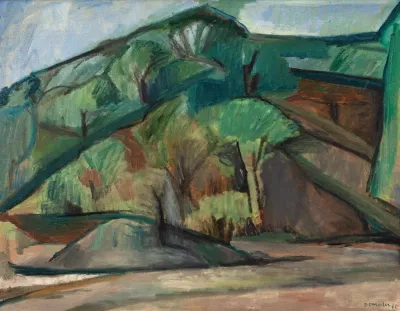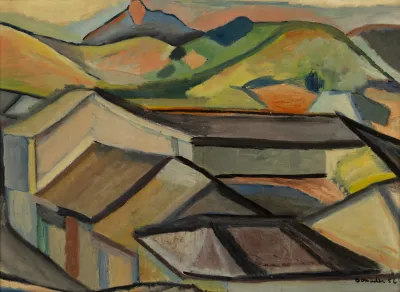
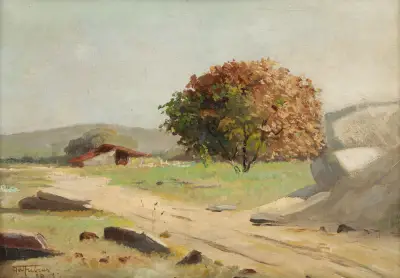
Antônio Parreiras (Niterói RJ 1860 - Idem 1937)
Antônio Parreiras was a painter, draftsman and illustrator. He began his artistic studies as a free student at the Imperial Academy of Fine Arts (Aiba), in Rio de Janeiro, in 1883, remaining until mid-1884. During this period, he attended landscape classes, flowers and animals, a discipline taught by Georg Grimm. For disagreeing with the teaching offered, he left Aiba and followed his former teacher, joining the Grimm group alongside artists such as Castagneto, Caron and Garcia y Vasquez, dedicating himself to painting outdoors. In 1888, he traveled to Italy and, for two years, attended the Accademia di Belle Arti di Venezia, becoming a disciple of Filippo Carcano. Back in Brazil in 1890, he started teaching landscape classes at Aiba, but left the institution two months later, in disagreement with the curriculum reform promoted that year. In 1891, he founded the Escola do Ar Livre, in Niterói, Rio de Janeiro. Between 1906 and 1919, he often traveled to Paris, where he kept a studio. In 1911, he received the title of delegate of the Société Nationale des Beaux-Arts, an honor rarely granted to foreigners. In 1926, he released the autobiographical book História de um Painter told by himself, with whom he joined the Fluminense de Letras Academy. He founded the Salão Fluminense de Belas Artes in Niterói, in 1929. In 1941, his studio house, in the same city, was transformed into the Antônio Parreiras Museum, with the aim of preserving and publicizing his work.
Critical Comment
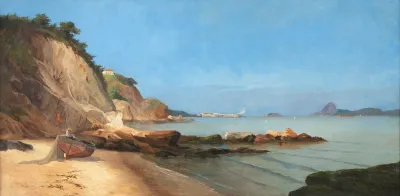
The painter and draftsman Antônio Parreiras joined AIBA in 1883, first as a free student and then as a regular student. During the period when he attends school, he mainly dedicates himself to classes in landscape painting, flowers and animals, with the German painter Georg Grimm. The teacher encourages students to paint outside the gym's ateliers. In 1884, Grimm leaves the institution, and his closest students, including Parreiras, Caron, Castagneto, Garcia y Vasquez and Francisco Ribeiro (ca.1855-CA.1900), accompany him. Grimm teaches outdoor painting classes to the group - which would be known as Grupo Grimm - in the region of Boa Viagem, in Niterói, Rio de Janeiro. The collective represents a renewal in Brazilian landscape painting. It treats the theme with autonomy, escapes from academic models and seeks the specificity of the Brazilian natural panorama, based on the direct observation of nature. Grimm. With the disarticulation of the collective, the artist continues learning as a self-taught. The following year, he toured with the painter Pinto Bandeira (1863-1896) through the Serra de Petrópolis, Rio de Janeiro. There, it carries out landscapes in which the sky is painted in a curvy way, the atmosphere is charged and the vegetation is wild. From there, his brushstroke becomes thicker and his themes more dramatic. Parreiras paints scenes in which nature appears with uncontrollable force. These paintings achieve increasing success. In 1886, Emperor Dom Pedro II (1825-1891) acquired the painting Foz do Rio Icarahy (1885), and the following year Aiba buys the canvases in the afternoon and Rio de Janeiro after the storm.
This recognition allows the artist to travel to Europe in 1888. Arrives at the port of Genoa and after establishing himself for a short period in Rome, he settles in the city of Venice, enrolling as a free student at the Accademia di Belle Arti di Venezia where he studies for two years, taking classes with Professor Filippo Carrano. Through this contact Parreiras is enthusiastic about the possibility of painting nature in mutation, figuring ephemeral processes, such as the transformations produced by the fog and by changing atmospheric conditions in the landscape. His canvas become more full of figures and with the ink folder even thicker. The artist approaches impressionist techniques of Italian painting. It is in the European season that he begins to be interested in the human figure and comes into contact with classical poetry.
On his return to Brazil, in 1890, Parreiras is appointed interim teacher of the Aiba Landscape Chair, remaining in office for only two months. That same year, the curriculum reform proposed by Rodolfo Bernardelli (1852-1931) and Rodolfo Amoedo (1857-1941) extinguished the landscape discipline and changed the name of the institution to the National School of Fine Arts (ENBA). The following year, Parreiras started teaching at the open-air school, founded by him, in Niterói, with guidance contrary to that of official education. It maintains direct contact with the landscape and is dedicated to capturing the specificity of the Brazilian landscape. By 1894, his paintings became clearer, showing an interest in typically national luminosity. In the country painting (1896), he approaches the virgin nature and distant from the presence of man. In this work, the painter intends to figure the vigor of an untouched and typically Brazilian flora, discovered in his studies in expedition in the forests of Teresópolis, Rio de Janeiro. It expands the range of themes and fails to dedicate itself exclusively to landscapes. As of 1899, it receives orders for the execution of panels in some palaces and public buildings. Encouraged by Victor Meirelles (1832-1903), he performs paintings of historical scenes for the public power. Among them stand out the proclamation of the Republic, the death of Estácio de Sá and the arrest of Tiradentes, works that increase his notoriety in Brazil. Success gives you a more comfortable life. From 1906 onwards, Parreiras lives between Paris and Niterói. He maintains a studio in France, where he works and exhibits regularly. In 1909, he showed his work with Numa Feminino Fantasia, at the Salon de la Societé National des Beaux Arts. The repercussion is very positive, and this genre of painting becomes one of the main veins of its production. Parreiras is elected, by the readers of the Fon Fon magazine, the greatest Brazilian painter alive in 1925. The artist died in 1937, in Niterói.
Criticism
"The hand was running for him. febrile, he stabbed the canvas, he only accused the frustrated form of things. This way, which characterized him, was only in recent times attenuated and improved by the long practice of work. At first it was an impulse. hallucinated vigor, from this breadth to the strength of the wrist, which facilitated the ardor of its fecundity. (...)
But the persevering work, the practice of the palette, the education of the eyes, the reflection of age and the successful calm to exaltment of the innovators of the painting changed him. And each exhibition he made was a victory, because it was a confirmed advance. Little by little, his fine and clear hand had become more skillful, his straight and long fingers that seemed to copy the contour of his trowel of his box. field, they handled the brushes more carefully. The understanding of the typical lines of our landscape was clarified, the color that defines it becomes clearer, the excess detail to repel and the synthesization of the motifs. (...)
Its wide, somewhat brave style, in brush lambadas, which, as we have already noted, has changed advantageously, subordinating itself to large screens, it thins out with estimable precision. Interpretator of Minds in Small Frames (...)".
Gonzaga Duque
Duque, Gonzaga. Contemporaries: painters and sculptors. 255 P. P. 42-43, 49.
"The 1920s are a time when the artist feels quite well how much the environment was changed around him. to maintain the success that had characterized the previous decade; Even if he now had greater prestige, it is necessary to concentrate his efforts on activities of a grandiose nature, which would reveal his permanent disposition and the immutability of his value at 60 years of age. As a consequence, the landscaping in his work has a very limited expression in this period. In addition to the scarce amount of landscapes painted in the 1920s, there is a surprising decline in its evolution, with the presence of execution artifices and even a certain mannerism that is not compatible with the solid originality of the general set of its production. It is, therefore, for no reason that in the vast majority of counterfeits in its landscapes, the preference of counterfeiters can be seen for associating illegitimate screens at this time (...)". LEVY, Carlos Roberto Maciel. Antônio Parreiras: 1860-1937, Painter of Landscape, Genre and History. color.
"The work of Antônio Parreiras can basically be divided into two periods (...) Formation and affirmation. The period of training refers to the time when Parreiras was a student of Georg Grimm at the Imperial Academy of Fine Arts and, later, with the departure of the Bavarian Master from the academy, the study phase of outdoor painting, together with Castagento, Vazquez, Caros and Ribeiro, when they formed the school of Boa Viagem (...) Evidently, the canvases of this period always have a sense of study, where the elaboration and the technical process converge to the same objective: the understanding of nature (...) Most of them were produced on rigid supports (wood or cardboard), with the design made from several previous studies, Crayon or Graphite (...) the painting itself was achieved (...) through acute observation of nature. (...) The highest incidence of small format works is also characteristic of this training period (...). Period of affirmation: This phase refers to the moment when Parreiras actually begins his visual independence, in which he seeks the consolidation of his plastic language. This is not a sudden change: even years after the closing of the Grimm group's collective activities, it will still be possible to safely detect the strong influence of the German teacher. (...) In his period of affirmation, Parreiras manages to gather in his work all the technical resources developed throughout the 19th century. The full paste, the dry brush, the support breath, the false texture, the smear, the glaciers, the free invoice (paint drawing), the magnification of the palette (or the most colorful use of the same), the most daring cuts and even the theory divisionist, which the artist subjectively addresses his landscapes (...) and more objectively in some decorative mural paintings".
Cláudio Valério Teixeira
LEVY, Carlos Roberto Maciel. Antônio Parreiras: 1860-1937, Painter of Landscape, Genre and History. Rio de Janeiro: Pinakotheke, 1981. p.125-126
"(...) Parreiras has an existence of struggles and emotions (...) Hence, therefore, a great sadness acting in the temperament of the individual by the continuous crumble of hopes only lobbed. Part of this fact, I believe, the cause of vines abuses a lot of white: M. Paul Bert, in his observations presented to the French Academy, in 1878, states that most often the use of favorite colors is motivated, not by a change in sight, but for reasons Of an intellectual nature (...) white is not a sad ink, but it is a cold ink. Entering, exaggeratedly in the combination of other paints, it pales the tone. Too much more - should be taken into account the predilection that the artist has for the saddest hours of the day. The moment he chooses is always (...) that of rest, in the evening hours, when the last ray of sun stopped gilding the clouds. (...) By giving them the predominantly white or gray tone, you will be able to illuminate them with a balance of prismatic colors, so that they will never tire the eyes of those who contemplate them for a long time."
Alfredo Palheta
Palheta, Alfredo (Pseud. Gonzaga Duque). Fine Arts: Third Exhibition by A. Parreiras. The Week, Year III, nº 133, Rio de Janeiro, July 16, 1887, quoted by LEVY, Carlos Roberto Maciel. Antônio Parreiras: 1860-1937, Painter of Landscape, Genre and History. Rio de Janeiro: Pinakotheke, 1981. p. 28
"Parreiras, although he carried out a work covering practically all artistic genres - landscape, historical paintings, female nudes, animals -, reveals a special relationship with the landscape from the beginning, given that it can be collected from the observation of the work he performed throughout His career as a painter as well as the reading of the writings he left and the book he wrote and published while he was still alive, in 1926, the story of a painter told by himself. For this reason, we consider it of fundamental importance to look at Parreiras, above all, and seek to place it as such in the scope of Brazilian art.
The landscapes of the first years of Parreiras are still strongly dominated by the language of the picturesque landscape, with their plans, distances, Textures, paths and the presence of a solitary figure, backwards or picturesque groups. In 1888 paintings, the painter makes use of the compositional resources typical of the sublime aesthetic in his landscapes, composed of denotative elements of the fury of nature such as crispy and dark skies, trees curved by the force of the wind, and the presence of the figure. Feminine, emblematic of romantic sensitivity, in a thoughtful attitude, given over to her world of reflections and apprehensions in the midst of the turmoil that takes place in nature, sitting on the stony ground, full of irregularities and full of texture. It is the language of the European romantic landscape of the first half of the 19th century in its most commonplace versions, made popular and accessible to a wider audience, inside and outside Europe, through ink-water reproduction or lithography.
It is certain that, in Works, Parreiras develops a modern landscaping, in the sense of the search for the empirical, attentive and observant of nature, certainly a consequence of the lessons of Grimm and the venerated practice of painting outdoors, but still demonstrates that it is attached to the consecrated formulas of the art of the landscape Romantic, of which the English were the greatest representatives both in practical and theoretical terms".
Valéria Salgueiro
Salgueiro, Valéria. Antônio Parreiras: notes and criticisms, speeches and short stories: Collection of texts by a landscape painter Niterói: Eduff, 2000. p.37-38.
"The influence of the art of Meirelles is manifested in the painting of Antonio's maturity vines. The great country landscape exposed in 1899, seems to amplify on a monumental scale the designs of forests executed by Araújo Porto Alegre in the 1950s. (...) Parreiras, Parreiras will specialize in the historical landscape, asserting itself as the greatest heir of the master of Florianópolis. Despite this, he will not fail to pay his tribute to the compositional schemes of Pedro Américo's monumental paintings (...), and in a cycle of great historical landscapes dedicated to the conquest of Brazil, today in the house-museum that the architect from São Paulo Ramos de Azevedo built for the artist in Niteroi. These works, as well as the painter's house and atelier, in contact with the garden - small monuments in themselves - show how Parreiras had not been immune to the influences of Ruskin's thought, Morris and the Art Nouveau of the Les Vingts de Brussels".
Luciano Migliaccio
MIGLIACIO, Luciano. The 19th Century. In: Exhibition of Rediscovery, 2000, São Paulo. Paulo: Associação Brasil 500 years Visual Arts, 2000. p. 151
Testimonies
"For many years I was exclusively paysagista.
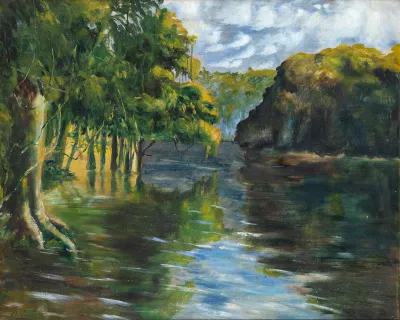
Annos I spent within the forests, or traveling along the coast and I found that, when this extraordinary - nature - Brazilian =, grandiose, phantom, the more difficult its interpretation has become. The years of endured and persistent study, of intimate and prolonged coexistence with this "nature", not yet modified by the preverse hand of man, sometimes allowed me to synthetize it with its wild character, its apparent monotony of greens. strong and vibrant; The mystery of its color-filled shadows, color felt only by those who are accustomed to the rapid contrast of the immensely strong, hard light, with a soft velocity of the transparent shadows.
The constant and passionate observation of this nature He ended up becoming familiar with his lines as he had made me familiar with his color, with these erect and upright columns of the jiquitibás or with tortuous trunks, tangled up in snake curves that are seen in the various undulations of the twisted cashew trees.
The years lived in the forests accustomed me to work in the green light of their environment".
Antônio Parreiras
Parreiras, Antônio Profession of Faith 027. In: Salgueiro, Valéria. Antônio Parreiras: Notes, Criticisms, Speeches and Tales: Collection of Texts by a Landscape Painter Niterói: Eduff, 2000. p. 77.
Cervos
Acervo Banco Itaú S.A. - São Paulo SP
Collection of the Pinacoteca do Estado de São Paulo/Brazil - São Paulo SP
Antônio Parreiras Museum - Niterói RJ
Museum of the Republic - Rio de Janeiro RJ
São Paulo Art Museum Assis Chateaubriand - MASP - São Paulo SP
Belém Museum of Art - Belém PA
Pernambuco State Museum - Recife PE
Historical Museum of the City of Rio de Janeiro - Rio de Janeiro RJ
Júlio de Castilhos Museum - Porto Alegre RS
National Museum of Fine Arts - MNBA - Rio de Janeiro RJ
Individual exhibitions
1885 - Niterói RJ - Individual, at the residence of the Artist, at Rua Santa Rosa
1885 - Niterói RJ - Individual, in the main room of the store A Photographia
1885 - Rio de Janeiro RJ - Individual, at Wilde's house
1886 - Rio de Janeiro RJ - Individual, at Casa Insley Pacheco
1886 - Rio de Janeiro RJ - Individual, at Glace Elégant
1887 - Niterói RJ - Individual, at the artist's new residence, at Rua Presidente Domiciano
1887 - Rio de Janeiro RJ - Individual, at the headquarters of the Grêmio de Letras e Artes do Rio de Janeiro
1888 - Rio de Janeiro RJ - Individual, at Casa Insley Pacheco
1888 - Rio de Janeiro RJ - Individual, at Casa Arthur Napoleão
1888 - Rio de Janeiro RJ - Individual, at the headquarters of the newspaper A Cidade do Rio
1888 - Venice (Italy) - Individual, in the Venetian Society
1889 - Rio de Janeiro RJ - Individual, at Casa Arthur Napoleão
1890 - Rio de Janeiro RJ - Individual, at Glace Elégant
1890 - Rio de Janeiro RJ - Individual, at the modern atelier
1893 - São Paulo SP - Individual, at Casa Steidel
1894 - São Paulo SP - Individual, at Casa Steidel
1895 - Campinas SP - Individual
1895 - Niterói RJ - Individual, at the artist's new residence, at Rua Tiradentes
1896 - São Paulo SP - Individual, at Casa Steidel
1901 - Niterói RJ - Individual, at the artist's residence
1901 - Rio de Janeiro RJ - Individual, in the prime hall of the confectionery Pascoal
1902 - Santos SP - Individual
1904 - Niterói RJ - Individual, at the artist's residence
1905 - Belém PA - Individual, at the Paz Theater
1905 - Manaus AM - Individual, at the Rio Negro Palace
1909 - Rio de Janeiro RJ - Individual, at the Commerce Employees Association
1911 - Rio de Janeiro RJ - Individual, at the Trade Employees Association
1917 - Recife PE - Individual
1917 - Rio de Janeiro RJ - Individual, at Enba
1919 - Paris (France) - Individual, at Petit Palais
1921 - Rio de Janeiro RJ - Individual, at Enba
1927 - Rio de Janeiro RJ - Individual, at Enba
1928 - Salvador BA - Individual, at Palácio Rio Branco
1929 - Rio de Janeiro RJ - Individual, at Galeria Jorge
1931 - Recife PE - Individual, at the Santa Isabel Theater
1932 - Niterói RJ - Individual, in the main hall of the Cantareira Company
1932 - Rio de Janeiro RJ - Individual, at Enba
1933 - São Paulo SP - Individual, at the Stoppel Gallery
Collective exhibitions
1887 - Rio de Janeiro RJ - Antônio Parreiras, Castagento and Henrique Bernardelli, at the Grêmio de Letras e Artes
1890 - Rio de Janeiro RJ - General Exhibition of Fine Arts, NA ENBA - Small Gold Medal and Acquisition Award
1892 - Rio de Janeiro RJ - Exhibition of the students of the open-air school, in the hall of the newspaper A Province
1893 - Rio de Janeiro RJ - Exhibition of students of the open-air school, in the newspaper A Cidade do Rio
1893 - Rio de Janeiro RJ - General Exhibition of Fine Arts, at Enba
1895 - Rio de Janeiro RJ - Exhibition of the students of the open-air school, at the Fluminense Library
1895 - São Paulo SP - Salão da Paulicéia
1896 - Niterói RJ - Exhibition of students of the open-air school, at the artist's residence located at Rua Tiradentes
1896 - Rio de Janeiro RJ - Antonio Parreiras, Alberto Silva, Cândido de Souza Campos and Álvaro Cantanheda, at the Lapa Pavilion
1897 - Rio de Janeiro RJ - Exhibition of the students of the open-air school, at the Fluminense Library
1909 - Paris (France) - Salon de la Société Nationale des Beaux-Arts
1910 - Paris (France) - Salon de la Société Nationale des Beaux-Arts
1911 - Paris (France) - Salon de la Société Nationale des Beaux-Arts
1911 - São Paulo SP - First Brazilian Exhibition of Fine Arts, at the Liceu de Artes e Ofícios
1912 - São Paulo SP - Second Brazilian Exhibition of Fine Arts, at the Liceu de Artes and Crafts
1913 - Paris (France) - Salon de la Société Nationale des Beaux-Arts
1914 - Paris (France) - Salon de la Société Nationale des Beaux-Arts
1915 - Rio de Janeiro RJ - Antônio Parreiras and Dakir Parreiras, at Enba
1917 - Rio de Janeiro RJ - 24th General Exhibition of Fine Arts, at Enba
1918 - Rio de Janeiro RJ - 25th General Exhibition of Fine Arts, at ENBA - Gold Medal
1919 - Niterói RJ - Comemeorative exhibition of the centenary of the foundation of Vila Real de Praia Grande, in the company's salon Cantareira
1919 - Rio de Janeiro RJ - 26th General Exhibition of Fine Arts, at Enba
1920 - Paris (France) - Salon de la Société Nationale des Beaux-Arts
1921 - Rio de Janeiro RJ - 28th General Exhibition of Fine Arts, at Enba
1922 - Rio de Janeiro RJ - 29th General Exhibition of Fine Arts, at ENBA - Medal of Honor
1922 - Rio de Janeiro RJ - Exhibition of the Centenary of Independence - Great Medal
1923 - Rio de Janeiro RJ - 30th General Exhibition of Fine Arts, at ENBA - Medal of Honor
1927 - Rio de Janeiro RJ - 34th General Exhibition of Belas Arts, at Enba
1929 - Barcelona (Spain) - Universal Exhibition of Barcelona - Gold Medal
1929 - Rio de Janeiro RJ - 36th General Exhibition of Fine Arts, at Enba
1929 - Seville (Spain) - Ibero-American Exhibition of Seville - Gold Medal
1930 - Rio de Janeiro RJ - 37th General Exhibition of Fine Arts, at Enba
1933 - Rio de Janeiro RJ - 40th General Exhibition of Fine Arts, at Enba
1934 - Rio de Janeiro RJ - 3rd Salon of Núcleo Bernardelli, at Enba
1936 - Rio de Janeiro RJ - Sociedade Sul-Rio-Grandense
1937 - Rio de Janeiro RJ - 43rd National Salon of Fine Arts, at the MNBA
Posthumous exhibitions
1940 - São Paulo SP - Retrospective exhibition: works of the great masters of painting and his disciples, at the Municipality of São Paulo
1948 - Rio de Janeiro RJ - Retrospective of painting in Brazil, at MNBA
1950 - Rio de Janeiro RJ - A century of Brazilian painting: 1850-1950, at MNBA
1953 - São Paulo SP - 2nd São Paulo International Biennial, at the State Pavilion
1954 - São Paulo SP - 19th São Paulo Fine Arts Hall, at the Prestes Maia Gallery
1970 - São Paulo SP - Pinacoteca do Estado de São Paulo 1970
1977 - Rio de Janeiro RJ - Aspects of the Brazilian landscape: 1816-1916, at MNBA
1980 - Rio de Janeiro RJ - The Grimm Group: Brazilian landscaping in the 19th century, in the Collection Art Gallery
1980 - São Paulo SP - The Brazilian landscape: 1650-1976, at Paço das Artes
1981 - Niterói RJ - Antônio Parreiras 1860-1937: Painter from Landscape, genre and history, at the Historical Museum of the State of Rio de Janeiro
1981 - Rio de Janeiro RJ - Antônio Parreiras 1860-1937: Painter of landscape, genre and history, at the Art Gallery Collection
1981 - São Paulo SP - Antônio Parreiras 1860-1937: Painter of landscape, genre and history, at the Pinacoteca do Estado
1983 - São Paulo SP - Reinterpretation Project, at the Pinacoteca do Estado
1984 - São Paulo SP - Tradition and rupture: synthesis of Brazilian art and culture, at the Bienal Foundation
1985 - São Paulo SP - 100 Obras Itaú, at MASP
1985 - São Paulo SP - 18th International Biennial of São Paulo, at the Fundação Bienal
1986 - São Paulo SP - Nineteenth century: A turn in the century, at the state's Pinacoteca
1986 - São Paulo SP - Time of Madureza, at Ranulpho Art Gallery
1988 - São Paulo SP - Brasiliana: The Man and the Land, at the Pinacoteca do Estado
1989 - Fortaleza CE - Brazilian art from the 19th and 20th centuries in the Ceará collections: paintings and drawings, at the Unifor Cultural Space
1989 - Rio de Janeiro RJ - Rio de Janeiro by Machado de Assis, at CCBB
1989 - São Paulo SP - Painting Brazil 19th century: works from the Banco Itauga collection, in Itaugaleria
1992 - Rio de Janeiro RJ - Nature: Four centuries of art in Brazil, at CCBB
1994 - São Paulo SP - Bienal Brasil Século 20th, at Fundação Bienal
1994 - São Paulo SP - A critical look at the 19th century collection, at the Pinacoteca of the State
1998 - Rio de Janeiro RJ - Marines in large collections in São Paulo, at the Naval and Oceanographic Museum
2000 - Porto Alegre RS - from Frans Post to Eliseu Visconti: Collection National Museum of Fine Arts - RJ, at Margs
2000 - São Paulo SP - Brazil + 500 Rediscovery Exhibition, at Fundação Bienal
2000 - São Paulo SP - São Paulo: From Vila to Metrópole, at the Masp Prestes Gallery Maia
2001 - São Paulo SP - 30 Masters of Painting in Brazil, at MASP
2001 - São Paulo SP - Aldo Franco Collection, at the Pinacoteca do Estado
2001 - São Paulo SP - Museum of Art Brazilian: 40 years old, at MAB/FAAP
2001 - São Paulo SP - Trajectory of light in Brazilian art, at Itaú Cultural
2002 - Brasília DF - Barão do Rio Branco: his work and his time, at the Ministry of Foreign Affairs. Palácio do Itamaraty
2002 - Niterói RJ - Brazilian art on paper: 19th and 20th centuries, at Solar do Jambeiro
2002 - São Paulo SP - Image and identity: a look at the history in the collection of the Museum of Fine Arts, in the Banco Santos Cultural Institute
2004 - Curitiba PR - The landscape of Paraná and its painters, at Casa Andrade Muricy
Source: Itaú Cultural