
Antonio Manuel (Avelãs de Caminho, Portugal 1947)
Antonio Manuel da Silva Oliveira is a sculptor, painter, engraver and draftsman, with a central role in contemporary Brazilian art. Antonio Manuel da Silva Oliveira arrives in Brazil in 1953 and settles with his family in Rio de Janeiro. In the mid-1960s, he studies at the Escolinha de Arte do Brasil, with Augusto Rodrigues (1913–1993), and attends the studio of Ivan Serpa (1923–1973), being also a listening student at the National School of Fine Arts (ENBA).
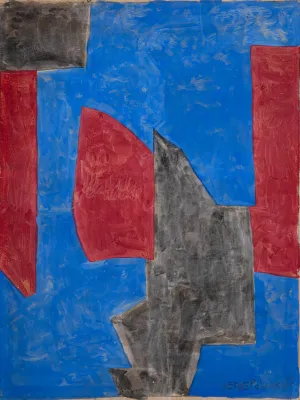
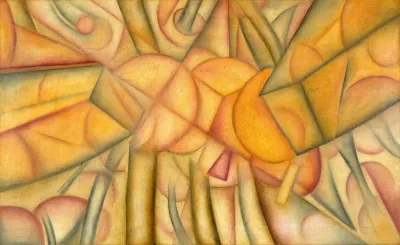
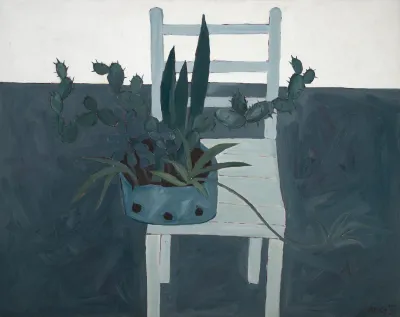
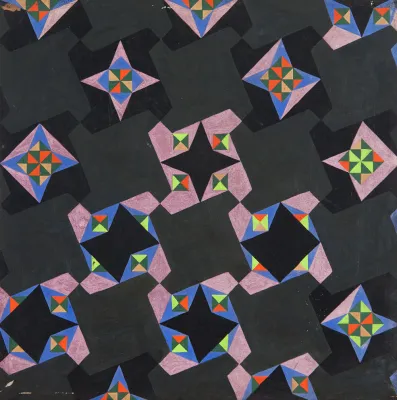
In this initial period, Antonio Manuel da Silva Oliveira uses the newspaper and its matrix, the flan, as a support for his works, making interferences and inventing news that address political themes and aesthetic debates. In 1968, at the exhibition Apocalipótese, organized by Hélio Oiticica (1937–1980) and Rogério Duarte, he presented the hot urns, sealed wooden boxes for the active participation of the public. In 1970, at the Salão de Arte Modern Art of the Museum of Modern Art of Rio de Janeiro (MAM/RJ), Antonio Manuel da Silva Oliveira proposes his own body as a work. Culture (1973) and Semi-Optics (1975). From the 1980s onwards, he developed abstract-geometric paintings, exploring orthogonals and maze suggestions. In 1994, he presents the first version of the installation Phantom, a work that, like others by Antonio Manuel da Silva Oliveira, proposes a critical reflection on the Brazilian social and political context.
Critical comment
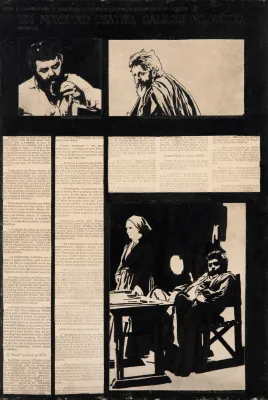
Antonio Manuel da Silva Oliveira, at the beginning of His career uses the newspaper as a support for his work, making interference with ink ink, canceling some news or images and adding or illuminating others. Then, he starts to use the flan, a plasticized embossed card that works as a matrix for printing newspapers, even creating his own flans, in which he invents news that is printed and distributed on newsstands as if they were authentic. Antonio Manuel da Silva Oliveira creates a series of newspapers that address political themes, such as the 1968 student movement, in addition to issues related to aesthetic and poetic discussions. Aterro do Flamengo and conceived by Hélio Oiticica and Rogério Duarte as a collective art experience, Antonio Manuel da Silva Oliveira presents the hot urns, closed and sealed wooden boxes that should be broken by the public for their content to be revealed. In these boxes, the artist inserts texts referring to political or aesthetic situations, associated with images of violence cut from newspapers. As in other works from this period, the work invites the spectator to participate, who starts to act as a co-director, establishing a direct relationship with the context of political repression and censorship of the media in Brazil. In 1970, Antonio Manuel da Silva Oliveira proposed his own body as a work at the Salão de Arte Moderna, held at the Museum of Modern Art in Rio de Janeiro (MAM/RJ), a proposal refused by the jury. On the opening night of the exhibition, the artist presents his naked body to the public.
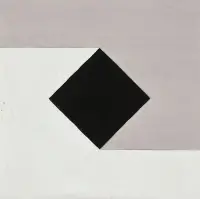
According to Antonio Manuel da Silva Oliveira, in O Corpo é o Obra, the intention is to question the criteria of selection and judgment of works of art, transforming the gesture into a protest against the political, artistic and social system current. About this performance, the critic Mário Pedrosa says that the artist performs “the experimental exercise of freedom”. From that moment on, the interest of Antonio Manuel da Silva Oliveira focuses on the issue of the body and its senses, producing several short film films, such as Madness & Culture (1973) and Art Today (1976). Since the 1980s, Antonio Manuel da Silva Oliveira has been dedicated to acrylic painting, developing geometric-abstract canvases in which he explores the suggestion of a labyrinth. In 1994, it presents the first version of the Phantom Installation, an environment composed of coals suspended by nylon threads, creating the sensation of fluctuation in the exhibition space. According to Antonio Manuel da Silva Oliveira, the photograph that integrates the work portrays a real character who, by having his image publicized by the press as a witness to a crime, starts to live in secret, losing his identity. With the use of multiple languages, the work of Antonio Manuel da Silva Oliveira presents a character of restlessness and promotes a constant reflection on the Brazilian social and political context.
Critiques
"(...) The first and best known significant works of Antonio Manuel dates from 1966/67 and in them the artist first used the newspaper sheet, then the flan itself, as a support for his work, redesigning photos and headlines (...)
In 1968 he was one of the members of the demonstration Called Apocalipothesis developed by Hélio Oiticica, in the Aterro do Flamengo, presenting its hot urns and, in 1969, it was one of the awardees in the Compass Hall that, without wishing, definitively launched this generation of but the most radical proposition of Antonio Manuel was his 'denudation' for an astonished audience at the inauguration of the National Salon of Modern Art, whose jury, of which I was a part, did not accept as a work(...)
In the case of this Streaking of Antonio Manuel, the critic Mário Pedrosa, in a dialogue with the artist said: 'His attitude transcends the plan of purely aesthetic discussion in terms of a work. It's life itself. A work is no longer discussed, but a creative action. It is an eminently vanguard art. It is an aspect of the cultural revolution, where taboos are broken. The fact that today you have done this shakes the whole perspective of art, the aesthetic discussion, the discussion about art. Discuss everything. and with enormous authenticity. What Antonio Manuel is doing is the experimental exercise of freedom' (...)".
Frederico Morais
MORAIS, Frederico. 04. 1977. In: Alvarado, Daisy Valle Machado Peccinini de (Coord. ) Object in the art: Brasil 60s. São Paulo: FAAP, 1978.
"Sublimated to the political and literary burden, the work now turns to its origin - the visuality, the untranslatable intelligence of the gaze. I see a lesson in the artist's sincerity there. With Mondrian, Klee, Torres Garcia and Volpi, among others, he takes up the languages that finally made his own. And in the limited and traditional perimeter of the painting, A. Manuel would be obliged to build other species of 'hot urns': to provide the experience of concealment and uncovering, secrecy and liberation. In a more intimate way, of course, the new screens propose a game of this genre: to violate interiority to find an open space that gathers and crosses everyone. And this transmitting the sensation of the obstacles and barriers that interpose between us and this dreamed space. Mondrian's schemes will therefore be literally vulgarized. Devoid of metaphysical intentions, they point to the contradictory relationships of a chaotic metropolis. However, they still express the eagerness to find order and meaning behind what can only be seen as misery and disorder - for example, the favela and its inextricable network of relationships. (...)"
Ronaldo Brito
Antonio Manuel. Texts by Antonio Manuel et al. Rio de Janeiro: Funarte, 1984. (Contemporary Brazilian Art).
"Defiant and Restless, Antonio Manuel always invested a constant load of aggression in his work. It was not unique, however, it was one of the few to measure this situation of discomfort in the face of fear. This challenge was the core of his work. reacted to the context by provoking it. but as it was not strictly a reactive attitude but a constitutive attitude, the trait of aggression remained a manifestation of restlessness and dissatisfaction. As certain provocateurs brought in provocation a dimension of affection, although averse to feelings and good intentions, showed certain impasses of the revolt, the conflict in self-inflicting itself, undressing in the museum, exposing the oppression by showing the Oppressed, a conflict that, on the one hand, was ethical, remained as a latent trait in his painting.
(...) The initial element in Antonio is not the lines, the colors, is the space; But space is concentrated in the cell, not a biological cell, but a geometric cell with the unpredictable dynamics of the social. It proliferates, invades space. (...) The course of Antonio's painting is a synthetic and evocative story of the memory and the actuality of the space we live in.
Its current canvases suggest the overcoming of a saturation point, where everything was consumed and it is necessary to start over. So the work turns on itself and on the artist, a situation that Antonio calls 'realism', that is, the work becomes a new reality, demands a new reality. Then work returns to its beginning to become again."
Paulo Venancio Filho
Venancio Filho, Paulo. 1990.
"The artist is the one who never loses contact with nature. Others tend to lose, but the artist is the one who does not lose contact even in another plane, inside the machines. He sees things in a direct relationship - he and the world. He and reality. He and nature.
And, without a doubt, Antonio Manuel with that carried forward the entire process of the art of despoiling - typically anti-academic art - and even dismantled the myth of making art without work. (...)
What Antonio Manuel is doing is the experimental exercise of freedom. He is not wanting to dominate others. It is just proposing the total authenticity, which is always creative. (...)
The modern epoch is a time in search of exactly the final authenticity of things, of attitudes. To break with the mystification of the mass consumption society, and even of mass culture, what there is is the cultural revolution. Mass culture exists based on urban folklore. It is the media, which, in the end, says that no one exists individually. And this media, which has an extraordinary power of communication, is not authentic. She is an intermediary, a mediation. She imagines herself authentic due to an acceptance of the immediate, of the mass everyday.
So, art is the only way to break with this taboo, to put the problems in its final authenticity. An act like Antonio Manuel's, which is an act in itself, is a legitimate communicator, since authentic communication is not done through the media. It is not the media that communicates with others, it is the fact itself - the fundamental unity irreducible of man - that communicates with the other. (...)
Art is the only thing that is against the entropy of the world."
Mário Pedrosa
Pedrosa, Mário. Excerpts from testimony about the body is the work, May 1970. In: Manuel, Antonio. Antonio Manuel. Rio de Janeiro: Centro de Arte Hélio Oiticica, 1997.
Individual exhibitions
1967 - Rio de Janeiro RJ - Individual, at the gallery Goeldi
1973 - Rio de Janeiro RJ - from 0 to 24 pm, on newsstands, work edited in a supplement by O Jornal
1975 - Rio de Janeiro RJ - That's it, at Petite Galerie
1976 - São Paulo SP - That's what it is, at Galeria Arte Global
1980 - Rio de Janeiro RJ - Frutos do Espaço, at Espaço Brasileira Contemporânea, at Parque da Catacumba
1983 - Rio de Janeiro RJ - Antonio Manuel: Paintings, at Galeria GB Arte
1985 - Rio de Janeiro RJ - Individual, at Galeria Saramenha
1986 - São Paulo SP - Individual, at the Art Office
1986 - São Paulo SP - Quadro A painting, at the Art Office Raquel Arnaud
1986 - Rio de Janeiro RJ - All this exists, at Petite Galerie
1988 - Rio de Janeiro RJ - Por Tudo, at Galeria Montesanti
1990 - São Paulo SP - Shadows and Flickers, at the Art Office Raquel Arnaud
1993 - Rio de Janeiro RJ - Antonio Manuel: Paintings, at the Goudard Gallery
1997 - Rio de Janeiro RJ - Individual, at the Art Center Hélio Oiticica
1998 - Vitória ES - Antonio Manuel: Paintings and Drawings, at the UFES Art and Research Gallery
1998 - Niterói RJ - Antonio Manuel, at MAC/Niterói
1999 - Paris (France) - Ghost - Installation, at the Galerie Nationale du Jeu de Paume
1999 - São Paulo SP - Individual, at the Art Cabinet Raquel Arnaud
2000 - Porto (Portugal) - Individual, at the Serralves Foundation
2001 - Rio de Janeiro RJ - Individual, at H.A.P Gallery
2002 - Rio de Janeiro RJ - Antonio Manuel, at the Chácara do Céu Museum
2002 - São Paulo SP - Antonio Manuel, at the Art Office Raquel Arnaud
2003 - São Paulo SP - Antonio Manuel, at the CCSP
Collective exhibitions
1965 - Rio de Janeiro RJ - Teenage Hall
1966 - Curitiba PR - 23rd Salão Paranaense de Belas Artes, at the Paraná Public Library - Drawing Award
1966 - Rio de Janeiro RJ - 15th National Salon of Modern Art
1966 - Salvador BA - 1st National Biennial of Plastic Arts
1967 - Brasília DF - 4th Federal District Modern Art Salon, at the National Theater of Brasília
1967 - Campinas SP - 3rd Contemporary Art Salon - Grand Medal Silver
1967 - Petrópolis RJ - 1st National Youth Painting Hall, at the Quitandinha Hotel
1967 - Rio de Janeiro RJ - 16th National Salon of Modern Art
1967 - Rio de Janeiro RJ - Nova Brazilian objectivity, at MAM/RJ
1967 - Rio de Janeiro RJ - Tropicália, at MAM/RJ
1967 - São Paulo SP - 9th São Paulo International Biennial, at Fundação Bienal - Acquisition Award
1968 - Campinas SP - 4th Contemporary Art Salon, at MAC/Campinas - Drawing Award
1968 - Curitiba PR - 25th Salão Paranaense, at the Paraná Public Library - Engraving Award
1968 - Rio de Janeiro RJ - 17th National Salon of Modern Art
1968 - Rio de Janeiro RJ - Apocalipothesis, in the Japanese Pavilion
1968 - Rio de Janeiro RJ - Art in the landfill: one month of public art, in the Flamengo landfill and Japanese pavilion.
1968 - Rio de Janeiro RJ - The Brazilian artist and mass iconography, at ESDI
1968 - Salvador BA - 2nd National Arts Biennial Plastics
1969 - Rio de Janeiro RJ - Salão da Comússola, at MAM/RJ - Acquisition Award
1970 - Rio de Janeiro RJ - 19th National Salon of Modern Art, at MAM/RJ
1971 - Tokyo (Japan) - International Biennial Exhibition of Prints
1971 - Kyoto (Japan) - International Biennial Exhibition of Prints
1973 - São Paulo SP - Expo-Projection 73, at Espaço Grfe
1975 - Rio de Janeiro RJ - Experimental Art Exhibition of Super-8, Audiovisual Films and Videotape, at the Maison de France Gallery
1976 - Venice (Italy) - 38th Venice Biennale - Sector International Current Affairs
1978 - São Paulo SP - The Object in Art: Brasil 60s, at MAB/FAAP
1979 - Lisbon (Portugal) - Lis´79: Lisbon International Show
1980 - Milan (Italy) - Quasi Cinema, in Centro Internazionale di Brera
1980 - Rio de Janeiro RJ - Fruits of Space, at Espaço ABC
1980 - Rio de Janeiro RJ - Homage to Mário Pedrosa, at the Jean Boghici Gallery
1981 - Curitiba PR - Antonio Manuel, Reinaldo Jardim and Rettamazzo, at Solar do Rosário
1982 - Lisbon (Portugal) - Brazil 60 years of modern art: Gilberto Chateaubriand Collection, at the José de Azeredo Perdigão Center for Modern Art
1982 - London (United Kingdom) - Brazil 60 years of modern art: Gilberto Collection Chateaubriand, at Barbican Art Gallery
1983 - Rio de Janeiro RJ - The flower of the skin: painting and pleasure, at the Rio Entrepreneurship Center
1983 - Rio de Janeiro RJ - Installation, at Parque da Catacumba
1984 - Niterói RJ - Current Brazilian art, at UFF
1984 - Rio de Janeiro RJ - Interventions in the urban space, at Funarte. Sérgio Milliet Gallery
1985 - Rio de Janeiro RJ - Meetings, at Petite Galerie
1986 - Rio de Janeiro RJ - Testimony of a generation: 1969-1970, at the Banerj Art Gallery
1986 - São Paulo SP - Collective, at the Art Office
1987 - Rio de Janeiro RJ - to the collector: Homage to Gilberto Chateaubriand, at MAM/RJ
1988 - Ribeirão Preto SP - Art Hoje 88, at Casa da Cultural - Guest Artist
1988 - Rio de Janeiro RJ - The eternal is ephemeral, at Petite Galerie
1989 - Rio de Janeiro RJ - Brazilian engraving: 4 themes, EAV/Parque Lage
1989 - Rio de Janeiro RJ - Rio Hoje, at MAM/RJ
1990 - São Paulo SP - Figurativism/abstractionism. o Red in Brazilian Painting, at Itaú Cultural
1991 - Lisbon (Portugal) - Collective, at the Lisbon Department of Culture
1991 - Rio de Janeiro RJ - Image over image, at the Sérgio Porto Cultural Space
1991 - Rio de Janeiro RJ - Mário Pedrosa, Art Revolution, Reflection, at CCBB
1992 - Porto Alegre RS - Mário Pedrosa, Art, Revolution and Reflection, at the Municipal Culture Center
1992 - Rio de Janeiro RJ - 1st on the way to Niterói: João Sattamini Collection, at Paço Imperial
1992 - Rio de Janeiro RJ  - Coca-Coca 50 years with art, at MAM/RJ
1992 - São Paulo SP - Coca-Coca 50 years with Art, at MAM/SP
1992 - São Paulo SP - 60's/70's: Gilberto Chateaubriand Collection - MAM/RJ, at the SESI Art Gallery
1993 - Brasília DF - A look at Joseph Beuys, in MAB/DF
1993 - Florence (Italy) - Brazil: Segni d'Art, at the Nationale Centrale di Firenze Library
1993 - Milan (Italy) - Brazil: Segni d'Arte, at the Nazionale Braidense Library
1993 - Rio de Janeiro RJ - Erotic Art, at MAM/RJ
1993 - Rio de Janeiro RJ - Body Emblems: O Nude in Brazilian Modern Art, at CCBB
1993 - São Paulo SP - The modern design in Brazil: Gilberto Chateaubriand Collection, at the SESI Art Gallery
1993 - Venice, Milan, Florence and Rome (Italy) - Brazil, Segni d'Arte, at Querini Stanpalia, at the Braidense Library, at the Nationale Library and at the Brazilian Studies Center
1994 - Belo Horizonte MG - The ephemeral in Brazilian art: 60s/70s
1994 - Penápolis SP - The ephemeral in Brazilian art: 60s/70s, at the Itaú Cultural Gallery
1994 - Rio de Janeiro RJ - Installation, ghost, at the IBEU Gallery - Awarded
1994 - Rio de Janeiro RJ - Object book: The frontier of the voids, at CCBB
1994 - Rio de Janeiro RJ - The modern design in Brazil: Gilberto Chateubriand Collection, at MAM/RJ
1994 - Rio de Janeiro RJ - Trenches: Art and Politics in Brazil, at MAM/RJ
1994 - São Paulo SP - Bienal Brasil Século 20th, at the Bienal Foundation
1994 - São Paulo SP - The ephemeral in Brazilian art: 60's/70's, At Itaú Cultural
1994 - São Paulo SP - Poetics of the Resistance: Aspects of Brazilian Engraving, at the SESI Art Gallery
1995 - Erfurt (Germany) - Configa 2 - Dialog Der Kulturen, in the Gallery Fischmark
1995 - Rio de Janeiro RJ - The phallic weapon, in Rio Art
1995 - São Paulo SP - Object book: The frontier of the voids, at MAM/SP
1996 - Brasília DF - The ephemeral in Brazilian art: 60s/70s, at Itaú Galeria
1996 - Niterói RJ - Brazilian contemporary art at the João Sattamini collection, at MAC/Niterói
1997 - New York (United States) - Re-Aligning Visions: Alternative Currents in South American Drawing, at El Museo del Barrio
1997 - Little Rock (United States) - Re-Aligning Visions: Alternative Currents in South American Drawing, at Arkansas Art Center
1997 - Porto Alegre RS - 1st Mercosul Visual Arts Biennial, at the Mercosur Biennial Visual Arts Foundation
1998 - Austin (United States), Caracas (Venezuela) and Monterrey (Mexico) - Re-Aligning: Alternative Currents in South American Drawing, at Archer M. Huntington Art Gallery, Museo de Bellas Artes and at the Contemporary Art Museo
1998 - Niterói RJ - Occupations Discoveries, at MAC/Niterói
1998 - Rio de Janeiro RJ - 60s/70s: Gilberto Chateaubriand collection, at MAM/RJ
1998 - Rio de Janeiro RJ - Thirty years of 68, at CCBB
1998 - São Paulo SP - 24th São Paulo International Biennial, at the Bienal Foundation
1998 - Paulo SP - Transitive Forms: Brazilian Art, Construction and Invention 1970/1998, at the Art Office Raquel Arnaud
1998 - São Paulo SP - Fronteiras, at Itaú Cultural
1998 - São Paulo SP - multiples, at Valu Oria Art Gallery
1998 - São Paulo SP - The Modern and the Contemporary in Brazilian Art: Gilberto Chateaubriand Collection - MAM/RJ, at MASP
1998 - São Paulo SP - Theory of Values, MAM/SP
1999 - Miami (United States) - Re-Aligning Visions: Alternative Currents in South American Drawing, at the Miami Art Museum
1999 - New York (United States) - Global Conceptualism: Points of Origins 1950s-1980s, at The Queens Museum of Art
1999 - New York - Global Conceptualism: Point of Origin 1950-80, Queens Museum of Art
1999 - Minneapolis - Global Conceptualism: Point of Origin 1950-80, at Walker Art Center
1999 - Miami (United States) - Global Conceptualism: Point of Origin 1950-80, at the Miami Art Museum
1999 - Rio de Janeiro RJ - Daily life/art. The object - 60s/90s, at MAM/RJ
1999 - São Paulo SP - Daily life/art. Consumption - Beba Mona Lisa, at Itaú Cultural
1999 - São Paulo SP - Daily life/art. The object - 60s/90s, at Itaú Cultural
2000 - Madrid (Spain) - Versiones del Sur: five proposals around a la arte en América, at the Museo Nacional Reina Sofía Art Center
2000 - Niterói RJ - Paintings in the João Sattamini Collection, at the Museum of Contemporary Art
2000 - Rio de Janeiro RJ - Jornal Aberto, at the Telephone Museum
2000 - Rio de Janeiro RJ - Situations: Brazilian Art 70's, at Fundação Casa França-Brasil
2000 - São Paulo SP - Brazil + 500 rediscovery exhibition. Contemporary Art, at Fundação Bienal
2000 - São Paulo SP - Constructive Readings, at the Art Office Raquel Arnaud
2001 - Campinas SP - (almost) Efêmera Arte, at Itaú Cultural
2001 - New York (United States) - Brazil: Body and Soul, at Solomon R. Guggenheim Museum
2001 - Oxford (United Kingdom) - Experiment Experience: Art in Brazil 1958-2000, at the Museum of Modern Art
2001 - Rio de Janeiro RJ - The trajectory: the artist's experiment, the trajectory and the process, at Funarte
2001 - Rio de Janeiro RJ - Brazilian watercolor, at the Light Cultural Center
2001 - Rio de Janeiro RJ - The spirit of our time, at MAM/RJ
2001 - São Paulo SP - 70s: trajectories, at Itaú Cultural
2001 - São Paulo SP - O Espírito of our time, at MAM/SP
2001 - São Paulo SP - Trajectory of Light in Brazilian Art, at Itaú Cultural
2002 - Rio de Janeiro RJ - Artefoto, at CCBB
2002 - Rio de Janeiro RJ - Paths of the Contemporary 1952-2002, at Paço Imperial
2002 - Rio de Janeiro RJ - Between the image and the word: Module 2, at the Mam-Cittá América Room
2002 - Rio de Janeiro RJ - Identities: The Brazilian portrait in the Gilberto Chateaubriand collection, at MAM/RJ
2002 - São Paulo SP - The Form and the Technical Image in the Art of Rio de Janeiro: 1950-1975, at Paço das Artes
2002 - São Paulo SP - Map of the Now: Recent Brazilian Art in the João Sattamini Collection of the Museum of Contemporary Art of Niterói, at the Tomie Ohtake Institute
2003 - Brasília DF - Artephoto, at CCBB
2003 - Campos dos Goytacazes RJ - Planar-Spatial Poem, at SESC
2003 - Madrid (Spain) - Arco/2003, at Parque Ferial Juan Carlos I
2003 - Nova Friburgo RJ - Poem Planar-Spatial, at Galeria Sesc Nova Friburgo
2003 - Rio de Janeiro RJ - Bandeiras do Brasil, at the Museum of the Republic
2003 - São Paulo SP - The subversion of the media, at Itaú Cultural
2003 - São Paulo SP - Arco 2003, at the Art Office Raquel Arnaud
2003 - São Paulo SP - Art and Society: a controversial relationship, at Itaú Cultural
2004 - São Paulo SP - Contemporary Art: an open history, At the Art Office Raquel Arnaud
2005 - Belo Horizonte MG - 40/80: A Brazilian Art Exhibition, at Léo Bahia Contemporary Art Manuel
Source: Itaú Cultural