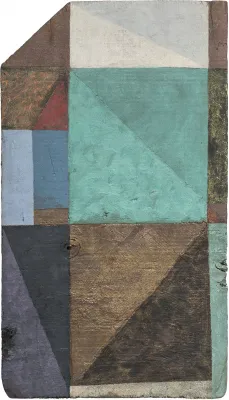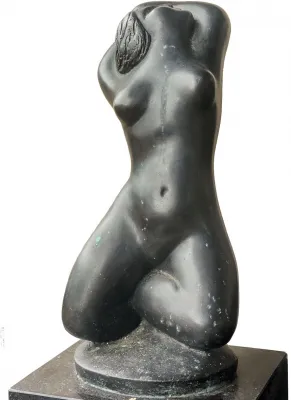
Alfredo Ceschiatti (Belo Horizonte MG 1918 - Rio de Janeiro RJ 1989)
Sculptor, designer, professor.
In 1938, he travels to Italy and Above all, it is of interest to the works of Renaissance artists. In 1940, in Rio de Janeiro, he joined the National School of Fine Arts - ENBA, where he studies sculpture with Corrêa Lima (1878 - 1974). He frequents the studio installed at the National Library, Rio de Janeiro, together with Bruno Giorgi (1905 - 1993) and José Pedrosa (1915 - 2002). In 1944, he created the bas-relief of the Church of São Francisco de Assis, in Pampulha, in Belo Horizonte, by order of Oscar Niemeyer (1907 - 2012). The following year, he won with this work the award for travel abroad at the 51st National Salon of Fine Arts, in Rio de Janeiro. Between 1946 and 1948, he remains in Europe and knows the work of Max Bill (1908 - 1994), Henri Laurens (1885 - 1954), Giacomo Manzù (1908 - 1991) and, mainly, Aristide Maillol (1861 - 1944). His first solo exhibition takes place at the headquarters of the Instituto dos Arquitetos do Brasil - IAB, in Rio de Janeiro, in 1948. In 1956, he was part of the winning team of the Project Contest for the Monument to the Dead of the Second World War, in Rio de Janeiro. In the early 1960s, he taught sculpture and drawing at the University of Brasília - UnB. Several of his works are in public spaces and buildings, including the Palácio da Alvorada, the Praça dos Três Poderes and the Palácio dos Arcos, in Brasília; the Latin America Memorial and Praça da Sé, in São Paulo; and the Brazilian Embassy in Moscow.
Critical Comment
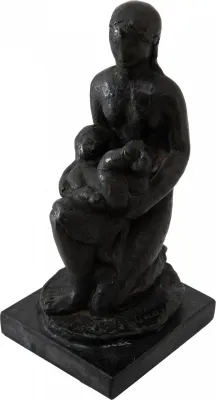
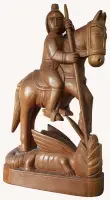
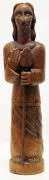
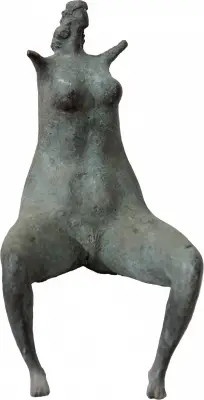
Alfredo Ceschiatti's sculptures are present in important public spaces in Brasília, such as the two sisters (1966), at Palácio dos Arcos; and The Angels (1970) and the Evangelists (1968), in the Cathedral of Brasília. The sculptor explores a lot of the female figure, represented in his works with curvilinear, pure, rounded shapes, which have, as a counterpoint, the movement of draping. The art criticism Sheila Leirner, providing balance and lightness to works such as the Angels of the Cathedral of Brasília, or the contortionist (1952). The artist, who is very interested in the Baroque Mineiro, rescues some elements of this tradition in several of his works, combining them with a greater formal simplification. (...) Ceschiatti catches and immortalizes - through an extremely personal vision - moments of high poetry, tension and strong plastic connotation, in which the rhythmic pulse remains always latent. Its pedestals or descend from the ceiling in suspension - statically, but full of this inner movement - to materialize the woman, figures and biblical scenes of intense drama, saints, angels, animals, ballerinas, acrobats, imposing historical personalities or Legendary, these bodies have their own organization, in which the arrangement of volumes, the play of limbs and the perfect proportion between the parts produces an effect of the most balanced and personal, an inevitable consequence of intuition and aesthetic sensitivity, combined with an excellent technique. (...) According to the basic principle of sculpture, as he said and employed Brecheret, Ceschiatti perpetuates their volumes in a single passage, without interruptions in the line that surrounds them, giving them to the forms in bronze and stone - materials that he manipulates with mastery - sensuality, poetry and musicality. Feminine forms exert an undeniable archetypal fascination over the sculptor. Their women are round and toned, sensual and lascivious, strong, and at the same time docile and fragile. (...) Ceschiatti is, above all, a designer of the sculpture. Their works are born and developed through a sensitive, sometimes picassian layout, which makes them acquire lightness, harmony and, above all, a clarity in the plastic formalization of their themes. It achieves a rare quality in today's sculptors: the adequate and profound assimilation of classical artists, especially with regard to the humanistic quality that characterizes their works". CESCHATTI, Alfredo. Ceschiatti. São Paulo: MAM, 1976. pp. [4-5].
"(...) Within the properties of the sculpture he has known how to compose the planes and anti-plans of vision, organize The gravitation of the masses around the centers of attraction, forming the horizon of its own at each formal manifestation, in short, has achieved with the expression of a beautiful way its best immersion in space. His sculpture is free, strong and healthy, like that of the brightest periods of this art, there are no dark and impenetrable corners, there are no evasions or betrayals in its contents, in its volumes and reliefs the insane insane mysteries of the eroticism or hallucination."
Joaquim Cardozo
1956
CESCHATTI, Alfredo. Ceschiatti. São Paulo: MAM, 1976. p. [14].
"It is certainly not an artist of powerful imagination. His personality is that of a formalist. Do not imagine this as a restriction, as it is about verifying the artist's system, and this literality is not uncommon in the history of the visual arts.
However, in the realization of the plastic form itself, when conceiving the piece itself, the sculptor Ceschiatti has been shy and restricted to classical models. He travels from the Greeks to the Renaissance with the same serene belief that 'through these paths the artist is safe'. Observing the whole of his work, it is more easily understood the official preference that his sculpture has deserved. sculptor of more renewing forms. The possibilities and technical security of Ceschiatti were asking, it seems to me, moments of greater flight and renewal.
Some of his works, especially the smaller pieces and the series of 'acrobats', suggest an artist with enough content to be a remarkable personality in the Brazil. And Ceschiatti didn't come to that. It is impressive that an artist with his opportunities, with the safety revealed and his connection and respect for modern architecture has been restricted to elaborating only his work, without influencing the new generations". Jacob. versus: Ten Years of Art Criticism. São Paulo: André Galeria de Arte, 1978. p. 24.
Testimonies
"Like two good friends, let's walk through life. I, absorbed by architecture, inventing shapes, playing with reinforced concrete; He, our Ceschiatti, to make his sculptures. These beautiful, baroque, curved women that their talent creates for marble. How I like to see them! To feel, after so many years that our friend did not change, that he did not enter other people's paths, remaining authentic, modest, irreproachable. I have no prejudices. I accept everything that seems good and true to me. And that's why I like Ceschiatti's sculpture, a necessary pause in this exhibitionist despair, which so often compromises and vulgarizes contemporary art".
Oscar Niemeyer
CESCHATTI, Alfredo. MAM, 1976. P. [2].
Individual exhibitions
1948 - Rio de Janeiro RJ - First Individual, at IAB/RJ
1956 - Rio de Janeiro RJ - Individual, at Jardins da Residence of Oscar Niemeyer
1976 - São Paulo SP - Alfredo Ceschiatti: Retrospective, at MAM/SP
1981 - Rio de Janeiro RJ - Alfredo Ceschiatti: Sculpture, at AM Niemeyer Art Interiores
Collective exhibitions
1943 - Rio de Janeiro RJ - 49th National Salon of Fine Arts. RJ - 50th National Salon of Fine Arts. Modern Division, at the MNBA - Silver Medal
1945 - Rio de Janeiro RJ - 51st National Salon of Fine Arts. 1946 - Rio de Janeiro RJ - The painters go to the Escola do Povo, in the Academic Directory of ENBA
1952 - Rio de Janeiro RJ - Exhibition of Brazilian Artists, at MAM/RJ
1953 - Rio de Janeiro RJ - 2nd Salon National Modern Art, at the MNBA
1953 - São Paulo SP - 2nd São Paulo International Biennial, at the Pavilion of the States
1955 - São Paulo SP - 3rd International Biennial of São Paulo, Pavilion of Nations
1964 - Rio de Janeiro RJ - The Nude in Contemporary Art, at the IBEU Copacabana Gallery
1972 - São Paulo SP - 4th Panorama of Current Brazilian Art, at MAM/SP
1975 - São Paulo SP - 7th Panorama of Current Brazilian Art, at MAM/SP
1978 - Penápolis SP - 3rd Salon of Plastic Arts of the Northwest, at the Educational Foundation of Penápolis
1982 - São Paulo SP - A century of sculpture in Brazil, at MASP
1983 - Rio de Janeiro RJ - 6th National Salon of Plastic Arts, at MAM/RJ
1984 - São Paulo SP - Tradition and rupture: synthesis of Brazilian art and culture, at the Foundation Biennial
1986 - Brasília DF - Brasília : open trail, at the Cultural Foundation of the Federal District
1986 - Rio de Janeiro RJ - A Nova Flor de Avocado, Grupo Guignard-1943 and Os Dissidentes-1942, at the Banerj Art Gallery
1986 - Rio de Janeiro RJ - Seven decades of the Italian presence in Brazilian art, at the Paço Imperial
Posthetic exhibitions
1990 - Brasília DF - Brasília, 30 years old, Performance Gallery
1990 - São Paulo SP - Individual, at Skultura Art Gallery
1993 - Rio de Janeiro RJ - Arte Erótica, at MAM/RJ
1994 - São Paulo SP - Individual, at Ricardo Camargo and Ugo di Pace Art Studio
1997 - São Paulo SP - Brazilian sculpture: profile of an identity, at Banco Safra
1997 - São Paulo SP - Three-dimensionality in Brazilian art of the 20th century, at Itaú Cultural
1997 - Washington (United States) - Brazilian Sculpture: profile of an identity, in the cultural center of the IDB
1997 - São Paulo SP - Brazilian sculpture: profile of an identity, at Banco Safra
1998 - Belo Horizonte MG - Three-dimensionality in Brazilian art of the 20th century, At Itaú Cultural
1998 - Brasília DF - Three-dimensionality in Brazilian art of the 20th century, at the Itaú Cultural Gallery
1998 - Penápolis SP - Three-dimensionality in Brazilian art of the 20th century, in the gallery Itaú Cultural
1998 - São Paulo SP - The Art of Exposing Art, at MAM/SP 
1999 - São Paulo SP - The female figure in the MAB collection, at MAB/FAAP
2000 - Rio de Janeiro RJ - When Brazil was modern: plastic arts in Rio de Janeiro from 1905 to 1960, at Paço Imperial
2000 - São Paulo SP - The female figure in the MAB collection, at MAB/FAAP
2000 - São Paulo SP - The human figure in the Itaú Collection, at Itaú Cultural
2000 - São Paulo SP - Brazilian sculpture: from the Pinacoteca to the Jardim da Luz, at the Pinacoteca do Estado
2000 - São Paulo SP - OS Angels are back, at the Pinacoteca do Estado
2001 - São Paulo SP - Aldo Franco Collection, at the Pinacoteca do Estado
2002 - Brasília DF - JK - An Aesthetic Adventure, in the Cultural Set of Caixa
2002 - Rio de Janeiro RJ - Brazilian art in the Fadel collection: from the restlessness of the modern to the autonomy of language, in the CCBB
2002 - São Paulo SP - Brazilian art in the Fadel collection: da Restlessness of the modern to the autonomy of language, in CCBB
2003 - Brasília DF - Brazilian art in the Fadel collection: from the restlessness of the modern to the autonomy of language, in the CCBB
2003 - São Paulo SP - sculptors - sculptures, at Pinakotheke
2004 - Belo Horizonte MG - Pampulha, work collected: 1943-2003, at MAP
2004 - São Paulo SP - The price of seduction: from corset to silicone, at Itaú Cultural
Source: Itaú Cultural