
Alex Flemming (São Paulo SP 1954)
Alex Flemming is a painter, sculptor and printmaker. He attended the independent film course at the Fundação Armando Álvares Penteado (Faap), in São Paulo, between 1972 and 1974. In 1979 and 1980, he studied screen printing with Regina Silveira (1939) and Julio Plaza (1938–2003), as well as intaglio printmaking with Romildo Paiva (1938). During the 1970s, he made short films and took part in several festivals.
In 1981, he traveled to New York, where he stayed for two years and developed a project at the Pratt Institute, on a Fulbright Foundation scholarship. From the 1990s onwards, he began making interventions in exhibition spaces and produced paintings with a strongly autobiographical character. He also began incorporating furniture such as chairs and armchairs into his works, applying paint, letters and texts to them.
In 1993 and 1994, he taught at the Kunstakademie in Oslo, Norway. Since 1995, he has lived in Germany, while maintaining a constant presence in exhibitions held in Brazil. In 1998, he created glass panels for the Sumaré Station of the São Paulo Metro, using photos of ordinary people on which he applied colored letters with excerpts from poems by Brazilian authors. The representation of the human body and maps of regions in conflict are themes of the series Body Builders (2001–2002).
In 2002, two books were published: Alex Flemming, by Edusp, edited by Ana Mae Barbosa, with texts by various visual arts specialists, and Alex Flemming, uma Poética... [Alex Flemming, a Poetics...], by Katia Canton, published by Metalivros. In 2005, Alex Flemming – Arte e História [Alex Flemming – Art and History], by Roseli Ventrella and Valéria de Souza, was released by Editora Moderna.
Critical Commentary
Alex Flemming initially devotes himself to printmaking, photography and painting, producing in 1983 a series of large paintings based on photographs of vigorous bodies. In 1990, his production takes a new direction: he also begins making interventions, displaying on the staircase of the Museu de Arte de São Paulo Assis Chateaubriand (Masp) a number of stuffed ox heads, painted metallic blue and set in upturned white trash cans.
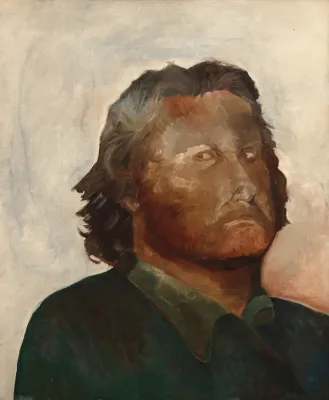
In the early 1990s, he produces several series of autobiographical paintings that use his own clothes as their support. Later, he begins collecting and painting used chairs, armchairs and sofas, on which he then applies letters forming texts taken from newspaper reports, thus displacing the established relationship with these objects. In Body Builders (2001-2002), he photographs young, slender bodies and then draws on these images maps of areas of conflict and war, such as those of the Middle East or the Chiapas region, in Mexico.
The use of graphic characters on photographs of people is also present in one of his most notable works: the panels of the Sumaré Station of the São Paulo Metro. Made up of photos of ordinary people, each one was assigned a poem, written in somewhat blurred letters, with some passages inverted or missing, which does not entirely prevent the text from being understood.
Critiques
"An artist of the contemporary world, Alex Flemming, though young, already reveals a very mature spirit, translated into his work, which is entirely a reflection on man, evident in the persistence with which he approaches the human body, focusing on enlargements of its different parts. His artistic path has always been linked to experimentation with new media. (...) His work brings together craft processes and post-industrial ones. His research always seeks to appropriate the most advanced means, as at the 17th Bienal Internacional de São Paulo, when he carried out experiments with videotext. The making of his paintings is very complex, all of it carried out by the artist himself. His photographic enlargements are turned into huge photolithographs ('made by myself', he says) and printed by photographic screen printing. In this process he transforms the erotic aspect into multiple readings, but the organic side persists, which, in its new dimension, takes on a very intense emotional charge".
Ilsa Leal Ferreira
A COR e o desenho do Brasil. São Paulo: Centro Brasileiro de Projetos de Arte, 1984.
"In fact, I think two trajectories cross in the development of Flemming's work in recent years. Around 1983, he makes large paintings based on photographs of the vigorous bodies of living people. Then he leaves photography of live models and looks for graphic models from past centuries (...). Now the mummies: he goes further and further back into the past, moving from the living body to the relic-body, while the figures are simplified as they become flat, in plain colors, positioned in an ostensible foreground - threatened, however, by the background. Threatened or not: for perhaps the figure's great desire is to become background. But it is a desire one must certainly fight against. Nevertheless, we shall become background, and the best that awaits us is to become a legacy. Alex Flemming works with the wavering space and time between figure and background. (...) Flemming's painting is not predominantly conceptual. It seduces me through its visual splendor, its chromatic richness, the sensuality of its matter, its tactile effect, the shifts in brightness and volume of the light falling on the metallic paint, and an undeniable grandiloquence".
Jean-Claude Bernardet
ALEX Flemming. Lisboa: Galerias de Exposições Temporárias/Fundação Calouste Gulbenkian, 1988.
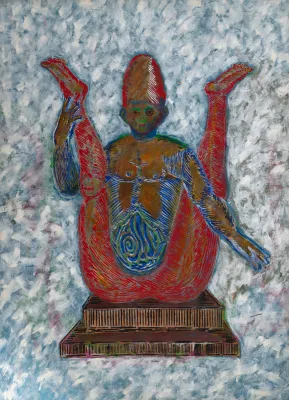
"From what exists in the depths of emotion or in the swamps of the unconscious - within us - to what might perhaps exist outside us, Alex Flemming draws the material of his creation. It is no accident that, behind the fiery, contrasting colors recalling the modernity of neon, in their grotesque force, these figures seem at the same time strangely primitive. Like cave drawings, immortalizing incomprehensible alien visitors or tormented (and equally incomprehensible) demons of the mind. Inspired by 17th-century engravings by Ulysses Aldrovandi, Flemming's work - after moving through the human body and through sacred and mythological figures - now finds in these images another line of coherence and development. Explicit, enormous, aggressively colored and without any intimism, they symbolically materialize fantasies that have dwelt in the human mind for centuries. And they unsettle us, threatening us with the materiality of the madness of our own condition".
Caio Fernando Abreu
BARBOSA, Ana Mae (org.). Alex Flemming. São Paulo: Edusp, 2002.
Alex Flemming and His Flying Carpets That Question Wests and Easts
Dismantling, deconstructing, undressing, peeling, scraping, mixing, overlaying, replacing, redoing, recovering, coating, renaming, building, rebuilding, reusing, gluing, regluing: the art of São Paulo-born Alex Flemming excels in production as a permanent process, in a dense body of work that explores the extensions and limits of subject and material.
A blend of unusual ideas – of indecipherable texts, strange textures, different supports and garish paints. A provocative art, made of printed bodies or de-reconstructed bodies, of furniture, objects and clothes coated in metallic colors, of stuffed and painted animals, etc.
Thinking and composing in series, Alex Flemming's work shows a concern with making and with documenting the steps, with organizing the stages and even showing the production process, which, on canvas and other supports, sometimes appears in camouflaged form and sometimes lays itself bare, in a translation of the world and of himself. Many of these series are recombined in different colors, textures and supports, offering us a range of possible readings.
A new concept of beauty? More than that, it is a play between transparency, thickness and what is hidden. And what all this production mirrors is the artist's own trajectory, that of a voluntary exile.
Living between two chaotic metropolises – São Paulo and Berlin –, Flemming talks about his work in a provocative and passionate way. He speaks of his concerns and reflections regarding life and death and political and cultural issues, portrayed in his work in an unconventional manner, as if the art object, indeed, were his point of contact with life, between worlds, countries and themes, in a becoming of both artist and work. A sign that art imitates life?
In this artistic nation, the body is a constant subject. Since the 1980s the artist has portrayed or used the human body, sometimes as a subject, sometimes as a support for discussing political, social and cultural issues.
In his work there is a reflection on the body and on the human, on the living body and the dead one, on the use of the body as identity, as absence or as memory. In short, one may say that the body and its possibilities of signification and resignification are among Flemming's main focuses.
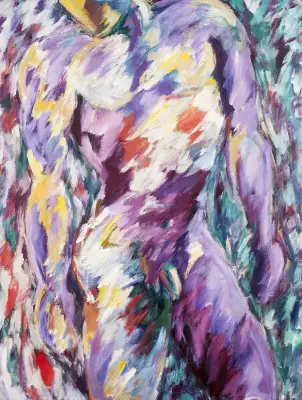
The beauty of the human body is carnally explored in the canvas “Torso”, from 1983. This painting shows a naked male chest, divided into four rectangles framed by different colors and textures, in reverence for the living, exuberant body or as an invitation to pleasure, sex and life. Here, as in other works featuring the nude figure, the artist shows, discusses and pays homage to the body in its physical appearance, in its vigor and in the erotic appeal the nude arouses.
The human body can also serve as a support for a critique-denunciation of contemporary society, as in the reworked photos of the series “Body Builders”, from 2002, in which the artist prints maps of regions of the world in conflict on the skin of athletic bodies.
Once again the nude, this time gigantically enlarged, spatialized and carnivalesquely colored, denouncing visually and verbally. In this series of sculpted bodies, the contemporaneity of the artist's work appears in the form of his engagement with history, technology and art.
The human body, present and in focus, also appears in the gigantic photos of anonymous people, as in bureaucratic documents, on which the artist splashes colored letters forming poems by renowned authors, in a work from 1998.
Mounting billboards in the Sumaré Station of the São Paulo metro, on 44 transparent glass panels, Flemming creates a code for commuters to decipher what is written/inscribed over the photos, bringing order to their perception. In this series, the artist singles out faces from the crowd, commenting on social sameness and anonymity.
The body also becomes memory or relic in the canvas “Múmia” [Mummy], from 1988. It is a metaphorization of the traditional figures of mummies, based on a culturally established idea, but here reworked in a translucent version, permeated by a background of brushstrokes in light, ethereal tones. They are three “almost” spiritual mummy-figures, suspended on the canvas, ready for the viewer's reverence, whether because he stands before the secrets the mummy hides or because of the idea of death and of the body's eternity these figures suggest.
There is also the series of religious bodies. In this series, the artist takes examples of popular religious images and covers them with unusual colors, textures and cutouts. In the canvas “Anjo” [Angel], from 1984, for example, Flemming works on eight rectangles that together show the outline of an angel figure. Background and figure blend through the strong colors, the colorful brushstrokes and the very assembly of the eight parts, composing an overlay of visual information in which interference creates a new sign.
Flemming is an artist who surrenders to the human body. In a new way of presenting and representing the body, his work takes the physical body as figure and as identity, places it on a pedestal and reveres it, whether by emphasizing it visually, transforming it beyond its natural boundaries, or expanding or tearing apart the body or its parts.
Alex Flemming's body takes on varied identities and may even be absent, as in the series of metallically colored clothes, but it is always beautiful and alive, because it is provocative, diverse, distinct, human. It is a body that steps out of the crowd, out of social and cultural erasure, and becomes center, subject and work. His most recent work reveals political engagement. In the new production “Tapetes Voadores” [Flying Carpets], Alex Flemming expresses his indignation at extremist acts, bringing out a feeling shared by any sensible citizen of the planet.
The opening of the exhibition “Flying Carpets”, at Galeria Sylvio Nery, provocatively coincided with the second anniversary of the attacks that brought down the twin towers of the World Trade Center in New York.
Alluding both to the age-old oriental flying carpets of the “Thousand and One Nights” and to modern Western aeronautical technology, the gigantic airplanes built by the artist from pieces of oriental rugs make a denunciation and recall the East versus West question that so troubles this beginning of the 21st century.
Maria Teresa Santoro
Exhibition “Flying Carpets”
Collections
Art Museum of Latin American - Washington (United States)
Birmingham Museum of Art - Birmingham (England)
Casa da Gravura - Curitiba PR
Casa de las Américas - Havana (Cuba)
Fundação Calouste Gulbenkian - Lisbon (Portugal)
Ibero-Amerikanisches Institut - Berlin (Germany)
Instituto de Estudos Brasileiros da Universidade de São Paulo (IEB/USP) - São Paulo SP
Museo de Arte Americano - Maldonado
Museo Nacional de Bellas Artes de Chile - Santiago (Chile)
Museu de Arte Brasileira da Fundação Armando Álvares Penteado (MAB/Faap) - São Paulo SP
Museu de Arte Contemporânea da Universidade de São Paulo (MAC/USP) - São Paulo SP
Museu de Arte Contemporânea do Paraná (MAC/PR) - Curitiba PR
Museu de Arte de Brasília (MAB/DF) - Brasília DF
Museu de Arte de São Paulo Assis Chateaubriand (Masp) - São Paulo SP
Museu de Arte Moderna Aloísio Magalhães (Mamam) - Recife PE
Museu de Arte Moderna de São Paulo (MAM/SP) - São Paulo SP
Museu de Arte Moderna do Rio de Janeiro (MAM/RJ) - Rio de Janeiro RJ
Museu Nacional de Belas Artes (MNBA) - Rio de Janeiro RJ
Pinacoteca do Estado de São Paulo (Pesp) - São Paulo SP
University of Essex Collection of Latin American Art - Colchester
Solo Exhibitions
1977 - São Paulo SP - Solo, Espaço Grife
1980 - Ribeirão Preto SP - Solo, Itaúgaleria
1980 - São Paulo SP - Solo, Masp
1981 - São Paulo SP - Solo, Paulo Figueiredo Galeria de Arte
1981 - Tel Aviv (Israel) - Solo, Centro Cultural Brasil-Israel
1983 - Barcelona (Spain) - Solo, Galeria Metronom
1983 - São Paulo SP - Solo, Galeria de Arte São Paulo
1984 - Rio de Janeiro RJ - Alex Flemming: Paintings, Galeria Cesar Aché
1984 - São Paulo SP - Solo, CCSP
1985 - Berlin (Germany) - Solo, Galeria Steigenberge
1985 - São Paulo SP - Solo, Paço das Artes
1987 - Rio de Janeiro RJ - Solo, Galeria Montesanti Roesler
1987 - São Paulo SP - Solo, Galeria Montesanti
1988 - Chicago (United States) - Solo, Latino Arts Coalition
1988 - Lisbon (Portugal) - Solo, Museu Gulbenkian da Fundação Calouste Gulbenkian
1988 - Rio de Janeiro RJ - Solo, Centro Cultural Candido Mendes
1989 - São Paulo SP - Paintings: 10 Days of Traveling Installations, on trucks through the city streets
1990 - São Paulo SP - A Rite of Passage, Masp
1990 - Washington (United States) - Brazilian Artist Alex Flemming, Museum of Modern Art of Latin America
1991 - Belo Horizonte MG - Solo, Grande Galeria do Palácio das Artes
1991 - Coral Gables (United States) - Solo, Opus Gallery
1991 - Rio de Janeiro RJ - Solo, Centro Cultural Candido Mendes
1992 - Berlin (Germany) - Solo, Galeria Tammen & Busch
1992 - Düsseldorf (Germany) - Solo, Galerie Tabea Langenkamp
1992 - Leipzig (Germany) - Solo, Galerie Lang
1993 - Amsterdam (Netherlands) - Solo, Aschenbach Galerie Contemporary Art
1993 - Krachtal (Germany) - Solo, Ursula Blickle Stiftung
1994 - Berlin (Germany) - Solo, Galerie Tammen & Busch
1994 - Düsseldorf (Germany) - Solo, Galerie Tabea Langenkamp
1996 - Cologne (Germany) - Solo, Lutz Teutloff Modern Art
1996 - São Paulo SP - Solo, Masp
1997 - Rio de Janeiro RJ - Solo, Centro Cultural do Banco do Brasil
1998 - São Paulo SP - Solo, Estação Sumaré do Metrô
2000 - Belo Horizonte MG - Solo, Celma Albuquerque Galeria de Arte
2000 - Lisbon (Portugal) - Alex Flemming: Recent Works, Galeria 111
2000 - Porto (Portugal) - Alex Flemming: Recent Works, Galeria 111
2001 - Berlin (Germany) - Solo, Galerie Blickensdorff
2001 - São Paulo SP - Collective Body, Centro Cultural do Banco do Brasil
2002 - Rome (Italy) - Solo, Palazzo Pamphili
2002 - Sydney (Australia) - Solo, Connie Dietzschold Gallery
2003 - Rio de Janeiro RJ - Body Builders, Paço Imperial
2003 - São Caetano do Sul SP - Paulistana, Sesc
2003 - São Paulo SP - Tapetes Voadores [Flying Carpets], Escritório de Arte Sylvio Nery da Fonseca
2004 - Brasília DF - Identity and Conflict, Centro Cultural do Banco do Brasil
2004 - Curitiba PR - Alex Flemming, Ybakatu Espaço de Arte
2004 - São Paulo SP - Alex Flemming: Photographs, Pinacoteca do Estado
2004 - São Paulo SP - Paulistana, Galeria Sesc Paulista
2005 - Berlin (Germany) - Solo, Galerie Blickensdorff
2005 - Chicago (United States) - Flying Carpets, Chicago Cultural Center
2005 - Lisbon (Portugal) - Flying Carpets, Galeria 111
2007 - Curitiba PR - Dead Photographs and a Few Exceptions, Ybakatu Espaço de Arte
2007 - São Paulo SP - Pleasure and Anguish in 50 Dead Photographs and a Few Exceptions, Museu de Arte de São Paulo
2008 - Berlin (Germany) - Uniplanetarisches System - In Memoriam Galileo Galilei, St. Johannes-Evangelist-Kirche
2008 - Brasília DF - Solo, Referência Galeria de Arte
2008 - Rio de Janeiro RJ - Uniplanetary System - In Memoriam Galileo Galilei, Museu de Arte Moderna
2009 - Recife PE - Solo, Amparo 60
2010 - Recife PE - Heights Series, Amparo 60
2010 - Rio de Janeiro RJ - Alex Flemming: Mapa-da-Mina [Treasure Map], Museu Nacional de Belas Artes
2011 - Santiago (Chile) - Galileo Galilei, Museo Nacional de Bellas Artes
Group Exhibitions
1977 - Belo Horizonte MG - 9th National Fine Arts Salon
1978 - Paris (France) - Images et Messages d'Amérique Latine, Centre Culturel de Villeparisi
1978 - Piracicaba SP - 11th Art Salon - acquisition prize
1979 - Curitiba PR - 36th Paraná Salon, Teatro Guaíra
1979 - Piracicaba SP - 12th Art Salon - acquisition prize
1979 - Ribeirão Preto SP - 4th Ribeirão Preto Art Salon, Casa da Cultura de Ribeirão Preto
1979 - Rio de Janeiro RJ - 2nd National Visual Arts Salon, Museu de Arte Moderna
1980 - Belo Horizonte MG - 12th National Fine Arts Salon
1980 - Caxias do Sul RS - Xerographies, Fundação Universidade Caxias do Sul
1980 - Curitiba PR - 37th Paraná Salon, Teatro Guaíra
1980 - Curitiba PR - 3rd Curitiba Annual Printmaking Show, Casa de Gravura Solar do Barão - Casa da Gravura Collection Prize
1980 - João Pessoa PB - Xerographies, Núcleo de Arte Contemporânea da Universidade Federal da Paraíba
1980 - São Paulo SP - Xerographies, Pinacoteca do Estado
1980 - Joinville SC - Xerographies, Museu de Arte de Joinville
1980 - Piracicaba SP - Xerographies, Casa de Cultura de Piracicaba
1980 - Porto Alegre RS - Xerographies, Espaço N.O. Centro Alternativo de Cultura
1980 - Ribeirão Preto SP - 5th Ribeirão Preto Art Salon, Casa da Cultura de Ribeirão Preto
1980 - Rio de Janeiro RJ - 3rd National Visual Arts Salon, Museu Nacional de Belas Artes
1980 - São Paulo SP - 12th Panorama of Current Brazilian Art: Drawing and Printmaking, Museu de Arte Moderna
1981 - Curitiba PR - 38th Paraná Salon, Teatro Guaíra
1981 - Piracicaba SP - 14th Piracicaba Contemporary Art Salon, Casa das Artes Plásticas Miguel Dutra
1981 - Recife PE - 34th Pernambuco Visual Arts Salon, Museu do Estado de Pernambuco
1981 - Ribeirão Preto SP - 6th Ribeirão Preto Art Salon, Casa da Cultura de Ribeirão Preto
1981 - São Paulo SP - 16th Bienal Internacional de São Paulo, Fundação Bienal
1981 - São Paulo SP - 2nd São Paulo Salon of Plastic and Visual Arts, Paço das Artes
1981 - São Paulo SP - Heliography Exhibition, Pinacoteca do Estado
1982 - New York (United States) - Young Artists, Kouros Gallery
1982 - San Diego (United States) - Body Language, Universidade de San Diego
1983 - Ribeirão Preto SP - Xerography: Brazilian Sampling, Galeria Campus
1983 - Rio de Janeiro RJ - 6th National Visual Arts Salon, Museu de Arte Moderna
1983 - São Paulo SP - 14th Panorama of Current Brazilian Art, Museu de Arte Moderna
1983 - São Paulo SP - 17th Bienal Internacional de São Paulo, Fundação Bienal
1983 - São Paulo SP - Art in the Street, organized by MAC/USP and presented on billboards across the city
1984 - Curitiba PR - 6th Curitiba City Printmaking Show
1984 - Fortaleza CE - 7th National Visual Arts Salon
1984 - Rio de Janeiro RJ - 7th National Visual Arts Salon, Museu de Arte Moderna
1984 - São Paulo SP - 15th Panorama of Current Brazilian Art, Museu de Arte Moderna
1984 - São Paulo SP - 2nd São Paulo Contemporary Art Salon, Fundação Bienal
1984 - São Paulo SP - 2nd São Paulo Contemporary Art Salon, Museu da Imagem e do Som
1984 - São Paulo SP - The Color and Drawing of Brazil, Museu de Arte Moderna
1984 - São Paulo SP - Arte Xerox Brasil, Pinacoteca do Estado
1984 - São Paulo SP - Artists for Direct Elections, in the lobby of the Folha de S.Paulo newspaper
1985 - São Paulo SP - Highlights of Brazilian Contemporary Art, Museu de Arte Moderna
1985 - São Paulo SP - Art and Technology, Museu de Arte Contemporânea da Universidade de São Paulo
1985 - São Paulo SP - Art New Media/Multimedia: Brazil 70/80, Museu de Arte Brasileira
1986 - Belo Horizonte MG - 9th National Visual Arts Salon: Southeast, Fundação Clóvis Salgado. Palácio das Artes
1986 - Curitiba PR - 7th Collection of the Museu Nacional da Gravura - Casa da Gravura, Museu Guido Viaro
1986 - Havana (Cuba) - 2nd Havana Biennial
1986 - São Paulo SP - 1st Helena Rubinstein Young Art Selection, Museu de Arte de São Paulo
1987 - Rio de Janeiro RJ - To the Collector: Tribute to Gilberto Chateaubriand, Museu de Arte Moderna
1987 - São Paulo SP - 20th Contemporary Art Exhibition, Chapel Art Show
1987 - São Paulo SP - 5th São Paulo Contemporary Art Salon, Pinacoteca do Estado
1987 - São Paulo SP - The Weave of Taste: Another Look at Everyday Life, Fundação Bienal
1987 - São Paulo SP - Second-Generation Images, MAC/USP
1988 - Campinas SP - 13th Campinas Contemporary Art Salon, Museu de Arte Contemporânea José Pancetti
1988 - Kraków (Poland) - 12th International Print Biennial
1988 - Curitiba PR - 8th Curitiba City Printmaking Show, Casa da Gravura Solar do Barão
1988 - Beijing (China) - 1st Brazil-China Exhibition, Galeria de Belas Artes da China
1988 - São Paulo SP - Juréia, Sadalla Galeria de Arte
1988 - São Paulo SP - MAC 25 Years: Recent Acquisitions and Donations, MAC/USP
1988 - São Paulo SP - 21st Chapel Art Show, Chapel Art Show
1988 - São Paulo SP - MAC 25 Years: Recent Acquisitions and Donations, Museu de Arte Contemporânea da Universidade de São Paulo
1989 - São Paulo SP - 20th Bienal Internacional de São Paulo, Fundação Bienal
1989 - São Paulo SP - 20th Panorama of Current Brazilian Art, Museu de Arte Moderna
1989 - São Paulo SP - Open Studio Circuit, Instituto de Arquitetos do Brasil. Departamento de São Paulo
1990 - Curitiba PR - 9th Curitiba City Printmaking Show, Museu da Gravura
1990 - São Paulo SP - 6th Brazilian Art Salon, Fundação Mokiti Okada M.O.A.
1991 - São Paulo SP - 21st Bienal Internacional de São Paulo, Fundação Bienal
1993 - São Paulo SP - Masp at Morumbi Shopping, Shopping Morumbi
1994 - Chicago (United States) - Art on the Map, Chicago Cultural Center
1994 - Dortmund (Germany) - Alex Flemming: Objekte/Malerei & Moritz Gotze: Grafik, Künstlerhaus
1994 - São Paulo SP - Bienal Brasil Século XX, Fundação Bienal
1995 - Erfurt (Germany) - Configura 2 - Dialog der Kulturen, Gallery Fischmarkt
1996 - Copenhagen (Denmark) - Containers 96: Art Across Oceans
1996 - Rio de Janeiro RJ - New Acquisitions: Gilberto Chateaubriand Collection, Museu de Arte Moderna
1996 - São Paulo SP - Ex Libris/Home Page, Paço das Artes
1997 - Havana (Cuba) - 6th Havana Biennial, Centro de Arte Contemporáneo Wifredo Lam
1998 - São Paulo SP - The Art of Exhibiting Art, Museu de Arte Moderna
1998 - São Paulo SP - Frontiers. Utopian Dimensions, Itaú Cultural
1998 - São Paulo SP - Migratory Motion: Four Brazilian Artists in Germany, Museu de Arte Contemporânea da Universidade de São Paulo
1998 - São Paulo SP - The Modern and the Contemporary in Brazilian Art: Gilberto Chateaubriand Collection - MAM/RJ, Museu de Arte de São Paulo
1999 - Rio de Janeiro RJ - Everyday Life/Art. The Object - 1960s/90s, Museu de Arte Moderna
1999 - São Paulo SP - Everyday Life/Art. The Object - 1960s/90s, Itaú Cultural
2000 - Belo Horizonte MG - Investigations. Brazilian Printmaking. Are They or Aren't They Prints, Itaú Cultural
2000 - Belo Horizonte MG - Are They or Aren't They Prints?, Itaugaleria
2000 - Brasília DF - Investigations. Brazilian Printmaking. Are They or Aren't They Prints, Galeria Itaú Cultural
2000 - Curitiba PR - New Trends, Casa Vermelha
2000 - São Paulo SP - The Human Figure in the Itaú Collection, Itaú Cultural
2000 - São Paulo SP - Almeida Júnior: An Artist Revisited, Pinacoteca do Estado
2000 - São Paulo SP - Ars Erótica: Sex and Eroticism in Brazilian Art, Museu de Arte Moderna
2000 - Siegburg (Germany) - Art-Identity, Stadtmuseum
2001 - Brasília DF - Contemporary Art Show, Caixa Cultural
2001 - Porto Alegre RS - 3rd Bienal de Artes Visuais do Mercosul, Museu de Arte do Rio Grande do Sul Ado Malagoli
2001 - São Paulo SP - Alex Flemming and Heloisa Pires Ferreira, Instituto de Estudos Brasileiros
2002 - Buenos Aires (Argentina) - 2nd Buenos Aires Biennial
2002 - Frankfurt (Germany) - Art Frankfurt
2002 - Havana (Cuba) - Contemporáneos Brasileños [Brazilian Contemporaries], Centro de Arte Contemporáneo Wifredo Lam
2002 - Oslo (Norway) - Rest in Space, Kunstnernes Hus
2002 - Rio de Janeiro RJ - The Image of Sound of Brazilian Pop Rock, Paço Imperial
2002 - Rio de Janeiro RJ - Artefoto, Centro Cultural do Banco do Brasil
2002 - Rio de Janeiro RJ - The Brazilian Portrait in the Gilberto Chateaubriand Collection, MAM/RJ
2002 - Rio de Janeiro RJ - Selection from the UCAM Art Collection, Centro Cultural Candido Mendes
2002 - São Paulo SP - 11th Pirelli/Masp Photography Collection, Museu de Arte de São Paulo
2002 - São Paulo SP - Metrópolis Contemporary Art Collection, Pinacoteca do Estado
2003 - Berlin (Germany) - Brazilian Contemporary Art in Germany: 10 Artists between 2 Countries, Embaixada do Brasil
2003 - Brasília DF - Artefoto, Centro Cultural do Banco do Brasil
2003 - Curitiba PR - Imagética, Museu da Gravura Cidade de Curitiba
2003 - Recife PE - Seeing Again/Seeing the New, Mamam
2003 - Rio de Janeiro RJ - Palavras Mais [More Words], Galeria Sesc Copacabana
2003 - Rio de Janeiro RJ - Twenty-Five Years: Galeria de Arte Cândido Mendes, Galeria Candido Mendes
2003 - São Paulo SP - 2080, Museu de Arte Moderna
2003 - São Paulo SP - The Subversion of the Media, Itaú Cultural
2003 - São Paulo SP - Arteconhecimento: USP 70 Years, Museu de Arte Contemporânea da Universidade de São Paulo
2004 - Campinas SP - Metrópolis Contemporary Art Collection, Espaço Cultural CPFL
2004 - Recife PE - Museu de Arte Moderna Aloísio Magalhães Collection: Donations 2001 - 2004, Museu de Arte Moderna Aloísio Magalhães
2004 - Rio de Janeiro RJ - New Acquisitions 2003: Gilberto Chateaubriand Collection, Museu de Arte Moderna
2004 - Rio de Janeiro RJ - Where Are You, Generation 80?, Centro Cultural Banco do Brasil
2004 - São Paulo SP - Reincarnated Painting, Paço das Artes
2004 - São Paulo SP - Still Life / Natureza Morta, Galeria de Arte do Sesi
2004 - São Paulo SP - New Acquisitions: 1995 - 2003, Museu de Arte Brasileira - FAAP
2005 - Curitiba PR - Ybakatu 10 Years: Tuca Nissel Collection, Ybakatu Espaço de Arte
2005 - Ribeirão Preto SP - The Portrait - Possibilities, Museu de Arte de Ribeirão Preto Pedro Manuel-Gismondi
2005 - São Paulo SP - The Portrait as Image of the World, Museu de Arte Moderna
2006 - Berlin (Germany) - Image of Sound: Football, Haus der Kulturen der Welt
2006 - Ribeirão Preto SP - Ribeirão Preto 150 Years Show, Museu de Arte de Ribeirão Preto Pedro Manuel-Gismondi
2006 - São Paulo SP - The City for the City, Galeria Olido
2006 - São Paulo SP - Brasiliana Masp: Modern Contemporary, Museu de Arte de São Paulo
2007 - Curitiba PR - 4th Latin American Visual Arts Show - VentoSul, Casa Andrade Muricy
2007 - São Paulo SP - Itaú Contemporâneo: Art in Brazil 1981-2006, Itaú Cultural
2008 - São Paulo SP - Art for the Amazon: Art and Attitude, Fundação Bienal
2008 - São Paulo SP - Brasil Brasileiro, Centro Cultural Banco do Brasil
2008 - São Paulo SP - 4th SP Arte, Fundação Bienal
2009 - Recife PE - Organic Line, Amparo Sessenta Galeria de Arte
2009 - Rio de Janeiro RJ - Brasil Brasileiro, Centro Cultural Banco do Brasil
2009 - São Paulo SP - A World Without Frames, Museu de Arte Contemporânea da Universidade de São Paulo
2010 - São Paulo SP - Lingering Gazes, Mizrahi Galeria
2010 - São Paulo SP - 6th SP-Arte, Fundação Bienal
Source: Itaú Cultural and others