Abraham Palatnik (Natal RN, 1928 - 2020)
Abraham Palatnik was a Brazilian artist, a pioneer of kinetic art, internationally recognized for integrating light, color and movement into his works. Born in Natal, Rio Grande do Norte, he moved as a child, in 1932, with his family to the region that today corresponds to Israel. This experience played an important role at the start of his technical and artistic training.
Between 1942 and 1945, Abraham Palatnik studied at the Montefiori Technical School in Tel Aviv, where he specialized in internal combustion engines. This knowledge was fundamental to the development of his technology-based artistic production. At the same time, he began his training in the visual arts with Haaron Avni and the sculptor Sternshus, and studied aesthetics with Professor Shor. He also attended the Tel Aviv Municipal Art Institute until 1947.
Abraham Palatnik returned to Brazil in 1948 and settled in Rio de Janeiro, where he came into contact with important names in Brazilian art, such as Ivan Serpa, Renina Katz and Almir Mavignier. During this period, he frequented the circle of the critic Mário Pedrosa and came into contact with the experiments of the psychiatrist Nise da Silveira, which influenced his perception of art and sensibility.
These influences led Abraham Palatnik to move away from traditional models of composition and to develop an experimental language centered on light, color and movement. In 1949, he began research that resulted in the creation of the first Aparelho Cinecromático [Cinechromatic Device], an important milestone in the history of kinetic art. The work was shown at the 1951 Bienal Internacional de São Paulo, where it received an honorable mention.
From 1964, Abraham Palatnik began developing the so-called Objetos Cinéticos [Kinetic Objects], in which the internal mechanisms are visible and do not depend on light projection. These works deepen the relationship between art, science and technology, central elements in his artistic career.
In 1954, Abraham Palatnik joined Grupo Frente, alongside artists such as Lygia Clark, Franz Weissmann and Ferreira Gullar, contributing to the development of concrete and neoconcrete art in Brazil.
With a body of work marked by constructive precision and experimentation, Abraham Palatnik established himself as one of the leading names in 20th-century Brazilian art and an international reference in kinetic art. His career was fundamental in bringing art, science and technology closer together, making Abraham Palatnik one of the most relevant artists in the history of Brazilian art.
Critical Commentary
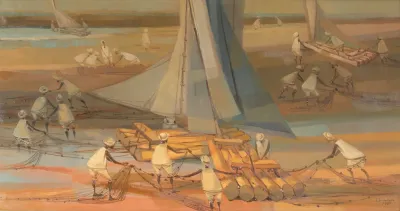
The son of Russian Jews, Abraham Palatnik migrated in 1932 to the region where the State of Israel is located today. Between 1942 and 1945, he studied at the Montefiori Technical School in Tel Aviv, where he specialized in internal combustion engines — technical training that would become central to his artistic production. From 1943, he attended the Tel Aviv Municipal Art Institute, studying drawing, painting and aesthetics until 1947. During this period, Abraham Palatnik produced landscapes, portraits and still lifes, revealing early technical mastery.
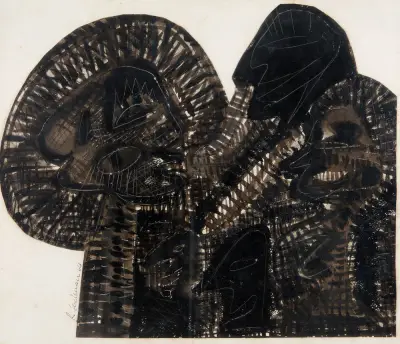
The critic Frederico Morais observes that in Abraham Palatnik's graphite drawings the line is agile, fluent and almost lyrical, while in his charcoal works the stroke takes on a firmer, more solid and at times expressionist character. This duality reveals an initial tension between formal rigor and expressiveness, which would later be redirected toward more experimental investigations.
In 1948, upon returning to Brazil and settling in Rio de Janeiro, Abraham Palatnik came into contact with artists such as Renina Katz, Almir Mavignier and Ivan Serpa. With Mavignier, he began to frequent the home of the critic Mário Pedrosa and the studios of the Engenho de Dentro Psychiatric Hospital, linked to the work of the psychiatrist Nise da Silveira. According to the artist himself, these experiences were decisive in his break with his earlier paradigms: “the impact of the visits [...] demolished my convictions about art”.
From then on, Abraham Palatnik abandoned the traditional criteria of representation and composition, shifting his research toward free relationships between form, color and structure. His production began to engage with abstract art and with constructive principles, but soon moved into radically innovative territory. In 1949, he began developing devices in which color manifests itself in movement, giving rise to the Aparelhos Cinecromáticos [Cinechromatic Devices] — structures that use lamps, motors and translucent materials to create dynamic luminous compositions.
First shown at the Bienal Internacional de São Paulo in 1951, the Aparelhos Cinecromáticos were defined by Mário Pedrosa as devices capable of projecting colored forms in movement onto translucent surfaces. Abraham Palatnik's work thus inaugurated a pioneering use of artificial light as a constituent element of the work of art, consolidating his position as a forerunner of kinetic art.
Abraham Palatnik's involvement with constructive issues and his ongoing dialogue with artists such as Ivan Serpa and Almir Mavignier led to his participation in Grupo Frente in 1954. His activity in the group reinforced his place in the context of concrete and neoconcrete art in Brazil, even though his production retained singular characteristics.
From the late 1950s, Abraham Palatnik expanded his research into the three-dimensional field, creating works that use electromagnetic fields and internal mechanisms to activate moving elements. At the same time, he developed two-dimensional works, such as the series Progressões [Progressions] (begun in 1962), in which he investigates optical effects through the repetition and arrangement of materials such as wood, paper and polyester.
In 1964, the Objetos Cinéticos [Kinetic Objects] appeared, in which movement is generated by motors and electromagnets, highlighting the technological dimension of his work. Although often compared to Alexander Calder's mobiles, Abraham Palatnik's creations stand apart for their mechanical control and the predictability of their movement, fitting into a rigorous constructive logic.
Abraham Palatnik's participation in the Venice Biennale in 1964 marked his international projection, establishing him as one of the leading names in kinetic art. That same year, he took part in the exhibition Mouvement 2, at the Galerie Denise René in Paris — a central venue for the dissemination of this artistic tendency.
Acclaimed as a pioneer, Abraham Palatnik had his career revisited in important retrospectives, such as those organized by Frederico Morais in 1999 at Itaú Cultural and at the Museu de Arte Contemporânea de Niterói. His work remains a fundamental reference in the articulation between art, science and technology, reaffirming Abraham Palatnik's role as one of the main innovators in 20th-century Brazilian art.
Note
1 MORAIS, Frederico, Abraham Palatnik: um pioneiro da arte tecnológica. In: RETROSPECTIVA Abraham Palatnik: a trajetória de um artista inventor. São Paulo: Itaú Cultural, 1999, p. 09. 2 Idem, ibidem, p. 10. 3 PEDROSA, Mário, Intróito à Bienal. In: AMARAL, Aracy (org.), Projeto Construtivo Brasileiro na Arte. Rio de Janeiro, MAM 1977. p.170. 4 MORAIS, Frederico, Abraham Palatnik: um pioneiro da arte tecnológica. In: RETROSPECTIVA Abraham Palatnik: a trajetória de um artista inventor. São Paulo: Itaú Cultural, 1999, p.16. 5 Idem, ibidem.
Critiques
"In his most recent research - alongside his long-standing interest in real mobility, which led him to incorporate new materials and processes, such as magnets and magnetic fields, leading to the direct participation of the viewer in games of pure ludic-visual perception -, Palatnik has moved toward the concept of virtual kineticism, with the 'progressive reliefs' assembled rhythmically in sequences of very thin strips of the same wood for each set; here, taking advantage of the evidence of grain, knots and other natural internal marks of a material that is also natural, he makes movement arise from the dynamics available to the eye of the viewer, willing to travel across the surface as if covered by a succession of film frames changing almost imperceptibly in space and over time. Activated visuality is, therefore, his core of action: 'There are certain natural conditions that impress man, and it is up to the artist to show them. That is why I aim to reach the senses, activating perception' ".
Roberto Pontual
PONTUAL, Roberto. Arte/Brasil/hoje: 50 anos depois. São Paulo: Collectio, 1973.
"Palatnik belongs to the line of researchers into the plastic art of light, that is, into the effects of space-time on our sensibility. (...) He started from the kaleidoscope, dissatisfied with the primitive system of contemplating images with one eye while turning a glass. He then wanted to enlarge the vision, freeing it from the little box in which it was hidden in order to project it onto the wall through a system of lenses. It was a revelation: visions of fantastic structures were destined never to go beyond the category of children's toys. From this discovery came the idea of seeking a means of controlling these fantastic structures, making them return to certain initial forms and thus creating a rhythm. But arbitrariness is inherent in the kaleidoscope. The structures are generated there by the chance of the observer's handling. The artist could not be satisfied with this arbitrariness, which excluded him from the work. He then wanted to intervene in the metamorphoses of the kaleidoscope in order to direct these forms in a plastic direction. (...) Color, finally, frees itself from the remains of its existence, dependent on the object, on its local, chemical materialism. It now becomes pure, direct, coming from artificial light sources. (...) Light becomes a means of plastic expression thanks to its own qualities, such as fluidity, irradiation, dynamism, discontinuity, infiltration, enveloping expansiveness, cooling, etc."
Mário Pedrosa
PEDROSA, Mário. Abraham Palatnik. In: MODERNIDADE: arte brasileira do século XX. São Paulo: MAM; Paris: Musée d'Art Moderne de la Ville de Paris, 1988.
"A pioneer in the use of electricity in the contemporary creative sphere, Palatnik also proves, through his cinechromatic device, to be a pioneer of programmed art, given the operation and projection of chromatic images in cycles defined by the artist. Still from the 1950s, this device offers the viewer, like a magic cave, abstract representations that follow one another over a set period of time. That is why Palatnik embodies so well the artist as inventor of our time, in which mastery of technique and imagination touch upon the visual poetics that so interested the concrete and neoconcrete artists. Even in his painting, in which rhythm is the basic element of the composition in progression, whether through modules of thin cuts of wood or when he paints with acrylic on canvas, mathematical precision acts as an ordering impulse in the organization of space".
Aracy Amaral
AMARAL, Aracy (Org.). Museu de Arte Contemporânea da Universidade de São Paulo: perfil de um acervo. São Paulo: Techint Engenharia, 1988.
"(...) aesthetic speculation aside, there has always been in Palatnik's creation the possibility of a creative/productive exchange between art, science, technology and industry. In the (...) 1981 interview, he states: 'To invent something you need unconventional behavior. I think industries should call on visual artists, because they have a perceptual potential that can solve many problems'. This was the proposal of the founders of the Bauhaus (1919/1933) when they based their teaching on establishing an art-industry circuit, in which art would serve to restrain the pragmatic excesses of industry and industry, conversely, would restrain the romantic excesses of art. 'I keep betting on intuition, although my work always requires mathematical calculations', he concludes".
Frederico Morais
MORAIS, Frederico. Abraham Palatnik: um pioneiro da arte tecnológica. In: Retrospectiva Abraham Palatnik: a trajetória de um artista inventor. São Paulo: Itaú Cultural, 1999.
Testimonials
"The evolution of the human being is directly linked to the adoption of technology and information, and is undoubtedly part of a project.
I believe in a dynamic culture in which, through appropriate technology, we use our acquired potential to evolve and constantly adjust to the world around us.
Man, a living organism immersed in a given environment, can only perceive through his sense organs.
This information is coordinated through the system of nerves and brain, undergoing a process of storage, comparison and selection. Finally it emerges to act on the outside world through exceptionally designed structural organs such as, among others, muscles and joints. Reactions occur that combine with information already accumulated to ensure more suitable future behavior. The validity of information lies in our constant adjustment to the outside world while we make our action felt on it, directly or through our extensions and technologies. A kind of 'exchange'.
Only in this way is our presence justified.
It is evident that technology has to be acquired the hard way, in contrast with the technology of animal society. The spider prepares an efficient and economical trap with a raw material it makes itself, highly sophisticated in viscosity and elasticity.
It immobilizes its victim with skill. It does maintenance and repairs. Its architecture is planned along the hunting route, etc. . . And yet the spider never learns anything; it is born with its 'printed circuits'.
The ant, likewise, has rigid tasks, limited and molded into its structure, whose physiological conditions are comparable to the mass-produced 'cheap goods' of our society.
The human being represents a great investment in study and learning over dozens of years. To disregard this advantage would be a degradation of man's very nature and a waste of his potential. This potential must be preserved and activated by stimulating perception and creativity, diversifying our extensions, implanting in them our wisdom and skill and taking on a design command. A kind of anti-routine, thus countering the slow pace of spontaneous evolution. Without perception and creativity, learning through coded information can betray us.
The volume of information is increasing and its characteristics are changing, being ever more linked to the mass media and to coded language. Access to all this information is bewildering and impossible. Selection becomes necessary. Specialists appear who know more and more about less and less. One day they will know everything about nothing.
In my first works I look for the principles that generate information, that is, the principle of order and of essence. Information in the universe is generally hidden, disguised amid disorder.
The mechanism of perception and intuition is needed for it to manifest itself 'suddenly'. It is this 'surprise' that holds my greatest interest and fascination. The process of 'exchange' begins, and by means of appropriate technology I seek to discipline the information.
I also think that the form of something is not only its outline but, above all, its essence. Reaching that essence is truly intriguing. It is the origin of all the aesthetic manifestations handled by artists. Sensibility is put to the test, the mechanism of improvisation blossoms, and playfulness appears, bringing man back to his condition of participation and integration".
Abraham Palatnik, 1977
PALATNIK, Abraham. Abraham Palatnik. Rio de Janeiro: IAB, 1981.
Trivia
An interview with the visual artist Abraham Palatnik conducted in 1986 and now republished in the book "Luz & Letra". "Luz & Letra", a book recently released by the US-based Brazilian artist Eduardo Kac, brings together articles and essays written in the 1980s and published in Brazilian newspapers and magazines. The collection allows the reader to build a kind of "portrait of the artist as a young man". At the same time, the release offers an overview of technological art at the time. Excerpt from the interview conducted by Eduardo Kac with the painter and draftsman Abraham Palatnik.
Eduardo Kac - How did your contact with Mário Pedrosa come about? What influence did he, as a critic attuned to avant-garde art, have on your creative process?
Abraham Palatnik - I got to know Mário Pedrosa in 1948, through colleagues such as Ivan Serpa and Almir Mavignier. Mário gave a lot of support to my research, which was absolutely untraditional. I had already done painting, but when I began the experiments I abandoned the brush and started working with things that had nothing to do with the traditional concept of art. For the time, what I was doing could not be art, so much so that at the time of the 1st Bienal I had a lot of problems. I could not be judged, I could not get into the Bienal, there was no section at the Bienal for my kinetic art. Mário Pedrosa came up with the name for one of my devices, which from then on came to be called "Cinecromático" [Cinechromatic], and he greatly encouraged my investigations with light and movement.
Kac - What happened at the 1st Bienal? Was the first cinechromatic device seen as a revolutionary work of art or, on the contrary, as a curiosity with no major consequences for the future?
Palatnik - In fact I got in by luck. At first my device was rejected, because it was not painting, nor sculpture, drawing or printmaking. There was a lapse by the Japanese delegation, which did not manage to send the material it had promised in time. Then someone, I don't know who, remembered my work and suggested it be placed in the empty space. I remember Almir turning to me and saying: "Abraham, you're going to exhibit at the Bienal! They're going to stick you in Japan's place". In the end, the international jury was surprised and gave the work a special mention; that is how it came to be recognized as "an important manifestation of modern art", as they put it. Even so, at the following Bienals I received invitations to exhibit, but on condition that I did not compete for prizes, since there was no section that could accommodate my work.
Comunicação Cinética [Kinetic Communication] - 1967 Kac - You are one of the few Brazilian artists who are widely recognized abroad. In fact, better known abroad than in Brazil. What was the international response to your work in the 1950s, when you were carrying out pioneering research in the field of kinetic art?
Palatnik - Years after taking part in the São Paulo Bienals one after another, always improving my devices, I was invited to take part in the Venice Biennale, and there again I was lucky enough to be approached by an Italian poet and critic, Carlo Belloli. With proof that I had begun working with light and movement in 1949, and that I showed the first results in 1951, he corrected the record in Europe. Because the prevailing information at the time was that the forerunners of art with light and movement were Malina and Schöffer - and precisely at the 1st International Exhibition of Kinetic Art this correction was already evident in the diagram published by the Galerie Denise René in Paris.
Kac - Besides light and movement, you also research the potential of magnetism in art. To what extent does this interest in scientific phenomena contribute to your investigations?
Palatnik - In reality, all the physical forces of nature interest me. Magnetism is so surprising that it could never escape my aesthetic curiosity. I have made some magnetic works, and I am showing one of them at Aktuell. I sent a multiple of this piece to "A Nova Dimensão do Objeto" [The New Dimension of the Object], a group show now under way in São Paulo (at the Museu de Arte Moderna da USP). It is an object that uses the nature of the positive and negative poles of magnets, in terms of attraction and repulsion.
Kac - It is true that today "high tech" art is experiencing new forms of aesthetic expression, which have emerged with artists' command of new cutting-edge technologies. How do you see technological art today?
Palatnik - It is the understanding of the importance of form, not only in the outside world but also in the unconscious roots of human activity, that makes it possible to undo the usual opposition between art, science, technology and communications. Technology, in human evolution, acquires meaning and comes to the fore insofar as it gives the senses conscious access to the mechanics of natural forces. I am particularly interested in the new technologies and would like to work with some of them. If I were starting out in art today, I would no doubt be researching holography and computers, for example. I haven't been closely following everything being done in Brazil, but I was at the opening of the Brasil High Tech show this year, where I was able to see many interesting experiments. It is really the artists who do research who can essentially provide contact with the unexpected, thus bringing to life what we call "creativity".
Collections
Acervo Instituto Itaú Cultural - São Paulo SP
Coleção Museu de Arte Contemporânea da Universidade de São Paulo - SP
Solo Exhibitions
1960 - Rio de Janeiro RJ - Cinechromatic Device, at Museu de Arte Moderna
1964 - Saint Gallen (Switzerland) - Solo, at Saint Gallen University
1964 - Ulm (Germany) - Solo, at Galerie Studio F
1965 - Düsseldorf (Germany) - Solo, at Galerie Hella Nibelung
1965 - Munich (Germany) - Solo, at Consulado do Brasil
1965 - New York (United States) - Solo, at Howard Wise Gallery
1965 - Rio de Janeiro RJ - Solo, at Petite Galerie
1965 - Washington (United States) - Solo, at Pan American Union Gallery
1966 - Rome (Italy) - Solo, at Galeria d'Arte della Casa do Brasil
1971 - Rio de Janeiro RJ - Solo, at Galeria Barcinsky
1977 - Rio de Janeiro RJ - Solo, at Galeria Bonino
1981 - Rio de Janeiro RJ - Solo, at Instituto de Arquitetos do Brasil. Departamento do Rio de Janeiro
1984 - São Paulo SP - Solo, at Galeria de Arte Aplicada
1986 - Rio de Janeiro RJ - Solo, at Galeria Aktuell
1986 - Rio de Janeiro RJ - Solo, at GB ARTe
1989 - Rio de Janeiro RJ - Solo, at GB ARTe
1999 - Niterói RJ - Abraham Palatnik: Retrospective, at Museu de Arte Contemporânea
2000 - São Paulo SP - Solo, at Galeria Nara Roesler
2002 - Rio de Janeiro RJ - Solo, at Galeria Anita Schwartz
2002 - São Paulo SP - Pioneer Palatnik: Painting Machines and Slowing-Down Machines, at Itaú Cultural
2004 - São Paulo SP - Solo, at Galeria Nara Roesler
2005 - Rio de Janeiro RJ - Solo, at Galeria Anita Schwartz
2008 - São Paulo SP - Solo, at Galeria Nara Roesler
2009 - Rio de Janeiro RJ - Solo, at Anita Schwartz Galeria
Group Exhibitions
1948 - Rio de Janeiro RJ - 54th National Salon of Fine Arts, at MNBA
1949 - Rio de Janeiro RJ - 55th National Salon of Fine Arts, at MNBA
1951 - São Paulo SP - 1st Bienal Internacional de São Paulo, at Pavilhão do Trianon - honorable mention from the international jury
1953 - Petrópolis RJ - 1st National Exhibition of Abstract Art, at Hotel Quitandinha
1953 - São Paulo SP - 2nd Bienal Internacional de São Paulo, at Pavilhão dos Estados
1954 - Rio de Janeiro RJ - 1st Grupo Frente, at Galeria Ibeu Copacabana
1955 - Rio de Janeiro RJ - 2nd Grupo Frente, at MAM/RJ
1955 - São Paulo SP - 3rd Bienal Internacional de São Paulo, at Pavilhão das Nações
1956 - Resende RJ - 3rd Grupo Frente, at Itatiaia Country Club
1956 - Volta Redonda RJ - 4th Grupo Frente, at Companhia Siderúrgica Nacional
1958 - São Paulo SP - 47 Artists, at Galeria de Arte das Folhas
1959 - Leverkusen (Germany) - First Group Exhibition of Brazilian Artists in Europe
1959 - Munich (Germany) - First Group Exhibition of Brazilian Artists in Europe, at Kunsthaus
1959 - Vienna (Austria) - First Group Exhibition of Brazilian Artists in Europe
1959 - São Paulo SP - 5th Bienal Internacional de São Paulo, at Pavilhão Ciccillo Matarazzo Sobrinho
1960 - Hamburg (Germany) - First Group Exhibition of Brazilian Artists in Europe
1960 - Lisbon (Portugal) - First Group Exhibition of Brazilian Artists in Europe
1960 - Madrid (Spain) - First Group Exhibition of Brazilian Artists in Europe
1960 - Paris (France) - First Group Exhibition of Brazilian Artists in Europe
1960 - Rio de Janeiro RJ - 1st Visual Arts Salon, at Galeria Ibeu Copacabana
1960 - Rio de Janeiro RJ - 9th National Salon of Modern Art, at MAM/RJ
1960 - Utrecht (Netherlands) - First Group Exhibition of Brazilian Artists in Europe
1961 - São Paulo SP - 10th São Paulo Salon of Modern Art, at Galeria Prestes Maia
1961 - São Paulo SP - 6th Bienal Internacional de São Paulo, at Pavilhão Ciccillo Matarazzo Sobrinho
1964 - Venice (Italy) - 32nd Venice Biennale
1965 - Baden-Baden (Germany) - Licht und Bewegung, at Staatliche Kunsthalle
1965 - Berna (Switzerland) - Licht und Bewegung, at Kunsthalle
1965 - Boston (United States) - Art Turned On, at Institute of Contemporary Art
1965 - Brussels (Belgium) - Lumière, Mouvement et Optique, at Palais des Beaux-Arts
1965 - London (England) - Brazilian Art Today, at Royal Academy of Arts
1965 - Paris (France) - Mouvement II, at Galerie Denise René
1965 - Paris (France) - Salon Comparaisons
1965 - Rio de Janeiro RJ - 1st Esso Salon of Young Artists, at MAM/RJ
1965 - São Paulo SP - 1st Esso Salon of Young Artists, at MAC/USP
1965 - São Paulo SP - 8th Bienal Internacional de São Paulo, at Fundação Bienal
1965 - São Paulo SP - Proposta 65, at Faap
1965 - Tel Aviv (Israel) - Art et Mouvement, at Tel Aviv Museum of Art
1965 - Vienna (Austria) - Brazilian Art Today, at Museum für Angewandte Kunst
1966 - Bonn (Germany) - Brazilian Art Today, at Sala Beethovenhalle
1966 - Buenos Aires (Argentina) - Contemporary Brazilian Artists, at Museo de Arte Moderno
1966 - Córdoba (Argentina) - 3rd American Art Biennial - 3rd prize
1966 - Eindhoven (Netherlands) - Kunst-Licht-Kunst, at Stedelijk van Abbemuseum
1966 - Houston (United States) - Contemporary Painting in Brazil, at Kiko Gallery
1966 - Lima (Peru) - American Painting Festival, at Feira Internacional del Pacífico
1966 - Rio de Janeiro RJ - 4th JB Art Summary, at MAM/RJ
1966 - Rio de Janeiro RJ - Seventeen Latin American Painters, at MAM/RJ
1966 - San Francisco (United States) - Kinetic Art, at Fine Arts Museums of San Francisco
1966 - Montevideo (Uruguay) - Contemporary Brazilian Artists, at Museo de Arte Moderno de Montevidéu
1967 - Chicago (United States) - Contemporary American Painting and Sculpture, at Illinois University
1967 - Minneapolis (United States) - Light Motion Space, at Walker Art Center
1967 - Flint (United States) - Light and Movement, at Flint Institute of Arts
1967 - Houston (United States) - Art in America, at Associação de Arte Contemporânea
1967 - Milwaukee (United States) - Light Motion Space, at Milwaukee Art Center
1967 - New York (United States) - Let There Be Light, at Coleção Malcolm Forbes
1967 - New York (United States) - Lights in Orbit, at Howard Wise Gallery
1967 - New York (United States) - Luminism, at Hotel George Washington
1967 - Rio de Janeiro RJ - 3rd The Face and the Work, at Galeria Ibeu Copacabana
1967 - Rio de Janeiro RJ - 5th JB Art Summary, at MAM/RJ - 1st prize
1967 - Rio de Janeiro RJ - 5th JB Art Summary, at Galeria Bonino - 1st prize
1967 - Rio de Janeiro RJ - Salon of Boxes, at Petite Galerie
1967 - São Paulo SP - 9th Bienal Internacional de São Paulo, at Fundação Bienal
1967 - Urbana (United States) - Contemporary American Painting and Sculpture, at Illinois University
1967 - Worcester (United States) - Light and Motion, at Worcester Art Museum
1969 - São Paulo SP - 10th Bienal Internacional de São Paulo, at Fundação Bienal - Itamaraty Prize
1971 - Curitiba PR - 28th Paraná Salon, at Biblioteca Pública do Paraná
1971 - Rio de Janeiro RJ - 1st Eletrobrás Art Salon, at MAM/RJ - special room
1972 - Rio de Janeiro RJ - 10th JB Art Summary, at MAM/RJ - 1st prize
1972 - Rio de Janeiro RJ - 50 Years of Brazilian Art: Gilberto Chateaubriand Collection, at Galeria Ibeu Copacabana
1972 - São Paulo SP - Art/Brazil/Today: 50 Years Later, at Galeria da Collectio
1975 - Rio de Janeiro RJ - The Integration of the Artwork into Architecture, at Galeria Ibeu Copacabana
1977 - Rio de Janeiro RJ - Brazilian Constructive Project in Art: 1950-1962, at MAM/RJ
1977 - São Paulo SP - Brazilian Constructive Project in Art: 1950-1962, at Pinacoteca do Estado
1978 - São Paulo SP - The Object in Art: Brazil in the 1960s, at MAB/Faap
1979 - Rio de Janeiro RJ - Arts at the Mall, at Shopping Cassino Atlântico
1979 - Rio de Janeiro RJ - Brazilian Sculptors, at Galeria Aktuell
1979 - São Paulo SP - Playful Sculpture Exhibition, at Masp
1980 - Rio de Janeiro RJ - Tribute to Mário Pedrosa, at Galeria Jean Boghici
1982 - Rio de Janeiro RJ - Contemporaneity: Tribute to Mário Pedrosa, at MAM/RJ
1983 - Milan (Italy) - Arte Programmata e Cinetica: 1953-1963, at Palazzo Reale
1984 - Rio de Janeiro RJ - Grupo Frente 1954-1956, at Galeria Banerj
1984 - Rio de Janeiro RJ - Wood, Material of Art, at MAM/RJ
1984 - Rio de Janeiro RJ - Active Brazilian Painting, at Espaço Petrobras
1984 - Rio de Janeiro RJ - An Anniversary and 5 Great Artists, at Galeria Aktuell
1984 - São Paulo SP - Jewish Visual Artists, at MAB/Faap
1984 - São Paulo SP - Gilberto Chateaubriand Collection: Portrait and Self-Portrait of Brazilian Art, at MAM/SP
1984 - São Paulo SP - Geometria 84, at Paulo Figueiredo Galeria de Arte
1984 - Volta Redonda RJ - Grupo Frente 1954-1956
1985 - Belo Horizonte MG - Geometry Today, at Museu de Arte da Pampulha
1985 - Niterói RJ - Abraham Palatnik, Abelardo Zaluar, Rubem Ludolf, at Galeria Cândida Boechat
1985 - Rio de Janeiro RJ - Galeria Ibeu Copacabana 25 Years: 1960-1985, at Instituto Brasil-Estados Unidos
1986 - Resende RJ - Grupo Frente 1954-1956
1986 - Rio de Janeiro RJ - JK and the 1950s: A View of Culture and Everyday Life, at Galeria Investiarte
1986 - São Paulo SP - 17th Panorama of Current Brazilian Art, at MAM/SP - acquisition prize
1986 - São Paulo SP - The New Dimension of the Object, at MAC/USP
1987 - Paris (France) - Modernidade: Brazilian Art of the 20th Century, at Musée d'Art Moderne de la Ville de Paris
1987 - Rio de Janeiro RJ - 1st Geometric Abstraction: Concretism and Neoconcretism, at Fundação Nacional de Arte. Centro de Artes
1987 - Rio de Janeiro RJ - To the Collector: Tribute to Gilberto Chateaubriand, at MAM/RJ
1987 - Rio de Janeiro RJ - Bridge to the 21st Century, at Rio Design Center
1987 - São Paulo SP - 1st Geometric Abstraction: Concretism and Neoconcretism, at MAB/Faap
1988 - Rio de Janeiro RJ - Exhibition of the Prototypes of the Competition A Sculpture for the Sea of Angra, at EAV/Parque Lage
1988 - Rio de Janeiro RJ - Tribute to Décio Vieira, at Villa Rizzo
1988 - Rio de Janeiro RJ - Paper in Space, at Galeria Aktuell
1988 - Rio de Janeiro RJ - A Sculpture for the Sea of Angra, at EAV/Parque Lage
1988 - São Paulo SP - MAC 25 Years: Recent Acquisitions and Donations, at MAC/USP
1988 - São Paulo SP - Modernidade: Brazilian Art of the 20th Century, at MAM/SP
1988 - São Paulo SP - Rhythms and Forms: Contemporary Brazilian Art, at Sesc Pompéia
1989 - Copenhagen (Denmark) - Rhythms and Forms: Contemporary Brazilian Art, at Museu de Charlottenborg
1989 - Niterói RJ - Constructive Painters, at Centro Cultural Paschoal Carlos Magno
1989 - Rio de Janeiro RJ - Our 1980s, at Casa de Cultura Laura Alvim
1989 - Rio de Janeiro RJ - Viva França, at GB ARTe
1990 - Brasília DF - Brasília Visual Arts Prize, at Museu de Arte de Brasília
1990 - Rio de Janeiro RJ - Art as Construction, at Rio Design Center
1991 - Rio de Janeiro RJ - Mário Pedrosa, Art, Revolution and Reflection, at CCBB
1992 - Porto Alegre RS - Mário Pedrosa, Art, Revolution and Reflection, at Centro Municipal de Cultura
1992 - Rio de Janeiro RJ - 1st On the Way to Niterói: João Sattamini Collection, at Paço Imperial
1992 - Rio de Janeiro RJ - Eco Art, at MAM/RJ
1992 - São Paulo SP - The Seduction of Volumes: The Three-Dimensional Works of MAC, at MAC/USP
1992 - Zurich (Switzerland) - Brasilien: Entdeckung und Selbstentdeckung, at Kunsthaus Zürich
1993 - Rio de Janeiro RJ - Brazil, 100 Years of Modern Art, at MNBA
1993 - Rio de Janeiro RJ - Human Rights: Painting the Solution, at MNBA
1993 - São Paulo SP - 23rd Panorama of Current Brazilian Art, at MAM/SP
1994 - São Paulo SP - Bienal Brasil Século XX, at Fundação Bienal
1996 - Niterói RJ - Contemporary Brazilian Art in the João Sattamini Collection, at MAC-Niterói
1996 - Rio de Janeiro RJ - Constructive Tendencies in the MAC/USP Collection: Construction, Measure and Proportion, at CCBB
1996 - São Paulo SP - Inaugural exhibition, at Mercado de Arte e Cultura Silvia Curti
1997 - Porto Alegre RS - 1st Bienal de Artes Visuais do Mercosul, at Fundação Bienal de Artes Visuais
1997 - Porto Alegre RS - Constructive Strand and Design, at Espaço Cultural ULBRA
1997 - São Paulo SP - Three-Dimensionality in 20th-Century Brazilian Art, at Itaú Cultural
1998 - Belo Horizonte MG - Three-Dimensionality in 20th-Century Brazilian Art, at Itaú Cultural
1998 - Brasília DF - Three-Dimensionality in 20th-Century Brazilian Art, at Galeria Itaú Cultural
1998 - Niterói RJ - Mirror of the Bienal, at MAC-Niterói
1998 - Penápolis SP - Three-Dimensionality in 20th-Century Brazilian Art, at Galeria Itaú Cultural
1998 - São Paulo SP - Constructive Art in Brazil: Adolpho Leirner Collection, at MAM/SP
1998 - São Paulo SP - The Modern and the Contemporary in Brazilian Art: Gilberto Chateaubriand Collection - MAM/RJ, at Masp
1999 - Rio de Janeiro RJ - Constructive Art in Brazil: Adolpho Leirner Collection, at MAM/RJ
1999 - São Paulo SP - Everyday Life/Art. Technique - Art Machines, at Itaú Cultural
2000 - Madrid (Spain) - Heterotopías: medio siglo sin lugar 1918-1968, at Museo Nacional Centro de Arte Reina Sofía
2000 - Niterói RJ - Sattamini Collection: From Materials to Internal Differences, at MAC-Niterói
2000 - Rio de Janeiro RJ - When Brazil Was Modern: Visual Arts in Rio de Janeiro from 1905 to 1960, at Paço Imperial
2000 - São Paulo SP - Brasil + 500 Mostra do Redescobrimento. Modern Art, at Fundação Bienal
2000 - São Paulo SP - Pirelli Collection in the MAM Collection: Brazilian Art in the 1960s, at MAM/SP
2001 - Rio de Janeiro RJ - Brazilian Watercolor, at Centro Cultural Light
2001 - Rio de Janeiro RJ - 9th Universidarte, at Universidade Estácio de Sá. Galeria Maria Martins
2001 - São Paulo SP - The Trajectory of Light in Brazilian Art, at Itaú Cultural
2002 - Rio de Janeiro RJ - The Image of Sound of Brazilian Pop Rock, at Paço Imperial
2002 - Rio de Janeiro RJ - Brazilian Art in the Fadel Collection: From the Restlessness of the Modern to the Autonomy of Language, at CCBB
2002 - Rio de Janeiro RJ - Paths of the Contemporary 1952-2002, at Paço Imperial
2002 - São Paulo SP - Form and the Technical Image in the Art of Rio de Janeiro: 1950-1975, at Paço das Artes
2002 - São Paulo SP - Brazilian Art in the Fadel Collection: From the Restlessness of the Modern to the Autonomy of Language, at CCBB
2002 - São Paulo SP - Geometric and Kinetic, at Gabinete de Arte Raquel Arnaud
2002 - São Paulo SP - Portão 2, at Galeria Nara Roesler
2003 - Brasília DF - Brazilian Art in the Fadel Collection: From the Restlessness of the Modern to the Autonomy of Language, at CCBB
2003 - Mexico City (Mexico) - Cuasi Corpus: arte concreto y neoconcreto de Brasil: una selección del acervo del Museo de Arte Moderna de São Paulo y la Colección Adolpho Leirner, at Museo Rufino Tamayo
2003 - Rio de Janeiro RJ - Fiat Lux: Light in Art, at Centro Cultural da Justiça Federal
2003 - Rio de Janeiro RJ - Order x Freedom, at MAM/RJ
2003 - Rio de Janeiro RJ - Projeto Brazilianart, at Almacén Galeria de Arte
2003 - São Paulo SP - The Art Behind Art: Where Artworks Are Kept and How They Travel, at Espaço MAM - Villa-Lobos
2003 - São Paulo SP - MAC USP 40 Years: Contemporary Interfaces, at MAC/USP
2004 - Madrid (Spain) - Arco/2004, at Parque Ferial Juan Carlos I
2004 - Porto Alegre RS - Electrodigital Hyper-Relations, at Santander Cultural