
Yolanda Mohalyi (Cluj Napoca, Romania 1909 - São Paulo SP 1978)
Yolanda Mohalyi was a painter and designer. He studied painting at the Free School of Nagygania, Hungary, and in 1927 he joined the Royal Academy of Fine Arts in Budapest. In 1931, he moved to Brazil, settling in São Paulo, where he started teaching drawing and painting. Among his students were, among others, Maria Bonomi (1935) and Giselda Leirner (1928). From 1935, he began to attend the studio of Lasar Segall (1891-1957), with whom he artistically identified himself. Around 1937, he joined Group 7, alongside Victor Brecheret (1894-1955), Antonio Gomide (1895-1967) and Elisabeth Nobiling (1902-1975), among others. His first individual exhibition took place in 1945, at the Institute of Architects of Brazil – IAB/SP. In 1951, he began the production of his first woodcuts, with Hansen Bahia (1915-1978).
In 1958, he received the Leirner Award for Contemporary Art. Between the 1950s and 1960s, he executed stained glass windows for the Armando Álvares Penteado Foundation (FAAP) and murals for the Cristo Operário and São Domingos churches, in addition to mosaics for private residences. Subsequently, he also carried out stained glass windows for the chapel of São Francisco, in Itatiaia. Between 1960 and 1962, he taught in the Design and Plastic Course at FAAP. That same year, he represented Brazil at the 1st American Art Biennial, in Argentina, with some of his works chosen by the critic Sir Herbert Read for an itinerant exhibition in the United States. In 1963, he received the award for best national painter at the 7th International Biennial of São Paulo.
Critical Comment
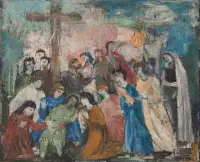
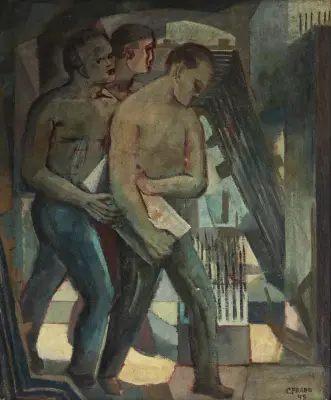
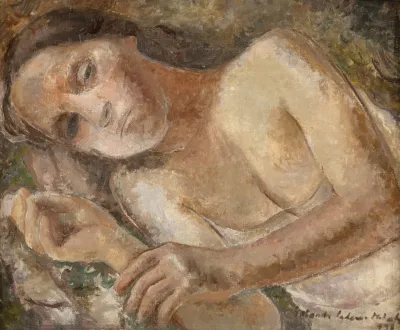
Born in Cluj Napoca, in present-day Romania, Yolanda Mohalyi studies drawing and painting at the Academy of Fine Arts in Budapest. It is formed in an artistic environment predominantly linked to German expressionism, but with a more poetic aspect. The Outdoor Moça (1930) painting is an example of this expressionist tendency and stands out for its heavy inks and for its melancholy and dramatic character. The artist came to Brazil in 1931, settling in São Paulo. His initial works have as their main theme the human figure and show concern for social injustices, as in the Unemployment (1931), carried out in dark tones.
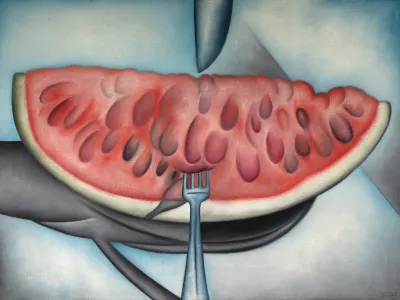
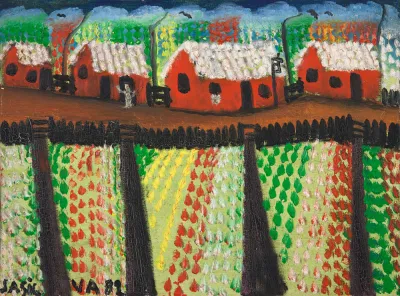
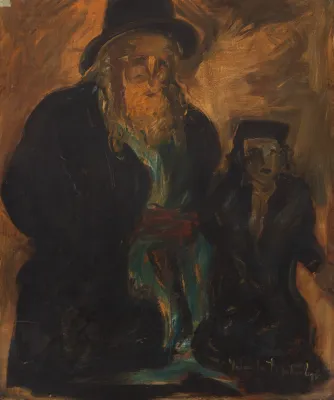
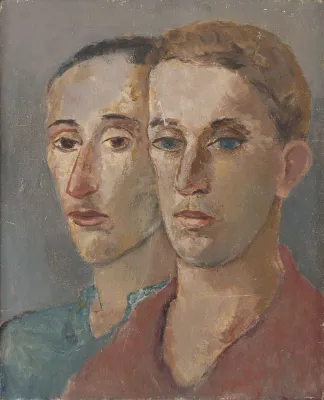
In Brazil, the painter is part of Group 7, with Victor Brecheret (1894). - 1955), Elisabeth Nobiling (1902 - 1975), Antonio Gomide (1895 - 1967), Rino Levi (1901 - 1965), John Graz (1891 - 1980) and Regina Graz (1897 - 1973). Yolanda reveals great admiration for the work of the painter Lasar Segall (1891-1957), of whom she becomes a friend. The affinity with Segall's poetics is shown in the formal aspects and also in the choice of themes: emphasis on the human figure, urban landscapes or fields with animals and especially in the concern to portray humble or disadvantaged characters, as occurs, for example, in the 20th century picture. (ca.1938). The palette is close to that used by Segall, with a dense and very elaborate chromatism, in which ocher tones predominate. Yolanda Mohalyi uses, however, more luminous and transparent nuances, compared to Segall's. It often uses yellow, although in lowered shades. It seeks to obtain, in oil painting, the effects of transparency characteristic of watercolor, a technique that it frequently uses and in which it reveals great dominance. It uses watercolor in various self-portraits, still lifes and also in some Brazilian landscapes, represented in a poetic climate as occurs in Ubatuba, Campos de Jordão or surroundings of Jacareí (all without date). In the watercolor boy with pineapple (1940) uses the formal simplification of Cubism, in a very personal invoice, with a light chromatic range.
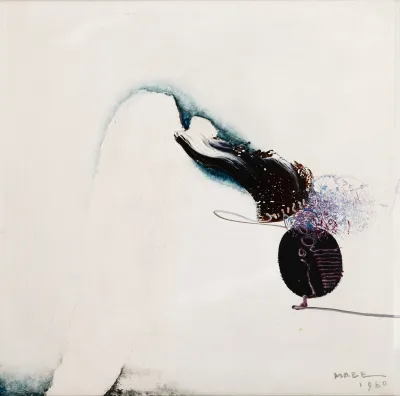
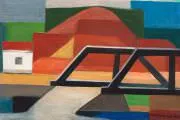
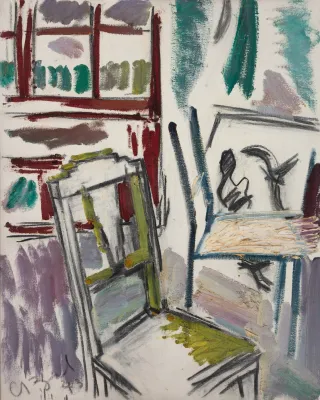
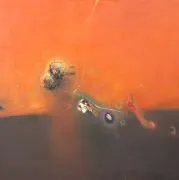
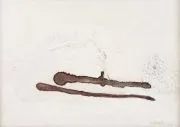
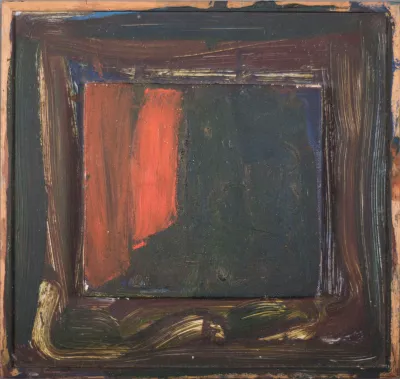
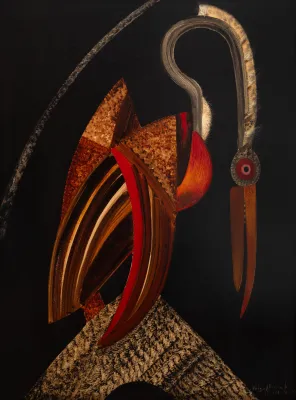
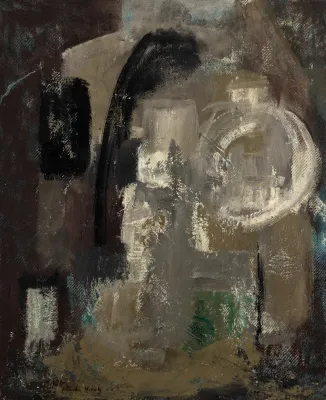
From the second half of the 1950s onwards, his work reveals the gradual passage to the abstraction, through the simplification and geometrization of the forms of the background of frames such as solitude (1955). Its abstract canvases from the 1950s feature color spots that approach rectangular shapes, painted very close to each other or overlapping and almost completely fill the surface of the canvas. The shades are usually dark and saturated. The artist often explores dense textures, using full-bodied paints, to which she adds sand and other rough materials, as occurs in a composition on the bank of the river (1959) or in research (s.d.).
Yolanda Mohalyi Since the late 1950s, it has become one of the most representative painters of informal painting in the country. He participates in several national and international exhibitions and in almost all the international biennials of São Paulo, between 1951 and 1967. Chosen as the best national painter at the 1963 Biennial, he has a special room at the next biennial. In this exhibition of 1965, it presents screens in which the condensation of color spots that emerge in large shapes occurs, on which linear elements appear, worked in wide gestures. The artist resumes in her paintings the search for the effects of transparency.
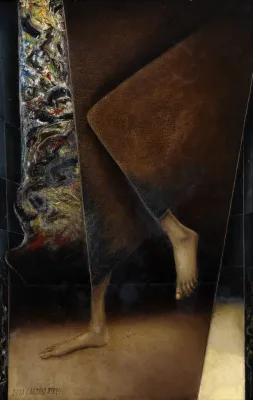
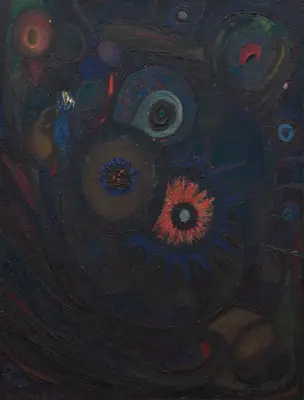
In her works, shapes gradually expand and occupy increasingly broad spaces, such as in A Grande Viagem (1969) or in evolving forms (s.d.). In the 1970s, the painter works with translucent images and explores musical harmonies such as in space flight (1971) or in autumn 72 (1972). Its paintings have floating colors, used in singular luminous expressions. The screen Meteoro (1971), representative of the last style adopted by it, offers the suggestion of a cosmic harmony, explored by the elaboration of the large space built in subtle tonal transitions.
Criticism
"Yoland Mohalyi stands out, in the fine arts, as one of the artist-painters among the most important we have had in the last 50 years. (...) Yolanda Lederer Mohalyi arrived in Brazil in 1931 (...). coloristics, coming from post-impressionist treatment, arriving at an expressiveness that we can call an expressionist force. The humble people, the children, the landscapes, which we have already mentioned, stand out with dark forests and old houses. (...) Little by little she felt that she also needed to give a more constructive nature in the composition of these images. (...) Thus, a well-defined phase emerged in his works, which limits the colorful planes in scenes represented by strong contours, many of which are black in color, which, consequently, led to a more abstract, more graphic, modality. (...) How she had always intensified her images through the modulation and beauty of colors, shortly afterwards she went on a much stronger non-figurative painting. At first there were true colored plaques, which she applied on the screens. Little by little this painting developed with more transparency, more luminosity, for the style of its painting, as it became better known and most appreciated".
Wolfgang Pfeiffer
PFEIFFER, Wolfgang. Mohalyi: a historical-critical synthesis. In: MOHALYI, Yolanda. Yolanda Mohalyi. São Paulo: Dan Galeria, 1982. p.3-4.
"His painting permeated human and social in the 30s and 40s, expressed by a palette of refined transparent tones. Later she would assume an informal abstract painting in which these chromatic values persisted and intensified.(...) Yolanda Mohalyi became one of the most representative figures of the trend (abstract expressionism) since 1957. Abandoning the figuration, always motivated, in the first half of the 1950s, by an abstraction of a geometrically ordered beginning, it approached the space occupied by freer forms. Through these, the painter prepared compositions of great ease, renewing her base colors - those that had identified her two decades before - and enriching her palette without losing anything from the emotional control that characterizes her".
Walter Zanini
ZANINI, Walter. New names In: ________ General History of Art in Brazil - I. São Paulo: Djalma Guimarães Foundation: Walther Moreira Salles Institute, 1983. p.618, 619, 697.
"The art for Yolanda Mohalyi has a specific purpose. Colors, systems of representation, the method are instruments in the service of their desire to organize and express a conception of life and the human being. Your vision is loaded with affection. It is the constant that accompanies his work away from theses and subjects. the inner belief and the posture in relation to human existence itself. It can be said that the main stimulus, the motive of its activity, is the internal combustion that, at a certain moment, needs the art for its concreteness. The internal constant and the expression - artistic object - is the consequence of an initial destination.
(...)
Yolanda Mohalyi, like many artists of her generation, humbly stood before art. (...) an artist who makes herself available to creation and not as a beneficiary and simple producer of pleasant or fashionable images. (...) There is no cult of the ego itself, there is no exaltation of the artist's personality. There is the severe and constant work of someone made available to the human being and who uses art as his vehicle.
But being available to the human being does not presuppose a sterile or mechanical engagement. Yolanda Mohalyi's art did not follow any political or sociological doctrine. She was an artist. His only guide was his sensitivity and intuition. His fidelity has always been to the human being, but his master guide, the sensor of his action, was intuition. (...) The only possible reality for the artist is his action. Yolanda Mohalyi's work reflects this initial condition. She devoted herself entirely to her action and, on the way, as with language creators, she approached artists and images."
Jacob Klintowitz
Klintowitz, Jacob. Yolanda Mohalyi. In: MOHALYI, Yolanda. Yolanda Mohalyi. São Paulo: Dan Galeria, 1984. p. 2-3.
"(...) The artistic creation for Yolanda did not constitute a mere craft, a simple profession. It was his reason for living, the link between the human dimension and spiritual transcendence. In a way, then, art assumed a ritualistic function for its religiosity.
(...)
Unstoppable in the quest to extend its limits, it was not content to remain in a style or technique, even if it dominated it. quietly. He studied continuously, renewing himself in each table through research and experience of new structuring and coloristic combinations.
The evaluation of his work, therefore, should not be stopped in the analysis of phases separately. Everything that produced a whole, a homogeneous set. The steps he took, from the figurative to the abstract, follow a natural, conscious order. Each period presupposes the other that precedes it. The changes do not occur by chance, but, on the contrary, they attend to an inner impulse of the artist. or rather, to his intuition.
In the figurative beginning, he uses his technique already refined to capture the real, exposing, on the one hand, his sensitivity to the Brazilian social theme and, on the other hand, the fascination with the tropical, country landscape and coastal. As his expressionist tendency is accentuated, aiming at Segall, but keeping his personal style in the watercolors of still life and landscapes, the figure becomes the vital concern: the child, the young, the old, the workers, the mutilated in the War.
Freeing oneself progressively from the influence of Segall and assimilating the new proposals of international art, through travel and biennials, it goes through a transitional phase. The crisis that erupts within you leads to a transformation. He is not satisfied with portraying the real, expressionistically. More concerned with the construction of forms, the compositions are geometrized under the inspiration of Braque and Picasso. Giving up the chromaticism he managed with total resourcefulness, he creates magnificent works of an excellent nascent technique. The figure, simplified by Cubism, slightly abstracted, stands out from an already clearly abstract background.
(...)
abstract, only resorting to the figure as a daily exercise of work, at the beginning it explores the grouping of forms, which appear closed, Accompanied by generally dark colors, sometimes modulated, sometimes saturated. It seems that the artist still could not release all the inner bonds, possibly due to the doubt between geometric and lyrical abstractionism.
Gradually, however, after research of importance and texture, the definition by lyrical abstractionism is solidified and the painter begins to make more and more audacious leaps, reaching, at the height of her career, the fullness of expression. His very original chromatic expression.
Since the first works of the 1930s, his paintings stand out for the coloristic treatment he lends to his compositions. The colors are used in the construction of the volumes of human figures, still lifes and landscapes.
In the period in which he approached Segall, by the way, what distinguishes it from the painter - to the point of causing him admiration - consists precisely in the effects of luminosity and transparency. present in the watercolors produced in this expressionist phase.
(...)
However, if figurative, until the end of the 40s, the Segallian influence is evident (...) Unmistakable".
Lucia Helena Bortolo de Rezende
REZENDE, Lúcia Helena Bortolo. From figurative to lyrical abstractionism: description and analysis of the work of the painting Yolanda Mohalyi. In: MOHALYI, Yolanda. Yolanda Mohalyi. Sao Paulo: MAC/USP, 1988. p.11-13.
Testimonies
"They say that the abstract It is overcome, but in fact its field is unlimited. The abstract, like a word, does not cover what we do, does not express the painter's process. Many ask if I will stop with the abstract. I say that when I saturate myself, I will look for another form of expression. But I think I am very connected to the discovery of the universe and this is reflected in the painting: my abstract always give an almost cosmic view.
I feel that the landscape, the systems, can exist in the cosmos; Even if they are not seen, they participate in our reality. The same law that governs the cosmos, governs the picture.
This is our creative attitude".
Yolanda Mohalyi
MOHALYI, Yolanda. Yolanda Mohalyi. are Paulo: MAC/USP, 1988. P. 18.
"About influences on personal style, I can add that style is the result of the individual's individualization; It depends on the artist's ability, as an individual - without being anti-collective, living reality, forming concepts - of deciding his course, forging his identity, without giving in to massification". MOHALYI, Yolanda. Yolanda Mohalyi. São Paulo: MAC/USP, 1988. P. 16.
Corps
Banca Itaú S.A. - São Paulo SP
Collection of the Pinacoteca do Estado de São Paulo/Brazil - São Paulo SP
Museum of Contemporary Art of the University of São Paulo - SP
Museum of Modern Art of São Paulo - SP
Museum of Modern Art of Rio de Janeiro - RJ
Museum of Contemporary Art - MAC/PR - Curitiba pr
National Museum of Fine Arts - MNBA - Rio de Janeiro RJ
Individual exhibitions
1945 - São Paulo SP - First individual, IAB/SP
1950 - São Paulo SP - Individual, at MASP
1951 - Salvador BA - Individual, at Galeria Oxumaré
1955 - New York (United States) - Individual, at South American Gallery
1955 - São Paulo SP - Individual, at MAM/SP
1956 - Buenos Aires (Argentina) - Individual, at Galeria Pizarro
1957 - Paris (France) - Individual, at Galerie Colette Allendy
1957 - São Paulo SP - Individual, at Galeria Ambiente
1961 - São Paulo SP - Individual, at Galeria Astreia
1962 - São Paulo SP - Individual, at Galeria São Luís
1962 - Paris (France) - Invidual, Galerie 1900-2000
1964 - Rio de Janeiro RJ - Individual, at the Montmartre-Jorge Gallery
1964 - São Paulo SP - Individual, at the gallery Vocational
1965 - New York (United States) - Individual, at the South American Gallery
1965 - Rio de Janeiro RJ - Individual, at MAM/RJ
1968 - Mexico City (Mexico) - individual, at the Merk-Cup Gallery
1969 - São Paulo SP - Individual, at the Documenta Galeria de Arte
1970 - Campinas SP - Individual, at Banco Lar Brasileiro
1970 - New York (United States) - Individual, at Iramar Gallery
1970 - Washington D.C. (United States) - Individual, at the Dimock Gallery
1971 - São Paulo SP - Individual, at the Cosme Velho Gallery
1972 - Belo Horizonte MG - Individual, at the gallery Guignard
1974 - Washington D.C. (United States) - Individual, at the Art Gallery of the Brazilian-American Cultural Institute
1975 - New Orleans (United States) - Individual, at Danna Center Art Gallery
1976 - Asunción (Paraguay) - Individual, at the Center for Brazilian Studies
1976 - São Paulo SP - Individual, at the Alberto Bonfiglioli Gallery
1976 - São Paulo SP - Retrospective, at MAM/SP
Collective exhibitions
ca.1928 - Budapest (Hungary) - participates in an exhibition at the Royal Academy of Fine Arts
1934 - São Paulo SP - 1st Salon Paulista de Belas Artes
1934 - São Paulo SP - 1st Salão Paulista de Belas Artes, at Rua 11 de Agosto
1934 - São Paulo SP - Collective, at the Sumaré House Gallery
1935 - São Paulo SP - 2nd Paulista Salon of Fine Arts - Small Gold Medal
1935 - São Paulo SP - 3rd Paulista Salon of Fine Arts
1937 - São Paulo SP - 1st May Salon, at the Esplanada Hotel de São Paulo
1936 - São Paulo SP - 4th São Paulo Salon of Fine Arts - Jury exemption and gold medal
1938 - São Paulo SP - 2nd Salão de Maio, at Esplanada Hotel de São Paulo
1939 - São Paulo SP - 3rd Salon of May, at Galeria Itá
1949 - Rio de Janeiro RJ - Exhibition of Painting Paulista
1951 - Rio de Janeiro RJ - Exhibition of dead natures, in the Food and Social Security Service
1951 - São Paulo SP - 1st São Paulo International Biennial, at the Trianon Pavilion
1952 - Rio de Janeiro RJ - Exhibition of Brazilian Artists, at MAM/RJ
1952 - São Paulo SP - 2nd Salon Paulista de Arte Moderna, at the Prestes Maia Gallery - State Government Award
1953 - Rio de Janeiro RJ - Collective, at the Department of Education - SAPS Award
1953 - Rio de Janeiro RJ - Collective, at the Department of Education at SESI - Social Award
1953 - São Paulo SP - 2nd São Paulo International Biennial, at the State Pavilion
1953 - Tokyo (Japan) - 2nd Tokyo Biennial
1954 - Salvador BA - National Salon of Modern Art of Bahia - Acquisition Award
1954 - São Paulo SP - 3rd Salão Paulista de Arte Moderna, at the Prestes Maia Gallery - Acquisition Award
1954 - São Paulo SP - 5 designers, at MAM/SP
1954 - São Paulo SP - Contemporary Art: Exhibition of the collection of the Museum of Modern Art of São Paulo, at MAM/SP
1955 - Rio de Janeiro RJ - 4th National Salon of Modern Art
1955 - São Paulo SP - 4th Salão Paulista of Modern Art, at Galeria Prestes Maia
1955 - São Paulo SP - Collective, at the Sumaré House Gallery
1957 - Rio de Janeiro RJ - 6th National Salon of Modern Art
1957 - São Paulo SP - 4th São Paulo International Biennial, at the Ciccilo Matarazzo Sobrinho Pavilion
1958 - Rio de Janeiro RJ - Collective, at MAM/RJ
1958 - São Paulo SP - Collective, at the Folhas Art Gallery
1959 - Leverkusen (Germany) - First collective exhibition of Brazilian artists in Europe
1959 - Munich (Germany) - First collective exhibition by Brazilian artists in Europe, at Kunsthaus
1959 - São Paulo SP - 5th São Paulo International Biennial, at the Ciccilo Matarazzo Sobrinho Pavilion - Federal Government Award
1959 - São Paulo SP - Collective, at the Folhas Art Gallery
1959 - Tokyo (Japan) - 5th Tokyo Biennial
1959 - Vienna (Austria) - First collective exhibition of Brazilian artists in Europe
1960 - Hamburg (Germany) - First collective exhibition of Brazilian artists in Europe
1960 - Lisbon (Portugal) - First collective exhibition of Brazilian artists in Europe
1960 - Madrid (Spain) - First collective exhibition by Brazilian artists in Europe
1960 - Paris (France) - First collective exhibition by Brazilian artists Europe
1960 - Rio de Janeiro RJ - 9th National Salon of Modern Art, at MAM/RJ - Jury Exemption
1960 - São Paulo SP - Leirner Collection, at the Folhas Art Gallery - Leirner Award Painting
1960 - São Paulo SP - Women's contribution to the fine arts in the country, at MAM/SP
1960 - Utrecht (Holland) - First collective exhibition of Brazilian artists in Europe
1960 - São Paulo SP - Contribution of Woman to the Fine Arts in the country, at MAM/SP
1961 - Rio de Janeiro RJ - 10th National Salon of Modern Art
1961 - São Paulo SP - 6th São Paulo International Biennial, at the Ciccilo Pavilion Matarazzo Sobrinho
1961 - São Paulo SP - 10th Salão Paulista de Arte Moderna, at Galeria Prestes Maia
1962 - Córdoba (Argentina) - 1st American Art Biennial
1962 - São Paulo SP - Selection of Brazilian works of art from the Ernesto Wolf collection, at MAM/SP
1963 - Campinas SP - Contemporary painting and sculpture, at the Carlos Gomes Museum
1963 - Munich (Germany) - Collective, at the consulate from Brazil
1963 - São Paulo SP - 7th São Paulo International Biennial, at the Bienal Foundation - Best National Painter
1963 - ULM (Germany) - Kunstverein
1964 - Bogotá (Colombia) - 1st South American Biennial
1964 - Rio de Janeiro RJ - 2nd The face and the work, at the Ibeu Copacabana Gallery
1964 - Rio de Janeiro RJ - Collective, at the gallery L'Atelier
1964 - Rome (Italy) - Collective, at Galeria d'Arte della Casa do Brasil
1965 - Europe - Current Brazilian painting (exhibition organized by Itamaraty and Itinerante in several cities Europeans)
1965 - São Paulo SP - 8th International Biennial of São Paulo - Special Room, at the Bienal Foundation
1966 - Berlin (Germany) - Collective, at the Consulate of Brazil
1966 - Rio de Janeiro RJ - Self-portraits, at Galeria Ibeu Copacabana
1966 - Rio de Janeiro RJ - Salão IV Centenary of Rio de Janeiro, at MAM/RJ
1966 - Salvador BA - 1st National Biennial of Fine Arts
1966 - São Paulo SP - Three premises, at MAB/FAAP
1967 - São Paulo SP - 9th São Paulo International Biennial, at the Bienal Foundation
1969 - São Paulo SP - 1st Panorama of Current Brazilian Art, at MAM/SP
1970 - São Paulo SP - 2nd Panorama of Current Brazilian Art, at MAM/SP
1971 - Curitiba PR - 28th Salão Paranaense, at the Public Library of Paraná - Awarded
1971 - São Paulo SP - 11th São Paulo International Biennial, at Fundação Bienal
1973 - Belo Horizonte MG - 5th National Contemporary Art Salon, at the Art of Pampulha Museum - Belo City Hall Award Horizonte
1973 - São Paulo SP - 5th Panorama of Current Brazilian Art, at MAM/SP
1975 - São Paulo SP - 13th International Biennial of São Paulo, at the Biennial Foundation
1976 - São Paulo SP - 8th Panorama of Current Brazilian Art, at MAM/SP
1976 - São Paulo SP - Immigrants in the Plastic Arts of São Paulo, at MASP
1976 - São Paulo SP - The salons: from the São Paulo Artistic Family, in May and from the Union of Plastic artists from São Paulo, at the Lasar Segall Museum
1976 - São Paulo SP - 8th Panorama of Current Brazilian Art, at MAM/SP
1977 - São Paulo SP - 14th International Biennial of São Paulo, at the Fundação Bienal
1978 - São Paulo SP - The Biennials and the Abstraction: The 50's, at the Lasar Segall Museum
Posthetic exhibitions
1979 - São Paulo SP - 15th São Paulo International Biennial, at the Bienal Foundation
1979 - São Paulo SP - Individual, at MAC/USP
1980 - São Paulo SP - Masters of lyrical abstractionism in Brazil, at the Eugenie Villien Gallery
1982 - São Paulo SP - From Modernism to Bienal, at MAM/SP
1982 - São Paulo SP - Yolanda Mohalyi: Retrospective, at Dan Galeria
1984 - São Paulo SP - Individual, at Dan Gallery
1985 - Rio de Janeiro RJ - Six decades of modern art: Roberto Marinho Collection, at Paço Imperial
1985 - São Paulo SP - 100 Obras Itaú, at Masp
1985 - São Paulo SP - 18th São Paulo International Biennial, at Fundação Bienal
1987 - São Paulo SP - 20th Contemporary Art Exhibition, at Chapel Art Show
1987 - São Paulo SP - The biennials in the MAC collection: 1951 A 1985, at MAC/USP
1988 - São Paulo SP - MAC 25 years: Highlights of the initial collection, at MAC/USP
1988 - São Paulo SP - Retrospective, at MAC/USP
1989 - Lisbon (Portugal) - Six decades of Brazilian modern art: Roberto Marinho Collection, at the José de Azeredo Perdigão Modern Art Center
1989 - São Paulo SP - 20th São Paulo International Biennial, NA Bienal Foundation
1989 - São Paulo SP - Painting Brazil 20th Century: works from the collection of Banco Itaú, in Itaugaleria
1990 - Brasília DF - figurativism/abstractionism: the red in painting Brazilian, at Itaú Galeria
1990 - São Paulo SP - Figoftivism/abstractionism: the red in Brazilian painting, at Itaú Cultural
1991 - Belo Horizonte MG - figuratetivism/abstractionism: the red in Brazilian painting, in the ItaúgaLeria
1991 - Santos SP - 3rd National Biennial of Santos, at the Patrícia Galvão Cultural Center
1993 - Campinas SP - Figurativism/abstractionism: the red in Brazilian painting, at the Center for Informatics and Culture II
1993 - João Pessoa PB - Woodcut: From Cordel to Galeria, at the Espaço Cultural da Paraíba Foundation
1993 - São Paulo SP - MASP at Morumbi Shopping, at Shopping Morumbi
1994 - São Paulo SP - Bienal Brasil Século 20th, at the Bienal Foundation
1994 - São Paulo SP - Woodcut: From Cordel to Galeria, in the company of the metropolitan of São Paulo
1996 - São Paulo SP - Brazilian art: 50 years of history in the MAC/USP collection: 1920-1970, at MAC/USP
1997 - São Paulo SP - Big names in Brazilian painting, at Jo Slaviero Art Gallery
1998 - São Paulo SP - São Paulo iconography in private collections, at the Museu da Casa Brasileira
2000 - São Paulo SP - Brazil + 500 rediscovery show. Modern Art, at the Bienal Foundation
2001 - Rio de Janeiro RJ - Brazilian Watercolor, at the Light Cultural Center
2002 - São Paulo SP - Modernism: from the week of 22 to the Art Section of Sérgio Milliet CCSP
2004 - São Paulo SP - Gesture and Expression: Informal abstractionism in the collections JP Morgan Chase and MAM, at MAM/SP
2004 - São Paulo SP - Abstraction as language: profile of a collection, in the Pinakotheke
2004 - São Paulo SP - Women painters, at the Pinacoteca do Estado
Source: Itaú Cultural