Wasth Rodrigues (São Paulo SP 1891 - Rio de Janeiro RJ 1957)
Painter, draftsman, ceramist, illustrator, historian and teacher.
José Wasth Rodrigues studied with Oscar Pereira da Silva (1867 - 1939) between 1908 and 1909 in São Paulo. In 1910, as a state government scholarship holder, he traveled to Paris. He enrolled at the Académie Julian, where he studied with Jean-Paul Laurens (1838 - 1921), and at the École Nationale des Beaux-Arts he attended the classes of Lucien Simon (1861 - 1945) and Nandi. He returned to São Paulo in 1914 and, two years later, opened a drawing and painting course with Georg Elpons (1865 - 1939) and William Zadig (1884 - 1952). In 1917, with Guilherme de Almeida (1890 - 1969), he created the coat of arms of the city of São Paulo. Around 1918, he began studies on colonial history and was one of the pioneers in the systematic analysis of the artistic activities practiced in that period. In the 1920s, he created decorative panels for the four monuments that adorn the Calçada do Lorena and the old road to Santos. In 1932, he was among the founders of the Sociedade Pró-Arte Moderna - SPAM [Pro-Modern Art Society]. He illustrated several books, among them Urupês, by Monteiro Lobato (1882 - 1948), Uniformes do Exército Brasileiro 1720-1922 [Uniforms of the Brazilian Army 1720-1922], by Gustavo Barroso (1888 - 1959), Brasões e Bandeiras do Brasil [Coats of Arms and Flags of Brazil], by Clóvis Ribeiro (1933), and Vida e Morte do Bandeirante [Life and Death of the Bandeirante], by Alcântara Machado (1875 - 1941). Between 1935 and 1936, he designed a project for the restoration of the benches and iron railings of the Church of Nossa Senhora do Rosário in Ouro Preto. The following studies of his authorship were published: Documentário Arquitetônico Relativo à Antiga Construção Civil no Brasil [Architectural Documentary on Old Civil Construction in Brazil] (1945), Mobiliário do Brasil Antigo [Furniture of Old Brazil] and Evolução de Cadeiras Luso-Brasileiras [Evolution of Luso-Brazilian Chairs] (1958).
Critical Commentary
Wasth Rodrigues studied painting with Oscar Pereira da Silva (1867 - 1939) between 1908 and 1909. He held his first solo exhibition in 1910 and received a state government scholarship to further his studies in Europe. In Paris, he studied at the Académie Julian with Jean-Paul Laurens (1838 - 1921) and at the École Nationale Supérieure des Beaux-Arts with Lucien Simon (1861 - 1945) and Nandi. He frequented the café La Rotonde, where he came into contact with artists such as Mugnaini (1895 - 1975), Alípio Dutra (1892 - 1964), Monteiro França (1875 - 1944) and José Marques Campão (1892 - 1949). He also befriended the painter Amedeo Modigliani (1884 - 1920).
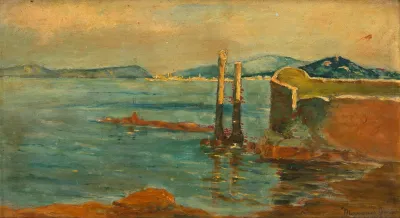
He returned to Brazil because of the outbreak of World War I (1914 - 1918) and settled in São Paulo. In 1916, he exhibited in the city the works made in France and also his new landscapes, many of them painted in towns in the interior of São Paulo state. As the scholar Ruth Tarasantchi points out, several of the canvases set in São Paulo are compositions with gentle hills in the background, stretches of river in the foreground and shrubs reflected in the calm waters, conveying an impression of great calm.
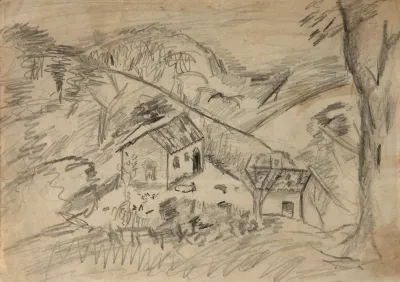
That same year, Wasth Rodrigues created an art course with the painter Georg Elpons (1865 - 1939) and the sculptor William Zadig (1884 - 1952), and taught painting at night. He traveled to Minas Gerais and made watercolors and pen-and-ink drawings in which he presented stretches of colonial architecture in rich detail. At the same time, he became a great scholar of the subject. In 1921, he traveled through the north of the country, Bahia and Pernambuco. His interest in the national landscape aroused the interest of Monteiro Lobato (1882 - 1948), who wrote about his works in the newspaper O Estado de S. Paulo and invited him to illustrate the newly launched Revista do Brasil. In 1918, he created the cover of the book Urupês, by Monteiro Lobato, the first of the many he would make.
Rodrigues painted portraits of historical figures, such as João Ramalho and Martim Afonso de Souza, and painted several views of the city of São Paulo based on drawings and watercolors by travelers who were here in the 19th century, especially Hercule Florence (1804 - 1879). The paintings were commissioned in the first decades of the 20th century by the director of the Museu Paulista da Universidade de São Paulo - MP/USP [Paulista Museum of the University of São Paulo], Affonso de Escragnolle Taunay; they belong to that institution's collection and helped build the imagery of the São Paulo bandeirante.
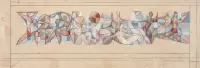
He also worked with painting on tiles, notably the works he made for the obelisk in Largo da Memória in São Paulo and for the monuments along the Caminho do Mar, the traditional road between Santos and São Paulo.
Wasth Rodrigues created many bookplates and coats of arms, such as that of the city of São Paulo, in 1917, with Guilherme de Almeida (1890 - 1969), and also that of the state, in 1932. He also stood out for his work as a historian, leaving several publications devoted to the architectural documentation of civil and religious construction and works on old furniture, costume, insignia and military weapons.
Critiques
"As a researcher, he wrote for the DPHAN journal on 'Móveis Antigos de Minas Gerais' [Old Furniture of Minas Gerais] and 'A Casa de Moradia no Brasil Antigo' [The Dwelling House in Old Brazil]. He also published documentaries on old civil construction, uniforms of the United Kingdom and the Empire, civil and military costume in Pernambuco during Dutch rule, and São Paulo troops of yore; he drew and painted in watercolor the uniforms of the Brazilian army for Gustavo Barroso's book, and also illustrated the book Brasões e Bandeiras do Brasil by Clóvis Ribeiro. He left hundreds of coats of arms and bookplates. He had a deep knowledge of the D. João V, D. José and D. Maria styles, carved both in Brazil and in Portugal. He also devoted himself to illustrating magazines and illuminations. Together with Guilherme de Almeida, he made the coat of arms of the city of São Paulo.
Even as a painter, J. W. Rodrigues never ceased to be a historian, which greatly influenced his work; countless are the works he left in pencil, pen and ink, watercolor and oil about colonial Brazil.
Considered a specialist in interpreting colonial settings, he painted landscapes of São Paulo based on old Spanish prints and a dozen 19th-century streets. He painted São Paulo ladies of 1808 from prints by John Mawe and Rugendas, soldiers of the Paulista legion of the Cisplatine and a gaucho, and colonial houses in Santos based on drawings by Florence. All these paintings are now in the Museu Paulista".
Ruth Sprung Tarasantchi
TARASANTCHI, Ruth Sprung. Pintores paisagistas em São Paulo (1890 - 1920). 1986. 303 p. Doutorado - , São Paulo, 1986, p. 445-446.
"I did not see in the Rio newspapers any notice of the death of José Wasth Rodrigues, which occurred on the night of April 21, in this very city. This gives an idea of what this illustrious and discreet man was, who could well claim for himself the title of one of the greatest Brazilian historians, not through the written word but through the image. All of Wasth Rodrigues's immense work, much esteemed by scholars, is almost unknown to the public. He did nothing to become news. His shade will forgive me if I now turn him into a chronicle.
Wasth Rodrigues was a painter, with a travel prize to Europe, but old Brazil concerned him more than the reality of today. So he went out across present-day Brazil to research the old, and there is practically no colonial house, church or bridge that he did not record in drawing or watercolor, for documentary purposes. Before the taste for photographic documentation spread, his pencil was already taking faithful notes of things that no longer exist or have been disfigured, and these sketches would serve the inventory of our artistic riches as precious elements of information. Many years after passing by an object worthy of historical contemplation, Wasth's memory was able to reconstruct it in a sure drawing, made with his left hand.
But he was not only a recorder of old forms, on paper or canvas. Three things he understood like an expert, and I do not know whether anyone would beat him in the shrewdness of identifying them: furniture, costume and weapons. His knowledge of old furniture, old uniforms and old swords and carbines was stored in an orderly way in his head, making him a living encyclopedia and, what is more admirable, without a trace of presumption. Wasth did not flaunt knowledge; he simply possessed it. No one saw him laying down doctrine in circles of artists, critics or researchers; when consulted, he informed and fell silent, with the shrewd silence of a caipira - that civilized caipira who still lingered in his voice, as they say also marked that of his fellow Paulista Almeida Júnior. Faced with loudmouths, he looked on, at most smiled slightly, and did not contradict. Rodrigo M. F. de Andrade observed that he had not the slightest interest in making his point of view prevail.
(...)
In Paris, in his youth, he was the roommate - and companion in poverty - of the painter Modigliani, who painted his portrait and gave him countless paintings, unfortunately lost. Wasth was far from foreseeing the world renown of his friend, whose great kindness he praised. For his part, he died poor, as is tradition among Brazilian artists and scholars. A silent collaborator of the D.P.H.A.N., a donor of books and drawings of his own to the agency's collection, the good Wasth Rodrigues was in every way an exemplary Brazilian, for his dignity, his profound knowledge and his charming modesty".
Carlos Drummond de Andrade
[Text originally published in 1957]
ANDRADE, Carlos Drummond de. O bom Wasth Rodrigues. O Estado de S. Paulo, São Paulo, 28 jan. 2001.
Solo Exhibitions
1910 - São Paulo SP - Solo
1915 - São Paulo SP - Solo
1925 - São Paulo SP - Solo
1953 - São Paulo SP - Solo
Group Exhibitions
1912 - São Paulo SP - Segunda Exposição Brasileira de Belas Artes [Second Brazilian Fine Arts Exhibition], at Liceu de Artes e Ofícios
1914 - Rio de Janeiro RJ - 21ª Exposição Geral de Belas Artes [21st General Exhibition of Fine Arts], at Enba - honorable mention
1914 - Paris (France) - Salon des Artistes Français - Société des Artistes Français
1915 - Rio de Janeiro RJ - 22ª Exposição Geral de Belas Artes [22nd General Exhibition of Fine Arts], at Enba - bronze medal
1916 - Rio de Janeiro RJ - 23ª Exposição Geral de Belas Artes [23rd General Exhibition of Fine Arts], at Enba - silver medal
1916 - São Paulo SP - Group show, at Palacete Prates
1922 - São Paulo SP - 1ª Exposição Geral de Belas Artes [1st General Exhibition of Fine Arts], at Palácio das Indústrias
1928 - Rio de Janeiro RJ - 35ª Exposição Geral de Belas Artes [35th General Exhibition of Fine Arts], at Enba
1928 - São Paulo SP - Grupo Almeida Júnior [Almeida Júnior Group], at Palácio das Arcadas
1929 - Rosario (Argentina) - 11º Salão de Rosário [11th Rosario Salon]
1933 - São Paulo SP - 1ª Exposição de Arte Moderna da SPAM [1st SPAM Modern Art Exhibition], at Palacete Campinas
1933 - São Paulo SP - Salão Paulista de Belas Artes [São Paulo Fine Arts Salon] - small gold medal
1934 - São Paulo SP - 1º Salão Paulista de Belas Artes [1st São Paulo Fine Arts Salon], at Rua 11 de Agosto - 1st painting prize
1935 - São Paulo SP - 2º Salão Paulista de Belas Artes [2nd São Paulo Fine Arts Salon]
1940 - São Paulo SP - Exposição Retrospectiva: obras dos grandes mestres da pintura e seus discípulos [Retrospective Exhibition: Works by the Great Masters of Painting and Their Disciples]
1949 - São Paulo SP - 15º Salão Paulista de Belas Artes [15th São Paulo Fine Arts Salon], at Galeria Prestes Maia
1953 - São Paulo SP - Group show, at Galeria de Arte de Barros
1956 - São Paulo SP - 50 Anos de Paisagem Brasileira [50 Years of Brazilian Landscape], at MAM/SP
Posthumous Exhibitions
1958 - São Paulo SP - Retrospectiva de suas obras [Retrospective of His Works], at ACM
1963 - São Paulo SP - Mostra de Aquarelas e Desenhos [Exhibition of Watercolors and Drawings], at Galeria de Arte São Paulo
1970 - São Paulo SP - Pinacoteca do Estado de São Paulo 1970 [São Paulo State Pinacotheca 1970], at Pinacoteca do Estado
1975 - São Paulo SP - SPAM e CAM [SPAM and CAM], at Museu Lasar Segall
1978 - São Paulo SP - A Paisagem na Coleção da Pinacoteca [Landscape in the Pinacoteca Collection], at Pinacoteca do Estado
1981 - São Paulo SP - Destaque do Mês [Highlight of the Month], at Pinacoteca do Estado
1986 - São Paulo SP - Dezenovevinte: uma virada no século [Dezenovevinte: A Turn of the Century], at Pinacoteca do Estado
1997 - São Paulo SP - São Paulo Antiga [Old São Paulo], at Arquivo Histórico Municipal
1998 - Rio de Janeiro RJ - Imagens Negociadas: retratos da elite brasileira [Negotiated Images: Portraits of the Brazilian Elite], at CCBB
1998 - São Paulo SP - Iconografia Paulistana em Coleções Particulares [São Paulo Iconography in Private Collections], at Museu da Casa Brasileira
2000 - São Paulo SP - O Café [Coffee], at Banco Real
2000 - Valencia (Spain) - De la Antropofagia a Brasilia: Brasil 1920-1950 [From Anthropophagy to Brasília: Brazil 1920-1950], at IVAM - Centre Julio González
2002 - São Paulo SP - Da Antropofagia a Brasília: Brasil 1920-1950 [From Anthropophagy to Brasília: Brazil 1920-1950], at MAB/Faap
2004 - São Paulo SP - São Paulo Ano 450 [São Paulo Year 450], at Conjunto Cultural da Caixa
Source: Itaú Cultural