Véio (Nossa Senhora da Glória, Sergipe, 1947)
Esculturer.
Cicero Alves dos Santos wins the nickname of Véio from other children for enjoying listening to the conversations of the elders. The fascination with cases and legends of country culture accompanies the artist throughout his life. These stories form the basis of your work and your relationship with the world. In the neighboring municipality of Feira Nova (Sergipe), on Sítio Soarte, he creates the Sertão Museum, bringing together a collection of 17,000 works that recount the ways of life and production of the sertanejo and preserve the popular culture of the region.
“I am not from Copy, like a parrot”, says Véio, who has never studied art, nor does he have masters, but has always dedicated himself to it with determination. As a boy, in the intervals of work in the fields, he molds small figures with beeswax with beeswax. Considering the activity as “playing a doll”, it breaks up the sculptures when an adult approaches. Over time, it abandons wax and adopts wood as raw material. But it doesn't cut down trees to get it. On the contrary: his preservationist instinct leads him to acquire the last stretch of virgin forest in the region. “I give life to what is already dead”, he says1.
With a strong creative impulse, he dedicates himself exclusively to his sculptures, a decision received with strangeness by the family and by acquaintances. opts for austere life and is proud to never work for others and refuse to sell his works when he thinks that the buyer does not value it. In other words, it never compromises its art to guarantee survival, nor does it consider its artistic work as a mere means of life.
The sculptor is one of those chosen by the 30-year Itaú Cultural Award, held in 2017, to highlight artists who impact the Brazilian cultural scene in recent decades. With a clear and fertile work method, he separates his works into two groups. “The larger, colorful pieces are showy, they speak loudly. They are visible from a distance, they create clearings around them, even when they are filled, as happens in their warehouse, workshop and museum. The smaller ones, which preserve the texture of raw wood, are discreet, speak. bass”, summarizes Carlos Augusto Calil (1951) and Agnaldo Farias (1955), curators of the artist's retrospective held in 2018 at Itaú Cultural2.
Largest works are produced at Starting from "open trunks", as Véio calls the pieces of wood whose angles and shapes suggest to him the way forward. It adds industrial, vibrant and intense colors to them, which give coherence to the sculptures and, according to the critic Rodrigo Naves (1955), generate a “pop effect”. These anthropomorphic figures, which spring from the artist's imagination when contacting the play to be carved, can hardly be reduced to popular art.
According to the critic Ronaldo Brito (1949), the works of veio flee from the mimetic virtuosity characteristic of this type of production to approach questions specific to modern and contemporary art3. In addition to the containment of the gesture and the impacting colors, these works question the very notion of art space. Véio distributes his strange figures around the site, as if they were inhabitants of the place and refers to them as bearers of history and life. But the appearance of these sculptures is easily transmuted, depending on the location and position in which they are. “Lying down, I was asking for help; standing, she wanted to hug me”4, details the artist when talking about the sensations that the original wood transmits to it and that, in a way, are preserved in the final piece.
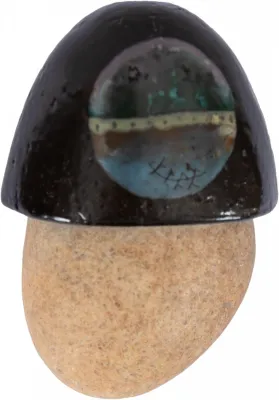
In the second group, there are the Carvings of the "closed woods", as Veio calls the less suggestive trunks, straighter and able to more imaginative, detailed and closest to the real world. These works have smaller dimensions, sometimes the size of a matchstick head. The difference in size, however, does not seem important to the artist: the small pieces also belong to the world of narrative and are like anecdotes told by the artist.
What I want “is to show lovers of art that it is not measured either by size or weight”. What matters is “your feeling, your form of expression”. Some themes are recurring: domestic scenes, with mothers and their children, the toil of artisans and the country man, the disregard for the culture and impotent loneliness of the Indians.
Veio also opens to the Torrent of myths, legends of northeastern culture and enchants the public with its mixture of fantasy and dexterity. In the series The Dogs of My Inferno, it portrays beings demonized in an intense shade of black. also portrays clowns and recreates The narratives and the imaginary of the illiterate people, who listen enraptured since childhood.
Notes
1 Testimony in Véio, Adelina Pontual Documentary (2005).
2 CALIL, Carlos Augusto; FARIAS, Agnaldo. Veio – the imagination of wood. São Paulo: Itaú Cultural, 2018, p.35.
3 Conversation around the exhibition Véio – by surprise in the world, 16 jun. 2017. Available at < https://www.youtube.com/watch?v=43L0888NFKW >. Access on: 23 Mar. 2018.
4 NAVES, Rodrigo. Cícero Alves dos Santos [Véio] – Sculptures. São Paulo: Martins Fontes, 2014, p.150.
Source: Itaú Cultural