
Ricardo Ribenboim (São Paulo SP 1953)
Ricardo Ribenboim is a graphic and product designer. He lives and works in São Paulo, where he has been developing editorial graphic design and visual identity projects since 1973. Between 1972 and 1975, he studied architecture at the Faculdade de Arquitetura de Santos. He was a student of Yutaka Toyota (1931), Evandro Carlos Jardim (1935), Babinski (1931), Luiz Paulo Baravelli (1942) and Carlos Fajardo (1941). In his work, he investigates the boundaries between graphic design and the visual arts, using different materials and media, both physical and electronic. He has carried out several urban interventions in Brazil and abroad, notably Bólides Marinhos [Marine Bolides] (1992), on Ipanema Beach during ECO-92, and the group of interventions for the project Arte Cidade 3: a cidade e suas histórias [Arte Cidade 3: The City and Its Stories].
From 1996 to 1997, he directed the Paço das Artes in São Paulo, and in 1997 he became director of Itaú Cultural. In 1998, he was the international curator of web art at the 24th São Paulo International Biennial. In 2002, he founded Base7 Projetos Culturais, a company that plans and coordinates cultural activities, responsible for organizing exhibitions at the Museu Oscar Niemeyer (MON) and for the design of the Espaço Frans Krajcberg, both in Curitiba.
Critiques
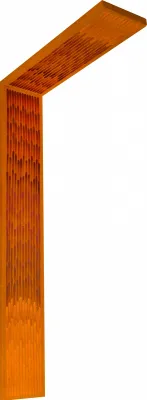
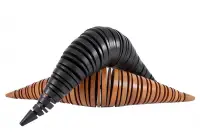
"[...] In his recent works, Ribenboim moves from matter to form, but without ever abandoning its latent sign quality; on the contrary, he deepens the study of the condition of every sign which, as such, finds in being its origin and destiny. Thus, the long cylinder made of articulated slices of dark wood, with its ends closing into cones, is a line segment and a serpent, a geometric figure, an animal and a virus. The ambiguity is heightened by the material used, as in the version made in silicone, a material with an organic appearance even though it results from an advanced stage of industry ["Open 2000", Venice].
In a presentation at the Nara Roesler gallery, a performance showed this sculpture intertwining with the body of a dancer. More than the interactivity between the work of art and the viewer, historically championed by our Constructive artists, what took place was a work constructed by the merging of bodies, a transitivity that called into question the proximity between being and sign. For those who conceived of these terms as separate, in this performance the body of the sign coiled around the body of being, a momentary suspension of the distance that keeps them apart.
Other new installations took place at the Paço - among them, the projection of virtual viruses into a smoke-filled room, which brings the visitor to the experience of contact - attraction and repulsion - and to the instability of drawing, in a space whose support is also unstable [...]."
Agnaldo Farias
"[...] Before Ribenboim's new works, shown here, the sensation one experiences is diametrically opposed: construction. And it is no accident that the closest reference I find in Brazilian art for his sculptures is Neo-Concretism and, within it, Lygia Clark's Bichos [Critters]. From this artist's work, Ribenboim recovered one of her most revolutionary innovations, the idea of participation, of interactivity. By deconstructing the internal structure of each piece, and his own mechanisms of creation, with the help of computer animation, Ribenboim further stimulates the participatory dynamic. And as if all this were not enough, he adds a sound dimension to his sculptures, which results from the very handling of the articulated elements that make up their structure.
At first glance, these new wooden sculptures, which spread across the floor like undulating serpents or hold themselves up in space like levitating structures, seem to indicate a formalist "retreat" on the part of their author. In fact, seen within his body of work as a whole, they help show that, without detriment to the semantic and even symbolic implications that would be the most visible mark of his creation, Ricardo Ribenboim has always been an artist concerned with formal questions.
In revisiting the interactivity of the Neo-Concrete model or, more broadly, of the Constructive model, Ribenboim reaffirms qualities that permeate his earlier work. But above all, what truly stands out in his new sculptures is a baroque will to form. Undulating, sinuous, sensual, coiled, twisted, vigorous, his sculptures win us over through their force of conviction and inventiveness."
Frederico Morais
MORAIS, Frederico. "Um Percurso: Percursos". In: RIBENBOIM, Ricardo. Troca de Pele. São Paulo, Galeria Nara Roesler, 1999, p. 17-19.
"In the sphere of Latin American art in the sixties and seventies, basically two Pop symbols circulated: Che Guevara and Coca-Cola, whose ideological specificities would be marked out in works by several artists of the region. Che Guevara would be the unifying symbol of the revolutionary ideal, while Coca-Cola would come to symbolize the expansion of imperialism. Che Guevara was the romantic icon shared by the world of revolutionary struggles in that period: "his ethic was based on collective, social and voluntary work, which could no longer be a commodity, but art, play". [...].
Coca-Cola would be addressed in this negative nexus by Latin American artists such as the Uruguayan Luis Camnitzer, the Brazilians Cildo Meireles, Antonio Manuel and Anna Bella Geiger, and the Colombian Antonio Caro. Andy Warhol, on the other hand, claimed that Coca-Cola was the Pop symbol of liberal democracy through consumption: "What's great about this country is that America started the tradition where the richest consumers buy essentially the same things as the poorest. [...]" His painting, operating through the repetition of images, as in 210 Coca-Cola Bottles or 192 One Dollar Bills, is built on the very idea of capitalist accumulation.
By covering the floor of an art gallery with empty Coca-Cola bottles and urinating in one of them, Antonio Manuel takes up this challenge: "Isto é que é" [This Is It] (1975), went the product's slogan, also appropriated by the artist. [...] Caetano Veloso, in Alegria Alegria (1968), consoled himself with a Coca-Cola and a song. [...]
Cildo Meireles's proposal in Inserções em Circuitos Ideológicos [Insertions into Ideological Circuits] (1970) [...] precipitates confrontations within the space of capitalism with its most consistent systems of symbolic exchange. As a guerrilla tactic, Cildo Meireles's Insertions into Ideological Circuits are defined as a model of symbolic action in significant social systems: inscribing ideas into existing socio-political circuits. [...] A radical change for the present approach to Brazilian art would come in 1992, when the thematic exhibition "Coca-Cola 50 Anos com Arte" [Coca-Cola 50 Years with Art], celebrating 50 years of Coca-Cola in Brazil, was organized at the Museu de Arte Moderna do Rio de Janeiro. Lúcia Rito, creator and general coordinator of the project, understands that "[...] the little Coca-Cola bottle is cult. It has become a fetish. [...]" [...] In Colombia, Antonio Caro [...] implicitly makes an acoustic mix of nouns that make up the drama of his country: Coca/Colombia/Coca-Cola/Cocaine, pointing to the "traffic of different sounds and drugs". [...] By breaking the bottles in his work, though they always remain recognizable as Coca-Cola, as Lúcia Rito shows, Ricardo Ribenboim, in the late 1990s, establishes a new connotation: Coca/caco [shard]/coca, as something inscribed in the bottle itself and as the sudden materialization of a concrete poem. The artist associates ideas in a chain: "mythification of the brand, form, color, effect. Coke as a drug, which stimulates memory. Memory and forgetting. Dilution and distancing of the myth".
At the end of the 1990s, Coca-Cola is probably not only the most talked-about and best-selling global brand. According to some figures, about 30 million Coca-Colas are drunk every day around the world. It may be the object, symbol, sign, brand, name, thing that appears most often in contemporary works of art. This saturation results in a twofold dilution of the sign. Ricardo Ribenboim seems to represent what would amount to the last possibility of resignifying this "being". Coca-Cola, its body, its virtual presence, its memory, its image, its presence, transmigrates between materialities, from porcelain to metal, from plastic to the photographic, from the trace of the gesture to the virtual. Its old scatological connotation now acquires the aseptic status of computer graphic waste. Ribenboim repeats a drawing of the Coca-Cola bottle countless times, as an exercise in the mechanics of memory, as if the drawing class were the war of advertising information. Coca-Cola now undergoes a scrutiny of its semiological existence. Ribenboim's drawing method, done without looking, without thinking, like those graphic organizations invented and un-invented by Waltercio Caldas in the exhaustion of learning and of the repetition of their order."
Paulo Herkenhoff
HERKENHOFF, Paulo. "Coca-Cola, uma pequena História Brasileira da Arte". In: Catálogo da Individual de Ricardo Ribenboim, KunstHaus, Berlim, n. p.
"The theme of this exhibition - 'Troca de Pele' [Shedding Skin] - opens a new path, at times rearticulating earlier operations. Moving away from the discourse on the destruction of one of the great myths of capitalism, the Coca-Cola icon, which the artist explored for several years, it deals with other thematic and formal implications which, moreover, take skin, real and artificial, as the seminal metaphor of many of the works. In others, the constructive will turns to materials and intentions, in the desire to bring tension to problems that have accompanied this line of contemporary art.
Skin understood as a natural surface, of the animal, plant and human body, from its minimal thickness - the film, the bark; the shell, the cocoon, the capsule, the skeleton, the structure, the volume - dissected, sliced. Besides building his volumes in wood, he expands the three-dimensionality of his works by adding an 'other space' - the virtual. Some of his pieces incorporate a computer-graphics projection of a virtual film that suggests a covering - an additional layer of a new skin that is not false; it exists, but it is not tangible, since it is only projected light.
The shedding of animal skin, transposed from nature to the space of the artist's thought, reconfigured by a movement in which interactive production, the curiosity of constructive operations and the illusions of the representations alluded to lead to a space of play that explores strategies, tactics, mental paths: a transcendent playfulness. Tangible and intangible, heavy and light, the objects seem bathed in a drawn light, while sounds emerge as if from within. Light and sound, each in its own way, contribute to the expansion of spatiality, to the interconversion of real and virtual.
Extending Neo-Concrete research, organic form supplants the mere serialization of objects, making the formal and interactivity resonate: the skins, in a state of attraction and repulsion, whose sensations, sensualities and sexualities are not unknown, project the metaphor of a fleshless nature, of the migration from the organic to the technological.
Evoking Neo-Concrete developments, perhaps in what could not be achieved at the time, Ribenboim, following his path from design to computer graphics, updates those possibilities through operations that transpose the organic into the virtual. Wood, skins, stones, rubber, wires - climbing, entwined, articulating relationships - allow games and arrangements that point to an ideal: art as an exercise of imagination and fantasy, of experience and thought. The articulations of the pieces repeat as if beckoning to an imaginary in which repetition fixes the rule, the procedures and the processes. Articulated with one another, the various pieces in the exhibition generate the imaginary of strange bodies: this is at once the strangeness that distances and, simultaneously, the strangeness that displaces the familiar."
Celso Favaretto
FAVARETTO, Celso. "Troca de Pele". In: RIBENBOIM, Ricardo. Troca de Pele. São Paulo, Galeria Nara Roesler, 1999, p. 3.
Testimonials
"At the end of this century, contrary to the assumptions expressed in works such as 2001, by Arthur Clarke and Stanley Kubrick, there are still no intelligent, omnipresent computers. The promise of total control over human activities has not come true.
Unlike the impact of photography, cinema, television and video, which in different ways contributed to a new perception of the world, the Internet is a virtualization of the real world. More than mirroring it, it imitates it and invites people (the 'users') to mirror themselves in it as well and to spend a significant part of their lives there. Faced with what were, in their time, the novelties of photography or cinema, no one would have said that life would somehow come to unfold inside the machine or the photographic film, or within the thickness of the projection screen.
This fact is generating a revolution in the contemporary world, forcing us to redefine the hitherto prevailing and common notions of space and time, natural and artificial, real and virtual. The phenomenon reaches all social fields and fields of knowledge, and it is already clear that this is a new context in the age of communication.
Do these new times mean greater freedom of choice, wider possibilities for leisure? Most likely not. One need only consider that because work and leisure take place in the same 'location' in virtual space, the two activities become confused. Thus, the hours spent in front of the computer can no longer be clearly attributed to one or the other. Whether actively (browsing) or passively (receiving and filtering endless messages that tell us nothing, the 'spams'), digital life constantly forces us to redefine and defend an ever more precarious privacy.
The concept of the 'global village' developed by Marshall McLuhan is often used to try to understand the impact of this medium: 'everything is present all the time, on a more complex and generalized scale, but in any case equivalent to the old tribal environment'. In more recent (and darker) terms, this impact is seen as a violent and irresistible transformation of human beings into 'data trash', a heap of bits infinitely manipulable by forces entirely beyond the individual's control and, worse, with his full consent (and satisfaction).
Art and Virtuality
My attitude toward the machine has swung between embrace and critique. In the first case, it brings enormous conveniences to everyday life and is also a stimulus to creativity. In the second, it blatantly displays the alienating aspects of the machine as a factor in the mechanization of life and as a stimulus to conspicuous consumption and waste.
These options are obviously not mutually exclusive; they may be expressed in different degrees, by different artists, or even color different phases of the work of a single creator. At one pole lies the embrace of the machine in its aesthetic dimension, as a producer of beauty - a pure beauty, devoid of any other meaning. At the opposite pole lies the use of the machine as an instrument of social and cultural critique. In Umberto Eco's terms, the 'integrated' would almost always belong to the constructive strand of modern and contemporary art that leads to high-tech art: Op Art (for example, Vasarely), Kinetic Art (for example, Tinguely or Palatnik), Cybernetic Art (a label still sub judice, which covers everything from artists such as Jeffrey Shaw to computer scientists such as Karl Sims), etc. The 'apocalyptic', in turn, would be closer to the anarchic or 'destructive' attitude of Dada. The optimists would see the machine as a source of visual pleasure: light and movement, extending into the tactile and verbivocovisual fields. The pessimists, as a source of intellectual pleasure, humor and irony. Lyotard frames this same polarity in terms of the artists' sense of the impossibility of representation. In this sense, they may be nostalgic, like Malevich, de Chirico or the German Expressionists, or trailblazing and anarchic, like Braque, Picasso, Lissitzky and Duchamp.
In this sense, Cybernetic Art (provisionally defined as art generated by the computer - making the artist a creator of new software - rather than art made via the computer - when the artist uses computational tools developed by others) will probably be the most fertile field of artistic experimentation in the coming decades, re-staging in the new medium the questions of Object Art. Such works will certainly be the result of the research and experimentation that began with the advent of personal computing and intensified with the spread of telematic networks and the Internet. The possibility of artistic creation using different media such as photography, sound, digital video, virtual images and hypertext will result in the total dematerialization of the visualities known to date. Today, research centers address the question of how to use available computer technology to produce art. But such research ends up itself altering the status of technology, something so well expressed in a title by Pierre Lévy ('Computing as One of the Fine Arts'). In Brazil, researchers such as Arlindo Machado discuss the issue in terms of, for example, 'where does artistic making lie, in the result or in the construction of the creative tool itself'? Events such as Arte/Tecnologia [Art/Technology] and Invenção [Invention] (both at Itaú Cultural, in 1997 and 1999 respectively) show that the discussion in the country is already mature, with cutting-edge works of a high technical and artistic level.
Such research shows that the initial resistance to computers as aids to artistic creation has been overcome. One need only recall that, in the early days of using personal computers in graphic production, the indiscriminate use of templates and clip art (ready-made examples that came with the software and were meant to make equipment and programs easier to use) gave rise to a (fair, it must be said) criticism that they made creation easier while stereotyping it, a criticism that was easily extended to all uses of computing. Today, with the novelty gone, simple and uncreative use can clearly be distinguished from thoughtful and innovative use.
With the projection onto marble, I deal here with images and processes generated, whether in the context of technology or in the materials used by the established arts, which prompt reflection and highlight the contemporary dissolution of the boundaries between technology and art. In the words of Thierry Chaput, 'Unavoidable technoscience is presented without taking over the stage. Purged of its fascinating content, of its magic, we perceive it from behind the scenes'. Hence the presence of the computer in the space, aligned with the work of art. They are not there for the fascinating character of the equipment itself or its products, but precisely to stress that the current question (postmodern, for Lyotard) is not to ask, before a stimulus, whether or not its source is an art object.
Research Perspectives
After a secret transparency of virtual objects, a volume and a thickness where before there was nothing, the two-dimensional surface of the computer screen gradually gains a third dimension, a depth.
I seek to express myself through a new aesthetic paradigm: these are the natural demands of our time, which rest on a new kind of language - a new 'tongue' in the Tower of Babel - the alphanumeric. Expressing oneself in the new medium means mastering at least part of its technical language and accepting the reality of these new inhabitants of the world: virtual objects.
I perceive the concrete possibility of the revolution that the new languages bring about in culture, in beliefs and codes. I am in fact facing a new way of perceiving things, people, places - one that will definitively transform our way of being in the world.
Virtuality calls for a new attitude and, therefore, a new approach to artistic production. It is a matter of incorporating these new media (without their 'fascinating' character, as Thierry Chaput said) into culture, in step with this new generation of citizens of the digital world.
I want to know, for example, how to create virtual worlds that escape the banal metaphors that imitate the real world, how to enhance the creative role in interactive environments; I want to know more about the nature of interactivity; I want to avoid dehumanization, ineffectiveness, 'data trash', and also the naive optimism that sees in the technology now available the panacea for society's problems. I want aesthetic experimentation above all else.
Almost a century ago, the artistic avant-gardes were divided between embracing and rejecting the machine. A middle position, so typical of an unreflective postmodernism, is not satisfying either. So I remain with similar questions, but on another level. On the one hand, the techniques are different, more attractive and more widespread; on the other, time is accelerating and one must learn to respond creatively to new challenges.
It is within this multifaceted framework that I must move in my next works: research that renews the dialogue between technique and contemporary artistic culture, between what always moves me - reflecting on the limits of design and of visual art production, free of exhaustive modern references - and something that points, for me, fundamentally to something new."
Ricardo Ribenboim
RIBENBOIM, Ricardo. "Arte e Virtualidade". In: Ricardo Ribenboim. Catálogo de Individual no Paço das Artes, 2000.
Solo Exhibitions
1992 - Rio de Janeiro RJ - Carries out, during ECO-92, an urban intervention on Ipanema Beach. Throws about 1,000 Bólides Marinhos [Marine Bolides] (inflatable buoys with inscriptions) into the sea, which the waves carry to bathers
1992 - São Paulo SP - Bólides Marinhos - Retrospectiva da ECO-92 [Marine Bolides - ECO-92 Retrospective], at MIS/SP
1993 - San Germán (Puerto Rico) - Carries out an urban intervention during the opening of the Museo del Papel de Puerto Rico. Installs fragments of handmade paper on the steps of the main church, addressing the preservation of historical heritage
1999 - Berlin (Germany) - Solo, at KunstRaum
1999 - São Paulo SP - Troca de Pele [Shedding Skin], at Galeria Nara Roesler
2000 - Miami (United States) - Flabra/Florida Brasil Festival, at Museum of Contemporary Art - MOCA
2000 - New York (United States) - Special project, at MoMA's P.S.1 Contemporary Art Center
2000 - Rio de Janeiro RJ - Troca de Pele [Shedding Skin], at Paço Imperial
2000 - São Paulo SP - Installs a work in the Sculpture Garden of MAC/USP
2001 - São Paulo SP - Solo, at Paço das Artes
2003 - New York (United States) - Infláveis [Inflatables]
2003 - Rio de Janeiro RJ - Solo, at Galeria Anna Maria Niemeyer
2004 - São Paulo SP - Em Tempo sem Tempo [In Time Without Time], at Paço das Artes
Group Exhibitions
1968 - São Paulo SP - 1st Salão dos Novos [New Artists Salon], at Hebraica
1968 - São Paulo SP - Primeira Feira Paulista de Opinião [First São Paulo Opinion Fair], at Teatro Ruth Escobar
1968 - São Caetano do Sul SP - 2nd São Caetano do Sul Contemporary Art Exhibition
1969 - São Caetano do Sul SP - 3rd São Caetano do Sul Contemporary Art Exhibition
1969 - São Paulo SP - 2nd Salão dos Novos [New Artists Salon], at Hebraica
1974 - São Paulo SP - Bienal Nacional 74 [National Biennial 74], at Fundação Bienal
1975 - São Paulo SP - 13th São Paulo International Biennial, at Fundação Bienal
1984 - São Paulo SP - Tradição e Ruptura: síntese de arte e cultura brasileiras [Tradition and Rupture: A Synthesis of Brazilian Art and Culture], at Fundação Bienal
1993 - São Paulo SP - 3rd International Image Technology Studio, at Sesc Pompeia
1993 - Venice (Italy) - Segni d'Arte, at Fondazione Querini Stampalia
1994 - São Paulo SP - Mostra de Arte em Defesa da Cidadania [Art Show in Defense of Citizenship]
1994 - São Paulo SP - Bienal Brasil Século XX [20th-Century Brazil Biennial], at Fundação Bienal
1995 - São Paulo SP - Arte Cidade 3 - Exposição do Lançamento do Projeto [Arte Cidade 3 - Project Launch Exhibition], at Estação Júlio Prestes
1997 - São Paulo SP - Arte Cidade: a cidade e suas histórias [Arte Cidade: The City and Its Stories]
1997 - São Paulo SP - Arte Cidade: percurso [Arte Cidade: Route]
1998 - São Paulo SP - City Canibal, at Paço das Artes
1998/1999 - Geneva (Switzerland) - Art for the World, at WHO
1998/1999 - New York (United States) - Art for the World, at P.S.1 Contemporary Art
1998/1999 - New Delhi (India) - Art for the World, at Lalit Kala Akademi, Rabindra Bhavan
1998/1999 - São Paulo SP - Art for the World, at Sesc Pompeia
1999 - Belém PA - 3ª Eletromídia de Arte: exposição virtual [3rd Art Electromedia: Virtual Exhibition]
1999 - Belo Horizonte MG - 3ª Eletromídia de Arte: exposição virtual [3rd Art Electromedia: Virtual Exhibition]
1999 - Campinas SP - 3ª Eletromídia de Arte: exposição virtual [3rd Art Electromedia: Virtual Exhibition]
1999 - Campo Grande MS - 3ª Eletromídia de Arte: exposição virtual [3rd Art Electromedia: Virtual Exhibition]
1999 - Cuiabá MT - 3ª Eletromídia de Arte: exposição virtual [3rd Art Electromedia: Virtual Exhibition]
1999 - Jundiaí SP - 3ª Eletromídia de Arte: exposição virtual [3rd Art Electromedia: Virtual Exhibition]
1999 - Manaus AM - 3ª Eletromídia de Arte: exposição virtual [3rd Art Electromedia: Virtual Exhibition]
1999 - Osasco SP - 3ª Eletromídia de Arte: exposição virtual [3rd Art Electromedia: Virtual Exhibition]
1999 - Ouro Preto MG - Urban intervention at the 31st UFMG Winter Festival. Installs a sculpture in front of the Igreja de N. S. do Carmo
1999 - Ouro Preto MG - Digital Art Show at the 31st UFMG Winter Festival
1999 - Porto Alegre RS - 3ª Eletromídia de Arte: exposição virtual [3rd Art Electromedia: Virtual Exhibition]
1999 - Recife PE - 3ª Eletromídia de Arte: exposição virtual [3rd Art Electromedia: Virtual Exhibition]
1999 - Ribeirão Preto SP - 3ª Eletromídia de Arte: exposição virtual [3rd Art Electromedia: Virtual Exhibition]
1999 - Rio de Janeiro RJ - 3ª Eletromídia de Arte: exposição virtual [3rd Art Electromedia: Virtual Exhibition]
1999 - Salvador BA - 3ª Eletromídia de Arte: exposição virtual [3rd Art Electromedia: Virtual Exhibition]
1999 - Santo André SP - 3ª Eletromídia de Arte: exposição virtual [3rd Art Electromedia: Virtual Exhibition]
1999 - Santos SP - 3ª Eletromídia de Arte: exposição virtual [3rd Art Electromedia: Virtual Exhibition]
1999 - São Paulo SP - 3º Eletromídia de Arte [3rd Art Electromedia], in urban spaces in several Brazilian cities
1999 - São Paulo SP - 3ª Eletromídia de Arte: exposição virtual [3rd Art Electromedia: Virtual Exhibition]
1999 - São Vicente SP - 3ª Eletromídia de Arte: exposição virtual [3rd Art Electromedia: Virtual Exhibition]
2000 - Buenos Aires (Argentina) - Exhibition of the Artba collection, at Museu da Recoleta
2000 - Curitiba PR - 12ª Mostra da Gravura de Curitiba. Marcas do Corpo, Dobras da Alma [12th Curitiba Printmaking Show. Marks of the Body, Folds of the Soul]
2000 - Havana (Cuba) - 7th Havana Biennial, at Centro de Arte Contemporáneo Wifredo Lam
2000 - San Sebastián (Spain) - Resistência [Resistance], at Museu de Arte Contemporânea
2000 - São Paulo SP - Obra Nova [New Work], at MAC/USP
2000 - Venice (Italy) - Installs a sculpture in an urban space as part of the Open 2000 project
2001 - São Paulo SP - Bienal 50 Anos: uma homenagem a Ciccillo Matarazzo [Biennial 50 Years: A Tribute to Ciccillo Matarazzo], at Fundação Bienal
2002 - Rio de Janeiro RJ - A Imagem do Som do Rock Pop Brasil [The Image of the Sound of Brazilian Pop Rock], at Paço Imperial
2002 - São Paulo SP - Infláveis [Inflatables], at Sesc Belenzinho
2002 - São Paulo SP - Portão 2 [Gate 2], at Galeria Nara Roesler
2004 - Porto Alegre RS - Hiper Relações Eletrodigitais [Electro-Digital Hyper Relations], at Santander Cultural
2006 - São Paulo SP - Brazilian Art Show, at Pavilhão Ciccillo Matarazzo Sobrinho
2007 - São Paulo SP - Itaú Contemporâneo: arte no Brasil 1981-2006 [Itaú Contemporary: Art in Brazil 1981-2006], at Itaú Cultural
Source: Itaú Cultural