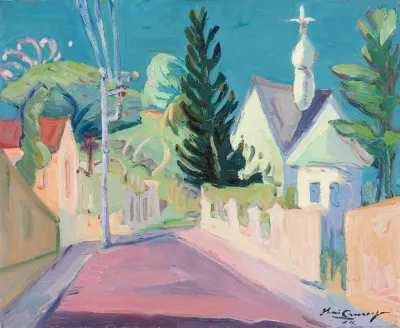
Ramón Cáceres (Quiindy, Paraguai 1944)
Painter, sculptor, restorer and singer.
He currently signs his works Cáceres; until 1984 he signed them Ramonchi.
Ramón Cáceres was born in 1944 in Quiindy, Paraguay. After studying painting and music at the Escuela de Bellas Artes of the Universidad Nacional del Paraguay in Asunción, he emigrated to Brazil in 1970 and settled in São Paulo, where he developed his artistic career.
Ramón has taken part in numerous group exhibitions in Brazil and abroad and has held seven solo exhibitions in Brazil, one of them at MASP – Museu de Arte de São Paulo, presented by its then director P. M. Bardi.
In parallel, he developed a career as a restorer and as a singer, becoming, in the words of the conductor Hermínio Gimenez, “one of the highest exponents, as a performer, of beautiful Paraguayan music”.
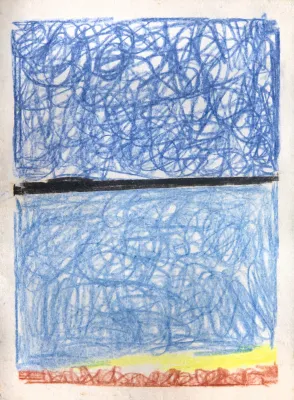
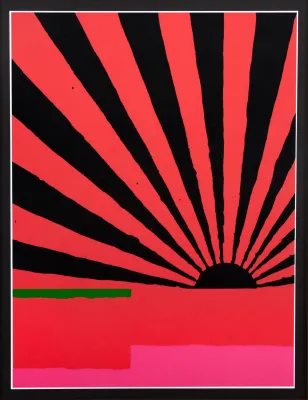
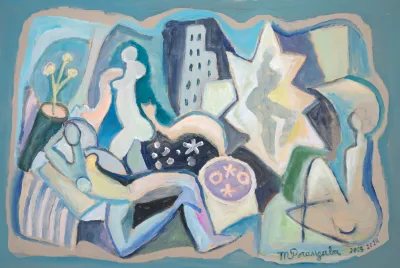
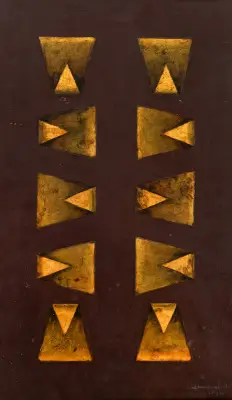
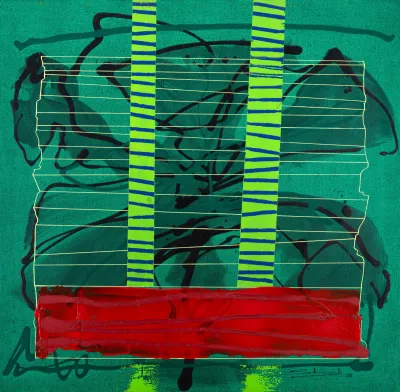
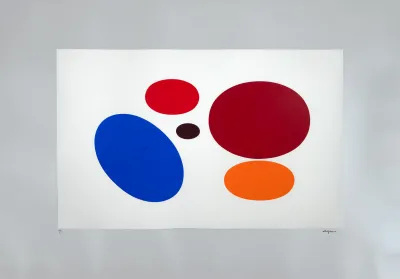
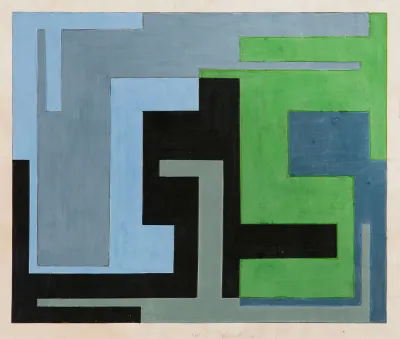
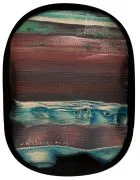
Initially figurative, Ramón Cáceres's painting moved toward geometric abstraction. His constructive painting often refers to flags.
In the preface to the catalog of his latest solo exhibition, held in 2007 at the Espaço Cultural do BNP Paribas in São Paulo, the art critic Enock Sacramento stated that, “among the artists stemming from Constructivism as a whole and from Concretism in particular in Brazil, Ramón Cáceres holds a special place for his refined sensibility and his remarkable ability to harmonize forms, colors and rhythms on the flat surface”.
History
The Paraguayan art restorer Ramón Cáceres, based in São Paulo since 1970, is a well-known figure in Brazilian art circles; besides his work as a restorer, however, he is also a free and creative painter.
1971 to 1978 - Studied and practiced restoration with Luciana Pellizzi Battioli. As a restorer, countless works of great artistic and historical value have passed through his hands, such as Portinari's panels for Banco do Brasil, works by Di Cavalcanti and Clóvis Graciano for the Secretaria de Transportes, the collection from Count Matarazzo's estate and other major private collections.
1984 - Solo exhibition at MASP at the invitation of Professor Pietro Maria Bardi
1985 - Solo exhibition at Galeria Art Selection
1987 - Solo exhibition at Galeria Espaço 1030, in São Paulo
1989 - Solo exhibition at Galeria de Arte Denis Perri, São Paulo
Solo exhibition FIEO – Fundação Instituto de Ensino para Feira Internacional de Artes Plásticas, Porto, Portugal
Solo exhibition at Galeria de Arte 245, Porto, Portugal
1992 - One of his works enters the collection of the Museo Nacional del Paraguay
1993 - Takes part in the group show "Eram brasileiros os que ficaram" [Those Who Stayed Were Brazilian], at the Pinacoteca do Estado, São Paulo, SP
Takes part in FACC - Feira de Arte Contemporânea de Coimbra [Coimbra Contemporary Art Fair], Portugal
Takes part in FIAP - Feira Internacional de Artes Plásticas [International Visual Arts Fair], Porto, Portugal
Takes part in FIAP - Feira Internacional de Artes Plásticas, at the Galeria de Arte do Casino Espinho, Portugal
Takes part in a group show at Galeria de Arte 245, Porto, Portugal
Takes part in the group show Arte Brasil 1993, at Edifício Chiado, Coimbra, Portugal
Takes part in the group show "Primavera no Capitólio" [Spring at the Capitol], Porto, Portugal
Takes part in a group show at the Musée Municipal de Lausanne, Switzerland
1994 - Solo exhibition "Bandeiras de Cáceres" [Cáceres's Flags] at Espaço Mário de Andrade, Memorial da América Latina, São Paulo, SP
1996 - Ramón Cáceres receives a Gold Medal from the Municipality of Luque, Paraguay, in recognition of his important cultural work in music and the visual arts
2000 - Takes part in the "Remate de Arte Latino-americano" [Latin American Art Auction] held at the Memorial da América Latina, São Paulo, SP
2005 - Solo exhibition at Espaço Euroart, in São Paulo
2007 - Solo exhibition at the Espaço Cultural do BNP Paribas, São Paulo, SP
2008 - Group exhibition "Nova Realidade" [New Reality], MACA - Museu de Arte Contemporânea de Americana, SP
2009 - Group exhibition “Madeira Malta Artes Plásticas Lusófonas” [Madeira Malta Lusophone Visual Arts], organized by the Bienal Internacional de Artes da Madeira at Galeria Casa das Mudas, Centro de Artes da Calheta, Madeira Island, Portugal
Takes part in the Malta International Arts Biennale, Republic of Malta, receiving a painting prize
Group exhibition, Espaço Cultural do Clube Paulistano, São Paulo, SP
2011 - Solo exhibition at Galeria Sergio Caribé
2012 - Solo exhibition "Curvas e Retas na Arte de Ramón Cáceres" [Curves and Straight Lines in the Art of Ramón Cáceres] at the Salão de Exposições do Paço de Santo André
Group exhibition “Diálogos Latino Americanos” [Latin American Dialogues], part of the Semana de Olhares para África e América Latina at UnB - Universidade de Brasília
Launch of the book "Arte de Ramón Cáceres" [The Art of Ramón Cáceres] at Galeria Sérgio Caribe
Cited in: Louzada, Júlio, Artes Plásticas, Brasil 87, vol. 2, p. 1991-2; Martins, Narcizo, Art Trade Internacional, Adrian Publishers, Lisboa, p.443-4.
Critical Texts
The Painting of Ramón Cáceres
In recent years, a number of exhibitions and important books on the subject have stirred public interest in Brazilian concrete art. The exhibition “Arte Construtiva no Brasil: Coleção Adolpho Leirner” [Constructive Art in Brazil: Adolpho Leirner Collection] (1998) at MAM/SP and the launch of the book of the same name, coordinated by Aracy Amaral, was a landmark in this revival. Three years later came the book Sacilotto, which I wrote, about the artist Waldemar Cordeiro considered “the mainstay of Brazilian concrete art”. The cycle of exhibitions “Arte Concreta Paulista” [São Paulo Concrete Art], presented by the Centro Universitário Maria Antonia in 2002, together with the launch of five books on the subject by Cosac & Naify, celebrated the fiftieth anniversary of the “Ruptura” exhibition, ground zero of Brazilian Concretism, which brought together works by Anatol Wladislaw, Geraldo de Barros, Kazmer Féjer, Leopoldo Haar, Lothar Charroux, Luiz Sacilotto and Waldemar Cordeiro. The recent celebrations of the fiftieth anniversary of the 1st National Exhibition of Concrete Art in São Paulo and Rio de Janeiro - notably the exhibition “Concreta 56: A Raiz da Forma” [Concreta 56: The Root of Form], held in 2006 at MAM/SP, and the publication of the book of the same name by Lorenzo Mammi, João Bandeira and André Stolarski - have significantly increased interest in this singular movement in Brazilian culture.
Several participants in the 1st National Exhibition of Concrete Art, such as Lygia Clark, Hélio Oiticica, Lygia Pape, Sacilotto, Cordeiro and Amilcar de Castro, had already been strongly attracting the attention of scholars and collectors in recent years, owing to very favorable national and international assessments of their work. Interest also turned to the works of Ivan Serpa, Franz Weissmann, Fiaminghi, Judith Lauand, Maurício Nogueira Lima, Antonio Maluf, Rubem Ludolf and other historical concretists, also reaching painters who, at the time or a little later, developed work within the constructivist strand.
In the late 1950s, Concretism gave rise to Neo-Concretism, centered mainly in Rio de Janeiro but with some followers in São Paulo, such as Hércules Barsotti and Willys de Castro. Concretism brought together not only visual artists but also poets and other creative professionals, which makes it a wide-ranging movement of fundamental importance to twentieth-century Brazilian culture. The poet Theon Spanudis, who later became better known as an art critic and collector, was one of the theorists who drew attention to the work of some historical concretists and of others who shared constructivist ideals, such as Volpi (a participant in the 1st ENAC), Arnaldo Ferrari, Waldeir Maciel, Jandira Waters, Ramón Cáceres and others.
The Paraguayan Ramón Cáceres, who had studied visual arts and singing in Asunción, arrived in São Paulo in the early 1970s and first devoted himself to art restoration (he worked with Luciana Batiolli) and singing (he formed the musical group “Los Tres de Luque”). He was gradually drawn to constructivist painting, which impressed the director of MASP, P. M. Bardi, who scheduled a solo exhibition of his work at the museum in 1984 and wrote the introductory text for the catalog.
Spanudis, one of the first champions of Volpi's work, took it more than once as a reference in analyzing other constructive artists. Analyzing Ramón Cáceres's painting, he wrote: “... Ramón Cáceres has embarked on a very personal, sui generis constructivism, exploring the theme of flags. These are not Alfredo Volpi's little pennants, which are pointed, sharp forms, but the ordinary flags of ships and nations unfurled horizontally, gently rippling and furrowed by the wind”. And further on: “Ramón's latest works personally thrill and delight us, as Volpi's works did in the 1950s, when we bought them directly in Cambuci. In both cases, there is inexhaustible creativity and a very keen discernment that knows how to choose meaningful colors, whether in chromatic dialogues or polyphonies, now gentler, now softer, now firmer... Anyone who loves pure, eloquent, lyrical and poetic colors will find in Ramón an inexhaustible source of aesthetic pleasure and delight”.
Spanudis's enthusiasm is justified. Indeed, Ramón Cáceres took the shape of the rippling pennant as the starting point for a rich and unique body of work, both formally and in terms of color, using it as a pattern in formally symmetrical compositions - but not with “mirrored” forms - over flat backgrounds, without the rigor of some solutions of Concretism or op art. The curve is one of the reasons for the lightness of Ramón Cáceres's works. It dialogues harmoniously both with other curves and with straight lines, usually vertical but also oblique and, more rarely, horizontal. In some cases, Ramón worked directly with the pattern of the São Paulo state flag.
While Ramón produced an extensive series of paintings in which his pennants flutter on masts made of thin vertical lines, giving his rippling compositions grace, lightness and a festive mood, the works composed of only a few flags - sometimes two, sometimes one, or even just part of one, identified by its rippling curve - are also remarkable. Interestingly, these reductions or close-ups allow dialogues between lines and fields of color or of black and white, lending these compositions an unusual visual force and showing that the whole can be in the part, and that the part can be as eloquent as the whole, or more so.
Among the artists stemming from Constructivism as a whole and from Concretism in particular in Brazil, Ramón Cáceres holds a special place for his refined sensibility and his remarkable ability to harmonize forms, colors and rhythms on the flat surface.
Enock Sacramento
Ramón Cáceres at MASP
MASP presents a Paraguayan who is at once a singer and a painter: Ramón Cáceres. He completed his studies in Luque, known as the “city of music”, perfecting his voice at the Escuela Nacional de Canto with the renowned and celebrated soprano Sofia Mendonça; he won the National Folklore Festival of Paraguay and recorded several albums.
At the same time, he attended the School of Fine Arts and became a painter, following tendencies that alternate between Geometric Abstraction and Surrealism, in a figuration of singular communicativeness.
Our public will thus see the young painter's exhibition and enjoy his singing. MASP hosts an artist from a friendly nation, introducing someone regarded in his homeland as one of its most active and representative figures.
P. M. Bardi - Director of the Museu de Arte de S. Paulo - March 1984
The Work of Ramón Cáceres
The Paraguayan Ramón Cáceres has a dual profession. He is a very well-trained restorer and conservator of works of art and, at the same time, a creative painter. Let us examine his painting and analyze its components.
Just as his profession is twofold, his painting follows a twofold path. One is structural-constructive. The other is dreamlike, somewhat surreal and romantic. What unites these two different paths is his keen sensibility, his distinctive emotional depth, his poetic vein.
Let us first examine his structural-constructive path. He explores the theme of imaginary flags arranged geometrically in the space of the canvas. Dreamlike, flowing colors characterize the flag theme. A lyrical poetry emanates from these structures, a pure and simple lyricism. On the other path, the surreal and magical one, he explores the theme of trees. He creates reliefs with tree branches of substantial drama and telluric force. Flags and trees are his two favorite figurative elements. The flags (with their geometric order) open up poetic spaces, the trees bring the massive substance, the bodily drama and the telluric magic of the plant world. Two different paths, yet both expressive of a soul rooted in the cosmos, a telluric soul full of the magic of living things.
Ramón loves subtlety, whether in the dreamlike quality of the flags or in the drama of the trees. He celebrates living things in his aesthetic transposition. Without imitating others, utterly original, he has invented these two symbols of his metaphysical and ontic belief. A beautiful body of work characterized by its purity and simplicity. True poetry of artistic transfiguration. A sincere, independent voice in today's panorama of Brazilian pictorial creativity. A sincere dreamer and singer of living things.
Theon Spanudis (May 1985)
The Paraguayan art restorer Ramón Cáceres, based in São Paulo since 1970, is a well-known figure in Brazilian art circles; besides his work as a restorer, however, he is also a free and creative painter.
His painting, which began in Paraguay, was dark and telluric, revolving around plant forms, with the mysteries of fertilization and germination as its main subject.
Here in Brazil his painting began to brighten and, in recent years (he is an admirer and student of Joaquín Torres García), Ramón has embarked on a very personal, sui generis constructivism, exploring the theme of flags.
Theon Spanudis (São Paulo, 1987)