Paulo Monteiro (São Paulo SP 1961)
Sculptor, painter, draftsman, printmaker, illustrator.
Paulo Bacellar Monteiro studied at the Faculdade de Belas Artes de São Paulo in 1980. At that time, he also took a printmaking course with Sérgio Fingermann (1953). Two years later, with Carlito Carvalhosa (1961), Fábio Miguez (1962), Nuno Ramos (1960) and Rodrigo Andrade (1962), he formed the group Casa 7. Besides paintings and prints, he developed three-dimensional works. He illustrated the books Camões e os Lusíadas and Livros de Portugal, by Beatriz Berrini, and the cover of the album Vivendo e Não Aprendendo by the band Ira!.
Critical Commentary
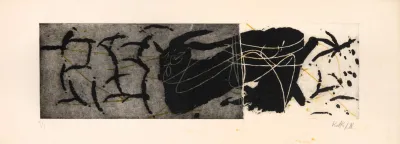
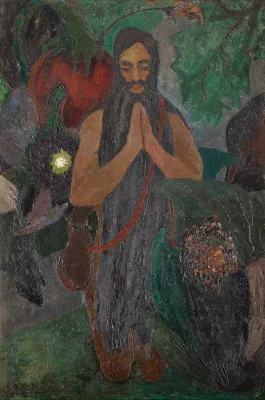
In the early 1980s, Paulo Monteiro, like the other Casa 7 artists, made works with affinities to the production of the German Neo-Expressionists, in their drama and somber atmosphere, and also with references to the work of the Canadian-born artist Philip Guston (1913 - 1980). At that time, Monteiro painted large canvases with broad handling and dripping paint. As the critic Aracy Amaral notes, the artist creates illusory interior depths in these paintings, with great formal freedom, combining elements of different densities on canvases structured by an excess of pictorial layers.
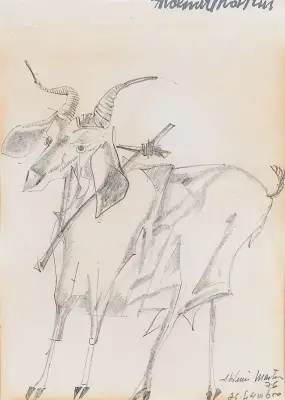
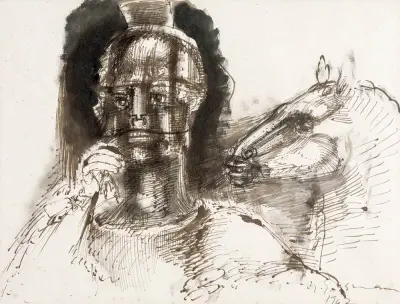
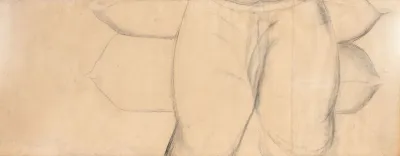
In the 1990s, he made drawings that reveal his admiration for the work of Mira Schendel (1919 - 1988). The lines spread across the paper along a seemingly dispersed path, escaping any graphic predictability. One notices the artist's effort to set the lines on the paper, developing mainly along its edges. As the critic Alberto Tassinari notes, Paulo Monteiro gives the impression of mobilizing more force than necessary to make the drawings. The artist presses the line, raising its power to a threshold beyond which the gesture threatens the support. All this concentration of action is expressed on the paper. Monteiro does not let himself be guided by spontaneous, instinctive drawing, but affirms through his line the will to record an action in its entirety, with its successes and failures.
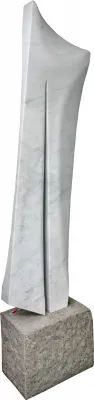
The artist also turned to sculpture, at first with small works modeled in clay and then cast in lead. In them, material is neither removed nor added, only displaced by rigorous gestures. He creates irregular, organic forms that explore surface roughness. Although made of metal, his sculptures look flexible and malleable. Some works recall masks or fragments of bodies. For the art historian Rodrigo Naves, the sculptures reveal a certain expansion, as if an inner core presided over an unpredictable dilation. Yet the impression of movement contrasts with the weight of the very material of these works, as if it were more an obstacle than a condition for their existence. For Naves, the sculptor's movement in handling the clay produces a structure which nonetheless emphasizes the instability of the whole - the tendency to return to its original formlessness. Although close to the works of Claes Oldenburg (1929 - 2022), Monteiro's sculptures reject the lightness and irony of pop art objects.
For the art historian Nelson Aguilar, in his sculptures the artist praises the constructive power of the gesture by confronting the inertia of clay with the least possible manipulation. This duel between emptiness and will is expressed in his drawings and paintings, in which the vastness of the white field of the paper or canvas tends to counterbalance the force of the graphite or paint on its surface.
Collection
Coleção João Sattamini/MAC - Niterói
Coleção Museu de Arte Moderna de São Paulo (SP)
Critiques
"The generation of painters that emerged in Brazil in the 1980s generally shows an admiration for the European painting celebrated in that period's return to the canvas. Among the young São Paulo artists starting out, a group that worked in the same space undoubtedly stood out (...). Among the artists of this group we highlight Paulo Monteiro who, like the others, worked during a period of frenzied production with enamel on kraft paper. In 1985, with quite evident figuration, he created illusory depths with interiors invented in complete constructive freedom, juxtaposing elements of different densities in a dramatic atmosphere, the human figure formally merging with elements of mineral or industrial appearance, in a unified pictorial treatment over the entire surface of the work. His development then passed through abstraction, where references to the outside world are no longer present, but in the muted tones of the canvas one already perceives the discipline of the paint application, on a plane where inscriptions appear like graffiti, dominated precisely by vertical-horizontal rhythms that lend the composition a will to construct. (...)".
Aracy Amaral
MODERNIDADE: arte brasileira do século XX. Paris: Musée d'Art Moderne de la Ville de Paris, 1988.
"Paulo Monteiro's new sculptures recall faces, masks, pieces of bodies. They are physiognomies still in formation. A little more born, and we would know what they represent, but then we would lose the grasp of the instant when the forming gesture still threatens to be lost. As in old gargoyles and figureheads, vision and astonishment are intertwined here.
In his earlier sculptures, Paulo Monteiro also dealt with the emergence of a figurative scheme. Sections of pipe were arranged so that they balanced on the floor. The pieces rose like a body drawing its posture. Now, however, the gesture alone engenders the works. It no longer ironically enlivens a mechanical order, but clings, frightened, to the indefiniteness of matter.
Yet something of a constructive procedure still survives in the new sculptures. As in Sérgio Camargo or Amilcar de Castro, the work arises from a zero-sum game. Material is neither removed nor added, only displaced. Every leftover, every burr is thus governed by the same economy of gestures that produced a surface, its refinement and its sheen. (...)
Every form, these works tell us, implies a deformation, since what is left over ought to lose meaning. But what is sought here is that difficult moment when meaning and non-meaning have not yet lost themselves to each other".
Alberto Tassinari
TASSINARI, Alberto. Paulo Monteiro. Galeria: Revista de Arte, São Paulo, n. 21, p. 94, 1990.
"Paulo Monteiro also shows reluctance to add materials to a dominant structure or to juxtapose elements. All his effort is focused on giving a backbone to a lazy mass of clay - later casting it in lead. With a few gestures, the artist seeks to reverse clay's tendency to slump and come to rest on the plane that supports it.
This operation, however, is only partly successful. Even held up by the act that in some way orders them, the pieces retain much of the slippery quality of something seeking rest. To a large extent, it is the coexistence of these two movements that gives Paulo Monteiro's works their particularity. On the one hand, a swift ascent that lends several of them a grand bearing, recalling Rodin's Balzac. On the other, the indolence of docile matter, governed by the law of least effort.
This interplay of oppositions should, however, be qualified. From the outset, one notes the difficulty of creating diversities that give the mass a more complex structure. Although the gestures produce hollows and recesses in the lead, no spatiality arises that would differentiate the parts - which might allow relations of solidarity with the surrounding environment, freeing the works from this sticky involvement with themselves.
The grooves opened in the lead do not manage to establish a link between inside and outside. On the verge of returning to their original wholeness, they rather reinforce the amorphous quality of the mass, capable of healing everything".
Rodrigo Naves
NAVES, Rodrigo. Paulo Monteiro. In: BIENAL BRASIL SÉCULO XX, 1994, SÃO PAULO, SP. Bienal Brasil Século XX: catálogo. São Paulo: Fundação Bienal de São Paulo, 1994. p.82.
"The form of Paulo Monteiro's sculptures, heavy pieces of cast lead, refers to objects linked to the earth, enlarged grains or seeds. At times they lie like the remains of a head - the scale in this case shows a similar conformity. A head with several faces, emptied of gaze, asserts itself as the result of an 'abstract anthropomorphism' (recalling Giacometti's proposal in The Cube, 1934, which is not a cube). Giacometti, whose incessant search operated through the exercise of feverish drawing, referred to a 'disintegrating relationship' - a condition that befits Monteiro's pieces, as the difference between the mass of material and the movement of the gesture impressed on it. The meaning of the project here is allegorical: one piece can stand in for others. To expose the formless and the inhuman, Monteiro resists both absolute abstraction and figuration (the forbidden). In this sense, the boundary line acts by accentuating the burrs between abstraction and disfigurement".
Lisette Lagnado
Lagnado, Lisette. Entre o desenho e a escultura. In: ENTRE o desenho e a escultura. São Paulo: MAM, 1995. p. 18.
Solo Exhibitions
1983 - São Paulo SP - Solo, at Galeria Sesc
1987 - São Paulo SP - Solo, at Gabinete de Arte Raquel Arnaud
1989 - Rio de Janeiro RJ - Solo, at Galeria Macunaíma da Funarte
1990 - São Paulo SP - Solo, at Paulo Figueiredo Galeria de Arte
1993 - São Paulo SP - Solo, at Paulo Figueiredo Galeria de Arte
1994 - São Paulo SP - Solo, at Marília Razuk Galeria de Arte
1998 - São Paulo SP - Solo, at Galeria Marília Razuk
2002 - São Paulo SP - Solo, at Galeria 10,20 x 3,60
2004 - São Paulo SP - Tudo é Desenho [Everything Is Drawing], at Centro Cultural São Paulo - CCSP
Group Exhibitions
1982 - Curitiba PR - 5th Curitiba Annual Printmaking Show, at Casa da Gravura Solar do Barão
1982 - São Paulo SP - Group show, at Galeria Suzanna Sassoun
1983 - São Paulo SP - Group show, at Museu de Arte de São Paulo - MASP - Pirelli Young Painting Prize
1984 - São Paulo SP - 2nd São Paulo Contemporary Art Salon
1984 - São Paulo SP - Group show, at Pinacoteca Municipal/Centro Cultural São Paulo - CCSP
1984 - São Paulo SP - Grupo Casa 7 and Sérgio Fingermann
1984 - São Paulo SP - Painéis [Panels], at Paço das Artes
1985 - Rio de Janeiro RJ - 8th National Visual Arts Salon, at Museu de Arte Moderna do Rio de Janeiro - MAM/RJ
1985 - Rio de Janeiro RJ - Casa 7: Painting, at MAM/RJ
1985 - São Paulo SP - 12 São Paulo Artists, at Subdistrito Comercial de Arte
1985 - São Paulo SP - 18th São Paulo International Biennial, at Fundação Bienal
1985 - São Paulo SP - Casa 7: Painting, at Museu de Arte Contemporânea da Universidade de São Paulo - MAC/USP
1985 - São Paulo SP - Casa 7: Painting, at Subdistrito Comercial de Arte
1986 - Havana (Cuba) - 2nd Havana Biennial
1987 - Paris (France) - Modernity: 20th-Century Brazilian Art, at Musée d'Art Moderne de la Ville de Paris
1988 - Rio de Janeiro RJ - Macunaíma Project, at Funarte. Centro de Artes
1988 - São Paulo SP - MAC 25 Years: Recent Acquisitions and Donations, at MAC/USP
1988 - São Paulo SP - Modernity: 20th-Century Brazilian Art, at Museu de Arte Moderna - MAM/SP
1990 - Brasília DF - Brasília Visual Arts Prize 1990, at Museu de Arte de Brasília
1990 - São Paulo SP - 21st Panorama of Current Brazilian Art, at MAM/SP
1991 - Caracas (Venezuela) - Brasil: la nueva generación [Brazil: The New Generation], at Fundación Museo de Bellas Artes
1992 - Rio de Janeiro RJ - 13 Artistas [13 Artists], at MAM/RJ
1992 - São Paulo SP - João Sattamini/Subdistrito, at Casa das Rosas
1993 - Paris (France) - Brésil, le Souffle d'un Pays Créatif, at Studio Kostel
1993 - Santos SP - 4th Santos National Biennial, at Centro Cultural Patrícia Galvão
1994 - Albuquerque (United States) - Do Brasil [From Brazil], at Richard Levy Gallery
1994 - Frankfurt (Germany) - Desenho Brasileiro Contemporâneo [Contemporary Brazilian Drawing], at Karmeliterkloster
1994 - São Paulo SP - 22nd São Paulo International Biennial, at Fundação Bienal
1994 - São Paulo SP - Bienal Brasil Século XX [20th Century Brazil Biennial], at Fundação Bienal
1995 - Londrina PR - Arte Brasileira: confronto e contrastes [Brazilian Art: Confrontation and Contrasts], at Pavilhão Internacional Octávio Cesário Pereira Júnior
1995 - Rio de Janeiro RJ - The 1980s: The Stage of Diversity, at MAM/RJ
1995 - São Paulo SP - The 1980s: The Stage of Diversity, at Galeria de Arte do Sesi
1995 - São Paulo SP - Between Drawing and Sculpture, at MAM/SP
1996 - Rio de Janeiro RJ - Influências Poéticas: Dez Desenhistas Contemporâneos [Poetic Influences: Ten Contemporary Draftsmen], at Paço Imperial
1996 - São Paulo SP - Brazilian Contemporary Art: Recent Donations/96, at MAM/SP
1997 - Salvador BA - 4th MAM-Bahia Salon, at Museu de Arte Moderna da Bahia - MAM/BA
1998 - Belo Horizonte MG - The Contemporary Urban Landscape, at Itaú Cultural
1998 - Campinas SP - The Contemporary Urban Landscape, at Itaú Cultural
1998 - Campinas SP - Medidas de Si [Measures of Oneself], at Itaú Cultural
1998 - Niterói RJ - Mirror of the Biennial, at Museu de Arte Contemporânea de Niterói - MAC/Niterói
1998 - Penápolis SP - The Contemporary Urban Landscape, at Galeria Itaú Cultural
1998 - São Paulo SP - The Contemporary Urban Landscape, at MAM/SP
1998 - São Paulo SP - Medidas de Si [Measures of Oneself], at MAM/SP
1998 - São Paulo SP - The Collector, at MAM/SP
1999 - Curitiba PR - Group show, at Casa da Imagem
1999 - São Paulo SP - Arte Brasileira sobre Papel na Coleção do Museu de Arte Moderna de São Paulo [Brazilian Art on Paper in the Collection of the Museu de Arte Moderna de São Paulo], at MAM/SP
1999 - São Paulo SP - United Artists: Journeys of Identities, at Casa das Rosas
2000 - Lisbon (Portugal) - 20th Century: Art of Brazil, at Centro de Arte Moderna José de Azeredo Perdigão. Fundação Calouste Gulbenkian
2000 - São Paulo SP - Brasil + 500 Rediscovery Exhibition, at Fundação Bienal
2001 - Rio de Janeiro RJ - Blind Mirror: Selections from a Contemporary Collection, at Paço Imperial
2001 - Rio de Janeiro RJ - The Spirit of Our Time, at MAM/RJ
2001 - São Paulo SP - Blind Mirror: Selections from a Contemporary Collection, at MAM/SP
2001 - São Paulo SP - The Spirit of Our Time, at MAM/SP
2002 - Rio de Janeiro RJ - Paths of the Contemporary 1952-2002, at Paço Imperial
2002 - São Paulo SP - 10 Years of Marília Razuk, at Marília Razuk Galeria de Arte
2002 - São Paulo SP - Map of Now: Recent Brazilian Art in the João Sattamini Collection of the Museu de Arte Contemporânea de Niterói, at Instituto Tomie Ohtake
2003 - São Paulo SP - 2080, at MAM/SP
2003 - São Paulo SP - Claudio Cretti and Paulo Monteiro, at Marília Razuk Galeria de Arte
2003 - São Paulo SP - MAC USP 40 Years: Contemporary Interfaces, at MAC/USP
2003 - São Paulo SP - Marcantonio Vilaça - Contemporary Passport, at MAC/USP
2003 - São Paulo SP - My Friends, at MAM/SP
2004 - Rio de Janeiro RJ - Onde Está Você, Geração 80? [Where Are You, 80s Generation?], at Centro Cultural Banco do Brasil - CCBB/RJ
2004 - São Paulo SP - Contemporary Art in the Municipal Collection, at CCSP
2004 - Porto Alegre RS - Tangenciando Amilcar [Touching on Amilcar], at Espaço Cultural Santander
2004 - São Paulo SP - Lucio Fontana: A Ótica do Invisível [Lucio Fontana: The Optics of the Invisible], at CCBB/SP
2006 - São Paulo SP - Projeto Parede [Wall Project], at MAM/SP
2006 - São Paulo SP - Formassas, at Centro Universitário Maria Antonia
Source: Itaú Cultural