Pablo Picasso (1881 - 1973)
Picasso was a painter, sculptor and draftsman, considered one of the main plastic artists of the 20th century. Born in Malaga, Andalusia, he was the son of Maria Picasso y López and José Ruiz Blasco. Around his birth, several legends emerged, some of which he himself helped to spread. According to one of them, he would have been born dead, leading the midwife to focus her attention on the weak mother. It was the doctor Don Salvador who would have saved him from asphyxiation, blowing cigar smoke on his face, which made him cry and thus start his breath.
"Art washes away the dust of life from the soul everyday."
Pablo Picasso
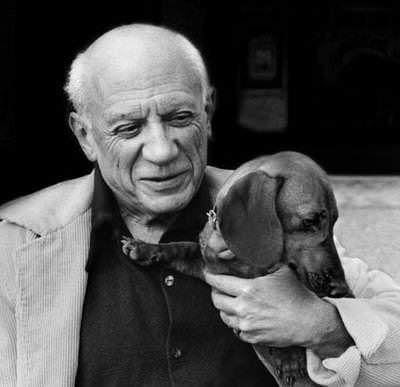
Pablo Picasso
Her birth on October 25, 1881, at eleven and A quarter of the night would thus be described by Picasso to his biographers, who published it willingly. Roland Penrose, one of Picasso's best-known biographers, sought in his origins the reason for his genius and his openness to art, something natural in the understanding of a genius. In the generation of their parents, there are several traces. His father was a painter and draftsman, a very mediocre talent.
Don José, he dedicated himself to painting the pigeons that landed on the plazas of the Plaza de la Merced, close to his house. Occasionally, he asked his son to finish his paintings. The paternal lineage made it possible to study until the year 1541. From the maternal descent researched, Dona María had among her ancestors with two painters. Picasso's features are also similar to his mother's. Pablo's first ten years of life are spent in Malaga. His father's small salary as a museum conservator and a drawing teacher at Escuela de San Telmo, at a cost ensured the family's support. When he was offered a better pay placement at the Eusébio da Guarda Institute in the north of the country, hesitation overlapped the need, and together with his family, Don José departs for A Coruña, a provincial capital on the edge of the Atlantic Ocean.
"When I was a child, my mother told me: 'If you become a soldier, you will be a general. If you become a monk, you will be the Pope. " Instead, he became a painter and ended up like Picasso. "
Pablo Picasso
Picasso's childhood drawings represented bullfighting scenes. His first preserved work was an oil on wood, painted at the age of eight, is called the bullfighter. Picasso preserved this work his entire life, taking him with him whenever he moved house. Years later he painted another similar picture, the death of the outstanding and futile woman. Picasso is angry and rebellious. This picture is clearly an insulting expression of his relationship with the woman. Little Pablo was his school performance, but he did not give up the opportunity to foster his son's talent. Drawing was from an early age the most appropriate form of Picasso to express himself and, perhaps because of that, secondary. He takes charge of his artistic training himself. At the age of thirteen, and following his father's model, Picasso had already reached the progenitor's expertise (who was also not of great refinement). Documentary The Mystery of Picasso.
The family moved again, this time to Barcelona, in the spring of 1895, and the admission test at the La Lonja School of Art is successful. The works that he was supposed to present at the end of the month, Pablo presented them after a few days, after which his work stood out, including that of the finalists. At the age of fourteen, Picasso managed to overcome the demands of a renowned academy of art. Academic works, which, according to him, after several years scared him. His work placed him in the series of renowned painters in Barcelona, such as Santiago Rusiñol and Isidro Nonell, and his painting The First Communion is exhibited in the famous exhibition of the time in the city. Despite having opted for a religious theme, this is still a private event, of the family plan. Despite being realistic and satisfying academic demands, on the other hand, the work turns out to be an attempt to combat conventionalism.
After a stay in Malaga, in 1897 he settled in Madrid.
Between Madrid and Barcelona
In Madrid, installed in a new studio, it is enrolled in the most prosperous and renowned Spanish Academy of Arts, the Royal Academy of Fine Arts of São Fernando. Constantly, he visits the Prado Museum, where he copied the great masters, captured their style and tried to imitate it, which proved, on the one hand, to an advance, as he developed ephemeral capacity, and on the other hand, an expression of a creative genius Limited to the copy of the work of the historical, whose works also came to be the subject of a revisiting and reinterpretation of Picasso in more advanced stages.
However, his stay in Madrid is interrupted. At the beginning of July of that year, Picasso fell ill with scarlet fever and the recovery forces him to return to Barcelona, soon after with Manuel Pallarés, his friend, to the Horta de Ebro village in the Pyrenees. The recollection helped him to restore new and ambitious projects he carried out as soon as he returned to Barcelona. He had moved away from the academy and the paternal home, and tried to open himself to the innovations of Spanish art, keeping in touch with his most famous representatives. The cultured space of the Spanish vanguard was Café Els Quatr Gats. There he met the modernists and revived their art, influenced by the French art and the vanguards Britências.
In 1900, on the premises of the same establishment, his first exhibition opened to the public. However, the desire to get to know Paris increased
Picasso in Paris
After starting as an art student in Madrid, Picasso made his first trip to Paris (1900), the artistic capital of Europe. There he lived with Max Jacob (journalist and poet), who helped him with the French language. Max slept at night and Picasso during the day, he used to work at night. It was a period of extreme poverty, cold and despair. Many of his drawings had to be used as combustible material for the heating of the room.
In 1901 with Soler, a friend, he founded a magazine Arte Joven, in the city of Madrid. The first number is all illustrated by him. It was from this date that Picasso began to sign his works simply &ldquopicasso & rdquo, previously signed &LDQUOPABLO RUIZ y Picasso &rdquo.
In the blue phase (1901 to 1905), Picasso painted loneliness, death and abandonment. When he fell in love with Fernande Olivier, his paintings changed from blue to pink, inaugurating the pink phase (1905-1906). He worked at night until dawn. In Paris, Picasso met a select group of famous friends in the neighborhoods of Montmartre and Montparnasse: André Breton, Guillaume Apollinaire and the writer Gertrude Stein.
In the pink phase there is an abundance of pink tones and red, characterized by the presence of acrobats, dancers, harlequins, circus artists, the world of the circus. In the summer of 1906, during a stay in Andorra, his work entered a new phase marked by the influence of the Greek, Iberian and African arts, it was protocubism, the antecedent of Cubism. The famous portrait of Gertrude Stein (1905-1906) reveals a face treatment in the form of a mask.
In 1912, Picasso performed his first collage, glued pieces of newspapers, papers, fabrics, Cigarettes.
Fell in love with Olga Koklova, a ballerina. They were married on July 12, 1918. In this period the artist had already become known and was an artist of society. When Olga became pregnant, she created a series of paintings of mothers with children.
Between the beginning and end of the 2nd World War (1939-1945), she also devotes herself to sculpture, engraving and ceramics. As a recorder, he masters the various techniques: strong water, ink, dry tip, lithogravure and engraving on colored linoleum. In addition, his dedication to sculptural art was sporadic. Buffalo head, metamorphosis is a great example of his work with this medium. He is considered one of the pioneers in making sculptures from the junction of different materials.
In 1943, Picasso meets the painter Françoise Gilot and has two children, Claude and Paloma and found a little peace and painted the joy of Viver.
In 1968, at the age of 87, he produced in seven months a series of 347 engravings recovering the themes of youth: the circus, bullfighting, theater, erotic situations. Years later, an operation of the prostate and vesicle, in addition to the poor vision, puts an end to its activities. As a special honor for him, on his 90th birthday, they are celebrated with an exhibition in the Grand Gallery of the Louvre Museum. Thus he becomes the first artist alive to exhibit his works in the famous French museum. Pablo Picasso died on April 8, 1973 in Mougins, France at the age of 91.
It is said that he took his whole life to paint like a child.
His full name: Pablo, in honor of his uncle, canon of the city's cathedral; and, Diego, as his grandfather Patern and José, as his father, the ninth son of Diego; and Francisco de Paula, as his maternal grandfather; and Juan Nepomuceno, as his godfather; and also Maria de los Remedios, and Cipriano de la Santissima Trinidad; Picasso was his mother's surname. .
It was like this: Pablo Diego José Francisco de Paula Juan Nepomuceno Maria de Los Remedios Cipriano de la Santissima Trinidad Ruiz y Picasso.
Chronology
1881 - October 25th. Born in Málaga Pablo Ruiz Picasso, son of Maria Picasso Lopez and José Ruiz Blasco.
1881 - November 21. He is baptized in the Church of Santiago in Malaga by Father José Fernández Quintero, who had also celebrated his parents' marriage.
1888 - Influenced by his father, he begins to draw and paint.
1893/1894 - Picasso begins his artistic work under his father's guidance.
1896 - Attends drawing classes in La Lonja, he is highly praised in the school admission exams.
1897 - He is part of the Bohemian group in Barcelona The first exhibition is held in Els Quatre Gats, the group's headquarters The first criticism about his work is published in La Vanguardia. He makes friends with Jaime Sabartés and other young artists and intellectuals, who introduce him to the universe of modern painting movements (Toulouse-Lautrec, Steinlen etc). His painting Ciencia y Caridad (Science and Charity) receives an honorable mention in Madrid. In autumn he is admitted to the painting course at the Royal Academy of San Fernando in Madrid.
1898 - Leaves the Academy. Its painting Costumbres de Aragon (Aragon's Habits) receives awards in Madrid and Málaga.
1900 - Drawings of yours were published in the magazine Joventut, a magazine in Barcelona. It sells three drafts to Berthe Weill.
1901 - Funda com Soler, in Madrid, the magazine Arte Joven. The first number is all illustrated by him. He exhibits works in Pastel at Salon Parés (Barcelona). Complimentary criticisms are published in Pel y Ploma. Exhibits at the Vollard Space in Paris. Positive criticism is published in La Revue Blanche. Finds Max Jacob and Gustave Coquiot. The blue period begins. He starts to sign his works simply as "Picasso" previously signed "Pablo Ruiz y Picasso".
1902 - he exhibits 30 works in the space of Berthe Weill in Paris. Share a room with Max Jacob on Boulevard Voltaire.
1904 - He settles in Paris. end of the blue period.
1905 - They buy some of their paintings. beginning of the pink period. Start making sculptures and engravings. Paints Garçon à la Pipe and self-portrait with a cover, one of his most famous paintings.
1906 - He meets Matisse who, together with the Fauves, had shocked the public in the autumn salon of the previous year. Transition time for sculptures.
Image:Les Demoiselles de Avignon.jpg1907 - Meets Braque and Derain. Visit the Cézanne Exhibition in the Autumn Hall. The Cubist phase begins with the painting Les Demoiselles d'Avignon.
1908 - makes the first clearly Cubist landscapes. He makes his first exhibition in Germany (Galeria Thannhauser, Munich).
1910 - Flowering of Cubism. He does portraits of Vollard, Uhde, Kahnweiler.
1911 - First exhibition in the United States (Photo-Secsional Gallery, New York). Kahnweiler publishes Max Jacob's Saint Matorel with illustrations by Picasso.
1912 - He makes his first exhibition in London (Galeria Stafford, London). He exhibits in Barcelona (Dalman Gallery). begins the collages.
1913 - Death of Picasso's father in Barcelona. Starts Synthetic Cubism.
1915 - Makes portraits with realistic drawings of Vollard and Max Jacob.
1917 - Goes to Rome with Cocteau to create scenography for the ballet Parade, directed by the group of Diaghilev, the Russian ballets. keeps in touch with the world of theater. Meets Stravinsky and Olga Koklova. Visit museums and see ancient art and the Renaissance period. in Rome, Naples, Pompeii, and Florence. spends the summer in Barcelona and Madrid.
1918 - Marries Olga Koklova.
1919 - Goes to London and makes drawings for Le Tricorne.
1920 - Makes scenarios for Pulcinella, Stravinsky. Classical themes appear in his works.
1921 - Birth of Paul (his 1st child) . Makes many drawings of the mother with the child. Makes the scene for the Cuadro Flamenco ballet. He does both versions of The Three Musicians and Three Women in the Spring, I work using different styles.
1924 - Makes scenarios for the ballet Le Mercure Draws the curtain for the Le Train Bleu. begins the series of great dead natures.
1925 - Participates in the first exhibition of the surrealists at the Pierre gallery in Paris. In addition to the classic works, he produces his first works that present a contained violence.
1928 - He makes a series of small paintings with vivid colors, with audaciously simplified shapes. begins a new period in his sculptures.
1930 - Acquires Boisgeloup Castle, and sets up his sculpture studio in it.
1931 - Le Chef-d'oeuvre inconnu de Balzac are published. (Vollard) and the Métamorphoses of Ovid (Skira), both illustrated with engravings by Picasso.
1932 - Retrospective exhibitions in Paris (Gallery Georges Petit) and Zurich (Kunsthaus). A new model, Marie-Thérèse Walter, begins to appear in Picasso's paintings.
1934 - Repaint bullfights.
1935 - Definitive separation of Olga Koklova. Birth of Maia, daughter of Marie-Thérèse Walter and the painter.
1936 - Beginning of the Spanish Civil War. It does traveling through Spain. He is appointed director of the Prado Museum.
1937 - Edita Engraving Sueño y Lie de Franco (dream and lie of Franco) with satirical text of his own authorship. After the air attack in Guernica (on April 28) paints the mural for the Spanish Republic pavilion (Feira Mundial de Paris).
1939 - A large retrospective exhibition is made in New York (Museum of Modern Art). Picasso's mother dies in Barcelona. After the beginning of the Second World War, he returned to Paris.
1941 - He writes a surrealist play Desire taken by the tail. The woman in the armchair series begins.
1941 - Paints the famous painting Dora Maar au Chat.
1942 - Publishing illustrations with pictures in water-ink for the book Histoire Naturelle by Buffon.
1945 - Exhibition in London (VictoriaAlbert Museum). returns to doing lithographs.
1946 - Starts the series of paintings whose theme is the joy of living.
1947 - Birth of the son Claude. He does lithographs and starts making ceramics at the Madoura factory.
1948 - Ceramics exhibition at Masion de la Pensée Française (Paris).
1949 - His daughter Paloma is born. He exhibits works started from the beginning of the war in the Maison de la Pensée Française. Picasso's dove is used in the Paris Peace Congress poster and becomes a universal symbol.
1951 - exhibits sculptures in the Maison de la Pensée Française. He does retrospective exhibition in Tokyo. Paints massacre in Korea.
1952 - Pinta Guerra e Paz in Vallauris.
1953 - Retrospective exhibitions in Lyon, Rome, Milan, São Paulo. separates from Françoise Gilot.
1954 - Paints the series Sylvette. He begins a series of studies based on The Women of Algiers, by Delacroix.
1955 - Death of Olga Koklova, his ex-wife. He exhibits at the Musée des Arts Décoratifs and the Bibliotèque Nationale in Paris and Germany.
1956 - Makes a series of studio interior scenes.
1957 - Retrospective exhibition in New York. He does a series of studies based on As Girls, by Velázquez.
1958 - He paints the mural of the UNESCO building in Paris. Acquires Vauvenargues Castle, near Aix.
1959 - Exposes Linooleos.
1960 - Explore themes with dead natures and interiors of Spanish inspiration.
1961 - He studies on Déjeuner sur l'Herbe, by Manet. He marries Jacqueline Roque.
1962 - Series on the theme "Rapto das Sabinas".
1963 - Series on the theme "The painter and his model".
1964 - Series on the theme "The painter and his easel."
1965 - Publication of Sable Mouvant, by Pierre Reverdy with Picasso paints.
1966 - His 85th birthday is celebrated with three simultaneous exhibitions in Paris.
1967 - Commemorative exhibitions are held in London and the United States. He returns to mythological themes.
1968 - The series integrates 347 engravings, most of them with erotic themes. After the death of his secretary and confidant Jaime Sabartés, he donates his series about the girls to the Picasso Museum, in Barcelona.
1969 - paints 140 canvases that are exhibited the following year at the Palais des Popes in Avignon.
1970 - Donates 2,000 oil canvases and this
Individual exhibitions
1992
São Paulo – São Paulo – Brazil – “Non touch, live painting”. Pablo Picasso (1992 : São Paulo, SP) – MAC/USP (SP)
Collective exhibitions
1930
Recife – Pernambuco – Brazil – Exposition de L’École de Paris (1930 : Recife, PE) – Teatro de Santa Isabel
Rio de Janeiro – Rio de Janeiro – Brazil – Exposition of L’école de Paris (1930 : Rio de Janeiro, RJ) – Palace Hotel (Rio de Janeiro, RJ)
São Paulo – São Paulo – Brazil – Exposition by L’École de Paris (1930 : São Paulo, SP) – Palacete da Glória (São Paulo, SP)
1960
São Paulo – São Paulo – Brazil – Leirner Collection (1960 : São Paulo, SP) – Folhas Arts Gallery (São Paulo, SP)
1966
São Paulo – São Paulo – Brazil – 40 national and foreign prints from the MAC collection (1966 : São Paulo, SP) – Museum of Contemporary Art of the University of São Paulo (Butantã, São Paulo, SP)
Ribeirão Preto – São Paulo – Brazil – 40 national and foreign engravings from the MAC collection (1966 : Ribeirão Preto, SP) – Ribeirão Preto School of Visual Arts (Ribeirão Preto, SP)
1968
Piracicaba – São Paulo – Brazil – 40 national and foreign engravings from the MAC collection (1968: Piracicaba, SP) – University of São Paulo. Luiz de Queiroz Higher School of Agriculture (Piracicaba, SP)
1970
Penápolis – São Paulo – Brazil – 40 national and foreign prints from the MAC collection (1970: Penápolis, SP) – without place set.
Olinda – Pernambuco – Brazil – 40 national and foreign engravings from the MAC collection (1970 : Olinda, PE) – Pernambuco Museum of Contemporary Art (Olinda)
1973
Rio de Janeiro – Rio de Janeiro – Brazil – 36 foreign artists: engravings (1973 : Rio de Janeiro, RJ) – Bonino Gallery (Rio de Janeiro, RJ)
1982
Curitiba – Paraná – Brazil – Annual Engraving Exhibition City of Curitiba (5.: 1982 : Curitiba, PR) – Casa da Gravura Solar do Barão (Curitiba, PR)
1988
São Paulo – São Paulo – Brazil – MAC 25 years: Highlights of the initial collection (1988 : São Paulo, SP) – Museum of Contemporary Art of the University of São Paulo (Ibirapuera, São Paulo, SP)
1992
São Paulo – São Paulo – Brazil – The formation of the modernist gaze (1992 : São Paulo, SP) – MAC/USP (SP)
1999
Porto Alegre – Rio Grande do Sul – Brazil – Picasso, Cubism and Latin America (1999 : Porto Alegre, RS) – Margs (Porto Alegre, RS)
2000
São Paulo – São Paulo – Brazil – The Role of Art (2000 : São Paulo, SP) – SESI Art Gallery (São Paulo, SP)
2002
São Paulo – São Paulo – Brazil – 22 and The Idea of the Modern (2002 : São Paulo, SP) – Museum of Contemporary Art of the University of São Paulo (Butantã, São Paulo, SP) São Paulo, SP) – Brazilian Art Museum (São Paulo, SP)
Rio de Janeiro – Rio de Janeiro – Brazil – Archipelagos: The plural universe of MAM (2002: Rio de Janeiro, RJ) – Museum of Modern Art (Rio de Janeiro, RJ)
2003
São Paulo – São Paulo – Brazil – MAC USP 40 years: Contemporary Interfaces (2003 : São Paulo, SP) – Museum of Contemporary Art of the University of São Paulo (Butantã, São Paulo, SP)
São Paulo – São Paulo – Brazil – Entre Aberto (2003 : São Paulo, SP) – Brazilian engraving (São Paulo, SP)
São Paulo – São Paulo – Brazil – Art Knowledge: 70 years USP (2003: São Paulo, SP) – Museum of Contemporary Art of the University of São Paulo (Butantã, São Paulo, SP)
Rio de Janeiro – Rio de Janeiro – Brazil – Design autonomy (2003 : Rio de Janeiro, RJ) – Museum of Modern Art (Rio de Janeiro, RJ)
2005
São Paulo – São Paulo – Brazil – Odorico Tavares: my Bahian house – Dreams and desires of a collector (2005 : São Paulo, SP) – SESI Art Gallery (São Paulo, SP)
São Paulo – São Paulo – Brazil – Erotica: the senses in art (2005: São Paulo, SP) – Banco do Brasil Cultural Center (São Paulo, SP)
Curitiba – Paraná – Brazil – Odorico Tavares: my Bahian house – dreams and desires of a collector (2005 : Curitiba, PR) – Oscar Museum Niemeyer (Curitiba, PR)
2006
Rio de Janeiro – Rio de Janeiro – Brazil – Erotica: The Senses in Art (2006: Rio de Janeiro, RJ) – Centro Cultural Banco do Brasil (Rio de Janeiro, RJ)
2008
São Paulo – São Paulo – Brazil – MAM 60 (2008 : São Paulo, SP) – OCA (São Paulo, SP)
2010
São Paulo – São Paulo – Brazil – SP-Art (6. : 2010 : São Paulo, SP) – Bienal Foundation (São Paulo, SP)
Fortaleza – Ceará – Brazil – from Picasso to Gary Hill (2010 : Fortaleza, CE) – Centro Dragão do Mar de Arte e Cultura (Fortaleza, CE)
2011
Rio de Janeiro – Rio de Janeiro – Brazil – That's how it is! (2011: Rio de Janeiro, RJ) – Museum of Modern Art (Rio de Janeiro, RJ)
São Paulo – São Paulo – Brazil – Modernisms in Brazil (2011: São Paulo, SP) – Museum of Contemporary Art of the University of São Paulo (Ibirapuera, São Paulo, SP)
Source: Wikipedia