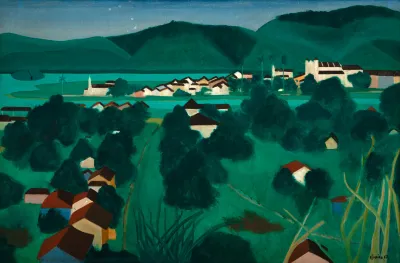
Nicolau Facchinetti (Treviso, Italy 1824 - Rio de Janeiro RJ 1900)
Painter, draftsman, set designer and teacher.
According to some scholars, Nicolau Antonio Facchinetti studied at the Bassano School of Drawing and continued his studies at the Venice Academy.1 He received awards from the Regia Accademia di Belle Arti in Venice "for copying engravings" and for work on ornaments in 1842 and 1843. He possibly came into contact with the work of Ippolito Caffi (1809 - 1866) and Luigi Querena (1824 - 1887), well-known landscape painters. In 1849, he moved to Brazil and settled in Rio de Janeiro. He mainly produced portraits while also teaching drawing and working as a set designer. In 1868, he obtained a diploma in drawing from the Academia Imperial de Belas Artes - Aiba [Imperial Academy of Fine Arts]. From the mid-1860s on, he painted landscapes of the mountain regions of Rio de Janeiro and Minas Gerais and of the coffee plantations of the Paraíba Valley, in São Paulo. The artist traveled to study the characteristics of each region and made drawings on paper, which he later transferred to canvas. He took part in several editions of the Exposição Geral de Belas Artes [General Exhibition of Fine Arts] between 1850 and 1900, and received an honorable mention in 1864 and a silver medal in 1865. His production was studied by the historian Donato Mello Júnior, who published a book on the artist in 1982. In 2004, the exhibition Nicolau Facchinetti: 1824-1900 was held at the Centro Cultural Banco do Brasil - CCBB in Rio de Janeiro, curated by the museologist and visual artist Carlos Martins and the historian Valéria Piccoli.
Critical Commentary
The Italian painter Facchinetti came to Brazil in 1849 and initially devoted himself to portraits and set design, later turning to landscape painting, a genre in which he established himself as one of the most important artists of his generation.
The artist produced vast panoramas of the city of Rio de Janeiro and its surroundings, contrasting the view of new houses with that of the exuberant nature around them. He also painted views of Petrópolis and Teresópolis, in Rio de Janeiro, of the rural Paraíba Valley and of some regions of Minas Gerais.
In his works there is a sense of the grandeur of the landscape, a broad presentation of the topography in aerial perspective, which at times contrasts with the small figures and buildings. In the canvas Panorama de São Tomé das Letras [Panorama of São Tomé das Letras] (ca. 1876), for example, the artist portrays himself painting in a tiny thatched hut. In the various canvases set in Guanabara Bay, on the other hand, he is concerned with recording details of the landscape. In general, his paintings are almost unpopulated.
Facchinetti showed a preference for capturing nature at certain times of day, such as dawn or dusk, exploring the effects of light. According to the art critic Gonzaga Duque (1863 - 1911), before painting, the artist would travel to the site to study the characteristics of the region and sketch the motif on paper, to later transfer it to canvas.
Notes
1 On this question, see: CHIAVARI, Maria Pace. A síntese de dois mundos na paisagem de Facchinetti. In: FACCHINETTI, Nicolau. Facchinetti. Rio de Janeiro: Centro Cultural Banco do Brasil, 2004.
Critiques
"Nicolau Facchinetti must have followed the evolution of our landscape painting mainly through the General Exhibitions and his relationships with some professionals. In the second half of the 19th century, landscape tended to be studied and even made outside the studio, according to the new ideas of love of nature and the concepts of naturalism and, in the last third of the century, of Impressionism, born in France and concerned with the problems of light and its effects. In academic teaching, the Romantic and idealist Neoclassical schools predominated. Only slowly did realism and Impressionism reach the Academy in the 1880s, with the teaching of Grimm (...) Facchinetti must have followed this evolution from studio painting to open-air painting, of a verist character, which was the approach used by a new group of artists headed by the German painter Johann Georg Grimm (...)".
Donato Mello Júnior
MELLO JÚNIOR, Donato. Facchinetti. São Paulo: Art: Record, 1982.
"But it seems more important to draw attention to Facchinetti's, so to speak, 'cinemascopic' conception of space, which clearly seeks to expand to the utmost the possibilities of expressing grandeur, spatial infinity. It is certainly no accident that an impressive number of his landscapes have the format of a CinemaScope projection, as if the appeal to the expansion of space had to correspond to a rupture and a redrawing of the physical, conventional limits of representation (...) Facchinetti's senseless ambition to force the fabric of his vision, to refuse any optical selection of orders of magnitude, to present the viewer with a world in which the tension between the infinitely small and the infinitely large is present".
Luiz Marques
O BRASIL pintado por mestres nacionais e estrangeiros: séculos XVII-XX. São Paulo: MASP, 1987.
"In the genre to which he devoted himself, miniature, there is currently no one who can rival him and dim the brilliance of his name. His pictures are painted with characteristic and patient care, colored with uncommon splendor, drawn with extraordinary, almost exhausting scruple.
One recognizes, at the slightest glance, a great artifice employed by the painter to overcome everything that escaped his faculty of coordination; and the work, which little by little appears better to us thanks to the skill of his technique and the warmth of his color, is, in its complexity, more a work of patience, more a proof of tireless care, than a simple work of art.
(...) Facchinetti's pictures deserve, far from complacency or hypocrisy, sincere praise. In the genre in which they are made, they are perfectly finished works. (...)
The color is warm, almost always exact, well observed; the drawing meticulous in every detail, the perspectives happily developed; in short, his works are completed with the utmost rigor.
To overcome all difficulties, to obtain the exact form and tone of the most insignificant things and those farthest from the point of observation, he resorts to magnifying lenses, for it is entirely impossible for his unaided eye to take in the expanses that we clearly observe in his pictures. Hence a certain detriment to the tonality of the picture, which, if the artist lacked a perfect knowledge of chiaroscuro, would appear to us without aerial perspective and planimetry. But Facchinetti is a true artist, he knows all the secrets of drawing and color, and, without detracting from the importance of his small canvases, he replaces spontaneity with fidelity. I am not fond of miniature applied to landscape, because of both the impression and the personality of the artist, but I am obliged to see in Nicolau Facchinetti's works a merit that is relative, but firm and unquestionable".
Gonzaga-Duque
DUQUE, Gonzaga. A arte brasileira. Introdução Tadeu Chiarelli. Campinas: Mercado de Letras, 1995. p. 132-134.
Collections
Museu Imperial [Imperial Museum] - Petrópolis RJ
Pinacoteca do Estado de São Paulo/Brasil Collection - São Paulo SP
Museu Nacional de Belas Artes - MNBA [National Museum of Fine Arts] - Rio de Janeiro RJ
Museu Mariano Procópio - Juiz de Fora MG
Museu de Arte de São Paulo - MASP - São Paulo SP
Museu Castro Maya - Rio de Janeiro RJ
Instituto Ricardo Brennand - Recife PE
Coleção Brasiliana [Brasiliana Collection] / Fundação Estudar - São Paulo SP
Solo Exhibitions
1898 - Rio de Janeiro RJ - Solo, at Ladeira da Glória, 15
Group Exhibitions
1849 - Rio de Janeiro RJ - 10ª Exposição Geral de Belas Artes [10th General Exhibition of Fine Arts], at Aiba
1850 - Rio de Janeiro RJ - 11ª Exposição Geral de Belas Artes [11th General Exhibition of Fine Arts], at Aiba
1864 - Rio de Janeiro RJ - 16ª Exposição Geral de Belas Artes [16th General Exhibition of Fine Arts], at Aiba - honorable mention
1865 - Rio de Janeiro RJ - 17ª Exposição Geral de Belas Artes [17th General Exhibition of Fine Arts], at Aiba - silver medal
1867 - Rio de Janeiro RJ - 19ª Exposição Geral de Belas Artes [19th General Exhibition of Fine Arts], at Aiba
1870 - Rio de Janeiro RJ - 21ª Exposição Geral de Belas Artes [21st General Exhibition of Fine Arts], at Aiba
1872 - Rio de Janeiro RJ - 22ª Exposição Geral de Belas Artes [22nd General Exhibition of Fine Arts], at Aiba
1875 - Rio de Janeiro RJ - 23ª Exposição Geral de Belas Artes [23rd General Exhibition of Fine Arts], at Aiba
1884 - Rio de Janeiro RJ - 26ª Exposição Geral de Belas Artes [26th General Fine Arts Exhibition], at Aiba
1886 - Rio de Janeiro RJ - Nicolau Facchinetti e Henrique Bernardelli [Nicolau Facchinetti and Henrique Bernardelli], at Imprensa Nacional
1890 - Rio de Janeiro RJ - Exposição Geral de Belas Artes [General Exhibition of Fine Arts], at Enba
1894 - Rio de Janeiro RJ - 1ª Exposição Geral de Belas Artes [1st General Exhibition of Fine Arts], at Enba
1895 - Rio de Janeiro RJ - 2ª Exposição Geral de Belas Artes [2nd General Exhibition of Fine Arts], at Enba
1900 - Rio de Janeiro RJ - 7ª Exposição Geral de Belas Artes [7th General Exhibition of Fine Arts], at Enba
Posthumous Exhibitions
1944 - Rio de Janeiro RJ - Paisagem Brasileira [Brazilian Landscape], at MNBA
1948 - Rio de Janeiro RJ - Retrospectiva da Pintura no Brasil [Retrospective of Painting in Brazil], at MNBA
1953 - São Paulo SP - 2ª Bienal Internacional de São Paulo [2nd São Paulo International Biennial], at Pavilhão dos Estados
1956 - São Paulo SP - 50 Anos de Paisagem Brasileira [50 Years of Brazilian Landscape], at MAM/SP
1959 - Rio de Janeiro RJ - Marinhas [Seascapes], at MNBA
1961 - Rio de Janeiro RJ - O Rio na Pintura Brasileira [Rio in Brazilian Painting], at Biblioteca Estadual da Guanabara
1965 - Rio de Janeiro RJ - Aspectos do Rio [Aspects of Rio], at MNBA
1977 - Rio de Janeiro RJ - Aspecto da Paisagem Brasileira 1816-1916 [Aspect of the Brazilian Landscape 1816-1916], at MNBA
1980 - São Paulo SP - A Paisagem Brasileira: 1650-1976 [The Brazilian Landscape: 1650-1976], at Paço das Artes
1982 - São Paulo SP - Pintores Italianos no Brasil [Italian Painters in Brazil], at MAM/SP
1984 - São Paulo SP - Tradição e Ruptura: síntese de arte e cultura brasileiras [Tradition and Rupture: A Synthesis of Brazilian Art and Culture], at Fundação Bienal
1987 - São Paulo SP - O Brasil Pintado por Mestres Nacionais e Estrangeiros: séculos XVIII - XX [Brazil Painted by National and Foreign Masters: 18th - 20th Centuries], at Masp
1989 - Rio de Janeiro RJ - O Rio de Janeiro de Machado de Assis [Machado de Assis's Rio de Janeiro], at CCBB
1992 - Rio de Janeiro RJ - Natureza: quatro séculos de arte no Brasil [Nature: Four Centuries of Art in Brazil], at CCBB
1993 - Rio de Janeiro RJ - Paisagens Brasileiras pelos Artistas Estrangeiros [Brazilian Landscapes by Foreign Artists], at Galeria de Arte Sesc Tijuca
1994 - São Paulo SP - Um Olhar Crítico sobre o Acervo do Século XIX [A Critical Look at the 19th-Century Collection], at Pinacoteca do Estado
1994 - São Paulo SP - O Brasil dos Viajantes [The Travelers' Brazil], at Museu de Arte de São Paulo
1995 - Lisbon (Portugal) - O Brasil dos Viajantes [The Travelers' Brazil], at Centro Cultural de Belém
1996 - London (England) - Brazil Through European Eyes, at Christie's
1998 - Rio de Janeiro RJ - Marinhas em Grandes Coleções Paulistas [Seascapes in Major São Paulo Collections], at Museu Naval
1998 - São Paulo SP - Brasil Século XIX: uma exuberante natureza [19th-Century Brazil: An Exuberant Nature], at Fundação Maria Luisa e Oscar Americano
1999 - Rio de Janeiro RJ - O Brasil Redescoberto [Brazil Rediscovered], at Paço Imperial
2000 - Porto Alegre RS - De Frans Post a Eliseu Visconti: acervo Museu Nacional de Belas Artes RJ [From Frans Post to Eliseu Visconti: Museu Nacional de Belas Artes RJ Collection], at Margs
2000 - Rio de Janeiro RJ - Visões do Rio na Coleção Geyer [Views of Rio in the Geyer Collection], at CCBB
2000 - Rome (Italy) - Viajantes e Naturalistas Italianos: Imagens do Brasil nos Séculos XVIII e XIX [Italian Travelers and Naturalists: Images of Brazil in the 18th and 19th Centuries], at Palazzo Santacroce
2000 - São Paulo SP - Brasil + 500 Mostra do Redescobrimento: Arte do Século XIX [Brazil + 500 Rediscovery Exhibition: 19th-Century Art], at Fundação Bienal
2000 - São Paulo SP - Brasil Sobre Papel: matizes e vivências [Brazil on Paper: Hues and Experiences], at Espaço de Artes Unicid
2000 - São Paulo SP - Coleção Brasiliana [Brasiliana Collection], at Pinacoteca do Estado
2001 - São Paulo SP - 30 Mestres da Pintura no Brasil [30 Masters of Painting in Brazil], at Masp
2001 - São Paulo SP - Trajetória da Luz na Arte Brasileira [The Trajectory of Light in Brazilian Art], at Itaú Cultural
2002 - São Paulo SP - Imagem e Identidade: um olhar sobre a história na coleção do Museu de Belas Artes [Image and Identity: A Look at History in the Museu de Belas Artes Collection], at Instituto Cultural Banco Santos
2004 - Rio de Janeiro RJ - Solo, at CCBB
2005 - Fortaleza CE - Arte Brasileira: nas coleções públicas e privadas do Ceará [Brazilian Art: In the Public and Private Collections of Ceará], at Espaço Cultural Unifor
2005 - Rio de Janeiro RJ - Obras-primas da Arte Brasileira [Masterpieces of Brazilian Art], at Centro de Exposições do Rio Design Barra
2009 - São Paulo SP - Paisagem e Panoramas [Landscape and Panoramas], at Pinacoteca do Estado
2010 - São Paulo SP - 6ª sp-arte [6th SP-Arte], at Fundação Bienal
Source: Itaú Cultural