Nair de Teffé (Rio de Janeiro RJ 1886 - Niterói RJ 1981)
Designer, painter and caricaturist.
Daughter of Antonio Luiz Von HOVNHOLTZ (1837 - 1931) - The Baron of Teffé, moves with his family in 1901 to Paris, and attends for two years the painting course taught by Louise Lavrut (1874 - S.D.). In 1905, he returned to Brazil and settled with his family in the city of Petrópolis. In this city, it begins in the caricature portraying the members of the elite who visited their residence. In 1909, he published his first caricature, entitled the artist Rejane, in the magazine Fon-Fon. The following year, he began to publish, in this magazine, the column illustrated Galeria das Elegâncias, where he portrays women from the Rio elite, and collaborates in the magazine A Careta, with his drawings in the Galeria das Ladies section. Still in 1910, he published his drawings in the Gazeta de Notícias, in the Galeria dos Smarts section. Shortly thereafter, in the French magazine Fantasio, he edits two pages of caricatures of his own, with the title Souvenirs de Rio. The following year, he received from the French government the degree of officier de l'Instruction Publique. In 1912, he held an individual exhibition at the headquarters of Jornal do Comércio, inaugurated by the then President of the Republic, Marechal Hermes da Fonseca (1855 - 1923), with whom he marries the following year. His drawings return in the 1920s to the pages of Fon-Fon and Magazine of the Week magazines. After living for almost two decades in Niterói, in 1964, he moved again to Rio de Janeiro, where he released the book The Truth about the Revolution of 22, in 1974.
Critical Comment
Nair de Teffé is the first and one of the few caricaturists in the Brazilian press. He becomes known by the pseudonym of Rian, with which he signs his works, constituted by the letters of his name to the contrary. Daughter of the farmer Barão de Teffé (owner of the Palace of Nova Friburgo, subsequent Palácio do Catete, current Museum of the Republic, in Rio de Janeiro), she was a cultured, theater and reading lover, belonging to the high society of the time. In 1913, he married Marshal Hermes da Fonseca, then President of the Republic.
At the beginning of the 20th century, he frequents painting courses in France with Louise Lavrut. (1874 - ?) and a living model at Académie Julian. But it is in Petrópolis, where he resides from 1906 onwards, that he begins to perform caricatures more frequently, focusing mainly on friendly people. During this period, he exhibits his work weekly in showcases of fashion houses in Rio de Janeiro. In 1909, he published for the first time his work, a caricature of actress Réjane, in the magazine Fon-Fon!. The following year, the artist dedicates herself to drawing female personalities of importance at the time, for the Galeria das Elegâncias, by Fon-Fon!, and for the Galeria das Ladies Aristocratic, by Careta magazine. During this period, the Smarts Gallery begins at Gazeta de Notícias, focusing on male figures there. It has caricatures published in several French periodicals such as Le Rire, Excelsior, Fémina and Fantasio. In 1914, with several caricatures of Brazilian personalities, the book The Beautiful Rio de Janeiro, by Alfred Gray Bell, published in London, published in London.
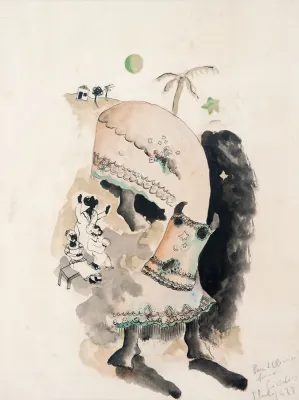
Her drawings are close to the works of certain French caricaturists, such as, for example, those of Daniel de Losques (1880 - 1915). Rian, like this artist, performs a schematic caricature, in which the characters are composed in agile and elegant traits. For the historian Herman Lima, what surprises in his work is the spontaneity of the drawing, the power of synthesis that his works manifest when presenting only the essentials of the character and expression of the portrayed without the resource of deformations.
After a long period without performing Caricatures, resumed activity in the 1940s, encouraged by Herman Lima, stopping only in 1979, due to health problems. Rian, together with Emílio Cardoso Ayres (1890 - 1916), is one of the main caricaturists to focus on Rio's society at the beginning of the 20th century. Undeniable, what is surprising in the art of Rian is the spontaneity of the trait, the power of synthesis, the ability to dispense with the superfluous detail, for the exclusive fixation of the essential, in the instantaneous capture of the character and expression of the caricatured. which the Cuban writer Bernardo G. Barrios observes very well: "In the Rian process, the canons of deformative caricature do not prevail. It is a simple and precise art, which remembers a lot of the de losques invoice. As the well-known French caricaturist, Rian prefers the essential traits combined with the frequent use of black planes. It is the same schematic caricature that has just triumphed in Paris, but crueler, less smiling. They are cartoons in which the grotesque is neither hidden nor concealed; It comes in five or six traits whose effect is completed by the contraposition of the stain, which never fully accepts the euphemism of the half-tones or the defined shadow retouched with care. The misshapen never appears in these caricatures... it is the fine perception of the characteristic point and the psychology of the individual, expressed without the need to force the grotesque. Simple and difficult art that makes Rian consider one of the most important figures in South American humor. "The influence of French caricature on Rian's art has been repeatedly marked. In fact, it cannot be denied that, in an attempt to classify, we would have to put it next to the great ones. Parisian "potrait-chargists" of the beginning of the century, which does not diminish, however, the high meaning of the artistic personality, as it is not about, at all, a pastor without other merits that do not transplant to Brazil the way of foreign masters, but of a Artist endowed with a great vivacity of observation, of a creative spontaneity, which is proven in all his works".
Herman Lima
Lima, Herman. History of Caricature in Brazil III. Rio de Janeiro: J. Olympio, 1963. 1266-1289 p., il. B&W. color. p. 1275-1276.
"The illustrious birth would not have been enough for Rian (he was the daughter of the Baron of Teffé) nor the agile and elegant trait to achieve the fame that she enjoyed, at a very young age, from 1913. (...) But if some of his caricatures were able to shock the conservative society of the time, the success of his drawings contributed to a broad popularity of the character Nair de Teffé, which lasted far beyond the mandate of her husband, to whom she survived for 58 years. The first caricaturist woman to achieve fame in Brazil, Rian began her career in Paris, and her portrait-chrages had already been appreciated since 1909, when they began to be published in the Rio de Janeiro press. together with Emilio Cardoso Ayres, she was the caricaturist par excellence of the society of Rio de Janeiro at the beginning of the century. Both were immune to the influence of Julião Machado, and the presence of the famous French caricaturist without the presence of the famous French caricaturist without it can be identified much more clearly."
Pedro Corrêa do Lago
Lago, Pedro Corrêa do. Brazilian caricaturists: 1836-1999; Preface Zuenir Ventura; presentation. Rio de Janeiro: Sextante Artes, 1999. 215 p., il. color. p. 54.
Individual exhibitions
1910 - Rio de Janeiro RJ - Individual, at Casa David
1910 - Rio de Janeiro RJ - Individual, at Chpelaria Watson
1912 - Rio de Janeiro RJ - Individual, at the headquarters of Jornal do Comércio
Collective exhibitions
1929 - Niterói RJ - 1st Salão Fluminense de Belas Artes
Exhibitions Posthumous
2001 - São Paulo SP - Brazilian caricaturists, at the Instituto Cine Cultural
Source: Itaú Cultural