Modesto Brocos (Santiago de Compostela, Spain 1852 - Rio de Janeiro RJ 1936)
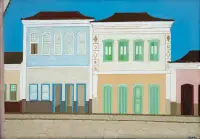
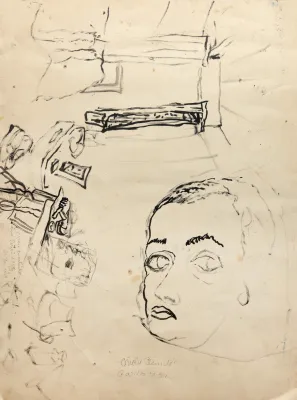
Modesto Brocos was a painter, engraver, illustrator, designer and teacher. Initially, he studied drawing with his brother Isidoro, sculptor and secretary of the Academy of Fine Arts in La Coruña, in Spain. Around 1870, he traveled to Argentina, where he worked as an illustrator. In 1872, he moved to Brazil and, three years later, joined as a free student in the courses of the Imperial Academy of Fine Arts (AIBA) in Rio de Janeiro, being a student of Victor Meirelles (1832-1903) and Zeferino da Costa (1840-1915). In 1877, he took improvement courses in Paris, at the École Nationale Supérieure des Beaux-Arts, as a student of Henri Lehmann (1814-1882). Subsequently, he attended the Royal Academy of Bellas Arts in San Fernando and the studio of the painter Federico Madrazo y Kuntz (1815-1894), both in Madrid. In 1882, he attended the Chigi Academy in Rome. His artistic production includes scenes of genre, portraits and landscapes.
Back to Brazil, he took over, in 1891, the chair of Figurative Drawing Teacher at the National School of Fine Arts (ENBA), at the invitation of the sculptor Rodolfo Bernardelli (1852-1931), a position he held until his death. Among his students were Quirino Campofiorito (1902-1993), Reis Júnior (1903-1985) and Sigaud (1899-1979). Brocos was also the author of books on artistic education, such as The Question of the Teaching of Fine Arts (1915) and Rhetoric of Painters (1933). It also stood out for encouraging the development of engraving in Brazil. In 1952, the National Museum of Fine Arts (MNBA), in Rio de Janeiro, held an exhibition about his production, commemorating the centenary of his birth.
Critical comment
The Spanish painter Modesto Brocos travels to Argentina, around 1870, where he works as an illustrator. In 1872, he moved to Rio de Janeiro. He makes illustrations for the journal O Mequetrefe, in which, as the art historian Teixeira Leite points out, introduces a novelty: the intercalation between drawing and text. In 1877, the artist was perfected in Paris, Madrid and Rome. In this period, he makes one of his most important historical compositions: The Defense of Lugo, 1886.
At the invitation of the sculptor Rodolfo Bernardelli (1852 - 1931) returns to Brazil to assume the position of Figurative Drawing Professor of the Escola Nacional de Belas Artes - ENBA, in 1891. In 1892, it carried out the Tela Engenho da Cassava, in which it focuses on the customs of the countryside, a work that stands out for the use of colors and light. The rural theme becomes constant in its production, as in peeling guavas and sifting coffee, both from 1901. The Redemption of CAM, 1895, one of his most famous paintings, has, for Teixeira Leite, an allegorical character and must be understood as an allusion to the progressive whitening of the black race, within the concept of eugenics in vogue at the end of the 19th century.
Criticism
"Your technique is European, learned in Italy and Spain. The design is correct, since something cold: there is a documentary concern incompatible with the spirit of the 20th century. (...) Broccos is not an innovator, either in print or much less in painting: his greater audacity constituted the use of an expressive environment practically unknown in our country, subordinating it, however, to the lesson of its predecessors (in the work on Exame, the ancestry of Eugene Delacroix is blatant), and cautiously avoiding looking to the future".
José Roberto Teixeira Milk
Pontual, Roberto. Dictionary of Visual Arts in Brazil. Presentation by Antonio Houaiss. Texts by Mário Barata et al. Rio de Janeiro: Brazilian Civilization, 1969.
Carves
National Museum of Fine Arts - MNBA - Rio de Janeiro RJ
Historical Museum of the Republic - Rio de Janeiro RJ
Collection National Library - Rio de Janeiro RJ
Pinacoteca Collection of the State of São Paulo/Brazil - São Paulo SP
Collection Art Gallery - Rio de Janeiro RJ
Fadel Collection - Rio de Janeiro RJ
Collective exhibitions
1876 - Rio de Janeiro RJ - 24th General Exhibition of Fine Arts, at AIBA
1882 - Paris (France) - Official Fine Arts Hall
1887 - Madrid (Spain) - Collective
1894 - Rio de Janeiro RJ - 1st General Exhibition of Fine Arts, at ENBA
1895 - Rio de Janeiro RJ - 2nd General Exhibition of Fine Arts, at Enba  - Gold Medal
1896 - Rio de Janeiro RJ - 3rd General Exhibition of Fine Arts, at Enba
1897 - Rio de Janeiro RJ - 4th General Exhibition of Fine Arts, at Enba
1898 - Rio de Janeiro RJ - 5th General Exhibition of Belas Artes, at Enba
1900 - Rio de Janeiro RJ - 7th General Exhibition of Fine Arts, at Enba
1901 - Rio de Janeiro RJ - 8th General Exhibition of Fine Arts, at Enba
1902 - Rio de Janeiro RJ - 9th General Exhibition of Fine Arts, at ENBA
1903 - Rio de Janeiro RJ - 10th General Exhibition of Fine Arts, at Enba
1904 - Rio de Janeiro RJ - 11th General Exhibition of Belas Artes, at Enba
1905 - Rio de Janeiro RJ - 12th General Exhibition of Fine Arts, at ENBA
1906 - Rio de Janeiro RJ - 13th General Exhibition of Fine Arts, at Enba
1907 - Rio de Janeiro RJ - 14th General Exhibition of Fine Arts, at ENBA - Silver Medal
1908 - Rio de Janeiro RJ - 15th General Exhibition of Fine Arts, at ENBA
1909 - Rio de Janeiro RJ - 16th General Exhibition of Fine Arts, at Enba
1910 - Rio de Janeiro RJ - 17th General Exhibition of Fine Arts, at Enba
1911 - Rio de Janeiro RJ - 18th General Exhibition of Fine Arts, in the ENBA
1911 - São Paulo SP - First Brazilian Exhibition of Fine Arts, at the Liceu de Artes e Ofícios
1912 - Rio de Janeiro RJ - 19th General Exhibition of Fine Arts, at Enba
1913 - Rio de Janeiro RJ - 20th General Exhibition of Fine Arts, at Enba
1914 - Rio de Janeiro RJ - 21st General Exhibition of Fine Arts, at Enba
1915 - Rio de Janeiro RJ - 22nd General Exhibition of Belas Artes, at Enba
1916 - Rio de Janeiro RJ - 23rd General Exhibition of Fine Arts, at Enba
1917 - Rio de Janeiro RJ - 24th General Exhibition of Fine Arts, at Enba
1927 - Rio de Janeiro RJ - 34th General Exhibition of Fine Arts, at ENBA
Posthumous exhibitions
s.d. - New York (United States) - Exhibition inaugurated at the Roerich Museum with other painters of the 19th and 20th centuries
1948 - Rio de Janeiro RJ - Retrospective of painting in Brazil, at MNBA
1950 - Rio de Janeiro RJ - A century of Brazilian painting: 1850-1950, at MNBA
1954 - Rio de Janeiro RJ - Europe in Brazilian Art, at MNBA
1958 - Rio de Janeiro RJ - Work in Art MNBA
1976 - São Paulo SP - The portrait in the collection of the Pinacoteca, in the Pinacoteca do Estado
1980 - São Paulo SP - The Brazilian landscape: 1650-1976, in the Paço das Artes
1984 - Rio de Janeiro RJ - Recent donations 82-84, at MNBA 
1984 - São Paulo SP - Tradition and rupture: synthesis of Brazilian art and culture, at Fundação Bienal
1985 - São Paulo SP - 100 Obras Itaú, at Masp
1986 - São Paulo SP - Nineteenth: a turn in the century, at the Pinacoteca do Estado
1989 - Fortaleza CE - Brazilian art from the 19th and 20th centuries in the collections of Ceará: paintings and drawings, at the Unifor Cultural Space
1989 - São Paulo SP - Painting Brazil 19th and 20th centuries: works from the Banco Itaú collection, in Itaugaleria
1994 - São Paulo SP - A critical look at the 19th century collection, at the Pinacoteca do Estado
1995 - Campinas SP - From the Navy to the still life
1999 - Rio de Janeiro RJ - Exhibition Rio Engraving: Brazilian modern engraving: Collection National Museum of Fine Arts, in the MNBA
1999 - Rio de Janeiro RJ - Brazil rediscovered, in the Imperial Palace
2000 - Porto Alegre RS - National Library: Rares, Margs
2000 - São Paulo SP - Brazil + 500 Rediscovery Exhibition, at Fundação Bienal
2001 - São Paulo SP - Trajectory of light in Brazilian art, at Itaú Cultural
Source: Itaú Cultural