Miguel Bakun (Marechal Mallet PR 1909 - Curitiba PR 1963)
Painter and draftsman.
He is considered one of the pioneers of modern art in Paraná. Son of Slavic immigrants, he joined the School of Apprentices of the Navy, in Paranaguá, in 1926. Transferred to the Escola de Gruumetes in Rio de Janeiro in 1928, he met the sailor and artist José Pancetti, who encourages him to draw. In 1930, he was disconnected from the Navy and returned to Curitiba, where he works as a traveling photographer and, even without systematic training, is dedicated to painting. To keep yourself financially, runs advertisements, signs and interior decorations. Later, he met the painters Guido Viaro and João Baptista Groff. In search of a more favorable cultural environment, he returned to Rio de Janeiro in 1939, meeting the painter José Pancetti again. But, given the difficulties encountered in establishing himself as a painter, he returned permanently to Curitiba in the early 1940s. He installs a studio in a building assigned by the city to several artists, where he lives with the painters Alcy Xavier, Loio-Pérsio, Marcel Leite and Nilo Previdi. The 1950s is the most productive of the artist: he is dedicated to painting portraits, still lifes, marines, and, above all, to landscape painting. From 1960 onwards, he carried out works on a religious theme. At that time, there is a predominance of abstractionism in the few exhibitions of the city, marginalizing figurative artists. Miguel Bakun feels this process and suffers from his precarious economic situation. At the time, he receives medical treatment because of severe depression. In early 1963, at the age of 54, the artist commits suicide in his studio.
Critical Comment
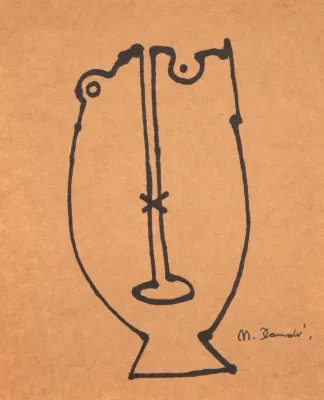
With a painting of post-impressionist and expressionist accents, Miguel Bakun is considered One of the pioneers of modern art in Paraná. Son of Slavic immigrants, he joined the School of Apprentices of the Navy, in Paranaguá, in 1926. He is transferred to the Escola de Gruumetes in Rio de Janeiro in 1928, where he meets the young sailor and artist still unknown José Pancetti (1902 - 1958). Stimulated by his friend, he begins to draw, following his childhood inclination. He makes drawings in the different periods when he needs to rest because of accidents. In 1930, he was disconnected from the Navy for physical incapacity, as a result of a fall from the ship's mast. He moves to Curitiba, where he works as a traveling photographer. He soon met the painters Guido Viaro (1897 - 1971) and João Baptista Groff (1897 - 1970), who encourage him to paint. Self-taught, he dedicates himself professionally to painting until the end of his life.
In search of a more favorable cultural environment, he returned to Rio de Janeiro in 1939. He meets Pancetti again and carries out a series of landscapes of the city, mainly in Morro Santa Tereza. But in the face of the difficulties encountered in establishing himself as a painter, he returns permanently to Curitiba in the early 1940s. He installs a studio in a building provided by the City Hall and starts to live with other artists averse to academicism, such as Alcy Xavier (1933), Loio-Pérsio (1927), Marcel Leite and Nilo Previdi (1913 - 1982). This contact allows Bakun to know the plastic values of the painting. The surprising emotionality of the paintings he paints overcomes the deficiencies of his formation, being soon noticed by the critics. In a 1948 text, the critic Sérgio Milliet (1898 - 1966), after a visit to the city, points to the Van-Goghiano spirit of Bakun, emphasizing that he lacks the notion of the screen as a whole and there is an excess of impassion. However, he concludes his criticism by saying: "The enthusiasm of the painter, his intense participation in the work, however, makes his own defects sympathetic". his melancholy and depressive temperament. The artist himself accepts it, recognizing his admiration for Vincent van Gogh (1853 - 1890), whose paintings he knew in reproductions or in person. Another point of similarity between the two is a certain mystical religiosity in conflict with a feeling of deep loneliness, which of different ways and intensity manifests itself in his works.
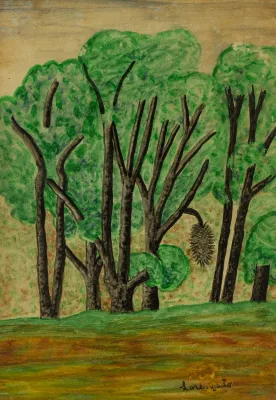
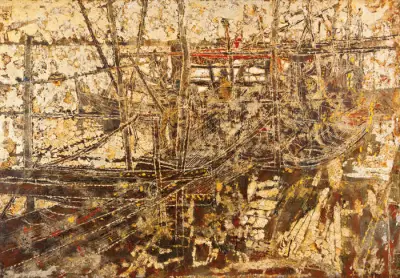
The 1950s is the most productive of Bakun, who is dedicated to painting the Portraits, still lifes, marines, but, above all, to landscape painting, whose most recurrent theme is the surroundings of Curitiba, with its forests and simple houses and the intimacy of the backyard. It is in this last genre that he finds his best artistic performance. The ignorance of the canon laws of the perspective for the construction of pictorial space makes the artist practical and intuitively invent his own solutions. The elaboration of a space with almost no depth and points of escape, built by the corporeality of the paint, singularizes its landscapes.
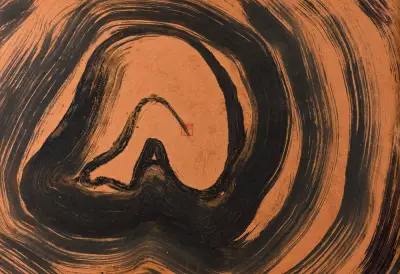
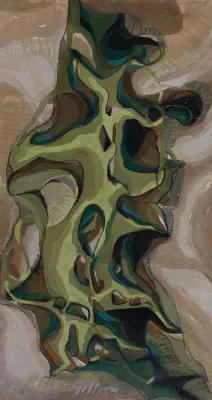
Despite using pencil sketches on canvas or paper, the drawing does not appear in his paintings. Forms are created through the management of pictorial matter itself. Its palette is restricted to shades of blue, green, white, sometimes orange and red, and the preferred color is yellow. The variation between dense and other thin areas, sometimes reaching the absence of ink, constitutes the rhythmic spatialization of his works. The environments, usually familiar and everyday like trees in the backyard, fences, worn wooden doors in simple houses, roadsides, forests, acquire an air of mystery.
The pantheistic mysticism of Miguel Bakun leads him to a deep connection with nature. For him, God is present in all living elements, animal or plant, and colors can reveal this sacred component. It is in this sense that restrictions should be made on critics who see in their works a purely expressionist bias. If, on the one hand, his singular gaze is manifested with freedom, on the other hand, respect for nature does not distance him from the will to represent the real. What we see is an involvement between the artist and the landscape, in which man and nature are permeable to each other. This is revealed in the feeling of spatial proximity provided by its canvases.
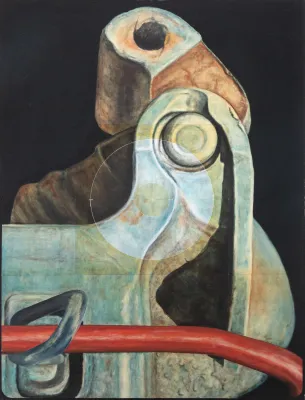
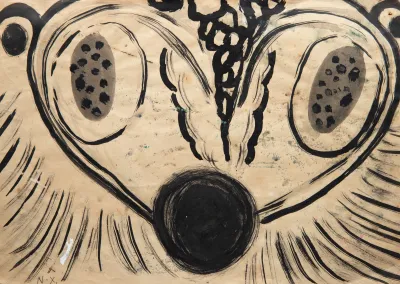
In the late 1950s, the artist introduces strange creatures to the painting, in an animist view of nature even if some critics mistakenly see the influence of surrealism in his work. In the early 1960s, he carried out works on a religious theme. He feels marginalized with the arrival of abstractionism, which begins to dominate the few exhibitions in Curitiba. Its economic situation also becomes increasingly precarious. These factors contribute to the worsening of his depression, clinging to religion like never before. In February 1963 he committed suicide in his studio.
Criticism
"Oscar Wilde said that nature is the creation of art. (...) Miguel Bakun was an artist who belonged to no movement. His art flowed naturally, but not without apparent suffering. The doubts, the inquiries, the mysticism of Miguel Bakun had to do with his art solely because it was the same person. There is no doubt that, within that concept of Oscar Wilde, Miguel Bakun is a fertile example that nature was his creation. It was the way of doing things and not because he was consciously desired, or culturally, to execute it. Or rather, it was not a program. It was a way of interpreting the world, through the angles of his own expression. So seek mysticism, anguish in work, but in man. This anguish, however, also had its simplest aspect. much of it derived from an eagerness to know. Perhaps if the answers were more convincing, or if they gave him work and encouragement relating to the answers I intended to obtain, there would have been no outcome. Because there was, in Miguel Bakun, there was no expectation of uselessness, or a self-discouragement. Everything that Miguel Bakun did was derived from a decisive deliberation, in his art, in his life. The doubts that assailed him and the anguish he carried with him were not in such a way as to prevent him from carrying out what was within his deliberation. That's why his art is a strong, energetic painting. at the same time lyrical. Bakun enjoyed life and so much that he was, the center of his attention. Its final act is demonstrating this circumstance."
Eduardo Rocha Virmond
VIRMOND, Eduardo Rocha. [Text]. In: BAKUN, Miguel. Miguel Bakun, 25 years later. Curitiba: Sala Miguel Bakun/Secretariat of State for Culture, 1989. p. 8.
"Staken at the quality of the engraving in painters still unbelievable in oil or watercolor, I heard from Viaro, this statement moving: 'is that the engraving comes from within'. It expresses desires and emotions that do not have their purity diverted by the sensuality of color, nor by the injunctions of the objective world. The lack of market for common canvases and the absence of criticism, perhaps explain the relative insignificance of the painting itself. Bakun has qualities, however, it is a Van-Goghano temperament. It is impulsive to those who lack the notion of the screen as a whole and who abuses warm colors without any balance. On the other hand, it is still attached to a dangerous conception of matter. Excessive pastement confuses the values and attenuates the cleaning of the color. The enthusiasm of the painter, his intense participation in the work, however, make his own defects sympathetic".
Sérgio Milliet
MILLIET, Sérgio. Eliane. The Nature of Destiny: Miguel Bakun. 2000. 59 F. Course Completion Work (Specialization - History of Art)-School of Music and Fine Arts of Paraná, Curitiba, 2000. p. 47. [Text published Originally in the newspaper O Estado de São Paulo, February 1948]
"In the elaboration of its landscapes, some images were carried out on a small scale, and later enhanced and re-elaborated with more preciosity and details. But, on the whole, Bakun's production appropriates small-scale quality, resorting to intimacy, delicacy and the possibility of discourse that it provides, a circumscribed surface that makes us look inside and on the canvas. An art whose space suggests a certain shyness and, at the same time, a wisdom of the possibilities and limits of its environment, without weighing the monumentality and officiality or laxity that some almost mural paintings demonstrate with their brush strokes of an illustrative character. This size of visuality and action chosen by the artist allows the formulation of an enriching, problematized and unstable whole, which fits him in the handling of the hands. making the time of its realization a single impulse, whole, without stops and resumptions of painting. The non-vibrant character of light, non-transparent of matter, and the non-fluid and extensive spatiality propose to us a fair, tight and slippery transit. the artist sets out to build the thickness of the world, and the small format presents us with the condensation of such energy".
Eliane Prolik
PROLIK, Eliane. ______. The nature of fate: Miguel Bakun. 2000. 59 F. Course Completion Work (Specialization - History of Art)-School of Music and Fine Arts of Paraná, Curitiba, 2000. p. 20.
Individual exhibitions
1946 - Marechal Mallet PR - Individual, in the City Hall
1949 - Curitiba PR - Individual, at the Guaíra Theater
1957 - Curitiba PR - Individual, in the exhibition room of the Public Library of Paraná
Collective exhibitions
1944 - Rio de Janeiro RJ - Paranaense Art Exhibition
1946 - Curitiba PR - 3rd Salão Paranaense de Fine Arts
1947 - Curitiba PR - 4th Salão Paranaense de Belas Artes, in the Orfeão building of the Normal School of Curitiba - Gold Medal
1947 - Paraná - Expos at Clube Concórdia - Gold Medal
1948 - Curitiba PR - 5th Salão Paranaense de Belas Artes, at the School of Music and Fine Arts of Paraná - Honorable Mention
1948 - Paranaguá PR - Arte do Paraná, at the Literary Club
1949 - Curitiba PR - 6th Salão Paranaense de Belas Artes, at the Paraná Institute of Education Professor Erasmo Pilotto - Bronze Medal
1950 - Curitiba PR - 7th Salão Paranaense de Belas Artes, at the Institute of Education of Paraná Professor Erasmo Pilotto - Silver Medal
1951 - Curitiba PR - 8th Salão Paranaense de Belas Artes, in the Department of Culture - Exhibition Room
1952 - Curitiba PR - Permanent exhibition of artists from Paraná
1953 - Paraná - Centenary of the Political Emancipation of Paraná
1953 - Paraná - 6th Salon of Fine Arts of Spring - Bronze Medal
1956 - Curitiba PR - 12th Salão Paranaense
1956 - s.l. - 9th Spring Salon of Clube Concórdia
1957 - São Paulo SP - Painters of Paraná, at MASP
1958 - Curitiba PR - 6 painters from Paraná, at Galeria Cocaco
1959 - Curitiba PR - 16th Salão Paranaense
1959 - s.l. - 11th Spring Salon of Clube Concordia
1960 - Curitiba PR - 12th Spring Hall - Acquisition Award
1960 - Curitiba PR - 1st Annual Salon of Curitiba - Honorable Mention
1960 - Curitiba PR - 17th Salão Paranaense
1961 - Curitiba PR - 13th Spring Salon - Silver Medal
1961 - Curitiba PR - 2nd Annual Salon of Curitiba
1961 - Curitiba PR - 18th Salon Paranaense
1962 - Curitiba PR - Salão do Paraná, at the Public Library of Paraná - Gold Medal
Posthumous exhibitions
1963 - Curitiba PR - 20th Salão Paranaense de Belas Artes. Special Room, at the Public Library of Paraná
1974 - Curitiba PR - Retrospective Miguel Bakun, at the Badep Exhibition Hall
1978 - Curitiba PR - Tribute to Bakun, at Clube Curitibano
1980 - Curitiba PR - Miguel Bakun: Retrospective, at Sala Miguel Bakun
1984 - São Paulo SP - Tradition and Rupture: Brazilian Art and Culture Synthesis, at the São Paulo Biennial Foundation
1985 - São Paulo SP - 18th International Bienal de São Paulo Paulo, at Fundação Bienal
1986 - Curitiba PR - Tradition/Contradição, at MAC/PR
1987 - Curitiba PR - Unpublished works, at Studio R. Krieger
1989 - Curitiba PR - Miguel Bakun, 25 years later, at the Secretary of State for Culture
1991 - Curitiba PR - Municipal Museum of Art: Collection, at the Municipal Museum of Art
1994 - São Paulo SP - Bienal Brasil Século 20th, at the Bienal Foundation
1997 - Curitiba PR - Contemporary Art of Engraving, at the Metropolitan Museum of Art of Curitiba
1998 - Curitiba PR - Paranaense Art: Renewal Movement, at the Caixa Cultural Complex
2004 - Curitiba PR - The landscape of Paraná and its Painters, at Casa Andrade Muricy
Source: Itaú Cultural