Lula Cardoso Ayres (Recife PE 1910 - Idem 1987)
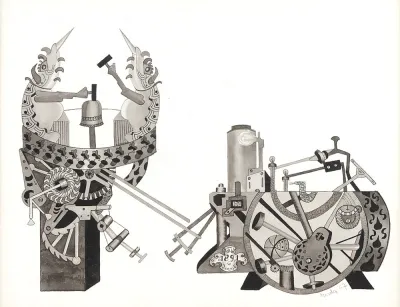
Lula Cardozo Ayres was a multifaceted Brazilian artist who acted as a painter, photographer, designer, Illustrator, muralist and scenographer. His work stands out for the valorization of popular Northeastern popular culture and the constant experimentation between figuration and abstraction, consolidating Lula Cardozo Ayres as one of the most relevant names in Brazilian art of the 20th century.
Lula Cardozo Ayres began his artistic formation Studying drawing and painting with Heinrich Moser, between 1922 and 1924. In 1925, he traveled to Paris, where he visited the International Decorative Art Exhibition, attended museums and workshops and had contact with artists such as Maurice Denis, in addition to getting to know the main movements of European modern art up close. He returned to Brazil in 1926.
In Rio de Janeiro, Lula Cardozo Ayres established an studio in the Laranjeiras neighborhood, attended the National School of Fine Arts and studied model Vivo with Rodolfo Amoedo. He also received training in Carlos Chambelland's studio. During this period, he approached Candido Portinari, with whom he developed a relationship of friendship. He worked professionally as a scenographer and illustrator, collaborating with the magazine for all.
In 1932, Lula Cardozo Ayres returned to Pernambuco to manage the family's sugar plant, living in the countryside until 1944. During this period, He toured villages in the region and recorded customs, parties and cultural manifestations, producing drawings and a wide photographic series. His interest in popular ceramics directly influenced his production in painting and watercolor.
In 1934, Lula Cardozo Ayres participated in the Afro-Brazilian Congress of Recife, where he met important intellectuals and artists, such as Cícero Dias, Ulysses from Pernambuco and Gilberto Freyre, with whom he maintained a strong intellectual connection.
After a crisis in family business in 1945, Lula Cardozo Ayres moved to Recife and began to live exclusively from his artistic production. During this period, he made murals and panels in several Brazilian cities, including a prominent work at the Guararapes airport. He also produced illustrations for authors such as Manuel Bandeira and Ascenso Ferreira. In 1947, he founded a drawing course for children and worked as a professor at the Federal University of Pernambuco.
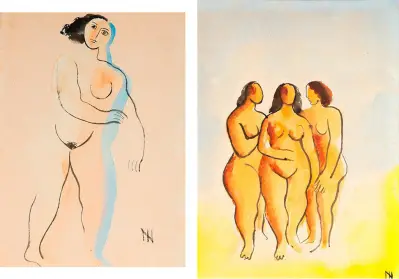
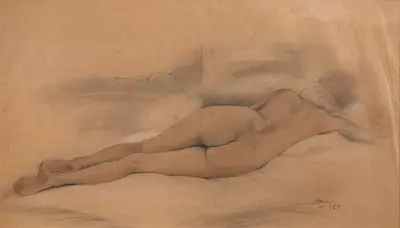
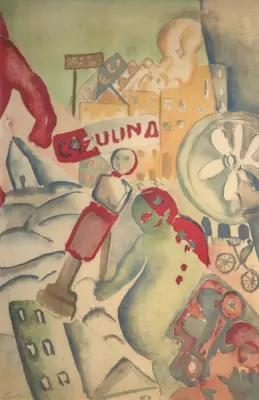
In the 1950s, the work of Lula Cardozo Ayres approached abstractionism, leading the artist to participate in the first editions of the Bienal de São Paulo. In 1960, he held a retrospective exhibition at the São Paulo Museum of Art, organized by Pietro Maria Bardi, focusing on his most recent production. Themes such as the feminine universe, animals and fantastic figures. In 1984, he made panels for the Recife subway. After his death, he was honored by the local artistic community, consolidating the legacy of Lula Cardozo Ayres as one of the main representatives of Pernambuco and Brazilian art. He starts early, at the age of 12, working as an assistant to the German artist Heinrich Moser in Recife, with whom he acquires the first knowledge of artistic techniques. Chambelland, and from this experience he recalls the drawing exercises with plaster models, which give him the mastery of halftones in the representation of volumes. January, and resumes in the 1940s in Recife. In his graphic production from Rio de Janeiro, which often portrays the female figure and the new conquests of modernity, the influence of Art Déco is noted.
In 1931, it produces the ambiance for the show O Espelho de Prospero, being responsible for the creation of the panels, choice of furniture and decoration. The non-realistic and subjective party of its scenography, a boldness by the standards of the time, arouses the interest of playwrights such as Paschoal Carlos Magno and Renato Viana, who publish laudatory comments about the artist in the press. Another work he carries out in this field is the painting of a large panel for the Carnival of the Clube Internacional do Recife, in 1941, in which he portrays scenes from the maracatu, the cortejo de reis and other popular folias.
In his artistic research process, Ayres begins to perform Photographs on different aspects of the life of rural populations. During the 1930s and 1940s, he intensified the anthropological interest in ways of life and rituals, partly stimulated by the coexistence with the poet Ascenso Ferreira and the sociologist Gilberto Freyre. It produces a large number of photographs and also several drawings of demonstrations such as Bumba Meu Boi, Maracatu, Carnival, the rituals of Candomblé and indigenous populations. Part of the photographs today is part of the collection of the Museum of the Northeast Man.
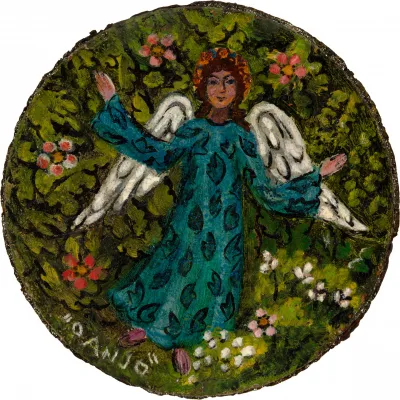
of his experience in the interior of Pernambuco, he is above all interested in popular ceramics. By making contact with this production, he seeks to transfer the colors and shapes of clay sculptures to the drawing and painting. The first drawings made to represent the form and constitution of clay dolls date from 1940. For the critic Clarival do Prado Valladares, author of a careful study of the artist, the discovery of popular ceramics greatly guides the production of Ayres, and is the by which he approaches synthetic cubism. Such a reference to ceramics can be noted in the massive shapes of the human figure, in the rounded volumes of the vegetation and in the staticity of the animals in works such as the oils on canvas representation of the bumba-meu-boi and engagement in the copy and in the watercolors Bride and horseback riding, all from 1943.
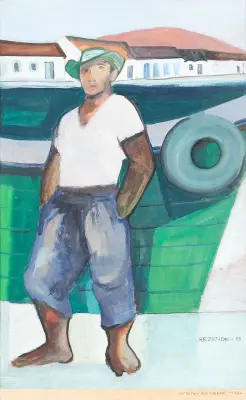
In a set of works, produced between 1945 and 1946, Ayres explores the phantasmagoria and hauntings. Such a universe, which refers to the narratives and popular beliefs of Recife, appears in works such as the haunted chapel, a haunted sofa, dressing the bride and burial, among others. 1940, is marked by social-themed canvases, representing regional figures and landscapes, such as migrants, girls begging for alms, blind guitar players, all from 1947, present in the Itamaraty retrospective held in the 1970s, highlighting this facet of the artist. Figures of the Recife Carnival, Frevo, Maracatu, Bumba Meu Boi, and sugarcane cutters are often portrayed in their paintings.
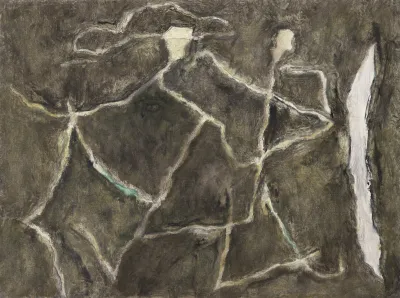
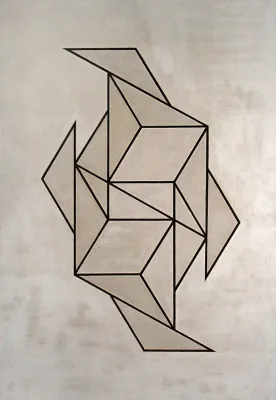
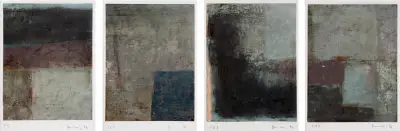
In the early 1950s, their production moves towards abstractionism, but without opening hand completely of figuration. Such a change of language is partly explained by the impact, recognized by the artist, of the realization of the first biennials in São Paulo. The ex-votos and three ex-votos canvases, elaborated in 1951, are examples of the particular solution explored by the artist in this phase, who works on the figure, intending to arrive at his synthesis. In tempera works, such as dancers or red bird, both from 1952, colors gain relevance over the drawing. In canvas such as King and Queen of Maracatu, from 1959, the artist achieves the synthesis of the figures through geometric schematization. Ayres returns to the theme in Rainha do Maracatu, from 1972, oil on canvas belonging to the Museum of Art of São Paulo Assis Chateaubriand - MASP, with a more figurative treatment. Mysterious females, on canvas like the door and women with cloaks, produced in 1964. In the 1970s, she was mainly dedicated to painting the female figure of the mulatto woman and the brunette, on canvas as the head of a mulatto woman, of 1970, in which the woman is portrayed with hollow eyes and voluminous long hair.
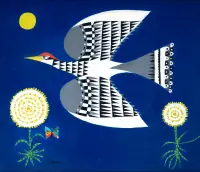
From the mid-1970s onwards, she produces several paintings in which imaginary animals appear using acrylic paint. In these works, he uses strong and contrasting colors and wide contours in black that shape animals, such as birds, emas, oxen and other invented beings.
The vast majority of his works can be seen at the Lula Cardoso Ayres Cultural Institute, in Jaboatão de Guararapes, Pernambuco. Created in 1993 at the family's initiative, the institute has in the collection more than 300 works by the artist, including paintings, drawings, photographs, illustrations and graphic works, studies and designs of its scenography and murals.
Critiques
"In just over forty years, the work of Lula Cardoso Ayres has been taking the path that took him from the use of the closest popular base to the experience of a disinterested abstraction of absolute purity and the re-entry of the last few years in the figuration of atmospheres lyrically surrealist, however, it is advisable not to see each of these phases as sudden and successive events, but as manifestations simultaneously present, to different degrees, at each moment of drawing and painting. Only in the initial phase, resulting from the experience in the interior of Pernambuco and the research of the genuine popular pottery produced there, it would be possible to find one of the three directions individualized; Lula wanted then to transfer to his work, at the same time re-creation at the same time realistic and transfigurative, certain colors, volumes and scenes typical of these rough clay sculptures, molding them to the paper or screen plane. But, afterwards, two new elements of style would add to that starting point: on the one hand, the use of the fantastic, which belongs to so many areas of the manifestations of popular religiosity; on the other hand, the referral to the analogical abstraction, sometimes approaching the childish resources of lyricism characteristic of Miró. Both tendencies served him, for example, to focus differently and at times not very distant, the bumba-meu-boi northeast, dramatizing it in strange luminosities, in the first case, and reducing it to almost graphical synthesis, in the second".
Roberto Pontual
Pontual, Roberto. In: ______. Art/Brazil/Today: 50 years later São Paulo: Collectio, 1973.
Individual exhibitions
1946 - Recife PE - Mostra, at the Faculty of Law do Recife
1946 - São Paulo SP - Mostra, at Galeria Itapetininga
1946 - Rio de Janeiro RJ - Mostra, at MEC
1952 - Rio de Janeiro RJ - Individual, at MAM/RJ
1960 - São Paulo SP - Individual, at MASP
1961 - Salvador BA - Individual, at MAM/BA
1962 - Rio de Janeiro RJ - Individual, at the Bonino Gallery
1966 - São Paulo SP - Individual, Oca Gallery
1968 - Recife PE - Retrospective, at the Government Palace
1968 - Salvador BA - Individual, at MAM/BA
1968 - Salvador BA - Individual, at the Castro Alves Theater
Exhibitions Collectives
1928 - Rio de Janeiro RJ - 35th General Exhibition of Fine Arts, at ENBA
1934 - Recife PE - 1st Afro-Brazilian Congress, organized by Gilberto Freyre
1951 - São Paulo SP - 1st São Paulo International Biennial, at the Trianon Pavilion
1952 - Paris (France) - May Salon
1952 - Rio de Janeiro RJ - Exhibition of Brazilian artists, MAM/RJ
1953 - São Paulo SP - 2nd São Paulo International Biennial, at the State Pavilion
1955 - São Paulo SP - 3rd São Paulo International Biennial, in the Pavilion of Nações
1960 - Recife PE - Contemporary Pernambuco painters, at the Arts and Communication Center of the Federal University of Pernambuco
1960 - São Paulo SP - Leirner Collection, NA Art of the Leaves Gallery
1961 - São Paulo SP - 6th São Paulo International Biennial, at the Ciccilo Matarazzo Sobrinho
1962 - São Paulo SP - Selection of works of Brazilian Art from the Ernesto Wolf Collection, at MAM/SP  
1962 - Washington (United States) - Collective, at the Pan American Union
1969 - São Paulo SP - Inauguration press conference at the Paço das Artes
1972 - Brasília DF - Retrospective of 50 years of work, at the Itamaraty Palace
1972 - São Paulo SP - Art/Brazil/Today: 50 years later, at the Collectio Gallery
1972 - São Paulo SP - The Week of 22: Background and Consequences, at MASP
1974 - São Paulo SP - Time of the Modernists, at Masp
1976 - São Paulo SP - The drawing in Pernambuco, at Galeria Nara Roesler
1982 - Lisbon (Portugal) - Brazil 60 years of modern art: Gilberto Chateaubriand Collection, at the José de Azeredo Perdigão Modern Art Center
1982 - London (England) - Brazil 60 years of modern art: Gilberto Chateaubriand collection, at Barbican Art Gallery
1982 - Penápolis SP - 5th Northwest Plastic Arts Hall, at the Educational Foundation of Penapolis. Faculty of Philosophy, Sciences and Letters of Penápolis
1982 - São Paulo SP - From Modernism to Bienal, at MAM/SP
1983 - Recife PE - 50 years of Casa Grande & Senzala, at the Joaquim Nabuco Foundation
1984 - Aracaju SE - 50 years of Casa-Grande & Senzala
1984 - Brasília DF - 50 years of big house & Senzala
1984 - Lisbon (Portugal) - 50 years of big house & Senzala, at the Gulbenkian Museum of the Calouste Gulbenkian Foundation
1984 - Salvador BA - 50 years of big house & Senzala
1984 - São Paulo SP - Gilberto Chateaubriand Collection: Portrait and Self-Portrait of Brazilian Art, at MAM/SP
1984 - São Paulo SP - Tradition and Rupture: Synthesis of Art and Culture Brazilians, at the Bienal Foundation
1984 - Vitória ES - 50 years of Casa-Grande & Senzala
1986 - Brasília DF - Pernambucanos in Brasília, at the ECT Art Gallery
1986 - São Paulo SP - Time of Madureza, at the Ranulpho Art Gallery
1987 - São Paulo SP - The craft of art: painting, at SESC
1999 - São Paulo SP - Daily life/art. O Consumption - Metamorphosis of Consumption, at Itaú Cultural
Posthumous exhibitions
1989 - São Paulo SP - Color of Pernambuco, at Ranulpho Art Gallery
1989 - Recife PE - Individual, on the Northeast Artefacto
1991 - Recife PE - Retrospective Reviver Lula Cardoso Ayres, at Galeria Vicente do Rego Monteiro of the Joaquim Nabuco Foundation
1991 - Recife PE - Reviving Lula Cardoso Ayres, at Galeria Vicente do Rego Monteiro/Joaquim Nabuco Foundation
1993 - Recife PE - Individual, at Ranulpho Art Gallery
1994 - Recife PE - Homage to the artist on the plastic artist's day, at the Associação dos Artistas Artistas Professional Plastics
1999 - São Paulo SP - Daily life/art. Consumption, at Itaú Cultural
2000 - Recife PE - Ateliê Pernambuco: Homage to Bajado and Mamam Collection, at MAMAM
2001 - Brasília DF - Collections of Brazil, at Centro Cultural Banco do Brasil
2003 - Recife PE - See again/see the new, at Mamam
2003 - Rio de Janeiro RJ - Treasures of the Caixa: Brazilian Modern Art in the Caixa collection in the Caixa Cultural Complex
Source: Itaú Cultural