John Graz (Genebra, Suíça 1891 - São Paulo SP 1980)
John Graz was a Swiss painter, decorator, sculptor and graphic artist who played a fundamental role in the development of modern art in Brazil. He began his studies in 1908 at the École des Beaux-Arts in Geneva, where his teachers included Eugène Gilliard, Gabriel Vernet and Daniel Baud-Bovy. He was also a disciple of Edouard Ravel, from whom he acquired a wide range of techniques and styles. Between 1911 and 1913, he studied decoration, design and advertising at the School of Fine Arts in Munich, under Carl Moos. He returned to Geneva from 1913 to 1915, a period in which he associated with the siblings Regina and Antonio Gomide, who would later be important figures in his life.
During a stay in Paris, he came into contact with the European avant-garde movements, such as Cubism, Fauvism and Futurism, and became familiar with the work of Paul Cézanne. He was twice awarded the Lissignol grant, which allowed him to study in Spain. Back in Switzerland, he worked as an illustrator on various projects. In 1920, he moved to Brazil and married Regina Gomide in São Paulo. Through Oswald de Andrade, he quickly became part of São Paulo's intellectual circles.
He took an active part in the 1922 Semana de Arte Moderna, where he showed seven works, and had one of his works published in the magazine Klaxon, in its seventh issue that same year. In 1923, he collaborated with the architect Gregori Warchavchik on projects that integrated art and architecture. He worked as a decorator of São Paulo homes, designing everything from furniture and lamps to stained glass, frescoes and gardens, always with a modern and functional approach.
John Graz was one of the founders of the Sociedade Pró-Arte Moderna (SPAM) in 1932 and, in the 1930s, produced numerous covers for the magazine Ilustração Artística do Brasil. He formed Grupo 7 with Regina Graz, Antonio Gomide, Elisabeth Nobiling, Rino Levi, Victor Brecheret and Yolanda Mohalyi.
Critical Commentary
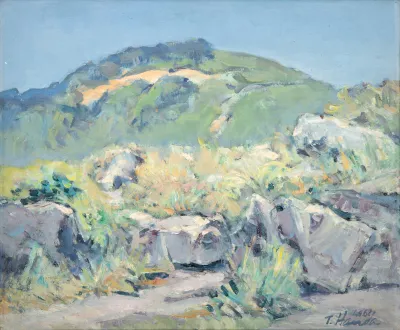
Between 1908 and 1911, John Graz attended courses in architecture, decoration and drawing at the École des Beaux-Arts in Geneva, where he studied with Eugène Gilliard (1861 - 1921) and Daniel Baud-Bovy (1870 - 1958). He then enrolled at the School of Fine Arts in Munich and studied with the graphic artist Carl Moos (1873 - 1959). On a trip to Paris, he met the sculptor Victor Brecheret (1894 - 1955). In 1913, he returned to Geneva, where he completed his studies at the École des Beaux-Arts. He twice received the Lissignol grant, which enabled him to go to Spain. There he painted large landscapes that reveal his interest in the works of Paul Cézanne (1839 - 1906) and, above all, of Ferdinand Hodler (1853 - 1918).
In Geneva, he designed stained glass and made illustrations for advertising posters. He became friends with the writer Sérgio Milliet (1898 - 1966) and met Regina Gomide (1897 - 1973) and her brother, Antonio Gomide (1895 - 1967), fellow students at the École des Beaux-Arts. Engaged to Regina, he came to Brazil in 1920 and married her. He joined the São Paulo modernist group, made up of Anita Malfatti (1889 - 1964), Di Cavalcanti (1897 - 1976), Brecheret and Mário de Andrade (1893 - 1945), among others. In 1922, he took part in the Semana de Arte Moderna with seven paintings. He made illustrations for the magazine Klaxon, the first modernist periodical.
From 1923 onward, he carried out home decoration projects: he created numerous stained-glass windows and designed furniture and items such as doors, locks, lamps, rugs and frescoes. Together with Regina and Antonio Gomide, he is considered one of those who introduced the Art Deco style in São Paulo. He worked with Gregori Warchavchik (1896 - 1972), recently arrived in the country, decorating the houses designed by the Russian architect. In 1925, Graz presented tubular furniture in São Paulo, made of metal tubes and wood laminates, with geometric forms. Endowed with great technical and manufacturing knowledge, he personally oversaw the production of the pieces at the Liceu de Artes e Ofícios, where he had the collaboration of Federico Oppido (1877 - 1950). He was an innovator in interior decoration. When designing furniture, he planned its arrangement in space and its relationship with panels, stained glass and frescoes. The integration of elements is a characteristic of the houses decorated by Graz: the same idea extends from the painted panels to the furniture, objects and lighting. The Cunha Bueno residence (Jardim América) is an example of his pioneering spirit: for its decoration, the artist even designed the geometric pattern of the garden paving. Unfortunately, the incipient state of Brazilian industry made it impossible to turn John Graz's prototypes into mass-produced items.
Critiques
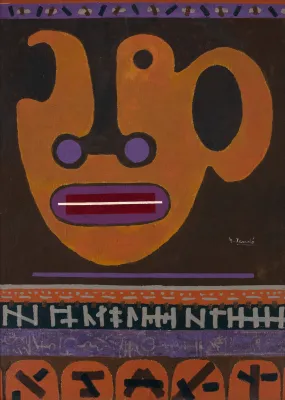
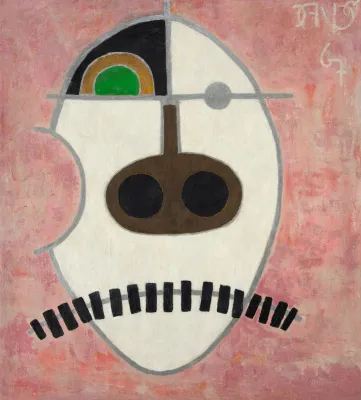
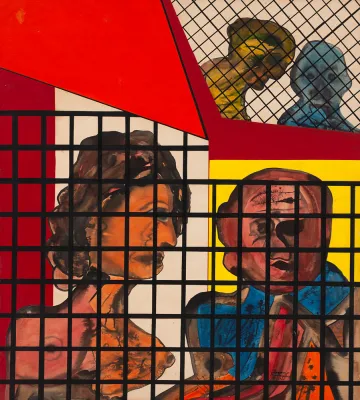
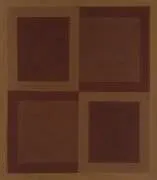
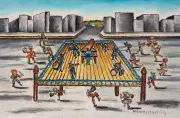
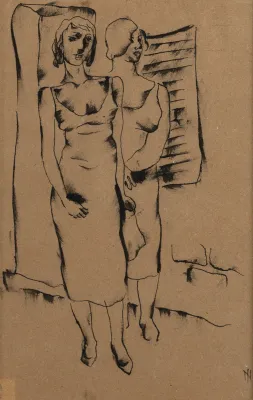
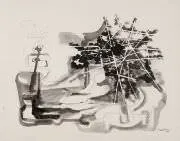
"Experiments in abstraction, with some geometric constructions, or purely informal ones, seeking a rich, dense, worked material. Very soon, however, John Graz would become convinced that this kind of painting did not suit his personal nature and did not correspond to his most intimate and profound aspirations. It is the painter himself who tells us that he loves what is alive, what breathes and moves. His path, therefore, is that of figuration, or rather, narrative figuration. This is where his palette expands and not infrequently shines. As in the excellent series of scenes from the São Joaquim market in Recife, with its odd merchants, the bird seller, the graceful girl at the basket stall, placed at the center of the canvas in an elegant pose, somewhere between coquettish and haughty; or the scene of young women, with the Colonial Church as a backdrop; and also the festive square, in deep, lively color, breathing joy, with its gas balloons so well integrated into the urban crowd. And many others, with a local accent, happily conveying the ambiance, the tropical atmosphere".
Paulo Mendes de Almeida
JOHN Graz. São Paulo: Galeria Documenta, 1974.
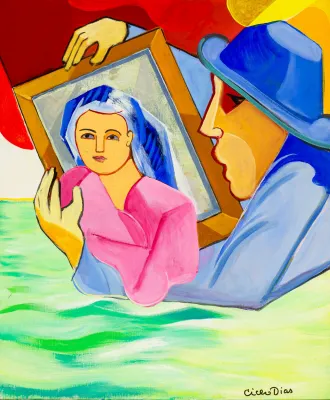
"I must confess a surprise before John Graz's latest paintings. The artist has given himself over to a complete diversification of themes, with an entire freedom of choice which, it seems to me, he had never reached before. We are indeed before a multiple repertoire, which is what first makes an impact, since the artist gives his themes full primacy, both in capturing space and visualizing it within the canvas and in the very free placing of figures and things within these rectangles. Not that painting counts for little to Graz at this point in time. He does have his own palette, and that is his hallmark, through the tonality it expresses, made entirely of low tones. Thus, when he records nature, landscape, fauna, lands and objects, he subjects them to a light that makes no concession whatsoever to tropicalisms. On the contrary, with a watchful restraint natural to him, the painter limits himself to paying homage to the changing spectacle of the land, fauna and flora, without yielding a millimeter to color. His green is his very own, as are his earths, his reds, his blues. (...)"
Geraldo Ferraz
JOHN Graz: obras selecionadas. Apresentação de Geraldo Ferraz. São Paulo: R &R Camargo Arte, 1976.
"All the paintings John Graz showed in the exhibition at the Municipal had been made while he was still in Europe, in Geneva, two of them (Paisagem na Espanha [Landscape in Spain]) during his scholarship. A certain modern transfiguration shows through in his canvases Retrato do Ministro Gomide [Portrait of Minister Gomide] and, more incisively, Paisagem Suíça [Swiss Landscape], where the compositional scheme based on parallel horizontal lines is quite evident. A strong structure is present in the two Spanish landscapes, especially the one that focuses on the bridge at Honda, where the tectonic concern is combined with a sensitive chromatic alteration that gains in drama. Unquestionably, alongside Anita Malfatti, John Graz stood out qualitatively in this exhibition, together with Vicente do Rego Monteiro, as one of the most interesting painters of the Semana de Arte Moderna".
Aracy Amaral
GALLAS, Alfredo G. (coord.). 100 obras Itaú. Prefácio e apresentação Pietro Maria Bardi. São Paulo: Itaugaleria, 1985. 210 p. il. color.
Solo Exhibitions
1920 - Lausanne (Switzerland) - Solo, at Sociedade de Arquitetos Pintores e Escultores de Lausanne
1969 - São Paulo SP - Solo, at Galeria Opus
1970 - São Paulo SP - Solo, at Galeria Opus
1970 - São Paulo SP - John Graz. Retrospective, at MAB/Faap
1971 - Santos SP - Solo, at CCBEU
1974 - São Paulo SP - Solo, at Documenta Galeria de Arte
1974 - São Paulo SP - John Graz: Retrospective, at Masp
1975 - Santos SP - Solo, at CCBEU
1976 - São Paulo SP - Solo, at Azulão Galeria
1976 - São Paulo SP - John Graz: Selected Works, at Camargo Arte
1978 - São Paulo SP - Solo, at Galeria de Arte Portal
1979 - Londrina PR - Solo, at Galeria Via Duomo
1980 - São Paulo SP - Solo, at Paulo Figueiredo Galeria de Arte
Group Exhibitions
1920 - Rio de Janeiro RJ - 27th General Fine Arts Exhibition, at Enba
1920 - São Paulo SP - Regina Gomide Graz and John Graz, at Salão do Cinema Central
1922 - São Paulo SP - Semana de Arte Moderna, at Teatro Municipal
1931 - Rio de Janeiro RJ - Exhibition at the First Modernist House of Rio de Janeiro, at Rua Toneleros
1931 - Rio de Janeiro RJ - Salão Revolucionário (Revolutionary Salon), at Enba
1933 - São Paulo SP - 1st SPAM Modern Art Exhibition
1942 - São Paulo SP - 7th Salon of the Visual Artists' Union, at Galeria Prestes Maia
1947 - São Paulo SP - John Graz and Antonio Gomide, at Rua Barão de Itapetininga
1971 - São Paulo SP - 11th Bienal Internacional de São Paulo, at Fundação Bienal
1972 - São Paulo SP - The 1922 Week: Antecedents and Consequences, at Masp
1972 - São Paulo SP - Art/Brazil/Today: 50 Years Later, at Galeria da Collectio
1974 - São Paulo SP - Time of the Modernists, at Masp
1975 - São Paulo SP - Modernism from 1917 to 1930, at Museu Lasar Segall
1975 - São Paulo SP - The Third Cycle of Brazilian Painting, at Museu Lasar Segall
1975 - São Paulo SP - SPAM and CAM, at Museu Lasar Segall
1976 - São Paulo SP - The Graz-Gomide Family: Art Deco in Brazil, at Museu Lasar Segall
1976 - São Paulo SP - Bienal Nacional 76, at Fundação Bienal
1976 - São Paulo SP - The Salons: of the Família Artística Paulista, of May and of the São Paulo Visual Artists' Union, at Museu Lasar Segall
1977 - São Paulo SP - Brazil Art 1922/77, at Galeria de Arte Portal
Posthumous Exhibitions
1980 - São Paulo SP - John Graz: Reminiscences of Modernism, at Paço das Artes
1981 - Maceió AL - Brazilian Artists of the First Half of the 20th Century, at Instituto Histórico e Geográfico
1981 - São Paulo SP - John Graz, Victor Brecheret and Guilherme de Almeida, at Metrô
1982 - São Paulo SP - 60 Years of the Semana de Arte Moderna, at Centro Campestre do Sesc
1982 - São Paulo SP - From Modernism to the Bienal, at MAM/SP
1982 - São Paulo SP - John Graz, at Instituto de Pesquisas Energéticas e Nucleares
1984 - São Paulo SP - Tradition and Rupture: A Synthesis of Brazilian Art and Culture, at Fundação Bienal
1985 - São Paulo SP - 100 Itaú Works, at Masp
1990 - São Paulo SP - Modernist Furniture, 1st Period, at Associação Pró Parque Modernista
1991 - São Paulo SP - John Graz and Design, at Associação Pró Parque Modernista
1992 - Rio de Janeiro RJ - Nature: Four Centuries of Art in Brazil, at CCBB
1992 - São Paulo SP - Oils and Papers: 1920 to 1970, at Espaço de Arte José Duarte Aguiar e Ricardo Camargo
1993 - São Paulo SP - Modern Drawing in Brazil: Gilberto Chateaubriand Collection, at Galeria de Arte do Sesi
1993 - São Paulo SP - Modernism at the Museu de Arte Brasileira: Painting, at MAB/Faap
1994 - Rio de Janeiro RJ - Modern Drawing in Brazil: Gilberto Chateaubriand Collection, at MAM/RJ
1994 - Rio de Janeiro RJ - Trenches: Art and Politics in Brazil, at MAM/RJ
1994 - São Paulo SP - Bienal Brasil Século XX, at Fundação Bienal
1996 - São Paulo SP - John Graz Retrospective, at Masp
1998 - São Paulo SP - Constructive Art in Brazil: Adolpho Leirner Collection, at MAM/SP
1998 - São Paulo SP - Impressions: The Art of Brazilian Printmaking, at Espaço Cultural Banespa-Paulista
1998 - São Paulo SP - The Collectors - Guita and José Mindlin: Matrices and Prints, Galeria de Arte do Sesi
1999 - Rio de Janeiro RJ - Constructive Art in Brazil: Adolpho Leirner Collection, at MAM/RJ
1999 - São Paulo SP - The 1950s and Their Involvements, at Jo Slaviero Galeria de Arte
2000 - Lisbon (Portugal) - Brasil-brasis: cousas notáveis e espantosas. Modernist Views, at Museu do Chiado
2000 - São Paulo SP - The Human Figure in the Itaú Collection, at Itaú Cultural
2000 - São Paulo SP - Coffee, at Banco Real
2000 - São Paulo SP - A Certain Point of View: Pietro Maria Bardi 100 Years, at Pinacoteca do Estado
2000 - Valencia (Spain) - Brasil 1920-1950. De la Antropofagia a Brasilia, at IVAM. Centre Julio González
2001 - São Paulo SP - Museu de Arte Brasileira: 40 Years, at MAB/Faap
2002 - Rio de Janeiro RJ - Brazilian Art in the Fadel Collection: From the Restlessness of the Modern to the Autonomy of Language, at CCBB
2002 - São Paulo SP - Brazilian Art in the Fadel Collection: From the Restlessness of the Modern to the Autonomy of Language, at CCBB
2002 - São Paulo SP - From Anthropophagy to Brasília: Brazil 1920-1950, at Museu de Arte Brasileira
2003 - Brasília DF - Brazilian Art in the Fadel Collection: From the Restlessness of the Modern to the Autonomy of Language, at CCBB
2003 - São Paulo SP - The Art Behind Art: Where Artworks Are Kept and How They Travel, at MAM/SP
Source: Itaú Cultural
More information about the artist can be found on the website of the Instituto John Graz. www.institutojohngraz.org.br