Giovanni Battista Castagneto (Genova, Italy 1851 - Rio de Janeiro RJ 1900)
Pinter, designer, teacher.
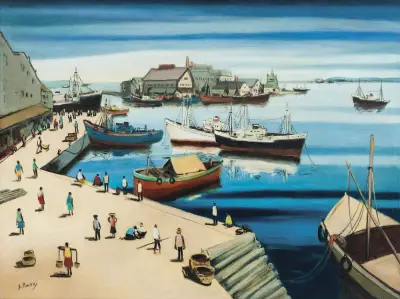
Giovanni Battista Felice Castagneto exercised the profession of sailor in Genoa. Accompanied by his father, he comes to Rio de Janeiro in 1874. In 1878, he enrolled in the Figurative Drawing, Geometric Design and Mathematics courses at the Imperial Academy of Fine Arts - AIBA, where he studied until 1884, with Zeferino da Costa as his teachers. (1840 - 1915) and Victor Meirelles (1832 - 1903), among others. From 1882 to 1884, he is guided by Georg Grimm (1846 - 1887) and, when he breaks with the academy, he accompanies him in the installation of his outdoor studio on Boa Viagem beach, in Niterói, and is part of the Grimm group. He teaches drawing at the Lyceum of Arts and Crafts in Rio de Janeiro and at the Liceu de Niterói. He exhibits individually for the first time in Rio de Janeiro, at Casa Vieitas, in 1886. He travels to France in 1890, where he meets the painter Frédéric Montenard (1849 - 1926), who advises him to study with the sailor François Nardi (1861 - 1936). He returned to Brazil in 1893 and, the following year, opened an individual exhibition at the National School of Fine Arts - ENBA with works produced in Toulon, France. Considered an important painter of marines and coastal landscapes, the artist continues to improve himself in this theme until the maturity of his production, achieved with the experiences on the coast of France. The navies produced in the last ten years of life reveal the complete technical mastery suggested by the balanced compositions, by the chromatic debugging and by the personal treatment given to the pictorial surface.
Critical comment
Giovanni Battista Castagneto was born in Genoa and goes to Rio de Janeiro in 1874. He joined the Imperial Academy of Fine Arts - AIBA, in 1878, where he studies, among other disciplines, a landscape with Georg Grimm (1846 - 1887), between 1882 and 1884, the year in which Grimm leaves Aiba. From the beginning, it turns to the representation of nature, especially the painting of marines. His first works already reveal the essential characteristics of his production: the free brushstrokes, the strong gesturalism and a tendency towards monochromaticism, as we see, for example, in a warehouse in the bay of Rio de Janeiro (1883).
In 1884, Accompanies Grimm when he breaks up with Aiba and creates an outdoor studio, on the beach of Boa Viagem in Niterói. The admiration for Georg Grimm's work lies in the perception of the landscape, choice of motifs, synthesizing the elements and restriction of the palette, as in the painting Porto do Rio de Janeiro (1884). Castagneto has an intense activity in painting, characterized by the elaboration of several series of works, which allow evaluating the artist's study of nature and the mutations of the marine atmosphere. He frequently moves to Niterói, where Grimm's students gather, fixing aspects of the coast. It often represents Santa Luzia beach: the effects of light on the sea and the renovations of the church. He performs a series of navies by Angra dos Reis, with a wide and aggressive brushstroke, painted from the natural, in which greens and grays predominate.
The artist reveals a romantic sensibility, through which he interprets the nature. Thus, their representations of the sea or dry boats, are loaded with feeling. The pictorial treatment is impulsive and almost violent, the sharp brushstrokes and the abundant pastry can be seen. Represents fishing vessels, simple canoes, which acquire dignity and grandeur, as in a dry canoe on the beach in Angra dos Reis (1886).
In 1887, he paints the painting a great gala in the bay of Rio de January, conceived in the Academy models, to compete for the travel award. The refusal of the painting by Aiba and the criticism published in the newspapers, caused a profound bitterness in the artist, whose production, in the following years, becomes irregular. He travels to France in 1890, with the help of friends. There he has contact with Frédéric Montenard (1849 - 1926), French painter traveling, who has a special affection for marine themes. Through him he met the Frenchman François Nardi (1861 - 1936), also a painter of marines, with whom he resides for a while in Toulon. It focuses on the fishing scenes and the study of the marine atmosphere. Its themes are the very colorful sailing boats, which occupy coves close to the city, such as in a fishing boat anchored in Toulon (1892) or the effects of light on the water, as in Vista de Mourillon (1892). During the stay in Toulon, the palette of Castagneto is diversified, it works with more freedom and the design is structured. In relation to the previous production, the French period represents a certain weakening of the romantic power, by adapting to the canons and the search for greater control of pictorial values.
Back to Brazil, its artistic work is consolidated. It is observed in his works the return to gestures in the management of brushes, the colors become more subtle and very soft, in relation to the landscapes painted in Toulon. The rigorous design, which marks the contours of the shapes, is broken, as can be seen in a stretch of Praia de São Roque in Paquetá (ca.1898). The light colors, clear and transparent tones, the use of gray blues, nuances of yellow and green-water predominate in their paintings. The original invoice of the works and the very personal treatment of the pictorial surface stand out: the pastures are often worked with the spatula, at certain points, even with the thumb. The landscape of the island of Paquetá has become, since 1896, the preferential environment of its paintings.
Castagneto is described by his contemporaries as a man on the fringes of society, bohemian, dissatisfied with the conventions. The critic Gonzaga Duque (1863 - 1911) describes the painter as tame and irascible, stating that "as the sea is rebellious" and "as an artist he feels, in a very original way, He has the secret, all the ecstasies, all the poetry of the waves".1 his painting presents softness and violence, combines the quick and anguished execution with a great lyricism.
Notes
1 Duke, Gonzaga. Brazilian art. Campinas: Mercado de Letras, 1995, p. 198.
Criticism
"Unlessed about the drawing, like the French impressionists, the painter is concerned with capturing the light through painting, fixing the fugitive, with a preference Theme: The light on the water, by the sea, almost always. In this work, the shapes are dissolved through the distance light, and, in the foreground, the different elements are composed as color spots, which he applies to the surface of the canvas. small dimensions and give the impression, seen closely, of being stained with the color, sometimes applied to the canvas, following a certain rhythm, sometimes presenting a disorderly and even nervous spelling, denouncing a quick execution. (...) Atelier was a boat moving in the Guanabara Bay, which he fixed in several of its aspects."
State Pinacoteca Team
Pinacoteca do Estado de São Paulo. Rio de Janeiro: Funarte, 1982.
"It was in a task in which many wandered in the doldrums of the sameness that Castagneto ranked and revealed the maximum of his creative power, the full mastery of technique. Achieving, he used a broad and deep experience of life, a connoisseur who was from the sea, as a whole and its nuances. However, Castagneto does not fail to build a conflicting unity between the sea and man and hence the variety of scenarios with which we become aware, as we The occurrences of his daily life reply. And it is in this sense that we will find a whole extraordinary spiritual wealth, always present in the various works that make up the set of his production".
Alcídio Mafra de Souza
LEVY, Carlos Roberto Maciel. Giovanni Battista Castagneto:1851-1900: The painter of the sea. Rio de Janeiro: Pinakotheke, 1982.
"Throughout 1896, the elements that would progressively and radically project the life and work of Giovanni Battista Castagneto were consolidated towards a Structural process of simplification. In the plane of existence, until then, his life had been a persistent succession of struggles characterized by nonconformity and libertarian temperament (...) he was a man on the fringes of society, dissatisfied with the protocols that she demanded and revolted against the conventions he imposed, but before he could, in his naive and uneducated intellectual universe, establish the paradigms against which he would like to oppose and fight, he found himself adulated, loved and 'understood' by the dominant layers of this society, which projected on him, Discreetly, his own desires for independence (...) The 19th century had ended and with the 20th century opened up an era of progress, revolutions and radical transformations in behavior, ideas and the possibilities of humanity. Castagneto died with the only period that, in history, could bear his romantic and open art; Earlier, it would have been pruned as a manifestation of madness; Later, interpreted as a corny simplism and reactionary (...)".
Carlos Roberto Maciel Levy
LEVY, Carlos Roberto Maciel. Giovanni Battista Castagneto:1851-1900: The Painter of the Sea. Rio de Janeiro: Pinakotheke, 1982.
"Castagneto (João Batista) is original. Son of a sea wolf, of an old nauta rocked by the vacancies of the Mediterranean and Ionio, João Batista Castagneto was born an artist and was born a sailor. He inherited from his father the love for the mysterious inconstancy of the sea, he received from his dear Italy the hot breath of artistic impressing. Like the sea, your temperament is rebellious. Love and hate. It is tame and irascible. One day he thought that academic study, instead of making it progress, came to prevent his steps; And he tore, from one moment to another, the reasons that tied him to the academy. As an artist he feels, in a very original way, a way that only he has the secret, all the raptures, all the poetry of the waves. The tormenting voice of the waters, the wolfish sob of the waves, the cyclopic struggles of the ocean vibrate inside him strange sound ropes of a sentimentality that nature has given to no one else. And, like the sea, its painting is strong and is sweet, it is fast and is slow, it has roughness and caresses, it looks transparent and looks compact, shines and gets dark. (...)
When you don't have time to change brushes, handle one, dip it in different paints, or paint with your fingers, nails, with the spatula, with the first object you have at hand: a resistant pebble, a piece of stick, a piece of rope, a toothpick, the pipe of the pipe, the tip of the cigarette.
(...) happy. Now, it is the ranch of the beach covered with lepers, tiles dismantled by the wind. Here is a subject taken at the fall of the afternoon. The sun slowly disappears from the sky; Caliginous clouds, formed in wide and capricious masses, wander through the air; The horizon is dyed an orange, intense, vivid color; In the distance, bluish hills, lost in the silence of space, like huge walls of an invincible citadel. In the sea, to the warm reflection of the last rays of the sun, from candles open to sudden turns, bulging falus run. There is a view of the Arsenal de Guerra, caught from the beach of Santa Luzia. In the background, beyond, far beyond, the sea rolls and comes in a tumultuous, restless, to swoon to the beach in a painful and rough stretch. The sun bathes nature. The roofs and whitewashed walls of the Arsenal's workshops, illuminated by the laughing light, seem to dilate in the picture a long laugh of strength in front of the sea that groans in the sand". Originally published in: Duque, Gonzaga. The Brazilian Art: Painting and Sculpture Rio de Janeiro: H. Lombaerts & C., 1888.]
DUQUE, Gonzaga. 1995. P. 198-200.
"The fusion between art and life, however, he found it in the painting of marines. This genre enjoyed a certain fortune in Brazil: D. Pedro II loved navy and warships. Before Castagneto, however, the history of marine painting in Brazil already had the meticulous naval modeling of Eduardo de Martino, present in the imperial collections, and with the 'electric' marines of Émile Rouède, so called because they were painted and often memory. These certainly influenced the technique of the young Castagneto. Then he extracted his love for the quick and synthetic technique and for the improvised support - cardboard, bottom of cigar boxes, plates, reeds and even, in one case, a dry cod skin. Also the memory of De Martino is present in the only ambitious attempt by a large historical navy produced by the painter, saved in the Bay of Guanabara in honor of Dom Pedro II, today at the Museum of Art of São Paulo, Masp, painted to get an award trip from the academy, in 1887.
It was the artist's greatest disappointment, nothing cut out for this type of celebration. Castageneto's painting needed other themes: 'All the artist's attention converged on the humble life of fishermen, to the measly corners of the seaside, where the landscape, if there were no fishery people, that translated the poetry of their existence obscure, I could remind her of the proximity of the land'.
For Castagneto, the painter of the sea, the sea was a state of soul and painting was a form of life. He lived on Santa Luzia beach, in a house that looked like a boat. Any object served to fix the memory of a stretch of beach or to copy a theme. Then, he took the theme with the feverish line of the hand and with a great economy of means, until he transfigured it into a simplified and quick image, in order not to lose the force of sensation.
At certain points, the violence of the gesture, the use of improvised instruments and even the thumb, in the manner of the sculptors. Castageneto's dry boats go beyond the limits of gender, often reached the domain of lyrical expression, as in the hulls-hieroglyphs of De Fiori, Volpi, or in the dazzling sands of Pancetti.
Finally, he managed to travel to the south of France, where he went to study with a then famous sailor, François Nardi. returned drunken light. captured her in paintings such as the Fort of Gragoatá, in the MNBA, but, confused and sick, early death came to lift him out of the surf".
Luciano Migliaccio
Rediscovery Show, 2000, São Paulo. Art of the 19th Century. São Paulo: Fundação Bienal de São Paulo: Associação Brasil 500 years Visual Arts, 2000. p. 129-130.
Cervos
Acervo Instituto Itaú Cultural (São Paulo SP)
São Paulo Museum of Art Assis Chateaubriand (São Paulo SP)
National Historical Museum (Rio de Janeiro RJ)
National Museum of Fine Arts - MNBA (Rio de Janeiro RJ)
Individual exhibitions
1886 - Rio de Janeiro RJ - Individual, at Casa Vieitas
1887 - Rio de Janeiro RJ - Individual, at Glace Elegant
1887 - Rio de Janeiro RJ - Individual, at Casa Vieitas
1888 - Rio de Janeiro RJ - Individual, at Elegant Glace
1889 - Rio de Janeiro RJ - Individual, at Glace Elegant
1890 - Juiz de Fora MG - Individual, in the newsroom of the newspaper O Farol
1890 - Rio de Janeiro RJ - Individual, in the hall of the newspaper O Paiz
1894 - Rio de Janeiro RJ - Individual, ENBA
1895 - São Paulo SP - Individual, at the Paulicéia concert hall
1895 - São Paulo SP - Individual, at Banco União
1896 - Rio de Janeiro RJ - Mostra, at Papelaria Gomes
1897 - Rio de Janeiro RJ - Shows, at Papelaria Gomes
Collective exhibitions
1884 - Rio de Janeiro RJ - 26th General Exhibition of Fine Arts, at AIBA - Gold Medal
1885 - Rio de Janeiro RJ - Laurent de Wilde store: Inaugural show, at the Laurent de Wilde store
1885 - Rio de Janeiro RJ - Castagneto and França Júnior, at Casa Vieitas (Rio de Janeiro, RJ)
1887 - Rio de Janeiro RJ - Antônio Parreiras, Castagento and Henrique Bernardelli, at the Grêmio de Letras e Artes
1890 - Rio de Janeiro RJ - General Exhibition of Fine Arts, at Enba
1894 - Rio de Janeiro RJ - 1st General Exhibition of Fine Arts, at Enba
1895 - Rio de Janeiro RJ - 2nd General Exhibition of Fine Arts, at Enba
1898 - Rio de Janeiro RJ - Art Exhibition Retrospective, in the artistic center
Posthumous exhibitions
1948 - Rio de Janeiro RJ - Retrospective of painting in Brazil, in the MNBA
1950 - Rio de Janeiro RJ - a century of Brazilian painting: 1850-1950, at the MNBA
1953 - São Paulo SP - 2nd São Paulo International Biennial, at the State Pavilion
1961 - Rio de Janeiro RJ - Rio in Brazilian painting, at the State Library of Guanabara
1963 - Assunção (Paraguay) - La Pintura en el Brasil
1970 - São Paulo SP - Pinacoteca do Estado de São Paulo 1970, at Pinacoteca do Estado
1974 - Rio de Janeiro RJ - O Mar, at the Ibeu Copacabana Gallery
1977 - Rio de Janeiro RJ - Aspects of the Brazilian landscape: 1816-1916, at MNBA
1978 - São Paulo SP ? individual, at Sociarte
1980 - Buenos Aires (Argentina) - OCHENTA AÑOS DE ART Brasileño, at Banco Itaú
1980 - Rio de Janeiro RJ - The Grimm Group: Brazilian Landscaping in the Century XIX, at the Art Gallery Collection
1980 - São Paulo SP - The Brazilian landscape: 1650-1976, at Paço das Artes
1982 - Bauru SP - 80 years of Brazilian art
1982 - Marília SP - 80 years of Brazilian art
1982 - Rio de Janeiro RJ - Giovanni Battista Castagneto 1851-1900: the painter of the sea, at the Art Gallery Collection
1982 - Rio de Janeiro RJ - Fluminense painters, at MAM/RJ
1982 - São Paulo SP - 80 years of Brazilian art, at MAB/FAAP
1982 - São Paulo, SP - Italian painters in Brazil, at the MAM/SP
1983 - Belo Horizonte MG - 80 years of Brazilian art, at the Clóvis Salgado Foundation. Palácio das Artes
1983 - Campinas SP - 80 years of Brazilian art, at Macc
1983 - Curitiba PR - 80 years of Brazilian art, at MAC/PR
1983 - Ribeirão Preto SP - 80 years of Brazilian Art
1983 - Santo André SP - 80 years of Brazilian art, at the Municipality of Santo André
1984 - São Paulo SP - Tradition and Rupture: Synthesis of Brazilian Art and Culture, at the Biennial Foundation
1985 - São Paulo SP - 100 works Itaú, at MASP
1986 - São Paulo SP - Nineteenth: a turn in the century, at the Pinacoteca do Estado
1987 - São Paulo SP - Brazil painted by national and foreign masters: 18th - 20th centuries, at MASP
1988 - São Paulo SP - Brasiliana: Man and Earth, at the Pinacoteca do Estado
1989 - Fortaleza CE - Brazilian art of the 19th and 20th centuries in the Ceará collections: paintings and Drawings, at Unifor's Cultural Space
1989 - Rio de Janeiro RJ - Rio de Janeiro de Machado de Assis, at CCBB
1989 - São Paulo SP - Painting Brazil 19th and 20th centuries: works from the Banco Itaú collection Itaugaleria
1992 - Rio de Janeiro RJ - Nature: Four centuries of art in Brazil, at CCBB
1993 - Rio de Janeiro RJ - Brazil, 100 years of modern art, at MNBA
1993 - Santos SP - Six great painters, at Pinacoteca Benedito Calixto
1994 - Rio de Janeiro RJ - Landscape iconography
1994 - São Paulo SP - A critical look at the 19th century collection, in the Pinacoteca do Estado
1995 - Campinas SP - From the Navy to the still life
1997 - Rio de Janeiro RJ - Giovanni Battista Castagneto: 1851-1900, at Pinakotheke
1998 - Rio de Janeiro RJ - Marines in large São Paulo collections, at the Marinha Cultural Space
2000 - Porto Alegre RS - From Frans Post to Eliseu Visconti: Collection National Museum of Fine Arts - RJ, in the Margs
2000 - São Paulo SP - 51st São Paulo Salon of Fine Arts, at the Legislative Assembly of the State of São Paulo - Honored
2000 - São Paulo SP - Brazil + 500 Rediscovery Exhibition, at the Fundação Bienal
2001 - São Paulo SP - 30 Masters of Painting in Brazil, at MASP
2001 - São Paulo SP - Aldo Franco Collection, at the Pinacoteca do Estado
2001 - São Paulo SP - Museum of Brazilian Art: 40 years, at MAB/FAAP
2001 - São Paulo SP - Trajectory of Light in Brazilian Art, at Itaú Cultural
2002 - Brasília DF - Barão do Rio Branco: His work and his time, at the Ministry of Foreign Affairs. Palácio do Itamaraty
2002 - Niterói RJ - Brazilian art on paper: 19th and 20th centuries, at Solar do Jambeiro
2002 - Rio de Janeiro RJ - Brazilian art in the Fadel collection: from the restlessness of the modern to autonomy of language, at CCBB
2002 - São Paulo SP - Brazilian art in the Fadel collection: from the restlessness of the modern to the autonomy of language, in the CCBB
2002 - São Paulo SP - Image and identity: a look at the history in the collection of the Museum of Fine Arts, at the Banco Santos Cultural Institute
2003 - Brasília DF - Brazilian art in the Fadel collection: from the restlessness of the modern to the autonomy of language, in the CCBB
Source: Itaú Cultural