Frans Post (Haarlem, Netherlands 1612 - Idem 1680)
Painter, designer and recorder.
Frans Janszoon Post Started in painting in Haarlem, Holland, where he possibly studies with his brother, the architect Pieter Jansz Post (1608 - 1669). He frequents the workshops of Pieter Molijn (1595 - 1661), Salomon van Ruysdael (ca.1602 - 1670) and of Salomon de Bray (1597 - 1664). Nominated by his brother to Count Maurício de Nassau, governor-general of Dutch Brazil, he is part of the delegation that comes to the country in 1637. Among his companions, the artists Albert Eckhout (ca.1610 - ca.1666) and Georg Marcgraf (1610 - 1644). Landscaper, Frans Post is in charge of documenting the topography, military and civil architecture, scenes of naval and terrestrial battles. The oil canvases painted in Brazil do not make a concession to exoticism, its landscape is serene and subordinated to reality. In 1644, he returned to Holland and continued to paint Brazilian themes, performing a hundred oil paintings based on his sketches and drawings, to which he began to add exotic elements of the tropical fauna and flora. In 1646, he joined the Corporation of the Painters of Saint Luke (Lukasgilde), an obligation of any painter who was not at the service of the Court, of which ten years later he became director and, later, treasurer. With a selection of the numerous drawings made about Brazil, the book Rerum per octennium in Brasília, by Gaspar Barléu (1584 - 1648), illustrates the achievements of Mauricio de Nassau during the eight years of government in Brazil, published in 1647.
Critical Comment
Little is known about the work of the Dutch landscaper Frans Post before his arrival in Pernambuco, in 1637, as a member of the delegation of artists and scientists brought by the Count Maurício de Nassau to document the new world during his government in Brazil. Son of the painter of stained glass Jan Janszoon Post (15-- - 1614) and brother of the architect and painter Pieter Jansz Post (1608 - 1669), Post turns early for one of the most important painting genres in Holland in the time, landscape painting. It is not known for sure how their formation took place. Perhaps he frequented the studios of prestigious landscapers such as Salomon van Ruysdael (ca.1602 - 1670) or Pieter Molijn. In any case, the relationship with Dutch painting of the first half of the 17th century is evidenced throughout his artistic production.
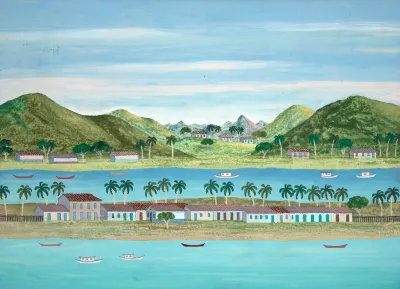
By landing on the Brazilian coast as an official painter responsible for portraying in drawings and canvases, the military deeds, the architecture of Dutch Brazil, post It was just a young talent promise. Nominated by his brother to Nassau, it is in contact with the Brazilian reality that he develops an original work. Even after his return to Europe, he does not fail to paint tropical views, specializing in Brazilian themes. It is believed that he painted 18 paintings in his nearly eight-year stay in the country, but only seven of them can be seen today. On screens such as Vista da Itamaracá Island, 1637, view of the surroundings of Porto Calvo, 1639 or Forte Hendrik, 1640, it is clear some characteristics that mark the production of post: Low lines of the horizon with skies High in open plans for a vast area as opposed to vegetation or foreground motifs in simplified but meticulous designs. On these canvases, a certain homogeneous color of lowered tones closer to the Dutch painting is noticed than to the color of the local landscape. Such low-perspective compositions were common to a type of panoramic painting developed at the time by the Dutch. To them, Post adds the landscape of the new world. From this junction, informative and serene paintings appear, contained in the face of tropical exuberance. In this sense, Post is "the first American artist to have given a faithful and at the same time poetic vision of the region, avoiding fantasies and implozenships", as the historian José Roberto Teixeira Leite observes.
Back to Europe, his drawings serve as a basis for the Planks published in the volume Rerum per octennium in Brasilia by Gaspar Barléu (1584 - 1648). He leaves Count Maurício de Nassau, but continues to paint tropical landscapes, for which he finds a market. This production carried out far from the motive, based on studies carried out in America, takes different paths. Until about 1659 the artist follows in his constructions of topographical landscapes of documentary precision. However, it is common to find in the scenes made in Europe a certain "break" of the serenity of the landscape through the placement of animals or wild scenes such as lizards, snakes, armadillos, snakes devouring rabbits, for example, in the foreground of the painting. At that moment, the diffuse light of his Brazilian works is also replaced by the contrast of stronger colors.
From 1660 to 1669, the maturity phase of a post, there is a growing mastery of technique and Brazilian themes, however this is due to detriment of spontaneity. There is no longer any documentary concern. The artist starts to compose based on the rearrangement of plant, animal, topographic and architectural elements, demonstrating a perfect handling of his pictorial vocabulary. These are ideal landscapes, often rich in picturesque details. In this period, he is in full power of his quality as a miniaturist. The invoice becomes more stacked and the background is structured in green and blue tones (in the tradition of Flemish painting). A certain diaphanous luminosity takes over the last works. However, in this phase of commercial peak, he does not risk new compositions, always returning to the same themes (example: views of Olinda, mills, landscapes with sparse houses and characters). In the last years of existence, Frans Post lives in an obscure way, given over to the drink and without the ability to create. Perhaps the dimension of his artistic success as the most important painter of the Brazilian landscape in the 17th century can be evaluated by the tribute of his friend Frans Hals (ca.1581 - 1666), who in mid-1655 carries out his portrait.
Criticism
"It is undeniable that, with its Brazilian landscapes, Frans Post has gained a separate domain, creating a genre in which it would not have competitors. Dutch his contemporaries, such as Philips Koninck, for example, benefited, however, by the uniqueness of the tropical theme. Historically, his importance is also great, having been the first painter to, in American land, give a version at the same time faithful and poetic of the region, at a time in that all emphasis was given to painting of a religious nature".
José Roberto Teixeira Leite
LEITE, José Roberto Teixeira. Critical Dictionary of Painting in Brazil. Rio de Janeiro: Artlivre, 1988. p. 420.
"The art of Post exerted a cultural influence over his compatriots that excited the curiosity and avidity of knowing more about this famous overseas country, of which he was the interpreter, the witness, the pictorial reporter. It is this fact that is credited in his favor. Post acquired his naturalization with his work. If his art did not influence the autochthonous painters, he is, however, his ancestor: the first true landscaper who worked under his sun. Being nicknamed 'The Interpreter of Brazil' . (...) The artist's work consists of more than one hundred canvases and numerous drawings and engravings, all on Brazilian motifs (...)".
Erik Larsen
AYALA, Walmir. Dictionary of Brazilian painters. Rio de Janeiro: Spala, 1992. 2 V.
"The flat aspect of the Dutch earth allowed the observer situated on the ground to perceive the extent and ostensible presence of the sky and led the artist to face a 'world mobile', made of space, air and light, clouds and wind, as Germain Bazin recognized. For the author, the Dutch made the landscape 'where the sky is everything' (...). Post, which had started to position the buildings according to the imaginary diagonals traced in the territory, so that the facades would receive directly the light he was throwing on the board, preferably entering the left diagonal, highlighting the other faces, dark of the building. It made it common in his work to obscure the foreground and illuminate the most distant region, from where he made a diffuse atmospheric luminosity radiate. the facades are bright. He owned several luminous resources, which he used simultaneously. Among them, the effect obtained by the contrast between the luminosity of the white clothes and the dark of the blacks, which always kept on the way, taking its unfailing white loads on the heads".
Ana Maria de Moraes Belluzzo
BELLUZZO, Ana Maria de Moraes. The Brazil of Travelers. São Paulo: Metalivros; Salvador: Fundação Emílio Odebrecht, 1994. V. 1: Imaginary of the New World.
"(...) Post He painted as a Dutch painter, with his abundant Haarlem fashion look, looking 'descriptively' only the visible, wiping the painting of every emblematic or rhetorical contribution; That is to say, he painted like a Dutchman in Brazil, against a secular and powerful Italianizing tradition. Consequently, these first landscapes (already) are no longer so: they are impregnated with the involutional gaze of a Dutch painter who condenses the conventions of a school in them, with their 'European' way of painting, along with nature still without name and certainly without aspect of the continent. American. Finally, to culminate the adventure with the obverse, when returning to Holanda Post, he did nothing but paint, like a painter from another world, in the serene uniformity of the distant United Provinces, 'Brazilian landscapes', memories of the tropic that would grant him a indisputable form of 'distinction' 'landscape whims' carried out inopportunely and with delay, like a long and languid 'return' of the landscapes that, when crossing the oceanic sea, had digested.
Every foundation acts according to a 'double temporality'. Every foundation unfolds and generates its effects, in two different, complementary, replaceable, mutually annihilating times. So post, founder of the 'American landscape', came to Brazil - at first moment of the foundation - for later, again in Holland, during a lasting and prolonged pictorial production to become aware - in a second moment of the foundation, in each frame and in the sum of all the paintings - of a Landscape that had already lost and needed, therefore, to restore (or replace). Then came the 'whims', the 'landscape costumes' that made him known, until today, by a double obsession: landscape obsession and tropical obsession". ORAMAS, Luis Pérez. Landscape and Foundation: Frans Post and the Invention of the American Landscape. Fundação Bienal de São Paulo, 1998. 570 p., Il. Color. p. 103-104.
"Although the post prints follow from the drawings made in America, it is urgent to understand them on the political agenda of the work of Barléu, for which they were recorded by the artist or by third parties. These engravings are distinguished from the painting performed at the same time, as their function is to accompany the text they illustrate. They must support the Encomiástica de Barléu. They need to publicize Nassau's military, political, economic and urban deeds and indicate the difficulties and economic potential of West India companies. They demonstrate the challenges facing a hostile and wild environment to be dominated and conquered to produce wealth, justifying the frustrated investment demands and military support by Nassau in their Brazilian period. Therefore, they are engravings that present strangeness, but, in the rationality of their political objectives, they do not grant exoticism. On the contrary, they can be consistently referred to the codes of the 17th century Dutch engraving and its models of symbolization of the relationship with the productive landscape, whether the countryside or the city. However, they can present not only similarities, but above all necessary or contingency differences in relation to the physical and human landscape of Europe and its iconological and artistic paradigms".
Paulo Herkenhoff
Herkenhoff, Paulo Representation of the Negro in the West Indies: Barléu, Post and Eckout. In: ______ (org.) Brazil and the Dutch: 1630-1654. Rio de Janeiro: Sextante Artes, 1999. 271 p., Il. Color. P. 136.
"Frans Post is not only the first painter of the Brazilian landscape but also the first landscaper in the Americas. It has, for Brazilian art, a position of fundamental importance (...) in fact it is not difficult to imagine the surprise and fascination of a 25-year-old painter, graduated from the Haarlem school, used to the low skies and the flat topography of Holland, before the Exuberant nature, the new light, flora, fauna and races that it discovers when it lands in Pernambuco. View of Itamaracá, carried out by post a few months after its arrival in 1637 (...), it is the first Brazilian landscape, and also the first oil painting with a profane theme performed by a professional artist in the Americas. It took a contest of highly unlikely circumstances for Post to come to Brazil and become the first old world painter to portray the landscape of the new world. The main historical chance was perhaps the very personality of Prince Mauritius of Nassau, who, in addition to being the military chief needed by the Netherlands to command the Brazilian provinces, was also a cultured and vain man, who wanted to carry scientists and talented artists into his entourage to register the Unknown who was waiting for him, and who already guessed of great interest to the European nobles who would find again when he returned to Holland. The production of a post known until today is made up exclusively of paintings with a Brazilian theme. In museums and private collections, in various parts of the world, just over 160 oils of very variable quality could be identified".
Pedro Corrêa do Lago
Rediscovery Show, 2000. The distant look. São Paulo: Fundação Bienal de São Paulo: Associação Brasil 500 years Visual Arts, 2000, p. 76.
Acerves
alte Pinakothek - Munich (Germany)
Maria Luisa Foundation and American Oscar - São Paulo SP
Historiches Museum - Frankfurt (Germany)
Ricardo Brennand Institute - Engenho São João da Várzea - Recife PE
J. Paul Getty Museum - Los Angeles (United States)
Landesmuseum - Mainz (Germany)
Musée du Louvre - Paris (France)
São Paulo Museum of Art - MASP - São Paulo SP
Museum From the State of Pernambuco - Recife PE
National Museum of Fine Arts - MNBA - Rio de Janeiro RJ
Museum Boijmans van Beuningen - Rotterdam (Holland)
Rijksmuseum Amsterdam - Amsterdam (Netherlands)
The Detroit Institute of Arts - Michigan (United States)
The Metropolitan Museum of Art - MET - New York (United States)
Posthetic exhibitions
1942 - Rio de Janeiro RJ - Frans Post: Retrospective, at the MNBA
1953 - São Paulo SP - 2nd São Paulo International Biennial, at the State Pavilion
1968 - Rio de Janeiro RJ - The painters of Maurício de Nassau, at MAM/RJ
1973 - São Paulo SP - Frans Post 1612-1680: works from São Paulo collections, at Masp
1980 - São Paulo SP - The Brazilian landscape: 1650-1976, at the Paço das Artes
1983 - Recife PE - 50 years of Casa-Grande & Senzala, at the Joaquim Nabuco Foundation
1984 - Aracaju SE - 50 years of Casa-Grande & Senzala
1984 - Brasília DF - 50 years of big house & Senzala
1984 - Lisbon (Portugal) - 50 years of Casa-Grande & Senzala, at the Gulbenkian Museum of the Calouste Gulbenkian Foundation
1984 - Salvador BA - 50 years of Casa-Grande & Senzala
1984 - Vitória ES - 50 years of big house & Senzala
1985 - São Paulo SP - 100 Obras Itaú, at Masp
1987 - Rio de Janeiro RJ - Images of Dutch Brazil 1630-1654, at Paço Imperial
1987 - São Paulo SP - Brazil painted by national and foreign masters: 18th - 20th centuries, at Masp
1990 - Rio de Janeiro RJ - Portraits of Paradise, at CCBB
1991 - São Paulo SP - A Mata, at MAC/USP
1992 - Rio de Janeiro - RJ - Nature: four centuries of art in Brazil, at CCBB
1992 - São Paulo SP - Sérgio's look on Brazilian art: drawings and paintings, at the Mário de Andrade
1992 - Zurich (Switzerland) - Brasilien: Entdeckung und Selbstendeckung, at Kunsthaus Zürich
1993 - Rio de Janeiro RJ - Brazilian landscapes by artists foreigners, at the Sesc Tijuca Art Gallery
1994 - Poços de Caldas MG - Unibanco Collection: exhibition commemorating the 70th anniversary of Unibanco, at the Casa de Cultura
1994 - Rio de Janeiro RJ - Iconografia da Landscape
1994 - São Paulo SP - The Brazil of Travelers, at Masp
1995 - Lisbon (Portugal) - The Brazil of Travelers, at the Centro Cultural de Belém
1995 - Rio de Janeiro RJ - Collection Unibanco: Exhibition commemorating the 70th anniversary of Unibanco, at MAM/RJ
1996 - London (England) - Brazil through European eyes, at Christie's
1998 - Brasília DF - Brazilian Like me, like me?, at the Ministry of Foreign Affairs
1998 - São Paulo SP - 24th São Paulo International Biennial, at Fundação Bienal
1998 - São Paulo SP - Highlights of the Unibanco Collection, at Instituto Moreira Salles
1999 - Paris (France) - Brésil Baroque: Between Ciel et Terre, at the Musée des Beaux-Arts
1999 - Rio de Janeiro RJ - Brazil and the Dutch MNBA
1999 - São Paulo SP - Brazilian like me, like who?, at MAB/FAAP. Cultural Hall
1999 - São Paulo SP - Brazil and the Dutch, at Banco Real
2000 - Porto Alegre RS - From Frans Post to Eliseu Visconti: Collection National Museum of Fine Arts - RJ Margs
2000 - Recife PE - Brazil and the Dutch, at the Bandepe Cultural Space
2000 - São Paulo SP - Brazil + 500 Rediscovery Exhibition, at Fundação Bienal
2001 - Nova York (United States) - Brazil: Body and Soul, at the Salomon R. Guggenheim Museum
2002 - São Paulo SP - Image and identity: a look at the history in the collection of the Museum of Fine Arts, at the Banco Santos Cultural Institute
2003 - Recife PE - Frans Post and Dutch Brazil, at the Ricardo Brennand Institute
2004 - São Paulo SP - Paper Office, at CCSP
2004 - São Paulo SP - Vila de Ipojuca CCSP
Source: Itaú Cultural