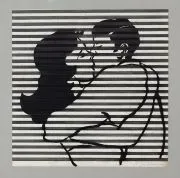
Flávio Império (São Paulo SP 1935 - idem 1985)
Flávio Império was an architect, visual artist, set designer and teacher. In 1956, he enrolled at the Faculdade de Arquitetura e Urbanismo da Universidade de São Paulo (FAU/USP) and in the drawing course of the Escola de Artesanato of the Museu de Arte Moderna de São Paulo (MAM/SP). That same year, he began his career as a set designer, working at the Comunidade Cristo Operário, the Teatro de Arena, the Teatro Oficina and the Teatro Experimental Cacilda Becker, for which he created the set of the play Morte e Vida Severina [Death and Life of Severino] (1960), regarded by his colleagues Sérgio Ferro (1938) and Rodrigo Lefèvre (1938 - 1984) as a landmark in the formulation of the so-called arquitetura nova [new architecture].
He joined the two architects in 1961 and, with them or individually, developed several projects until the group dissolved in 1968: the Simão Fausto house (1961); the Escola Normal e Ginásio Estadual de Brotas (1966–1967); the Instituto de Educação Sud Menucci (1967); the Ginásio Estadual de Vila Ercília (1967); the reconstruction of the Teatro Oficina (1967); the Hamburger family house (1967); and the Juarez Brandão Lopes house (1968), shown at the 1st Peruvian Architecture Biennial (1971) and at the Panorama da Arquitetura Brasileira Contemporânea (1982). From 1968, he devoted himself to set design, teaching and the visual arts. His last architectural project was the renovation of his own house on Rua Monsenhor Passalacqua (c. 1980).
He taught at FAU/USP from 1962 to 1977, leaving in solidarity with the professors removed by the regime, and was readmitted in 1985. Besides FAU, he also taught in the set design course of the Escola de Arte Dramática de São Paulo (EAD), between 1962 and 1966; in the drawing teacher training course of the Fundação Armando Álvares Penteado (Faap), in 1964 and 1965; and at the Faculdade de Arquitetura Belas Artes, between 1981 and 1985.
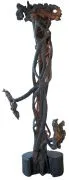
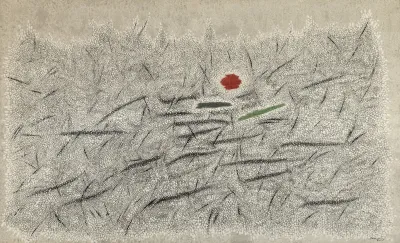
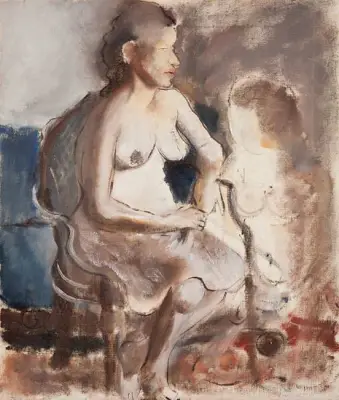
As an artist, he devoted himself to painting, taking part in exhibitions such as Opinião 65 (1965), Propostas 65 (1965), Alegres Pintores do Bexiga (1977) and Coisas & Loisas (1978), among others. He made the Super 8 films A Pequena Ilha da Sicília [The Little Island of Sicily] (1975) and Colhe, Carda, Fia, Urde e Tece [Harvest, Card, Spin, Warp and Weave] (1976), the latter developed in partnership with Lina Bo Bardi (1914 - 1992) and Edmar José de Almeida (1944). In the year of his death, he was honored with the Semana Flávio Império [Flávio Império Week]. In 1987, the Sociedade Cultural Flávio Império was created, responsible for organizing the exhibition Flávio Império em Cena [Flávio Império on Stage], held at Sesc Pompeia in 1997.
Critical Commentary
Responsible for renewing Brazilian set design from the 1960s onward, Flávio Império played an equally transformative role as a teacher, visual artist and, above all, as an architect in the Grupo Arquitetura Nova. An artist of many facets and media, Império used to say that architecture supported all his other activities. However, a closer look confirms his colleague Sérgio Ferro's (1938) reading of his work: "If the architect supported the others, all the other Flávios certainly got in the architect's way"1. Common to all of them is the conception of art as a political activity, the commitment to creating a new aesthetic engaged with the country's real socioeconomic conditions, and a concern with the means of producing it.
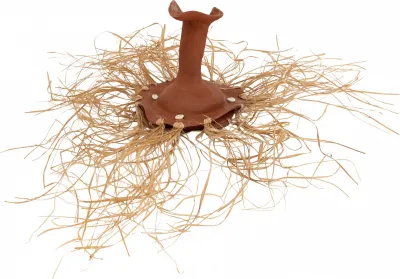
He began his set design work at the Comunidade Cristo Operário, where he came into contact with the dramaturgy of Bertolt Brecht (1898 - 1956). It was also there that he faced the challenge of creating with almost nothing. But it was at the Teatro de Arena that he made scarcity a constituent factor of the work, and at the Teatro Experimental Cacilda Becker that he achieved a potent ethical and aesthetic synthesis of great force when he designed the sets and costumes for Morte e Vida Severina (1960). In this play, Império used simple, cheap materials such as burlap sacks, paper and glue, and created a series of slide projections denouncing the miserable reality of Brazil's Northeast.
If his training as an architect "allowed him to discuss and re-propose not only the internal structure of the stage box, but also all the spatial relations between stage and audience, between building and surroundings, between setting and perception"2, so as to reveal to the audience that theater is nothing but representation and to draw it out of a passive attitude toward reflection on the present, he would not have achieved this synthesis without knowledge of Brecht's theatrical theory.
Political commitment and the boldness of working on the basis of precariousness opened the way for the arquitetura nova, an alternative to technological modernization following premises defended by the architect Vilanova Artigas (1915 - 1985). Its first realization was the Simão Fausto house (1961). With this experience and those carried out by Ferro in the Bernardo Issler (1961) and Boris Fausto (1961) houses, the architects of the Grupo Arquitetura Nova carried out, individually or collectively, a series of projects, notably the Escola Normal and Ginásio Estadual de Brotas (1966-7), the Hamburger family house (1967) and the Juarez Brandão Lopes house (1968).
In all of them, the architects adopted the same spatial principle of integrating and valuing collective spaces, and the serial constructive logic of using elementary techniques and prosaic, low-cost materials easily handled by the workers, with which they composed what they defined as the "poetics of economy"3.
In the group's last project, the Juarez Brandão Lopes house, Império disagreed with Lefèvre by advocating the use of perishable materials, such as fabric and marine plywood, to enclose the bedrooms and the side walls. In this way, he sought to radicalize the sensory experience of architecture and its capacity to propose new human relations.
The hardening of the military dictatorship, with the enactment of Institutional Act No. 5 in 1968, and his experience with the American group Living Theatre at the Teatro Oficina in 1970, reinforced the proposal sketched in this project: to center his battlefield not on making political themes explicit, not on direct confrontation, but on cultural and behavioral transformation through a greater understanding of the human psyche and the broadening of individual freedoms.
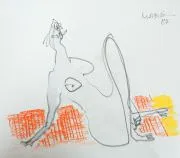
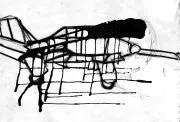
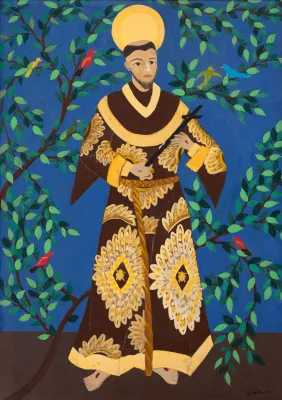
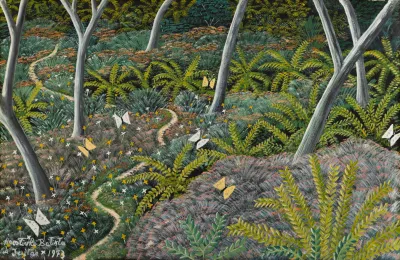
His paintings changed in the same direction, becoming more graphic, colorful and sensory. Yet his interest in the means of production and the intention of leaving them visible remained, as he showed didactically in the exhibition Coisas & Loisas (1978). The same happened with his set design and teaching. In his classes, Império drew on actor training techniques to break down the students' physical and mental resistance and make them experience spaces with their bodies and all their senses alert, the only way to make them conscious architects.
Notes
1 FERRO, Sérgio. Flávio arquiteto. In: IMPÉRIO, Flávio. Flávio Império em cena. Curadoria Gláucia Amaral, Renina Katz. São Paulo: Sesc/SP, 1997, p. 101.
2 LIMA, Mariangela Alves de. Flávio Império. In: Flávio Império em cena. São Paulo: Sesc/SP, 1997, p. 75.
3 FERRO, Sérgio; LEFÈVRE, Rodrigo. Proposta inicial para um debate: possibilidades de atuação [1963]. In: FERRO, Sérgio. Arquitetura e trabalho. São Paulo: Cosac Naify, 2006, p. 33-36.
Critiques
"(...) He is unquestionably the Daumier of today's Brazilian satirical art, potentially one of the greatest contemporary satirical painters in the whole world. Lately, Flávio has remarkably enriched his compositions through the use of numerous small objects affixed to his canvases, in an exceedingly felicitous way. He has thus managed to create definitive images of some of the prototypes of Brazilian political life in recent years. Endowed with a sharp and implacable intelligence, Flávio reveals the inhumanity, confusion and vociferous ineptitude of Brazilian reactionaries, unmasking their pompous emptiness. He differs essentially from artists such as Enrico Baj, Juan Genovés, Manuel Calvo and Rosenquist, who have such a deep tragic sense. Flávio unmasks and lashes out, without pity. He has greater political effectiveness (...)".
Mario Schenberg
SCHENBERG, Mario. Pensando a arte. São Paulo: Nova Stella, 1988.
"Flávio Império, architect, draftsman, graphic artist, painter, teacher and set designer. Few artists have this profile, especially because Flávio Império moved through these areas of artistic production with the ease of a specialist and with exceptional originality.
Three-dimensional space was his preferred territory. In theatrical set design he invested all his renewing potential, which did not prevent him from developing a vast pictorial and graphic production.
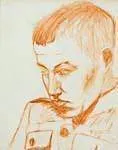
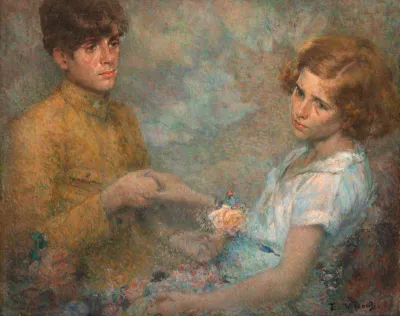
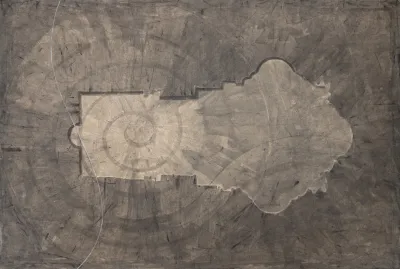
In painting he was a painter, in printmaking a printmaker, in drawing a draftsman. He knew the particularities of each technique and its possibilities as a language.
Flávio was agile in constructing and deciphering the meanings of visual language.
Verbally articulate, fluent in writing, he was endowed with refined visual thinking, qualities that made him a complete teacher.
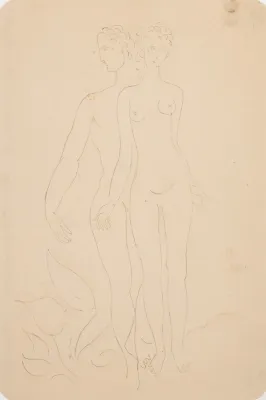
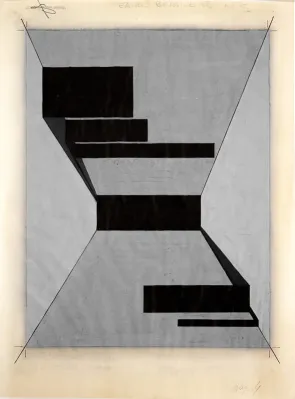
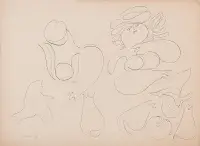
Flávio Império's drawing was an act of reflection, an instrument for organizing the idea, physical space and sensibility. It was, as it were, the sensible order.
Recalling Leon Battista Alberti in his Treatise on Architecture: 'Drawing is every idea separated from matter, it is the image of the work, independently of the technical processes and materials needed to make it'.
Drawing thus represents the general line of thought, of the image, and that is how Flávio Império used it, as the basis of all his artistic production. Drawing appeared as a marker of expressive intentions, a creator of ideas and artistic realities. From paper to stage set.
In both verbal and visual discourse, Flávio Império's poetic image was devoid of superfluous ornament and easy metaphors. He preferred to use all the senses, sight, touch, hearing, in apprehending the surrounding world. Everything that belonged to the sensory, tactile universe could be transformed into visuality and artistic matter.
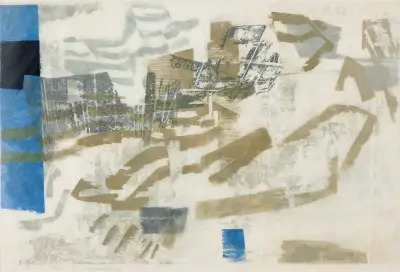
In screen printing and lithography, the drawing that structured tensions and movements was combined with color as an energizer of planes. Color was not introduced as mere tinting; it was optical matter. This characteristic is also present in his painting.
The choice of supports was free and diverse. From fabric to acetate, from opaque to transparent. From plane to relief, all the way to space, he approached everything for his artistic designs.
Using conventional techniques, his behavior was nonetheless unorthodox. Flávio Império did not believe in inviolable rules. He was an experimenter par excellence.
Drawing, painting, lithographing were exercises of the eye and mind, intelligent and sensitive acts, the search for the configuration of a personal visual poetics with universal scope. Thus we might define Flávio Império as a humanist of contemporary modernity."
Renina Katz
IMPÉRIO, Flávio. Flávio Império em cena. São Paulo: Sesc, 1997. p. 15.
"The associative model of the 1960s adds a civilizing ideal to socialist ideology, always tempered by imperialism and sometimes by nationalism. Flávio Império began his professional life within this new configuration of the artistic avant-gardes. From his first work, still as an amateur, to his association with the Teatro de Arena de São Paulo in 1959, he worked on artistic projects that contemplated the social redemption of the audience, in addition to its possible aesthetic and spiritual redemption. (...).
Undoubtedly supported by his knowledge of architecture, the novice set designer subjected the building to a critical breakdown and, as a result, chose the floor as the primordial element to sustain the scenic conception. On this base he placed simple constructive elements, such as platforms and props, which indicate - but do not hide - this center toward which all gazes converge. (...)
(...) In his connection with modern Brazilian architecture, he experimented with a language in which constructive elements are exposed and in which the chosen approach often seeks to propose new habits through the reorganization of space. Thus, a set design that seeks to be non-illusionist and stimulates a new way of seeing has a clear analogy with the architecture being made in the 1940s. As an architect, Flávio Império brought to scenic creation a procedure that considers the whole building as language, from its exterior to the area intended for performance."
Mariangela Alves de Lima
Flávio Império/Renina Katz e Amélia Império Hamburger (orgs.). São Paulo: Editora da Universidade de São Paulo, 1999. (Artistas Brasileiros; 13). p. 273
Testimonials
"theater taught me life;
architecture, space;
teaching, sincerity;
painting, solitude".
Flávio Império
IMPÉRIO, Flávio. Flávio Império em cena. São Paulo: Sesc, 1997. p. 70.
"Always very interested in studying the spatial schemes of the achievements of various historical moments, I was trained in the structural analysis of visual or sound languages. This gave me the opportunity to try to live with them as signs that record a specific type of knowledge and not as a stylistic or formal ensemble. Visual or sound language as a dialogue of the universe in semantic and syntactic signs allowed me to integrate each ensemble into the historical, philosophical, social, political, psychological framework, etc.
Each of my productions is a specific pastiche, a mixture of signs of diverse origins with a specifically theatrical internal cohesion. Roda Viva was the clearest example of this way of working. Although this 'eclectic' way of working with signs was the most evident, it was practically the same one used in Os Inimigos [The Enemies], by Maxim Gorky, or Andorra, by Max Frisch, or The Threepenny Opera, by Bertolt Brecht, or even Réveillon, by Flávio Márcio.
If the dramatic structure is more open, the contrasts are the very structuring of the visual and spatial plot (I am using here the expressions 'closed drama' and 'open drama' in their classical sense).
In any case, however, we learned that theater is whatever you want it to be. It does not pre-exist. The only thing it demands of you is your presence, all the openings of your body, the seven doors, the seven dwellings, your consciousness, all your emotions, all your energy and all the energy you can gather through the manipulation of matter, color, light, sound, like an alchemist who combines his gold and his silver in his test tube, according to his recipe.
In theater, you cannot leave any of your parts at home or in the wings, as if the footlights, whatever they may be, stood as the limit of the possible. It is the audience that remains within the limits imposed by the blocks of convention, of behavior socially accepted as normal. Beyond it, everyone is completely mad. If there is a rule, it is only this one. Beyond the footlights there is no separation between fiction and reality, dream or fantasy and truth.
Systematic analyses make me sick and tire me. They seem like a decorative repetition of an always very familiar methodological skeleton. I lost interest in methodologies, and chronicles, reports and poems always seem richer to me. At least more fun.
I promised to talk about space, color, rhythm and movement, and these elements only appear here and there without any organization of their own. For each space worked on there is an enormous set of influencing factors, as with all the other elements of language. But whenever I thought of writing about language itself, out came a treatise on theater, set design, architecture and painting. All very boring, and I doubt it would be different from what already exists. The way I appropriate these elements is increasingly random and intuitive. In the 1960s there was enormous coherence and systematization. Today, no.
Theater is just that, it gets old right away, because of the new things superimposed on what has already been done."
Flávio Império
Flávio Império/Renina Katz e Amélia Império Hamburger (orgs.). São Paulo: Editora da Universidade de São Paulo, 1999. - (Artistas Brasileiros; 13). p. 130-131.
Solo Exhibitions
1966 - Rio de Janeiro RJ - Solo, at Galeria Goeldi
1966 - São Paulo SP - Solo, at Galeria Teatro de Arena
1973 - São Paulo SP - Festa de São João [Saint John's Festival], at Centro de Estudos Macunaíma
1974 - São Paulo SP - Solo, at Galeria Múltipla de Arte
1975 - São Paulo SP - Acontecimento [Happening], at Centro de Estudos Macunaíma
1978 - São Paulo SP - Coisas e Loisas [Things and Stuff], at Sesc Consolação
1979 - São Paulo SP - Pinturas/79 [Paintings/79], at Seta Galeria de Arte
1980 - Brasília DF - Solo, at Galeria Oscar Seráphico
1980 - Santos SP - Solo, at Galeria de Arte do Cades
1980 - São Paulo SP - Pintura e Muita Bandeira [Painting and Lots of Flags], at Spazio Pirandello
1981 - São Paulo SP - Solo, at Tenda Galeria
1982 - São Paulo SP - Reciclagem [Recycling], at Ideo Bava
1982 - São Paulo SP - Reciclagem [Recycling], at Galeria Tenda
1983 - São Paulo SP - Rever Espaços: o espaço cênico segundo Flávio Império [Revisiting Spaces: Scenic Space According to Flávio Império], at CCSP
1984 - Jundiaí SP - Flávio Império: litogravuras [Flávio Império: Lithographs]
1984 - São Paulo SP - Expo Pirandello, at Spazio Pirandello
Group Exhibitions
1961 - São Paulo SP - 6ª Bienal Internacional de São Paulo [6th São Paulo International Biennial], at Pavilhão Ciccillo Matarazzo Sobrinho
1963 - Belém PA - Exposição de Cenografia [Set Design Exhibition], at Faculdade de Teatro da Universidade do Pará
1963 - São Paulo SP - 7ª Bienal Internacional de São Paulo [7th São Paulo International Biennial], at Fundação Bienal - prizewinning artist at the 4th Theatre Visual Arts Biennial
1963 - São Paulo SP - Exposição de Cenografia [Set Design Exhibition], at Faap
1965 - Rio de Janeiro RJ - Opinião 65 [Opinion 65], at MAM/RJ
1965 - São Paulo SP - 8ª Bienal Internacional de São Paulo [8th São Paulo International Biennial], at Fundação Bienal - Martins Penna Gold Medal at the 5th Theatre Visual Arts Biennial
1965 - São Paulo SP - Propostas 65 [Proposals 65], at Faap
1966 - Córdoba (Argentina) - 3ª Bienal Americana de Arte [3rd American Art Biennial]
1966 - São Paulo SP - 7 Pintores [7 Painters], at Galeria Aliança Francesa
1966 - São Paulo SP - Nova Objetividade [New Objectivity], at Galeria Aliança Francesa
1966 - São Paulo SP - Três Premissas [Three Premises], at MAB/Faap
1967 - Córdoba (Argentina) - Bienal Interamericana de Córdoba [Córdoba Inter-American Biennial]
1967 - Prague (Czechoslovakia - now Czech Republic) - Quadrienal de Cenografia e Arquitetura Teatrais [Prague Quadrennial of Theatre Design and Architecture]
1967 - Rio de Janeiro RJ - Nova Objetividade Brasileira [New Brazilian Objectivity], at MAM/RJ
1967 - São Paulo SP - 6 Pintores da Nova Objetividade [6 Painters of the New Objectivity], at IAB/SP
1968 - São Paulo SP - Primeira Feira Paulista de Opinião [First São Paulo Opinion Fair], at Teatro Ruth Escobar
1969 - Nancy (France) - 1º Festival Internacional de Teatro Universitário [1st International University Theatre Festival]
1969 - São Paulo SP - 10ª Bienal Internacional de São Paulo [10th São Paulo International Biennial], at Fundação Bienal
1972 - São Paulo SP - Múltiplos Brasileiros [Brazilian Multiples], at Galeria Múltipla de Arte
1973 - Brasília DF - Arquitetos Pintores [Architect-Painters], at Touring Club do Brasil
1973 - São Paulo SP - Objetos no Espaço [Objects in Space], at Galeria Compass
1974 - Brasília DF - Group show, at Centro de Artes da Fundação Cultural de Brasília
1974 - São Paulo SP - Group show, at Galeria Múltipla de Arte
1977 - São Paulo SP - Alegres Pintores do Bexiga [Merry Painters of Bexiga], at Teatro Célia Helena
1977 - São Paulo SP - Alegres Pintores do Bexiga [Merry Painters of Bexiga], at Teatro Igreja
1978 - Olinda PE - Baby, Flávio e Tiago [Baby, Flávio and Tiago], at Galeria Três Galeras
1979 - São Paulo SP - A Década de 60 [The 1960s], at Museu Lasar Segall
1979 - São Paulo SP - Matrizes, Filiais: 4 artistas [Matrices, Branches: 4 Artists], at Sesc
1979 - São Paulo SP - Volta à Figura: década de 60 [Return to the Figure: The 1960s], at Museu Lasar Segall
1981 - Grenoble (France) - Pintores do Terceiro Mundo [Painters of the Third World]
1981 - Ribeirão Preto SP - Coletiva de Gravuras [Print Group Show], at Itaugaleria
1982 - São Paulo SP - 1º Bazar de Arte [1st Art Bazaar], at Sesc Paulista
1985 - Rio de Janeiro RJ - Opinião 65 [Opinion 65], at Galeria de Arte Banerj
Posthumous Exhibitions
1988 - São Paulo SP - 63/66 Figura e Objeto [63/66 Figure and Object], at Galeria Millan
1989 - São Paulo SP - 20ª Bienal Internacional de São Paulo [20th São Paulo International Biennial], at Fundação Bienal
1994 - São Paulo SP - Solo, at IAB/SP
1995 - Rio de Janeiro RJ - Opinião 65: 30 anos [Opinion 65: 30 Years], at CCBB
1995 - São Paulo SP - Um Presente: Flávio Império [A Gift: Flávio Império], at Teatro dos Universitários de São Paulo
1997 - São Paulo SP - Flávio Império em Cena [Flávio Império on Stage], at Sesc Pompeia
1998 - São Paulo SP - Impressões: a arte da gravura brasileira [Impressions: The Art of Brazilian Printmaking], at Espaço Cultural Banespa
2003 - São Paulo SP - Israel e Palestina: dois estados para dois povos [Israel and Palestine: Two States for Two Peoples], at Sesc Pompeia
2008 - São Paulo SP - Solo, at Centro Universitário Maria Antônia
Source: Itaú Cultural