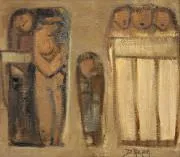

Dario Mecatti (Florence, Italy, 1909 - São Paulo, SP, 1976)
Dario Mecatti was a painter and designer whose artistic trajectory developed between Europe and Brazil, consolidating it as a relevant name in the visual arts scenario of the 20th century. Born in Italy, Dario Mecatti began his artistic training in Florence, where, around 1927, he produced posters for his cousin's cinema, marking the beginning of his professional performance. He received guidance from the Italian painter Camillo Innocenti, although his training took place independently, without ties to formal academic institutions.
In 1933, Dario Mecatti held his first exhibition in Florence, initiating a phase of intense international circulation. Then, he traveled through North Africa, passing through countries such as Libya, Tunisia and Algeria, where he presented exhibitions and produced works inspired by local landscapes and customs. Between 1936 and 1939, he was in Morocco, a period in which he developed a production marked by ethnographic observation and the representation of everyday scenes. In 1939, he passed through the island of São Miguel, in the Azores, expanding his visual and cultural repertoire.
Darius Mecatti's arrival in Brazil took place in 1940, alongside painters Renzo Gori and Silvio Nigri. He initially settled in Rio de Janeiro, where he held an exhibition at the Brazilian Society of Fine Arts. Then, he toured Minas Gerais cities such as Belo Horizonte, Juiz de Fora and Ouro Preto, taking up residence in São Paulo at the end of that year. its presence in the São Paulo artistic circuit. In 1941, he participated in the São Paulo Salon of Fine Arts, receiving the small silver medal, an important recognition in his career. In 1945, he married the painter Maria da Paz and, the following year, built his studio house, a space that became central to his production and where he started to hold annual individual exhibitions.
From 1947, Dario Mecatti He resumed his travels to Europe, starting to divide his life between Brazil and European countries. During the 1940s and 1950s, he presented his works in important Brazilian cities, in addition to Buenos Aires and Montevideo. Abroad, he exhibited in cultural centers such as Barcelona, Lisbon, Florence, Milan, San Remo and Berlin, expanding the international reach of his work.
Between 1969 and 1976, Dario Mecatti was an exclusive artist at the Irishini Gallery in Rio de Janeiro, which began to show its production on a continuous basis. His work, marked by the dialogue between different cultures and geographical experiences, consolidated its name among artists working on the Brazil-Europe axis.
In 1978, Dario Mecatti was honored posthumously at the São Paulo Fine Arts Hall, reaffirming the relevance of his contribution to Brazilian art and its insertion in the international context of the visual arts.
Critical Comment
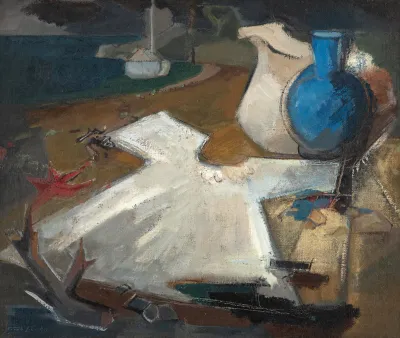
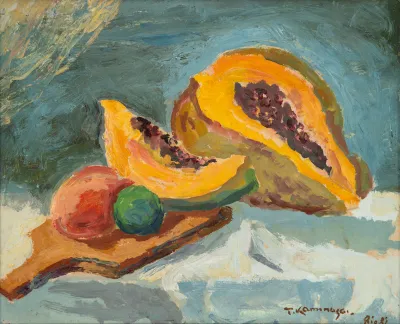
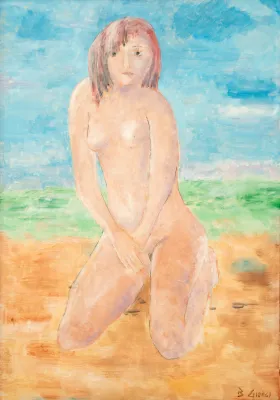
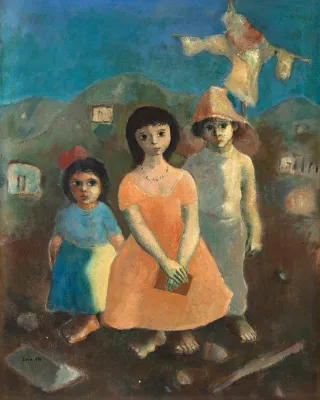
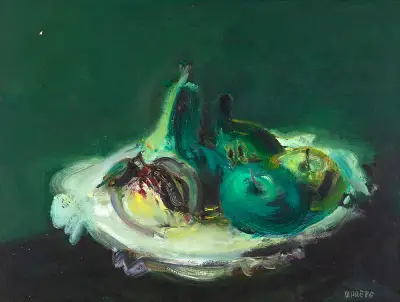
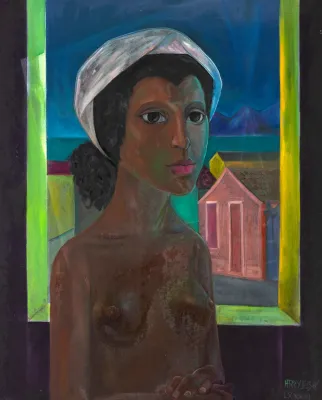
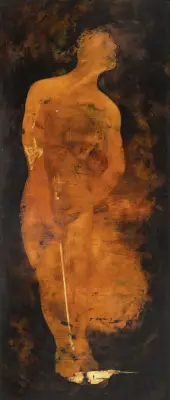
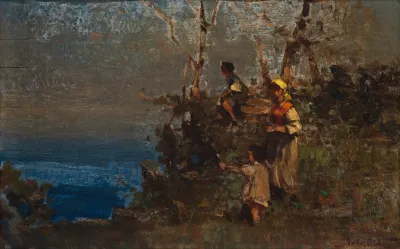
Darius Mecatti's production is organized mostly around genre painting, although the artist has also developed portraits, landscapes and still lifes throughout its trajectory. It was during his travels through North Africa, in the 1930s, that Dario Mecatti consolidated a thematic repertoire that would remain present in his work until at least the 1950s, already in the Brazilian context.
In this ensemble, Dario Mecatti It is dedicated to the representation of everyday scenes in Arab cities, visually exploring the dynamics of fairs and open-air markets, the work of fishermen on the piers and the flow of passers-by in narrow alleys or under ogival arcades — recurring elements of local architecture. In some works, the artist also addresses themes characteristic of the Orientalist imaginary, such as caravans of Bedouins in the desert and dance scenes of odalisques, revealing both a documentary and pictorial interest. Mecatti has affinities with the Italian movement of the Macchiaioli, which emerged in Florence in the mid-19th century as a reaction to academic rigidity. As art historian Giulio Carlo Argan observes, the Macchiaioli understood painting as an articulation of “colorful spots of light and shadow”, emphasizing a direct and sensitive approach to reality. The 1950s within a figurative tradition that, although linked to classical genres, does not fit the strict parameters of academicism. On the contrary, his compositions reveal a pictorial investigation based on observation and the chromatic construction of the scene.
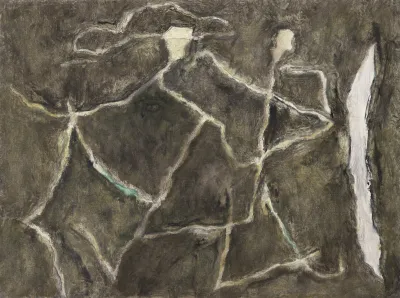
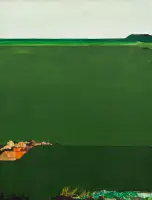
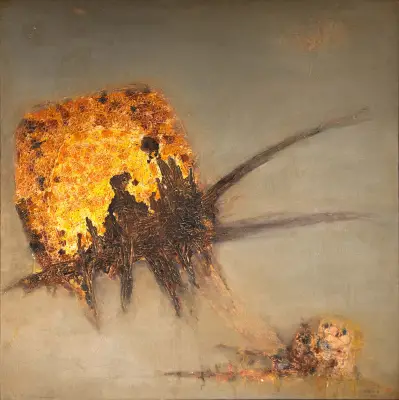
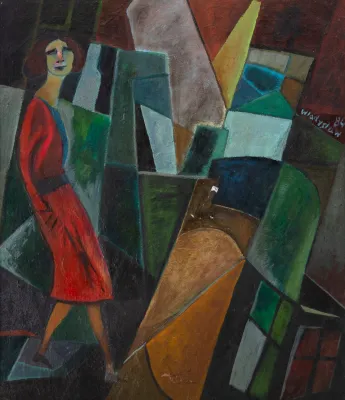
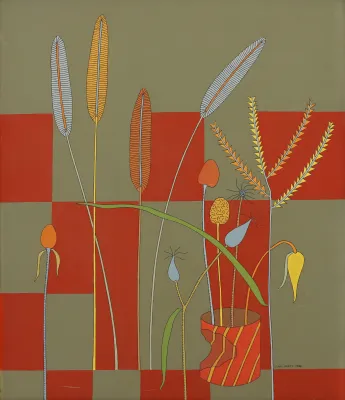
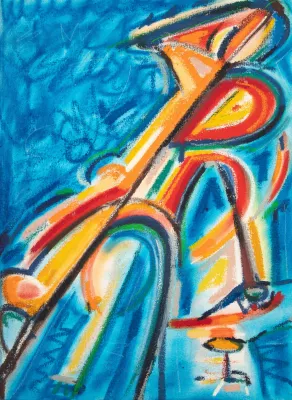
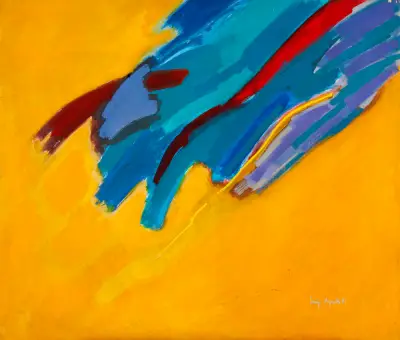
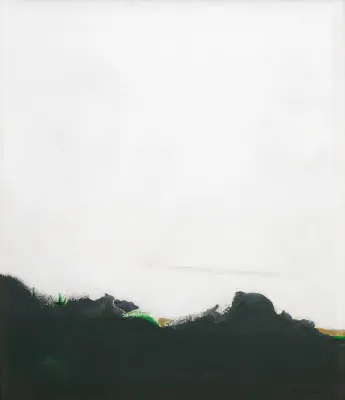
From the 1960s onwards, there is an inflection in the production of Dario Mecatti, marked by the progressive geometrization of forms. Elements such as houses arranged on slopes are now treated in a more synthetic way, evidencing a late assimilation of aspects of the modern vanguards and indicating an update of their artistic language without complete rupture with their figurative basis.
Notes
1 ARGAN, Giulio Carlo. History of Italian Art: From Michelangelo to Futurism. v. 3, trans. Wilma of Katinzky. São Paulo: Cosac Naify, 2003.
Critiques
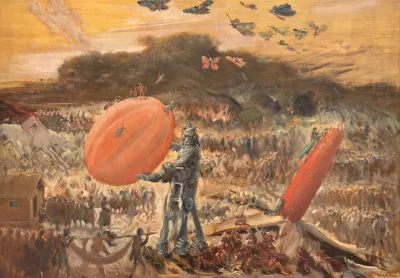
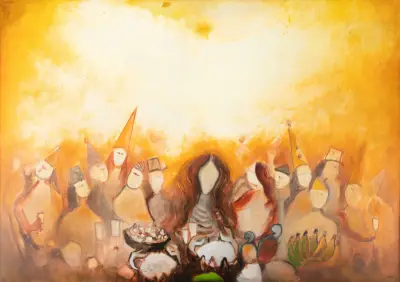
"Figures and landscapes were a constant in the extensive work left by Mecatti. 'I am a medieval. I am a medieval by birth. I was born in a totally medieval city, and since I was a child I already saw my eyes on walls entirely covered with frescos. This is inside me. And my painting is religious, as the medieval is religious. Pinto are erotically religious. The heavens need to be painted with a lot of melancholy. Especially in the afternoon skies, the prime time, where all light is golden. GALLAS, Alfredo G. (Coord.). 100 works Itaú. São Paulo: Itaugaleria, 1985.
Individual exhibitions
1940 - São Paulo SP - Individual, at Casa Jardim
1941 - São Paulo SP - Individual, at Casa Jardim
1944 - São Paulo SP - Individual, at Galeria Itá
1945 - São Paulo SP - Individual, in his studio
1976 - São Paulo SP - Individual, in his studio
Exhibitions Collectives
1933 - Florence (Italy) - First Exhibition
1934 - Tripoli (Lyby) (Libya) - Shows, at the Dante Alighieri Society
1935 - Mostaganem (Algeria) - Joint show with Renzo Gori, at the Municipal Theater
1935 - Sfax (Tunisia) Municipal
1937 - Casablanca (Morocco) - Show, at Galeria Sumica
1938 - Casablanca (Morocco) Arts, at the Salão de Arte Almeida Júnior of the Municipality of São Paulo
1942 - São Paulo SP - 8th Salão Paulista de Belas Artes, at the Prestes Maia Gallery - Small Silver Medal
1943 - Buenos Aires (Argentina) - Collective Moody Gallery
1943 - São Paulo SP - 9th Salão Paulista de Belas Artes, at the Prestes Maia Gallery
1944 - São Paulo SP - 10th São Paulo Salon of Fine Arts, at the Prestes Maia Gallery
1945 - São Paulo SP - 11th São Paulo Salon of Fine Arts, at the Prestes Maia Gallery
1947 - Rio de Janeiro RJ - Mostra, at the MNBA
1948 - São Paulo SP - Mostra, in the hall of the Municipal Theater
1949 - Rio de Janeiro RJ - Show, at Palace Hotel
1950 - São Paulo SP - Mostra, at the Rio Branco Gallery
Posthetic exhibitions
1978 - São Paulo SP - receives tribute at 42nd Paulista Salon of Fine Arts
1982 - São Paulo SP - Individual, at Dan Galeria
1982 - São Paulo SP - Italian painters in Brazil, at MAM/SP
1985 - São Paulo SP - 100 Works Itaú, at MASP
1993 - São Paulo SP - The Italian look at São Paulo, in the state's Pinacoteca
1998 - Rio de Janeiro RJ - Marines in large collections from São Paulo, at the Naval and Oceanographic Museum. Navy Documentation Service
1998 - São Paulo SP - São Paulo iconography in private collections, at the Museu da Casa Brasileira
2001 - São Paulo SP - Figures and Faces, at A Galeria
Source: Itaú Cultural