Conceição dos Bugres (Povinho de Santiago RS 1914 - Campo Grande MS 1984)
Conceição dos Bugres was a Brazilian sculptor of Indigenous origin, recognized as one of the greatest artisans of the Center-West region, especially Mato Grosso do Sul. Her work centers on the creation of Indigenous figures called “Bugres”, wooden sculptures that have become symbols of the art, culture and identity of Mato Grosso do Sul. In recognition of her importance, the Legislative Assembly of Mato Grosso do Sul named an annual award after her: the Conceição dos Bugres Medal, considered the “Oscar for artisans” in the state.
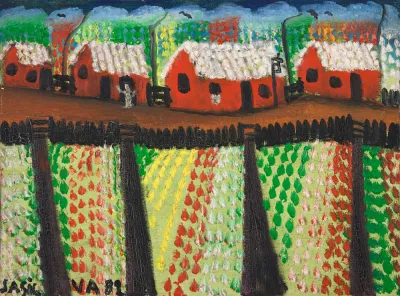
Conceição dos Bugres was born on December 8, 1914, in Povinho de Santiago, Rio Grande do Sul. As a child, she migrated with her family to Mato Grosso do Sul because of the persecution of Indigenous peoples during European immigration to southern Brazil. At age six, she settled in Ponta Porã, a town on the border with Paraguay, where she grew up in close contact with nature, learning from her father the use of medicinal herbs and developing skills as a folk healer. In 1957, she moved to Campo Grande, the state capital. One of her sons, the painter Ilton Silva, also became a regionally recognized artist and was instrumental in promoting her work.
In the 1960s, Conceição dos Bugres's work gained visibility when her son showed her sculptures to the artist Humberto Espíndola and the cultural producer Aline Figueiredo, founders of the Associação Mato-Grossense de Artes (AMA), who became her first admirers and promoters. In the 1970s, already over 50, Conceição dos Bugres took part in regional and national exhibitions, gaining artistic recognition but no significant financial reward. She died in poverty in 1984.
The sculptures known as Bugres are human figures with Indigenous features, generally made of wood with sharp, straight machete cuts, coated with beeswax and detailed in charcoal. Conceição dos Bugres originally began by carving cassava roots, inspired by their natural shape, which resembled human faces. Each piece had its own personality, despite recurring features such as a rounded body, upright posture and flat head. She also classified some sculptures as “tame Indians” or “little Black ones”, giving the latter to friends as amulets, a gesture of generosity and affection. For Conceição dos Bugres, her sculptures had a life of their own, and her relationship with them was maternal: many were given names and carefully individualized.
Conceição dos Bugres's work resonates with various artistic traditions, including the Moai of Easter Island, Egyptian art, Kadiwéu totems, Tarsila do Amaral's painting Abaporu, Northeastern ex-votos and Brancusi's minimalism. The term “bugre”, historically pejorative, was reclaimed by Conceição dos Bugres and became a cultural icon referring to her ethnic origins and to the persecution she suffered in childhood at the hands of the so-called bugreiros, who hunted Indigenous peoples.
Conceição dos Bugres is considered the first sculptor from Mato Grosso do Sul to achieve national recognition. Alongside Lídia Baís, she is one of the central names in the art of Mato Grosso do Sul, although Baís belongs more to the field of erudite art, while Conceição dos Bugres made her name in folk art. Her sculptures are powerful symbols of the state's popular iconography of identity and reflect the social and political conditions of Indigenous peoples in border regions. Despite this recognition, her work has been largely absent from public collections; most pieces are in private collections, with exceptions such as the Museu Afro Brasil and Itaú Cultural.
In 1979, the filmmaker Cândido Alberto da Fonseca made a documentary about Conceição dos Bugres; the footage deteriorated but was restored in 2016 and is now considered part of the heritage of Mato Grosso do Sul. In 2021, the artist's work received its first monographic museum exhibition, at MASP, titled Conceição dos Bugres: tudo é da natureza do mundo [Conceição dos Bugres: Everything Is of the Nature of the World], curated by Fernando Oliva with assistant curator Amanda Carneiro, consolidating her importance to Brazilian art.
Conceição dos Bugres's artistic legacy lives on through her descendants: after her death, her husband Abílio and her son Ilton continued to make Bugres, and today her grandson Mariano Antunes Cabral Silva carries on the tradition, ensuring that the technique and family memory endure. Marking the 110th anniversary of her birth in 2024, we celebrate the career of Conceição dos Bugres as a visionary artist who turned wood into living memory and established the Bugres as symbols of resistance, creativity and the cultural identity of Mato Grosso do Sul.
Solo Exhibitions
1971 - Rio de Janeiro RJ - 5 Artistas de Mato Grosso [5 Artists from Mato Grosso], at Galeria Ibeu de Copacabana
1972 - São Paulo SP - Art/Brazil/Today: 50 Years Later, at Galeria da Collectio
1974 - São Paulo SP - Bienal 74, at Fundação Bienal de São Paulo
2001 - Rio de Janeiro RJ - Expressão Popular [Popular Expression], at Centro Cultural Light
2004 - Campo Grande MS - Bugres: Conceição e sua gente [Bugres: Conceição and Her People], at Museu de Arte Contemporânea do Mato Grosso do Sul (MARCO)
2004 - São Paulo SP - Forma, Cor e Expressão: uma coleção de arte brasileira [Form, Color and Expression: A Collection of Brazilian Art], at Estação São Paulo
2021 - São Paulo SP - Conceição dos Bugres: tudo é da natureza do mundo [Conceição dos Bugres: Everything Is of the Nature of the World], at Museu de Arte de São Paulo (MASP)