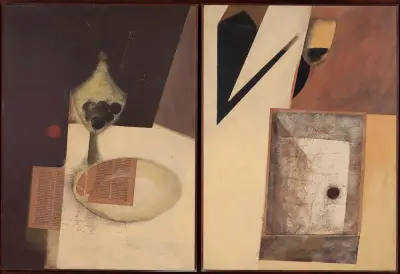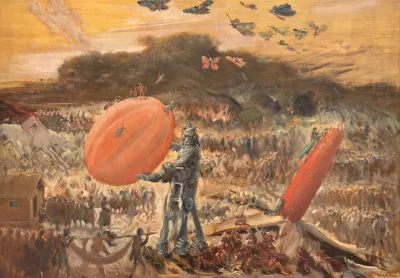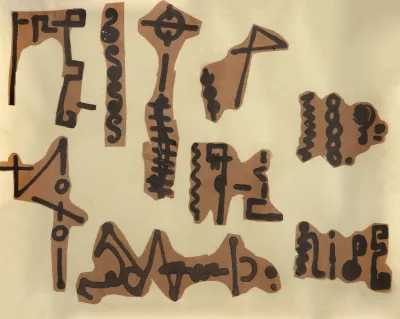
Carlos Vergara (Santa Maria RS 1941)
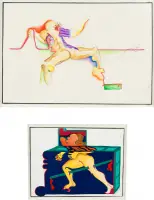
Carlos Vergara is an engraver, photographer and painter, he began his artistic trajectory in the 1950s, when he moved to Rio de Janeiro. In parallel with his work as a laboratory analyst, he dedicated himself to jewelry handicrafts, which were exhibited at the 7th São Paulo International Biennial in 1963. In the same year, he began to focus on drawing and painting, carrying out studies with Iberê Camargo. He participated in the Opinion 65 and 66 exhibitions at the Museum of Modern Art in Rio de Janeiro (MAM/RJ), consolidating himself in the Brazilian artistic scene. In 1967, he was one of the organizers of the Nova Objectivity Brasileira exhibition, which aimed to take stock of the vanguard in Brazil. During this period, Vergara also acted as a set designer and costume designer for theatrical plays, in addition to producing figurative paintings with influences from Expressionism and Pop Art.
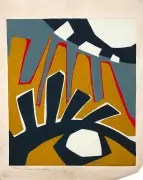
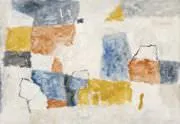
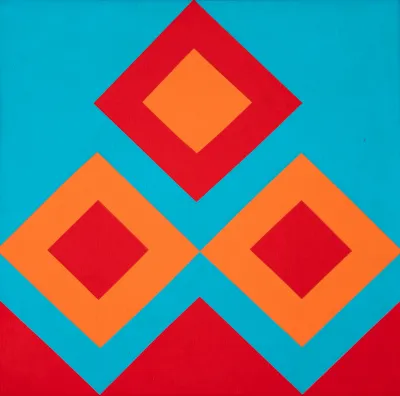
During the 1970s, Carlos Vergara began to use photography. and Super-8 films as tools for reflections on reality, in addition to researching Carnival, which has become one of its topics of interest. He also collaborated with architects in the creation of panels for various buildings, using materials and techniques from popular handicrafts. In 1972, he published the Caderno de Desenhos Blanco, by Editora Nova Fronteira. In the 1980s, he returned to painting, producing geometric abstract paintings, in which he explored plots of lozenges that created vibrant chromatic fields. At the end of the 1980s, he began to use natural pigments and ores in his works, using them as a basis for work on different surfaces.
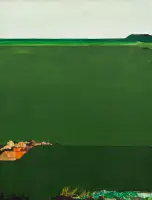
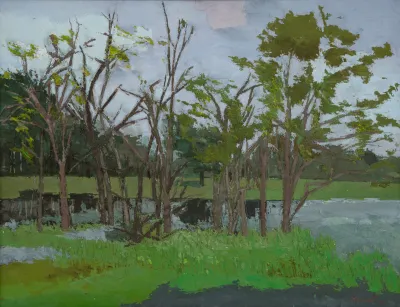
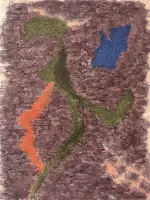
In 1997, Carlos Vergara performed the Monotypes of the Pantanal series, an exploration From direct contact with nature, transferring the textures of stones, leaves and other natural elements to the screen. This work reflected his continuous interest in the fusion between art and the natural environment.
Critical Comment
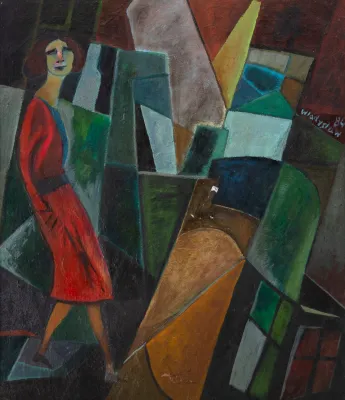
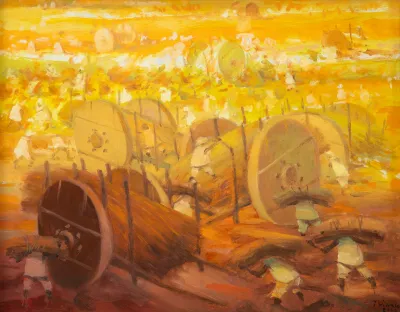
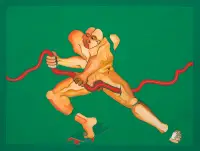
Still young Carlos Vergara begins to work with ceramics, and in the early 1960s, he makes silver and copper jewelry. Shows 13 of these pieces at the 7th International Biennial of São Paulo, in 1963. In that year, he began a course in drawing and painting with Ebert Camargo (1914 - 1994), and produced, until 1967, figurative paintings, with Agile brushstrokes and caricatured traits, in addition to an expressionist treatment. The art critic Paulo Sérgio Duarte compares these works to the paintings of the Cobra group, by artists such as Acir Juram (1914 - 1973) and Karel Appel (1921), for the "Cult to Expressive Liberty, appropriation of children's drawings, praise of the primitive and the mad."1 In 1965, he participated in the exhibition Opinion 65 with these three works: the general, vote and patroness.
From 1966, Vergara incorporates graphic icons and art elements into his expressionist base. Pop. He does his first works of applied art, such as the mural for the School of Public Health of Manguinhos and the scenography for the Tablado theater group, both in Rio de Janeiro, in 1966. In 1968, he began to paint on acrylic surfaces, making disappear the artisanal marks of their pictorial practice. In the same year, he explores new languages and shows the splendid cradle environment, at Galeria Art Art, in São Paulo. The work combines the sensory investigations of artists such as Hélio Oiticica (1937 - 1980) with political denunciation.
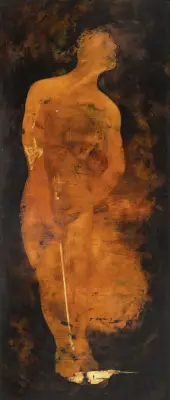
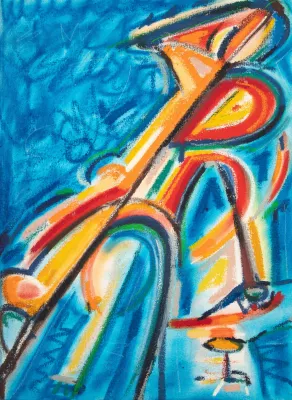
Since the 1980s, Vergara has been more decisively dedicated to painting. It uses natural pigments, taken from minerals, used in its works, materials that it also uses in the production of monotypes, many of them made in natural environments, such as the Pantanal Mato-Grossense.
Notes
1 DUARTE, Paulo Sérgio. Carlos Vergara. Rio de Janeiro: Santander Cultural, 2003. p. 94.
Criticism
"The initial statement of the work of Carlos Vergara proves how much 1964 was a watershed in society and in Brazilian art. Camargo) was reflected in the willingness to dissolve the figure in both nebulous and rigorous, dense and emblematic constellations, in the plumb line of the abstract. But the following drawings, between 1964 and 1965, are enough To assure us that Vergara also knew how to absorb the adventures of the upheaval environment around (...) when the hardnesses of 1968 were vertical, Vergara, while at the same time expanding the arsenal of his materials, associating them with the support conventional, made the reference to Brazil more obvious. The flag, the palm trees, the banana trees, the rainbow, the Indian and the yellow-green took a prolonged seat there, as evidence of a restless and critical look directed at a precise target. In the way of design, instantaneous of the idea coming and going, memory mixed with the maneuver, the works, particularly the drawings, took on an unequivocal conceptual direction".
Roberto Pontual
Pontual, Roberto. Between two centuries: 20th century Brazilian art in the Gilberto Chateaubriand collection. Preface by Gilberto Allard Chateaubriand and Antônio Houaiss. Presentation by M. F. do Nascimento Brito. Rio de Janeiro: Jornal do Brasil, 1987.
"In a country where a good part of contemporary art is directly or indirectly related, interacting or reacting, with the constructivist chapter that marked and still marks its art, the painting that Carlos Vergara has been developing since 1989, it produces a certain strangeness. This differentiation is carried out by the way it incorporates local issues. Paradoxically, it is strange because it is a Brazilian painting without connecting to the stereotypes of the province. He explored by creating exotic images of himself, we began to admit the reflective effort of constructivist and post-constructivist works that are guided by a conceptual order where any local element is mediated by so many instances that it goes unnoticed.
(...)
There is a romantic investment in this Vergara painting that seems to believe that there in the fragment, in the piece of the wall, the whole can be and that this encounter cannot be disturbed by an inhibiting rationality, but captured in the moment of the printing of the canvases. Current, the sublime here does not presuppose any transcendence, on the contrary, it directs in the shadows of these canvas the look at this territory where we find ourselves in such a way that we do not see it".
Paulo Sérgio Duarte
DUARTE, Paulo Sérgio. "Strange proximity". http:// www. carlosvergara. com. br/sobreframe. htm, 1995.
"(...) restless artists of his generation. Refusing to restrict himself to the mere pleasure of an aestheticist formalism, he goes deeper into his formal quest, by translating through it, with talent and originality, a will to transformation that makes the very act of painting a continuous gesture of pleasure, an expression of a natural process that emanates from life same. As one who breathes, he plucks into his own life the strength to unite this gesture with nature, from where he extracts his pigments of color and an energy that acts like a halo that permeates his canvas and that unites form, color, light, heat, matter, action and inaction in them.
With this Vergara reveals himself to be a painter looking for a recognizable Brazilianness in what could be most Brazilian, the earth, the pigment of the earth, the color of the earth. The texture that comes from this earth, with which it paints like someone who extracts from the bowels of nature the most precious mineral, builds an impressive range of earthy colors that adds a remarkable dose of drama to his work.
This dramatic load is the key to explaining his The baroque side, this dark-skinny that runs through their paintings and makes them baroque not only because of the religious sense with which they end up permeating themselves, but also when he appeals to the senses as an imperious call. This can be seen, for example, in the great monotypes, which he prints as in a playful act, playing with the pigment, the color and texture that come from this earth, to build a new form of expression that makes the painting itself a gesture of interpretation of life. Running like a powerful came from his works, this gesture was incorporated to them as a material force, a vital force."
Emanoel Araujo
ARAUJO, Emanoel. Carlos Vergara: In Search of Brazilian Color. Vergara: 89/99. São Paulo: Pinacoteca, 1999, p. 3.
Testimonies
"In 1989, my work did not take a new direction alone, I decided To give a new direction because I was sure that I had exhausted the series started in 1980, where I abandoned the figure and dive into a painting that had as a procedure a 'measurement with color' of the space of the canvas, diagonals parallel, forming a grid. had come to exhaustion; Continuing would be condemning me to no longer feel the sense of discovery and make everything bureaucratic. only handicrafts.
In 1989, I proposed for me, with detachment, to put myself in a zero-painting landmark and look inwards and outwards.
Painting means accepting the historical weight of an activity that is not anachronistic only if it contains An adventure, which overcomes the issue of the image, that messes with the procedure and has a project, even so the painting whenever the support determines. Therefore, it is necessary to 'read' the project and the procedure to know if it is not just mime, historically overcome. (...)
Painting, when it ceases to be an enigma, catalyst for more subtle areas of your being, is no longer necessary. It only takes an art that, as it is mobilizing, justifies its existence. It is this expressive capacity that gives you reason for being.
I am speaking from the painter's point of view. To speak from the public's point of view, we should talk about the countless forms of blindness and insensitivity. (...)
As for the theme of Brazilianness, it interests me, as it is not interested in others, to use a peculiar language, which, even if it is, saying, erudite, I take care of Brazil without boasting myself - by the way, because there are not so many reasons. In this symbolic good that is painting, I want you to recognize yourself with good or bad being. This personal pleasure of mine, I have already said, I do not think of paramount importance, nor even a value maker. I am more concerned that the speech goes beyond this by maintaining a flavor, a temperature, that shows a tradition without it being organized.
As for the question of time, there is a time evoked by the construction of the image, there is a time when the painting itself asks to be read, there is A physical time that drying requires for every screen attack. There is also a time of another order, relative to the moment of action. A time linked to the gesture, which only happens intuited and with impossible measurement. (...)
Each canvas is a crucible of painting and painting ideas. I'm thinking about what I'm doing while I'm doing it, and I put myself open to the contradictions that arise. I have no thesis to prove. I think that's where the differences that exist between the series of the works I produce come from. I don't panic and I even like it if the next work doesn't look like the previous one. (...)
Returning to the question of repetition, what I meant is that I think it is possible to add to the work, add more meaning with the ritualization of repetition, and not empty of meaning if this repetition is just mechanical. From the trip to India I made, I remember the way of venerating Hanuman, a deity-monkey, an important character who helped Rhama cross the forest in the epic Ramayana. The images depicting a monkey have been greased with orange oil and pigment for centuries, and they have no more shape, they are just an impressive orange accumulation with two eyes at the bottom. You only see a lot of orange and you know that there is Hanuman inside. And this orange is spreading around the place with the marks of the hands that people leave, when cleaning them from the paint they have left.
The revisits that I make to Minas Gerais of the oxides in these last 10 years I can say that it has been a Ritual that every time renews the feeling-thinking.
It may seem like a contradiction, but repetition helps to reflect, emptying premeditated thought. It is about producing an elaborately simple thing. There is an energetic difference in this.
At the time when painting was done only by addition and sculpture only by subtraction, this was easier to perceive". Luiz Camilo. "Conversation between Carlos Vergara and Luiz Camilo Osorio". In: Carlos Vergara: 89/99. São Paulo: Pinacoteca, 1999, p. 5-6, 21-22, 32.
Individual exhibitions
1966 - Rio de Janeiro RJ - Individual, at Fátima Arquitetura
1966 - Rio de Janeiro RJ - Individual, at MAM/RJ
1967 - Rio de Janeiro RJ - Individual, at Petite Galerie
1968 - São Paulo SP - Individual, at Galeria Art Art
1969 - Rio de Janeiro RJ - Individual, at Petite Galerie
1972 - Paris (France) - Individual, at Air France
1972 - Rio de Janeiro RJ - Individual, at MAM/RJ
1973 - Rio de Janeiro RJ - Individual, at the Paulo Bittencourt Gallery and Luiz Buarque de Holanda
1975 - Rio de Janeiro RJ - Individual with works from the Gilberto Chateaubriand collection, at the Maison de France gallery
1978 - Rio de Janeiro RJ - Individual, at Petite Galerie
1978 - São Paulo SP - Carlos Vergara: drawing, paintings, photographs, at the Global Art Gallery
1980 - Rio de Janeiro RJ - Notes on Carnival, at Galeria Hotel Méridien
1981 - São Paulo SP - Individual, at Galeria Monica Filgueiras
1983 - Rio de Janeiro RJ - Individual, at the Thomas Cohn Gallery
1983 - São Paulo SP - Individual, at the Art Office Raquel Arnaud
1984 - London (England) - Individual, at the Brazilian Center Gallery
1984 - São Paulo SP - Individual, at the Art Cabinet Raquel Arnaud
1985 - São Paulo SP - Individual, at the Raquel Arnaud Art Office
1987 - São Paulo SP - Individual, at the Art Office Raquel Arnaud
1988 - Rio de Janeiro RJ - Individual, at the Thomas Cohn Gallery
1989 - São Paulo SP - Individual, at the Art Office Raquel Arnaud
1990 - Rio de Janeiro RJ - Individual, at the Ipanema Art Gallery
1990 - Rio de Janeiro RJ - Individual, at Paço Imperial
1991 - Belo Horizonte MG - Individual, at Itaú Cultural
1991 - Belo Horizonte MG - Individual, at Palácio das Artes
1991 - São Paulo SP - Individual, at the Art Office Raquel Arnaud
1992 - Lisbon (Portugal) - recent works 1989-1991, at the Modern Art Center of the Calouste Gulbenkian Foundation
1992 - São Paulo SP - Individual, in the Chapel of Morumbi
1993 - Antwerp (Belgium) - Individual, at the Francis Van Hoof Gallery
1993 - Rio de Janeiro RJ - Individual, at Galeria Goudar
1993 - Rio de Janeiro RJ - Individual, at CCBB
1993 - São Paulo SP - Carlos Vergara, at the Art Office Raquel Arnaud
1994 - São Paulo SP - Individual, at the Art Office Raquel Arnaud
1995 - Paris (France) - Individual, at Galeria Debret
1995 - Rio de Janeiro RJ - Individual, at the Paulo Fernandes gallery
1997 - Rio de Janeiro RJ - Carlos Vergara: Engravings, at Fundação Castro Maia
1997 - São Paulo SP - Monotypes of the Pantanal and recent paintings, at MAM/SP
1998 - Rio de Janeiro RJ - Carlos Vergara: Papers on Paper, at GB Art
1998 - Rio de Janeiro RJ - Os Viajars, at Paço Imperial
1999 - São Paulo SP - Carlos Vergara 89/99, at Pinacoteca do Estado
2001 - Rio de Janeiro RJ - Individual, at Silvia Cintra Art Gallery
2001 - São Paulo SP - Individual, at Galeria Nara Roesler
2003 - Porto Alegre RS - Carlos Vergara Traveler: 1965 to 2003, at Santander Cultural
2003 - São Paulo SP - Carlos Vergara Traveler: Works from 1965 to 2003, at Instituto Tomie Ohtake
2003 - Vila Velha ES - Individual, at the Vale do Rio Doce Museum
2004 - São Paulo SP - Carlos Vergara, at Monica Filgueiras Art Gallery
Collective exhibitions
1963 - Lima (Peru) - Latin American painting, At the Institute of Contemporary Art
1963 - São Paulo SP - 7th São Paulo International Biennial, at the Biennial Foundation
1965 - Paris (France) - Salon de la Jeune Peinture, at the Musée d'Art Moderne de la Ville de Paris
1965 - Rio de Janeiro RJ - Opinion 65, at MAM/RJ
1965 - Rio de Janeiro RJ - 14th National Salon of Modern Art, at MAM/RJ
1965 - São Paulo SP - 2nd Exhibition of the Young National Drawing, at MAC/USP
1965 - São Paulo SP - Proposals 65, at FAAP
1966 - Belo Horizonte MG - Brazilian vanguard, at UFMG. Rectory
1966 - Lima (Peru) - Latin American Painting
1966 - Rio de Janeiro RJ - Opinion 66, at MAM/RJ
1966 - Rio de Janeiro RJ - Pare, at the gallery G4
1966 - Rio de Janeiro RJ - 1st Salon of April, at MAM/RJ
1966 - Rio de Janeiro RJ - 15th National Salon of Modern Art
1966 - Salvador BA - 1st Bienal National Plastic Arts
1966 - São Paulo SP - 8 artists, at Atrium
1967 - Belo Horizonte MG - 22nd Salon of Fine Arts in the city of Belo Horizonte, at map
1967 - Petrópolis RJ - 1st National Young Painting Salon, at the Quitandinha Hotel
1967 - Rio de Janeiro RJ - New Brazilian Objectivity, at MAM/RJ
1967 - Rio de Janeiro RJ - 3rd The face and the work, at the IBEU Gallery Copacabana
1967 - Rio de Janeiro RJ - Salão das Caixas, at Petite Galerie - O.C.A. Award
1967 - Rio de Janeiro RJ - 16th National Salon of Modern Art
1967 - São Paulo SP - 9th São Paulo International Biennial, at the Bienal Foundation - Acquisition Award
1968 - Rio de Janeiro RJ - 17th National Salon of Modern Art, at MAM/RJ
1968 - Rio de Janeiro RJ - 6th JB Art Summary, at MAM/RJ - JB Summary Prize for Object
1968 - Rio de Janeiro RJ - Flags in the square, at Praça General Osório
1968 - Rio de Janeiro RJ - 1st Art Fair of Rio de Janeiro, in the MAM/RJ
1968 - Rio de Janeiro RJ - The Brazilian artist and mass iconography, at ESDI
1968 - Rio de Janeiro RJ - The face and the work, at the Ibeu Copacabana Gallery
1969 - Rio de Janeiro RJ - 18th National Salon of Modern Art, at MAM/RJ - Jury Exemption Award
1969 - Rio de Janeiro RJ - Salão da Bússola, at MAM/RJ
1970 - Belo Horizonte MG - Object and Participation, at the Palácio das Artes
1970 - Medellín (Colombia) - 2nd Medellín Art Biennial, at the Antioch Museo
1970 - Rio de Janeiro RJ - 19th National Salon of Modern Art, at MAM/RJ
1970 - Rio de Janeiro RJ - 8th Summary of Art JB, at MAM/RJ - JB Summary Drawing Award
1970 - Rio de Janeiro RJ - Contemporary Brazilian painting, at MAM/RJ
1970 - São Paulo SP - 2nd Panorama of Current Brazilian Art, at MAM/SP
1971 - Rio de Janeiro RJ - 9th IAB/RJ Awards
1971 - Rio de Janeiro RJ - Exhibition of Multiples, at Petite Gallery
1972 - Rio de Janeiro RJ - 10th IAB/RJ Awards
1972 - Rio de Janeiro RJ - Domingos de Criação, at MAM/RJ
1972 - Rio de Janeiro RJ - Exhibition, at MAM/RJ
1972 - São Paulo SP - Art/Brazil/Today: 50 years later, at Collectio Gallery
1973 - Rio de Janeiro RJ - Question about nature: meaning and function of the work of Art, at the IBEU Copacabana Gallery
1973 - São Paulo SP - Expo-Projection 73, at Espaço Griffe
1974 - Campinas SP - 9th Contemporary Art Salon of Campinas, at MACC
1975 - Campinas SP - (Art), at MacC
1975 - Campinas SP - Waltercio Caldas, Rubens Gerchman, Carlos Vergara, José Resende, at MACC
1975 - Rio de Janeiro RJ - Communication according to plastic artists, Rede Globo
1975 - Rio de Janeiro RJ - Experimental Art Exhibition of Super-8 Films, Audiovisual and Video Tape, at Galeria Maison de France
1976 - Salvador BA - Brazilian Art from the 60s/70s in the collection Gilberto Chateaubriand, at MAM/BA
1977 - Brasília DF - Brazilian art from the 60s/70s at the Gilberto Chateaubriand Collection, at the Cultural Foundation of the Federal District
1977 - Recife PE - Brazilian Art of the Years 60/70 in the Gilberto Chateaubriand collection, in the mansion of João Alfredo
1978 - São Paulo SP - The object in the art: Brasil 60s, at MAB/FAAP
1980 - Milan (Italy) - Quasi Cinema, in the Centro Internazionale di Brera
1980 - Venice (Italy) - 40th Venice Biennale
1981 - Rio de Janeiro RJ - From the modern to the contemporary: Gilberto Collection, MAM/RJ
1981 - Rio de Janeiro RJ - Carnival Universe: Images and Reflections, at the Art Gallery Collection
1982 - Lisbon (Portugal) - Brazil 60 years of modern art: Gilberto Chateaubriand collection, in the center of Modern Art José de Azeredo Perdigão
1982 - Lisbon (Portugal) - From the modern to the contemporary: Gilberto Chateaubriand Collection, at the Calouste Gulbenkian Foundation
1982 - London (United Kingdom) - Brazil 60 years of modern art: Gilberto Chateaubriand Collection, at the Barbican Art Gallery
1982 - Rio de Janeiro RJ - Contemporaneity: Homage to Mário Pedrosa, at MAM/RJ
1983 - Rio de Janeiro RJ - 13 artists/13 works, at the Thomas Cohn Gallery
1983 - Rio de Janeiro RJ - 3 x 4 Large formats, in the Rio Empresarial Center
1983 - Rio de Janeiro RJ - The flower of the skin: painting and pleasure, in the Centro Empresarial Rio
1983 - Rio de Janeiro RJ - Brazilian self-portraits, at the Banerj Art Gallery
1983 - São Paulo SP - Imaginar o Presente, at the Art Office Raquel Arnaud
1984 - London (England) - Portraits of a Country: Brazilian Modern Art from the Gilberto Chateaubriand Collection, at Barbican Art Gallery
1984 - Rio de Janeiro RJ - Antonio Dias, Carlos Vergara, Roberto Magalhães and Rubens Gerchman, at the Rio Business Center Gallery
1984 - São Paulo SP - Gilberto Chateaubriand Collection: Portrait and Self-Portrait of Brazilian Art, at MAM/SP
1984 - São Paulo SP - Tradition and Rupture: Synthesis of Brazilian art and culture, at the Bienal Foundation
1985 - Brasília DF - Brasilidade e Independência, at the Teatro Nacional de Brasília/Fundação Cultural de Brasília
1985 - Porto Alegre RS - Iberê Camargo: trajectory and meetings, in the Margs
1985 - Rio de Janeiro RJ - Exhibition Cycle on Art in Rio de Janeiro/Opinion 65, at the Banerj Art Gallery
1985 - Rio de Janeiro RJ - Opinion 65, Art Gallery Banerj
1985 - São Paulo SP - 18th São Paulo International Biennial, at Fundação Bienal
1985 - São Paulo SP - Arte Novos Meios/Multimeios: Brazil 70/80, at MAB/SP
1985 - São Paulo SP - Highlights of Brazilian Contemporary Art, at MAM/SP
1986 - Brasília DF - Iberê Camargo: trajectory and meetings, at the National Theater of Brasília
1986 - Rio de Janeiro RJ - 1st Mostra Christian Dior of Contemporary Art: Painting, at Paço Imperial
1986 - Rio de Janeiro RJ - Iberê Camargo: trajectory and meetings, at MAM/RJ
1986 - Rio de Janeiro RJ - Christian Dior Contemporary Art: Painting, at Paço Imperial
1986 - São Paulo SP - Collective, at the Art Office Raquel Arnaud
1986 - São Paulo SP - Iberê Camargo: trajectory and meetings, at Masp
1987 - Rio de Janeiro RJ - To the collector: Homage to Gilberto Chateaubriand, at MAM/RJ
1987 - Rio de Janeiro RJ - New figuration Rio/Buenos Aires, at the Gallery of the Instituto Cultural Brasil-Argentina
1988 - Rio de January RJ - The eternal is ephemeral, at Petite Galerie
1988 - São Paulo SP - 63/66 Figure and object, at Galeria Millan
1989 - São Paulo SP - 20th International Biennial of São Paulo, Biennial Foundation
1989 - São Paulo SP - Painting Brazil 19th and 20th Century: Works of the Banco Itaú Collection, in Itaugaleria
1990 - Brasília DF - 9th Brazil-Japan Art Exhibition
1990 - Rio January RJ - 9th Brazil-Japan Contemporary Art Exhibition
1990 - São Paulo SP - 9th Brazil-Japan Contemporary Art Exhibition, at the Brazil-Japan Foundation
1990 - Tokyo (Japan) - 9th Brazil-Japan Contemporary Art Exhibition
1990 - Atami (Japan) - 9th Brazil-Japan Contemporary Art Exhibition
1990 - Sapporo (Japan) - 9th Brazil-Japan Exhibition of Contemporary Art, at the Brazil-Japan Foundation
1991 - Curitiba PR - 48th Salão Paranaense, at MAC/PR
1991 - Rio de Janeiro RJ - Image over image, at the Sérgio Porto Cultural Space
1992 - Paris (France) - Diversité Latino Americaine, at the Galerie 1900/2000
1992 - Rio de Janeiro RJ - 1st on the way to Niterói: João Sattamini Collection, at the Imperial Palace
1992 - Rio de Janeiro RJ - Brazilian Contemporary Art, at EAV/Parque Lage
1992 - Rio de Janeiro RJ - Coca-Cola 50 years with Art, at MAM/RJ
1992 - Rio de Janeiro RJ - Eco Art, at MAM/RJ
1992 - Rio de Janeiro RJ and São Paulo SP - Coca-Cola 50 years with Art, at MAM/RJ and MAM/SP
1992 - Santo André SP - Lithogravure: Methods and Concepts, in the Municipal Palace
1992 - São Paulo SP - 60s/70s: Gilberto Chateubriand Collection - MAM/RJ, at the SESI Art Gallery
1992 - São Paulo SP - Coca-Cola 50 years with Art (1992 : São Paulo, SP) - Museum of Modern Art (Ibirapuera, São Paulo, SP)
1993 - Rio de Janeiro RJ - Erotic Art, at MAM/RJ
1993 - Rio de Janeiro RJ - Brazil, 100 years of modern art, at the MNBA
1993 - Rio de Janeiro RJ - Body emblems: the nude in Brazilian modern art, at CCBB
1993 - São Paulo SP - The modern design in Brazil: Gilberto Chateaubriand Collection, at the SESI Art Gallery
1994 - Penápolis SP - The Ephemeral in Brazilian Art: 60's/70's, at Itaugaleria
1994 - Rio de Janeiro RJ - The modern design in Brazil: Gilberto Chateubriand Collection, at MAM/RJ
1994 - Rio de Janeiro RJ - Trencheiras: Art and Politics in Brazil, at MAM/RJ
1994 - São Paulo SP - Bienal Brasil Céculo 20th, NA Biennial Foundation
1994 - São Paulo SP - The ephemeral in Brazilian art: 60s/70s, at Itaú Cultural
1995 - Rio de Janeiro RJ - Libertinos/Libertários
1995 - Rio de Janeiro RJ - Limits of Painting, in the Caixa Cultural Complex
1995 - Rio de Janeiro RJ - Opinion 65: 30 years, at CCBB
1995 - São Paulo SP - Today's Brazil in the Mirror of the 19th Century: German and Brazilian artists redo the Langsdorff expedition, at Masp
1996 - Brasília DF - Collective, at the Reference Gallery
1996 - Brasília DF - The ephemeral in Brazilian art: 60's/70's, in the Itaugaleria
1996 - Goiânia GO - Collective, at Fundação Jaime Câmara
1996 - Niterói RJ - Brazilian Contemporary Art in the João Sattamini Collection, at MAC/Niterói
1996 - Palmas TO - Inaugural Exhibition of the Cultural Space of Palmas, at Espaço Cultural de Palmas
1996 - Rio de Janeiro RJ - Collective, at the Tolouse Gallery
1996 - Rio de Janeiro RJ - Today's Brazil in the Mirror of the 19th century: German artists and Brazilians redo the Langsdorff Expedition, at Fundação Casa França-Brasil
1996 - Rio de Janeiro RJ - Petite Galerie 1954-1988, a vision of Brazilian art, in the Imperial Palace
1996 - São Paulo SP - Collective, at Galeria A Estufa
1997 - Porto Alegre RS - 1st Mercosul Visual Arts Biennial, at the Mercosul Visual Arts Biennial Foundation
1997 - Porto Alegre RS - Cartographic, at Usina do Gasómetro
1997 - Rio de Janeiro RJ - Petite Galerie 1954-1988: a vision of Brazilian art, in the Paço Imperial
1997 - Rio de Janeiro RJ - a conversation with Rugendas, at the Castro Maya Museums
1997 - São Paulo SP - Art City: the city and its stories, at Estação da Luz, in the Matarazzo industries and at the central mill
1997 - São Paulo SP - Art City: Route
1997 - São Paulo SP - Bar des Arts: Auction nº 1, in Aldeia do Futuro
1997 - São Paulo SP - Galeria Brito Cimino Contemporary and Modern Art
1998 - Niterói RJ - Mirror of the Bienal, at MAC/Niterói
1998 - Rio de Janeiro RJ - Brazilian art in the collection of the Museum of Modern Art of São Paulo: recent donations 1996-1998, at CCBB
1998 - Rio de Janeiro RJ - Poeticas da Cor, at the Light Cultural Center
1998 - Rio de Janeiro RJ - Terra Incógnita, at CCBB
1998 - Rio de Janeiro RJ - Thirty years of 68, at CCBB
1998 - São Paulo SP - Fronteiras, at Itaú Cultural
1998 - São Paulo SP - The modern and the contemporary in Brazilian art: Gilberto Chateaubriand Collection - MAM/RJ, at Masp
1999 - Curitiba PR - Collective, at Galeria Fraletti and Rubbo
1999 - Rio de Janeiro RJ - Daily life/Art. Object 60s/90s, at MAM/RJ
1999 - Rio de Janeiro RJ - Exhibition Rio Engraving: Armando Sampaio Collection: Brazilian engraving, at the Calouste Gulbenkian Arts Center
1999 - Rio de Janeiro RJ - Rio Engraving: Brazilian Modern Engraving: Collection National Museum of Fine Arts, in the MNBA
1999 - São Paulo SP - Daily life/art. Consumption - Metamorphosis of Consumption, at Itaú Cultural
1999 - São Paulo SP - daily life/art. Consumption - Beba Mona Lisa, at Itaú Cultural
1999 - São Paulo SP - Lithography: Fidelity and Memory, at the Unicid Arts Space
1999 - São Paulo SP - Daily life/art. The object - the 60s/90s, at Itaú Cultural
2000 - Brasília DF - Exhibition Brazil Europe: Encounters in the 20th Century, in the Caixa Cultural Complex
2000 - Lisbon (Portugal) - 20th century: Art of Brazil, at the Foundation Calouste Gulbenkian. José de Azeredo Perdigão Modern Art Center
2000 - Niterói RJ - Paintings at the João Sattamini Collection, at MAC/Niterói
2000 - Rio de Janeiro RJ - Antonio Dias, Carlos Vergara, Roberto Magalhães, Rubens Gerchman, at GB Art
2000 - Rio de Janeiro RJ - Situations: Brazilian Arts 70s, at Fundação Casa França-Brasil
2000 - São Paulo SP - Brazil + 500 Mostra do Rediscovery, at Fundação Bienal
2001 - Belo Horizonte MG - From the body to the ground: a radical landmark in Brazilian art, at Itaú Cultural
2001 - Goiânia GO - 1st National Art Salon of Goiás, at Flamboyant Shopping center
2001 - Rio de Janeiro RJ - The image of the sound of Antônio Carlos Jobim, at Paço Imperial
2001 - São Paulo SP - 70's: Trajectories, at Itaú Cultural
2002 - Niterói RJ - Sattamini Collection: Modern and Contemporary, at MAC/Niterói
2002 - Niterói RJ - Dialogue, Antagonism and Replication in the Sattamini Collection, at MAC/Niterói
2002 - Passo Fundo RS - Engravings: Paulo Dalacorte Collection, at the Ruth Schneider Museum of Visual Arts
2002 - Porto Alegre RS - Engravings: Paulo Dalacorte Collection, at the Museu do Trabalho
2002 - Rio de Janeiro RJ - Artephoto, at CCBB
2002 - Rio de Janeiro RJ - Caminhos do Contemporânea 1952-2002, at Paço Imperial
2002 - Rio de Janeiro RJ - Caminhos do Contemporânea 1952-2002, at Paço Imperial
2002 - Rio de Janeiro RJ - Identities: The Brazilian portrait in the Gilberto Chateaubriand Collection, at MAM/RJ
2002 - São Paulo SP - 4th ArtecidadeZonaleste, at Sesc/Belenzinho
2002 - São Paulo SP - Map of the Now: Recent Brazilian Art in the João Sattamini Collection of the Museum of Contemporary Art of Niterói, at the Tomie Ohtake Institute
2002 - São Paulo SP - Gate 2, at the Nara Roesler Gallery
2003 - Brasília DF - ARTEFOTO, at CCBB
2003 - Rio de Janeiro RJ - Design autonomy, at MAM/RJ
2003 - Rio de Janeiro RJ - Flags of Brazil, at the Museum of the Republic
2003 - Rio de Janeiro RJ - Project in black and white, at Silvia Cintra Art Gallery
2003 - São Paulo SP - The subversion of the media, at Itaú Cultural
2003 - São Paulo SP - Art and society: a relationship Controversy, at Itaú Cultural
2003 - Vila Velha ES - O Sal da Terra, at the Vale do Rio Doce Museum
2004 - Rio de Janeiro RJ - 30 artists, at the Mercedes Viegas Art Office
2004 - São Paulo SP - Contemporary Art in the studio of Iberê Camargo, at Centro Universitário Maria Antonia
2004 - São Paulo SP - The price of seduction: from corset to silicone, at Itaú Cultural
Source: Itaú Cultural