Britto Velho (Porto Alegre RS 1946)
Painter, draftsman, engraver, teacher and sculptor.
Carlos Carrion de Britto Velho moves to Buenos Aires (Argentina) and resides from eleven to nineteen in the city, where he makes his first paintings. In 1965, he returned to Porto Alegre, where he exhibited for the 1st time in 1971. He studies lithography with Danúbio Gonçalves, in 1974. The following year, he travels to Paris (France) and does an internship at the Desjobert lithography printer. In the city, he paints the series Reflections and Variations on Latin America, where the figures in dark colors appear blindfolded and with microphones, which, according to the artist, represent a denunciation to the dictatorship of the time. He stayed in Paris until 1976, when he returned to Brazil and started teaching painting in the free studio of the Porto Alegre City Hall, between 1978 and 1981. At that time, a change in his work took place. The figures start to have eyes again and as at the beginning of their career, they are painted in lighter shades. In 1981, the figures gain a 3rd eye, which according to the artist means the eye of inner vision. In paintings, man, animals and everyday objects interact, such as wheel elephants, transforming themselves into vehicles and these having human limbs. From there, in all the paintings, the three eyes are observed, until 1995, when he returns to painting with two eyes. He is invited by Rede Brasil Sul de Comunicações de Porto Alegre to make a billboard for the Let's Color the City project. He moved to São Paulo in 1985 and the following year he participated in the 2nd Havana Biennial. Participates in the Extremos Project, an exhibition of painting with Aprígio Fonseca, Dina Oliveira and Leonel Mattos, set up in 10 Brazilian capitals. He is invited by Sesc Pompéia in São Paulo to make the poster for the exhibition Gente de Fibra, a show that he participates with sculptures. In 1991, he returned to live in Porto Alegre, where he receives tributes from the Museum of Contemporary Art of Porto Alegre - MAC and the Museum of Art of Rio Grande do Sul Ado Malagoli - Margs that highlight his work. At that time, the Magic Realism of Britto Velho carries out the retrospective, with works since 1975. He currently lives in Porto Alegre, where he teaches private painting courses in his studio.
Critiques
"Man is the goal in his work. de Britto Velho, while his research is not ceasing to apply, strictly speaking, strong colors in the previously determined areas. In his paintings a certain satirical/humoristic atmosphere of the human being predominates in search of his greater destiny. He assembles and dismembers the anatomy in continuous re-elaboration, clearly of an intuitive character".
Ivo Zanini
extreme: Aprigio, Britto Velho, Dina Oliveira and Leonel Mattos. São Paulo: Espaço Cultural Cásper Líbero, 1987.
"Carrion de Britto Velho produces an unusual art, which immediately refers us to images of the unconscious, therefore within the theories of André's surrealism Breton. His way of painting is a form of exorcism, at the same time as a reflection between conscious reality and unconscious 'reality'. According to Kühn, the imaginative style is one that presents a fantasy or an artist's experience in an 'unreal' and dreamy way, and sometimes 'abstract'. Old man is an imaginative artist, because his fantasy springs beyond the real, it is born from the unconscious, it is the product of Eros in its broadest form, its images are not products of reason or logic, but of the active image of the unconscious, exorcising ghosts in a permanent dialogue between conscious/unconscious. The image in Britto Velho is the shadow of a falling out, the sparkling projection of a fascination, which the memory witnessed. Therefore, such images do not please or displease, they only exist in a primitive state". VELHO, Britto Carlos Carrion de Britto Velho: Paintings São Paulo: Paço das Artes, 1988.
"No genetic engineering, cloning or DNA experiments. The gaucho painter Carlos Carrion de Britto Velho, disappointed with the human inability to solve his own problems, is making the man-man a more efficient animal-man, using as tools magical realism and chromatic abstraction. At first sight, the artist's work attracts attention for the almost abusive use of colors, an affront to the fragile nuances of academic art, a proposal of chromatic autonomy that often does not require and even surpasses form. His magical realism, a conscious extension of surrealism, in opposition, turns the focus to the entire figure, after a phase of obsession with the parts or just the heads." Gaucho painter, Britto Velho brings to Joinville the colors and shapes of the new human being Available at: [www.an.com.br/adframe/frameset.htm] Accessed: September 18, 2001.
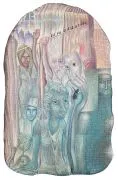
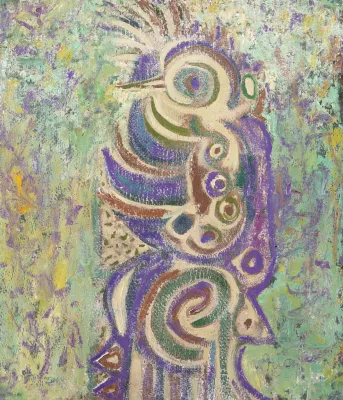
"Britto Velho's approach is psychological, the essence of human behavior being reflected in the importance of its parts. It approaches Wesley, in the importance of eroticism in human behavior, in the Freudian burden of actions referring to eternal symbols, to the Jungian archetypes, in the formation of new representations that refer to the original configuration. Roberto Magalhães puts the color as a result of a phase of alchemical transformation, the discovery of man by the action and reaction of the passions, red, green and yellow having values of eros and Thanatos in conflict, while Britto Velho releases the color of literary metaphors, creates tensions Dynamic spatials, makes the work vibrate, displaces the gaze through the areas, balances a harmonious whole by the disagreement between the parts. This is one of the highlights in Britto Velho's work: the dialogues of impossible colors, yellow-orange on a violet background adjacent to the green, blues separated by red on violet. It gives an exact dimension to the areas, delimits them by form, spaces the isolated figures in their own worlds that simultaneously aspire to dialogue, either by the tension of the colors they want to merge, or by the psychological meaning, in the realization of the psychic totality. His figuration is marked by the almost grotesque shapes of phallic noses, vulvar mouths, female boots containing buttocks and lips, in evident allusion to the foci of sexual attraction, pointed tongues between voracious teeth, beings reduced to heads and legs. As a characteristic mark, figures with three eyes and the flat cut of the image".
Walter de Queiroz Guerreiro
WARRIER, Walter Queiroz. Available at: [www.an.com.br/adframe/frameset.htm] Accessed on September 18, 2001.
Depoimentos
"I have a fixation in color and use as a limit between the Kitsch and the serious... Now, I closed the lens only on the figure, as if it were containing the entire universe... I don't like to theorize too much, but I have a certain knowledge of what I do based on people's considerations. Sometimes I do not agree with some opinions, but a work cannot be closed."
Britto Velho
Available at: [www.an.com.br/adframe/frameset.htm] Accessed on: September 2001.
"The artist crystallizes in his work the historical moment in which he lives. When I lived in Paris, I started to discover Brazil, Latin America and its problems. I had lived from nine to 19 years old in Argentina, which contributed to my interest. That's why I made my darkest paintings in Paris, with sales figures in the eyes and microphones, which I used as a way of denouncing the dictatorship of the time... I have an obsession with the human figure. While many painters tend to turn everything into things, I tend to humanize everything and realize the humor that can exist in certain objects like a chair for example... when I started painting three eyes on the figures, I thought at first about paying homage to Picasso, then I realized that it was a Mysticism already present in me for a long time and the 3rd eye represented the eye of inner vision".
Britto Velho
Velho, Britto. Interview granted by telephone to Itaú Cultural. São Paulo, 18 de September 2001.
Individual exhibitions
1971 - Porto Alegre RS - Individual, at Pancetti Gallery
1972 - Porto Alegre RS - Individual, at Pancetti Gallery
1973 - Buenos Aires (Argentina) - Individual, at Galeria Van Riel
1973 - Porto Alegre RS - Individual, at Galeria Gerdau
1973 - São Paulo SP - Individual, at Galeria Itália
1976 - Porto Alegre RS - Individual, at Eucatexpo Gallery
1978 - Porto Alegre RS - Individual, at Galeria Centro Comercial
1980 - Porto Alegre RS - Individual, at Galeria Independência
1980 - Rio de Janeiro RJ - Individual, Macunaíma Gallery
1982 - Porto Alegre RS - Individual, at the Kraft Art Office
1984 - Porto Alegre RS - Individual, at Galeria Teatro Mágico
1985 - Porto Alegre RS - Carlos Carrion de Britto Velho: Painting and engraving, at Cambona Centro de Arte
1985 - São Paulo SP - Individual, in the theme Contemporary Art
1987 - São Paulo SP - Individual, in the theme Contemporary Art
1988 - São Paulo SP - Carlos Carrion de Britto Velho: Paintings, in the Paço das Artes
1991 - Porto Alegre RS - The magical realism of Britto Velho, in the art bag
1991 - Porto Alegre RS - The magical realism of Britto Velho, in the cultural space BFB
1991 - São Paulo SP - The magical realism of Britto Velho, at Masp
1992 - Porto Alegre RS - Project Work in Evidence, at the Museum of Contemporary Art
1992 - Rio de Janeiro RJ - O Realismo Magician of Britto Velho, in MNBA
1993 - Porto Alegre RS - Presença Project, at Margs
1994 - Porto Alegre RS - Britto Velho: Paintings, in the art bag
1994 - Porto Alegre RS - Britto Velho: Paintings, at Margs
1994 - São Paulo SP - Britto Velho: Paintings, at Mônica Filgueiras Art Gallery
1994 - São Paulo SP - Britto Velho: paintings, no MAM/SP
1996 - Porto Alegre RS - Individual, at Cézar Prestes Arte
1997 - Passo Fundo RS - Individual, at the Ruth Schneider Visual Arts Museum
1997 - São Paulo SP - Individual, Silvio Nery Fonseca Art Office
1998 - Porto Alegre RS - Individual, at the Gesture Gallery
1999 - Joinville SC - Paintings, at the Victor Kursancew Gallery - House of Culture in Joinville
1999 - São Paulo SP - Individual, at MUBE
Collective exhibitions
1971 - Porto Alegre RS - 5th Salão Cidade de Porto Alegre, at the Rectory of UFRGS
1974 - Belo Horizonte MG - 6th Belo Horizonte National Art Salon
1974 - Rio de Janeiro - 3rd Visual Arts Exhibition - State of Rio de Janeiro
1974 - Rio de Janeiro RJ - 23rd National Salon of Modern Art, MAM/RJ
1974 - São Paulo SP - Bienal Nacional/74, at Fundação Bienal
1976 - Goiânia GO - 3rd Caixego
1976 - Porto Alegre RS - 9 plastic artists Gauchos, at the Azorean Tourist Information Office - Epatur
1976 - São Paulo SP - 7th São Paulo Contemporary Art Salon, at the Paço das Artes
1976 - São Paulo SP - National Biennial, at the Bienal Foundation
CA.1977 - Lisbon (Portugal) - Collective, at Galeria Arco
ca.1977 - Washington (United States) - 5 Gaucho painters, at the Brazilian American Cultural Institute
ca.1977 - Zurich (Switzerland) - Collective, at Galeria Semilha Hubert - Guest Artist
1977 - Belo Horizonte MG - 9th National Art Salon of Belo Horizonte
1977 - Curitiba PR - 34th Salão Paranaense
1977 - Goiânia GO - 4th Caixego
1977 - Porto Alegre RS - 4th Visual Arts Salon of Porto Alegre
1977 - São Paulo SP - 9th Panorama of Current Brazilian Art, at MAM/SP
1982 - Brasília DF - ART GAÚCHA TODAY, at Galeria Oswaldo Goeldi
1982 - Porto Alegre RS - Arte Gaúcha Today, at Margs
1982 - Porto Alegre RS - The panorama of art in the south, at the cultural space Yázigi
1983 - Curitiba PR - 5th Brazilian Drawing Exhibition, at the Guaíra Theater
1983 - Porto Alegre RS - National Art Collective, at the Kraft Art Office
1983 - Porto Alegre RS - Past to the present - 100 years of fine arts in Rio Grande do Sul, at Galeria Cambona
1983 - Recife PE - 36th Salão de Artes Flásticas de Pernambuco, at the Pernambuco State Museum
1983 - Rio de Janeiro RJ - 6th National Salon of Plastic Arts, at MAM/RJ
1983 - São Paulo SP - Arte Gaúcha Today, at Fundação Bienal
1983 - São Paulo SP - 14th current panorama of Brazilian art, in the MAM/SP
1984 - Fortaleza CE - 7th National Salon of Plastic Arts
1984 - Porto Alegre RS - Collective, at the Armazém de Arte stage
1984 - Porto Alegre RS - Garbage from Atelier, in the space Cultural Yázigi
1984 - Rio de Janeiro RJ - 7th National Salon of Plastic Arts, at MAM/RJ
1984 - Rio de Janeiro RJ - Gaúchos, at the IBEU Gallery
1984 - São Paulo SP - 2nd Salão Paulista de Arte Contemporânea, at MIS/SP
1984 - São Paulo SP - Gauchos, in Paço das Artes
1985 - Porto Alegre RS - Carlos Carrioni de Britto Velho: painting and engraving, Cambona Centro de Arte
1985 - São Paulo SP - Grupo Gaúcho: Painting, at Galeria Alberto Bonfiglioli
1986 - Curitiba PR - 7th Mostra da Engraving Cidade de Curitiba, at Casa da Engravura do Solar do Barão
1986 - Havana (Cuba) - 2nd Havana Biennial
1986 - Porto Alegre RS - 100 Years of the Automobile at Galeria Bolsa de Arte
1986 - São Paulo SP - 4th Salão Paulista de Arte Contemporânea, at Fundação Bienal
1986 - São Paulo SP - Contemporary Art Theme - Yesterday-Today-Tomorrow 1987 - São Paulo SP - Extremos, at Fundação Cásper Líbero
1987/CA.1989 - Belém PA - Extremos, at the Arte Liberal Art Gallery
1987/CA. at the Museum of the Federal University of Pará
1987/CA.1989 - Belo Horizonte MG - Extremos, at Manoel Macedo Art Gallery
1987/CA.1989 - Belo Horizonte MG - Extremos, at the Museu de Arte de Belo Horizonte
1987/CA.1989 - Brasília DF - Extremos, at the Oscar Seraphico Gallery
1987/ca.1989 - Curitiba PR - Extremos, on Mac/PR
1987/CA.1989 - Florianópolis SC - Extremos, in the art space
1987/CA.1989 - Florianópolis SC - Extremos, in Masco
1987/CA.1989 - Olinda PE - Extremos, at Mac/Olinda
1987/CA.1989 - Porto Alegre RS - Extremos, in the Porto Alegre Art Exchange
1987/CA.1989 - Recife PE - Extremos, in the Brazilian art
1987/ca.1989 - Rio de Janeiro RJ - Extremos, at Galeria Anna Maria Niemeyer
1987/ca.1989 - Salvador BA - Extremos, at MAM/BA
1987/CA.1989 - Salvador BA - Extremos, at The Easel Gallery of Art
1988 - Rio de Janeiro RJ - Engravings, at EAV/Parque Lage
1988 - Rio de Janeiro RJ - Engravings, MNBA
1990 - São Paulo SP - People of Fiber, at Sesc Pompéia
1991 - Porto Alegre RS - The magical realism of Britto Velho, at the BFB Cultural Space
1991 - São Paulo SP - Grandes Formats, at MAM/SP
1992 - Porto Alegre RS - 360 degrees of painting now, at the Museum of Contemporary Art
1993 - Porto Alegre RS - Arte Sul 93, at Margs
1993 - Porto Alegre RS - The Contemporary Look - Decentering and Position and Painting More representation, at the Museum of Contemporary Art
1994 - Porto Alegre RS - The Art and the Bola, at the Museum of Contemporary Art
1995 - Porto Alegre RS - Arte sees fashion, at the museum of Contemporary Art
1996 - Montevideo (Uruguay) - 1st Porto Alegre in Montevideo, at the Exhibition Center Atrium
1996 - Porto Alegre RS - 1st International Exhibition of Outdoor Sculptures, at SESC Campestre
1996 - Porto Alegre RS - Arte Sul 96, at Margs
1996 - Porto Alegre RS - 1st Sesc Sculpture: International Exhibition of Outdoor Sculptures, at Sesc Campestre
1997 - Porto Alegre RS - Two artists, at Espaço de Arte October 24th
1997 - Porto Alegre RS - Parallel Exhibition, at Galeria Cezar Prestes Art
1998 - Porto Alegre RS - Five Dimensions, at Cézar Prestes Art
1999 - Porto Alegre RS - Art Garage: Inaugural Exhibition, in the Art Garage
2000 - Bento Gonçalves RS - Engraving press, at the University of Caxias do Sul
2000 - Canela RS - Collective of engraving, at the University of Caxias do Sul
2000 - Caxias do Sul RS - Collective of Engraving, at the University of Caxias do Sul
2000 - Caxias do Sul RS - Collective of engraving, in the Coexistence at the University of Caxias do Sul
2000 - Farroupilha RS - Engraving Collective, at the University of Caxias do Sul
2000 - Guaporé RS - Engraving press conference
2000 - Nova Prata RS - Collective of Engraving, at the University of Caxias do Sul
2000 - Porto Alegre RS - Figure in the painting: Collection Museum of Contemporary Art of Rio Grande do Sul, at MAC/PR
2000 - Vacaria RS - Collective of engraving, at the University of Caxias do Sul
2000 - Veranópolis RS - Collective of engraving, at the University of Caxias do Sul
2001 - Porto Alegre RS - Exhibition in honor of Nelson's 80th birthday Jungbluth, at the Labor Museum
2002 - Porto Alegre RS - Drawings, engravings, sculptures and watercolors, in the art garage
Source: Itaú Cultural