Benedito Calixto (Conceição de Itanhaém SP 1853 - São Paulo SP 1927)
Benedito Calixto was a painter, teacher, historian and essayist. He moved to Brotas, in the interior of São Paulo, where he obtained notions of painting by helping his uncle, Joaquim Pedro de Jesus, in the restoration of sacred images of a local church. In 1881, he held his first solo exhibition at the headquarters of the newspaper Correio Paulistano, in São Paulo. Later, he moved to Santos, where he worked at the workshop of Tomás Antônio de Azevedo and was tasked with the decoration of the ceiling of Theatro Guarany. In 1883, he traveled to Paris to study drawing and painting, with resources granted by Viscount Nicolau Pereira de Campos Vergueiro. He attended the studio of Jean François Raffaëlli and the Académie Julian, living with renowned painters such as Gustave Boulanger, Tony Robert-Fleury and William-Adolphe Bouguereau. He returned to Brazil in 1884, bringing with him a camera, which he started to use to compose his works. He lived in Santos and, later, in São Vicente, where he produced numerous marines, representing the coast of São Paulo. At the beginning of the 20th century, it made several panels of religious themes for churches in the capital and in the interior of São Paulo. He also painted views of old sections of the cities of São Paulo, Santos and São Vicente for the São Paulo Museum of the University of São Paulo - MP/USP, by order of the historian Afonso d'Escragnolle Taunay, director of the museum. He also dedicated himself to historical studies of the region and the preservation of his heritage, publishing, among others, the books A Vila de Itanhaém, in 1895, and Captaincies from São Paulo, in 1924.
Industrialized art
Another negative factor to conspire against the art of Calixto was the high number of orders he always had to attend. Vítor Meirelles, at the end of the last century, had referred to the "drowning with which he thinks and the speed with which he performs what he thinks", adding that, if he lived by chance, Calixto in the river, would try to correct him, "forcing him to paint a work large, for two or three years."
For the last years of his life, above all, Calixto had become an authentic painting machine, as can be seen from this excerpt from a letter sent in May 1919 to a merchant who was incumbent on sell you the production:
I ask you to take note of people who want other paintings, so that they explain themselves about the size and gender they want, as well as the point or place I should reproduce.
Letter, disenchanted, adds:
Little or nothing helps me, now that I'm old, the opinion and advice of critics about my work. I would just want the newspapers to give news of the paintings sold, etc., and nothing else, because I don't need to complain.
Pedrin, daughter and clone
It was the isolation in which Calixto lived that prevented him from participating with frequency of the National Salon of Fine Arts, in whose catalogs its name appears only twice, in 1898 (third-class gold medal) and in 1900. This is also why it did not take part, but rarely, of international competitions, such as the exhibition of Saint-Louis of 1904, in which he also won a gold medal.
Even hidden in São Vicente, he never stopped being prestigious, as the clients prove and the large number of students, starting with his own daughter, Pedrina Calixto Henriques, whose painting is a subsidiary of his own, to the point that many works of her authorship were unscrupulously metamorphosed into originals by the father, a very simple task because, moreover, the artist was only signed by P. Calixto, just a recurved At the initial foot for the most prestigious signature to appear.
Multi-faceted painting
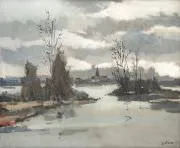
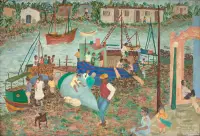
Calixto was a painter of marines, landscapes, popular customs, historical and religious scenes. If during his life the tendency was to consider him above all as a painter of history and religious (those in which he left an abundant production, including in the Cathedral and in the purse of Santos, in the Cardinal Palace of Rio de Janeiro, in the Church of Santa Cecília in São Paulo and in the Matriz de São João Batista in Bocaina), today it is customary to give much greater importance to port and coastal scenes, in which a perhaps rude character, but personally and deeply sincere in approaching the various aspects of nature goes beyond. Disembarkation of the coffee, in the primitive Port of Santos, next to its purely documentary aspect, is of expressive strength, despite the somewhat harsh appearance of the vessels, on the other hand, it is worth highlighting certain coastal or riverside scenes, in which a somewhat naive design and a precise coloring are combined with a clear atmospheric concern and a great respect for the environment.
Deceased on May 31, 1927, in São Paulo, but was buried in the Paquetá, in São Vicente. Three years earlier, he had received from Pope Pius IX the Commendation and the Cross of Saint Silvestre Pope, in reward to the services rendered to the Church with his art. painting. In 1881, he took up residence in Santos, a city that serves as an inspiration for several paintings. With a bag granted by the city of Santos, he travels to Paris, where he stays for less than a year, bringing from there a photographic equipment. It is with the picture flooding in Várzea do Carmo, ca.1892, that the artist achieves greater prominence: the criticism of the time points out the admirable accuracy with which he represents the city of São Paulo and some of its main points, such as the market, Rua 25 de Março, the Chitas and the Casario do Brás.
The artist performs several works for the São Paulo Museum of the University of São Paulo - MP/USP, made to order by Afonso d'Escragnolle Taunay (1876 - 1958), especially scenes from São Paulo Ancient and landscapes, some of which were based on drawings by Hercule Florence (1804 - 1879) or on photographs by Militão Augusto de Azevedo (1837 - 1905), among others. For his historical and religious paintings, such as the São Vicente Foundation, 1900 or the Santos Foundation, 1922, he carries out preparatory photographic studies, for which he uses a detailed historical research.
Landscapes are the theme most dear to the artist. In these works, he presents a smooth painting, with the use of sailings and a color always faithful to the local characteristics, although worked in a very personal way in the use of greens, blues and ochers. Cartographer, performing essays on maps of Santos, and as a historian, writing about the captaincies of São Paulo.
Criticism
"You can really divide the artistic activity of Benedito Calixto into three phases: the the first dedicated to landscapes and marines; the second to the historical themes that were particularly familiar to him; and the latter to religious matters that had a close relationship with his deep Christian spirit and that he knew as solidly as any theologian".
Emmanuel Guedes
GUEDES, Emmanuel. The art of Benedito Calixto. Presentation Emmanuel Guedes. [s.l.: s. n. ], 1946. 78 p.
"Calixto's paintings are tests of a moment of transition - passage from the 19th to the 20th century - when in this state the process of modernization still in progress begins, generator of transformations radicals in cities, in the countryside and on the coast. The precision in the recording of views, where the architecture appears, from panoramic views of the cities and their confines, of coastal landscapes, refers to a recent past, revealing scenarios that are almost unrecognizable. Pictures such as childhood portraits are seen, such as places revisited after a long absence, such as grandparents' reports. Time frozen in surprising images in the realization that it was so.
Two procedures are observable in the invoice of the assembled works: one, disciplined and restrained, denotes concern with the architectural and urban documentation, generally resorting to photography as a reference; another, of making less premeditated, reveals an affective approach to the landscape captured in loco. (...)
Discipline and technique allow the painter to invest in large canvases. The city as a spectacle in panoramic vision announces the big plans of cinema. Buildings spreading through the topography challenge the resistance of the tide, the river, the mountain. In the views of Vol d'Oiseau, the dispute between the civilizing will and nature is evident. The accelerated urbanization erases remaining traces of the colonial period. The modernization - initially the result of an economic leap resulting from the production and export of coffee, from the nascent industrialization, driven by a vast migratory outbreak - gives urban mutations a frenetic pace. The disorderly growth results today in cities without memory and in critical environmental conditions.
Calixto lives from his painting. He carries out numerous works under the sponsorship of the State, the Church and individuals. Involvement with historical and religious matters transcends their financial needs. The history of São Paulo loves him. He researches and writes about our past and, more than that, recreates it plastically. On the threshold of the 20th century, Caravels dreams, Anchieta among the Indians, Martim Afonso de Souza. . .
Assembles candles in the backyard to observe the effects of the wind, reconstitutes historical scenes with family members as extras. Experience the past aiming at the realization of works of historical reconstitution".
Maria Alice Milliet
OLIVEIRA, Maria Alice Milliet de. Benedito Calixto: Memória Paulista. São Paulo: Projeto Banespa, Pinacoteca do Estado, 1990. p. 19-21.
"A segment of his work increasingly seeks a documentary character, based on research and photographic records of the past. Many of the paintings of the Museu Paulista, the São Paulo Museum of Sacred Art, the Benedito Calixto Foundation and the Santos City Council reproduce imagery situations using third-party photographs, sometimes modified by data obtained in archives and suggestions for their imagination.
(...)
Lévi-Strauss passed through Santos in 1935, and thus described the landscape: 'The suburb of Santos, a flooded plain, riddled with ponds and swamps, Interrupted by narrow streams and canals, whose contours are perpetually blurred by a pearly mist, it resembles the earth itself, emerging at the beginning of creation. The banana plantations that cover it are of the youngest and most tender green that can be imagined... '
are precisely such shades that stand out in their works: the yellow linked to the blue, and the nacarados, which in contact with the green produce the brown of the earth and the brick; It is a restricted palette, where the code of chromatic values is complete and solves precisely the landscapes, vegetation and houses. (...)
A considerable part of Calixto's work is an important contribution to the memory of the cities of São Paulo, Santos, São Vicente and other locations in São Paulo. These works show provincialism, the peaceful life, the remnant of colonial traits in architecture, the sparsely populated suburbs where nature appears almost untouched."
Dalton Sala
room, Dalton. Benedito Calixto: Memória Paulista: Critical and biographical fragments. In: Benedito Calixto: Memória Paulista. 117.
"Immineered in the production of an iconographic universe for São Paulo and for the Catholic Church (which expanded through the interior of the state, following the coffee trail), divided between the experience of a landscape painter - amused with the peculiarities of the landscape coast of São Paulo - and that of a researcher in the history of São Paulo and Hagiography, Calixto, a researcher who paints, developed an extremely peculiar work.
If even in the first years of his career it was possible to perceive a desire to reach the same level than other colleagues - linked by affinity to the painting of landscapes with a naturalistic flavor -, over time, this desire tends to disappear.
Instead of improving in the interpretation of the landscape that surrounded it and the subjects that were dear to them (the history of the cities paulistas, the history of the saints) - as, each in his own way, made several artists of his generation -, Calixto seems to have preferred to stick to the scrupulous description of the real, even when this reality was an evocation of past times.
if in the Cited departure from the monção, by Almeida Júnior, the subservience to the description of the models and the local landscape is clearly perceived, it is also noted how the artist appropriates a typical aspect of the nature of the place - the morning fog - to create in the painting a halo of mystery that only brings interest to the work. In the foundation of São Vicente, in Calixto, nothing of the merely documentary becomes the interpretation of the scene itself. Everything is there uncovered, discriminated against, by a sensibility of a scientist who seems to override that of the artist, of a painter who seems to rely more on photography than on his own painting.
This data, in turn, makes his work even more interesting: Calixto is a Of the rare artists who, in São Paulo, in the first three decades of the 20th century, use photography as a structural basis for their works.
It is remarkable how photography helped a lot of painting to reflect on its specificity of a two-dimensional plane. However, this was not the lesson Calixto learned from this new technology of image production. In an instrumental way, he used it to reaffirm his concept of the world as theater, as a space for the staging of life and its facts".
Tadeu Chiarelli
CHIARELLI, Tadeu. Benedito Calixto: A researcher who paints. In: CALIXTO, Benedito; SOUZA, Marli Nunes (Coord.). Benedito Calixto: A painter by the sea. Texto Caleb Faria Alves, Tadeu Chiarelli. 2002, p. 33.
"The request for information to Calixto is extremely significant. Not that his painting did not have an intrinsic artistic value, which could not be admired for its purely aesthetic qualities. But the buyer wanted more than that, he wanted to be able to comment with his guests the characters and historical facts that took place in the painted place, he wanted to be able to relate the admired navy, in an unmistakable way, with São Paulo. No other painter gathered the qualities of Calixto to simultaneously meet this new appreciation of the paulistas for art and its coast. Only Calixto, born and raised on those beaches, and a student at Academie Julian in Paris, had the geographical knowledge and training required for the task.
The unique knowledge of the coast of São Paulo even made Calixto an authority for Brazil. He informs historians, politicians and intellectuals about points of view and essential locations for understanding Brazilian history. (...)
Rui Barbosa, Euclides da Cunha, Washington Luis and other characters in our history are interested in personally getting to know those places recently discovered in history and immortalized by Calixto, and they invariably turn to him as a guide: (...)
Calixto It even guided state bodies on the geographic landmarks that needed to be implemented. (...)
Calixto thus brings together qualities that we are used to seeing separately. Its navies are both historical canvases and products of modern romanticism that valued contact with these wild places in which man entered into communion with himself."
Caleb Faria Alves
ALVES, Caleb Faria. Mar Paulista. In: CALIXTO, Benedito; SOUZA, Marli Nunes (Coord.). Benedito Calixto: A painter by the sea. Texto Caleb Faria Alves, Tadeu Chiarelli. São Paulo: Fundação Pinacoteca Benedicto Calixto, 2002, p. 45-49.
Individual exhibitions
1881 - São Paulo SP - First Individual, at the headquarters of Correio Paulistano
1890 - São Paulo SP - individual, at Casa Levy
Collective exhibitions
1883 - Paris (France) - Exposes the work far from home, winner of a historical painting contest
1898 - Rio de Janeiro RJ - 5th General Exhibition of Fine Arts, at ENBA - 3rd Class Gold Medal
1900 - Rio de Janeiro RJ - 7th General Exhibition of Fine Arts, at Enba
1902 - São Paulo SP - Exhibition of Industrial Fine Arts
1904 - Saint Louis (United States) - International Exhibition - Gold Medal
1911 - São Paulo SP - First Brazilian Exhibition of Fine Arts, at the Liceu de Artes e Ofícios
Posthumous exhibitions
1935 - São Paulo SP - Individual, at the Liceu de Artes e Ofícios
1940 - São Paulo SP - Retrospective Exhibition: Works of the Great Masters of Painting and His Disciples
1953 - São Paulo SP - 18th Salão Paulista de Fine Arts, at the Prestes Maia Gallery
1970 - Itanhaém SP - Benedito Calixto Week, sponsored by the local city hall
1970 - São Paulo SP - Pinacoteca do Estado de São Paulo 1970
1980 - São Paulo SP - The Brazilian landscape: 1650-1976, at Paço das Artes
1981 - Rio de Janeiro RJ - 4th National Salon of Plastic Arts, at Funarte
1981 - São Paulo SP - Four great painters in São Paulo, at the Bienal Foundation
1982 - São Paulo SP - Marinhas e Ribeirinhas, at the Lasar Segall Museum
1984 - São Paulo SP - Benedito Calixto: Unpublished works, at DAN Gallery
1984 - São Paulo SP - Tradition and Rupture: Synthesis of Brazilian Art and Culture, at the Biennial Foundation
1985 - São Paulo SP - 100 Obras Itaú, at Masp
1986 - São Paulo SP - 1987: A turn in the century, at the Pinacoteca do Estado
1987 - São Paulo SP - Brazil painted by national and foreign masters: 18th - 20th centuries, at Masp
1988 - Curitiba PR - Artist do Month: Benedito Calixto, at the Paraná Art Museum
1989 - Rio de Janeiro RJ - Rio de Janeiro de Machado de Assis, at CCBB
1989 - São Paulo SP - Exhibition of the artistic-cultural collection of the Palace of the State Government of São Paulo, at the Government Palace
1989 - São Paulo SP - Painting Brazil 19th Century: Works from the Banco Itaú collection, in Itaugaleria
1990 - São Paulo SP - Benedito Calixto: Memória Paulista, at Pinacoteca do State
1991 - São Paulo SP - Images from São Paulo, in the Paço das Artes
1994 - São Paulo SP - Bienal Brasil Século 20th, at the Bienal Foundation
1994 - São Paulo SP - A critical look at the 19th century collection. at the Pinacoteca do Estado
1995 - Belém PA - Caminho das Águas, in Mabe
1995 - Campinas SP - From the Navy to the still life
1998 - Brasília DF - Brazilian like me, like me? of Foreign Affairs
1998 - Rio de Janeiro RJ - Marines in large collections in São Paulo, in the Naval and Oceanographic Museum. Navy Documentation Service
1999 - São Paulo SP - Brazilian like me, like me?, at MAB/FAAP
2000 - São Paulo SP - 7th Salon of Art and Antiques, at A Hebraica
2000 - São Paulo SP - Brazil + 500 Rediscovery Exhibition, at Fundação Bienal
2000 - São Paulo SP - Café, at Banco Real
2001 - Rio de Janeiro RJ - Brazilian Watercolor, at Centro Cultural Light
2002 - São Paulo SP - Benedito Calixto: a painter by the sea, at the Jockey Clube de São Paulo
2003 - São Paulo SP - Painters from the coast of São Paulo, at Sociarte
Source: Wikipedia, Itaú Cultural