
Ascânio MMM (Fão, Portugal 1941)
Ascânio MMM is a sculptor and painter. He has lived in Rio de Janeiro since 1959. He attended the National School of Fine Arts (ENBA) from 1963 to 1965. During this time, he developed his first sculptural works, using geometric wooden solids. In the mid-1960s, he maintained a studio with colleagues from ENBA, including Antonio Manuel (1947). He completed his degree at the School of Architecture and Urban Planning at the Federal University of Rio de Janeiro (FAU/UFRJ) in 1970.
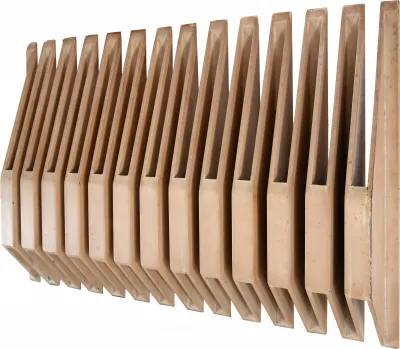
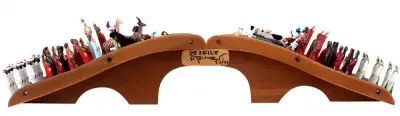
He worked as an architect until 1976. In the early 1970s, he used wooden slats, arranged in vertical and horizontal progressions, to create the caixas lúdicas [playful boxes], a type of wooden base on which the viewer could move hollow, square-shaped frames, interspersed, and of decreasing size. Since the 1970s, he has used acrylic and anodized aluminum profiles (rectangular tubes) to create the boxes and multiples.
At the end of the following decade, he created the first Piramidais, sculptures that present gradual displacements of the wooden slats or aluminum tubes, creating internal voids. In 2005, the book Ascânio MMM was released by Andrea Jakobsson, with texts by Paulo Sergio Duarte, Marcio Doctors, Lauro Cavalcanti and Fernando Cocchiarale.
About the Artist
Ascânio Maria Martins Monteiro was born on September 16, 1941, in Fão, Minho province, northern Portugal. As a child, he became familiar with wood and tools in the workshop of his great-uncle José Linhares, former owner of a shipyard at the mouth of the Cávado River. A regular at Sunday Mass, he helped decorate Baroque churches and set up nativity scenes. He took frequent walks to the Ofir pine forest, whose summer homes boasted modern architecture. The cleanliness of the space and furniture fascinated him. At 12, he considered becoming an architect. They were dwellings without memory, free from all constraints, he later observed. From the ages of 13 to 17, he worked in a hardware store in Esposende.
His father, Manuel Campos Monteiro, decided to follow the migratory flow of his compatriots to Brazil. The family's departure was dispersed. His father arrived in South America in 1954. Two years after settling in Rio de Janeiro, he requested the arrival of his eldest son. Ascânio was reluctant. Having begun reading at the Calouste Gulbenkian Foundation's traveling library, he wanted to study in Porto. His brother, Manuel, traveled to Brazil before him, in 1958. It was only in April 1959 that Ascânio and his remaining family (his mother, Maria Carmina Martins Moledo, his great-aunt Rosa, and his siblings Fernanda, Jorge, and Carmina) crossed the Atlantic.
He was just over 17 when he first experienced the metropolis. With a home address in the Estácio neighborhood, he found work in a hardware store, then in a construction office, and completed his studies at night. From 1962 onward, he worked at the Portugal Tourism Center in the Castelo neighborhood. In 1963, he saw his first visual arts exhibition at the National Museum of Fine Arts. That same year, he enrolled in the painting program at the National School of Fine Arts (ENBA) at the University of Brazil. The goal was to acquire drawing skills and prepare for his architecture exams. His interest grew significantly at the Museum of Modern Art in Rio de Janeiro, with a solo exhibition by Ivan Serpa in 1965.
The painter's Black Phase, with its deliberately expressionist figuration, surprised him. At the same museum, he discovered the bronzes of the Englishman Henry Moore, marked by the tension between the compact and the empty. In 1965, he enrolled in the School of Architecture and Urbanism (FAU) at the Federal University of Rio de Janeiro (UFRJ), on the University City Island, and began systematically observing urban plan models. He then collected materials from carpentry shops and created his first works with wood. In 1966, he was impressed by the exhibition of the English artist Victor Pasmore, who simultaneously developed geometric abstraction and organic morphologies in painting, reliefs, and engravings.
He maintained a studio in the Tijuca neighborhood with Antonio Manuel and students from ENBA. In 1967, he was introduced to the critic Mário Pedrosa. In late March 1968, he witnessed all the decisions made for the funeral of high school student Edson Luís Lima Souto, murdered by the Military Police. Involved in student politics since the previous year, Ascânio collaborated on the production of the newspaper of the Atílio Correia Lima Academic Directory of the FAU/UFRJ. The last issue, with articles against the military government, came out just days before the decree of Institutional Act No. 5 by Marshal Arthur da Costa e Silva on December 13, 1968. The state of emergency was established.
Also in 1968, he began to frequent Ivan Serpa's house. A member of the so-called AI-5 generation, immediately following the new figuration, and even though his interests focused on form and construction, Ascânio trained alongside Antonio Manuel, Cláudio Paiva, Manuel Messias, Raymundo Colares, Vera Roitman, and Wanda Pimentel, and conceptual artists such as Artur Barrio, Cildo Meireles, Luiz Alphonsus, and Odyla Ferraz, who chose the Museum of Modern Art as the nerve center of the visual arts in Rio de Janeiro. "Our group was in the wake of the student movement; there was no theoretical foundation," he recalls.
After leaving the Portuguese Tourism Center, he completed architecture internships until graduating on March 11, 1970, from FAU/UFRJ. In April, he became a Brazilian citizen. Having recently graduated, he worked in engineering offices in Rio de Janeiro and Vitória, Espírito Santo. From 1971 to 1973, he was part of the team that implemented the automatic signaling and duplication system for the Vitória-Minas railway. However, he maintained a studio in Rio de Janeiro. He married Ana Maria Ferreira da Costa, a history professor at the Federal University of Rio de Janeiro (UFRJ), on January 12, 1974, in the Santa Teresinha chapel in the Laranjeiras neighborhood. That same year, he visited Europe for the first time since immigrating. On January 22, 1976, Laura, his first daughter, was born.
This was also the last year in which, alongside his work as a sculptor, he developed architectural projects. On October 4, 1978, Joana, his second daughter, was born. His stint at the National Art Foundation was brief, responsible for the planning, coordination, and assembly of the III National Salon of Visual Arts: exactly nine months, between 1979 and 1980. In 1981, he was invited by Rui Rocha Veloso, president of the Brazilian Institute of Architects, Rio de Janeiro Department (IAB-RJ), to direct the non-commercial art gallery, aiming to foster debate on the relationship between art and architecture.
To share the directorial and curatorial duties, he invited painter Ronaldo Macedo and architects Ana Maria Pires Ribeiro and Antônio José Pedral. The IAB-RJ Art Gallery, located in the Botafogo neighborhood, opened on May 18 of the same year, with a retrospective exhibition of the work of sculptor Franz Weissmann. After solo exhibitions by Maria Leontina, Joaquim Tenreiro, Abraham Palatnik, and Ione Saldanha, to name a few, always intended as a summary of a career, the gallery's activities were summarily closed, without any justification or prior consultation with its curators.
In a letter to the press, dated late November 1982, they communicated the institute's new management's lack of interest in continuing the work, despite the excellent reception from architects, visual artists, specialized critics, and the general public. In 1983, following the installation of Módulo Rio (1971-83, painted aluminum, 350 x 430 x 600 cm) on the promenade of the Argentina building, Botafogo beach, Ascânio developed the idea of an art space with João Augusto Fortes, director of João Fortes Engenharia.
The partnership began when, as head of the IAB-RJ Art Gallery, he convinced the businessman to finance the catalogs for the retrospectives of Maria Leontina and Joaquim Tenreiro. For the next seven years, Ascânio shared the management of the Galeria do Centro Empresarial Rio with painter Ronaldo Macedo and João Augusto Fortes. The program consisted of the first solo exhibitions of artists from the 1980s generation (Angelo Venosa, Daniel Senise, and Jorge Barrão, for example), the annual Novos Novos exhibition, featuring discoveries in Rio de Janeiro's contemporary art scene (Adriana Varejão, Cristina Canale, Márcia X, Salvio Daré, to name a few), post-mortem exhibitions by the renowned Aloísio Carvão, Artur Barrio, Lygia Pape, and Raymundo Colares, and a first mapping of high-tech art in Brazil, with works by Eduardo Kac and Júlio Plaza, among others.
In 1990, in the context of the economic plan of the Fernando Collor de Mello government, and due to changes in the cultural policy of João Fortes Engenharia, the Galeria do Centro Empresarial Rio was closed. A keen observer of the government's cultural policies at the municipal, state, and federal levels, Ascânio is regularly consulted by Rio de Janeiro's leading newspapers. Between 1985 and 1996, he wrote the articles "The artist must participate," in which he calls for the engagement of his peers in criticizing institutional agendas; "Exhibition of abandonment," in which he notes the lack of political and financial support for the visual arts as something contrary to Rio de Janeiro's strong cultural tradition, even proposing the reuse of port warehouses for large art exhibitions; and "Rio needs references," in which he criticizes the absurd spending on streetlights for Rio-Cidade, the Rio de Janeiro City Hall's urban redevelopment program, to the detriment of the acquisition of sculptures to mark public spaces.
In 1986, he completed the expansion of his three-story studio, located at the same address where he had lived with his family since 1972: 165 Aureliano Portugal Street, in the Rio Comprido neighborhood. In 1989, exactly thirty years after arriving in Brazil, he held his first solo exhibition in Lisbon, a partially retrospective exhibition. In late 1991, he was invited to direct an art gallery designed for the RB1 building on Rio Branco Avenue in downtown Rio. To respond to this entrepreneurial initiative, he enlisted the painter Ronaldo Macedo, a longtime partner.
The RB1 Contemporary Art Space opened in January 1992 with Sculpture 92/Seven Expressions, featuring works by Amílcar de Castro, Angelo Venosa, Cristina Salgado, Frans Krajcberg, Franz Weissmann, Lygia Pape, and Tunga. For reasons unclear, it closed after the show. In May 1997, Module 6.5 (1970-97, painted aluminum, 300 x 900 x 450 cm) was installed as a Monument to the Integration of the Americas on Presidente Vargas Avenue, across from the São Sebastião Administrative Center, Rio de Janeiro City Hall. At the time, Ascânio suggested to Mayor Luiz Paulo Conde that he lend, for a limited period, abandoned houses in the Estácio neighborhood, which had not paid urban taxes for years.
In exchange for setting up studios and holding exhibitions, the artists receiving the grant were required to maintain the interior of the properties and restore their facades, preserving their styles. In September of the same year, he was awarded the Order of Merit, Commander's degree, by the President of Portugal, Jorge Sampaio, at the São Clemente Palace in Rio de Janeiro. Two years later, Piramidal 12.5 (1993-99, anodized aluminum, 620 X 286 X 128cm) became the artist's first work to occupy a public square in his home country, with an installation in Largo do Cortinhal, in Fão. After almost three decades, he moved his studio from Rio Comprido to Rua Corrêa Vasques, in Cidade Nova. He lives in Rio de Janeiro, in the Humaitá neighborhood, on Rua Mário de Andrade. The house number is also emblematic of Brazilian Modernism.
Critical Commentary
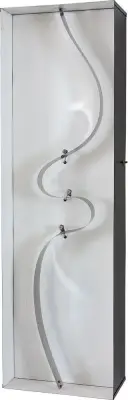
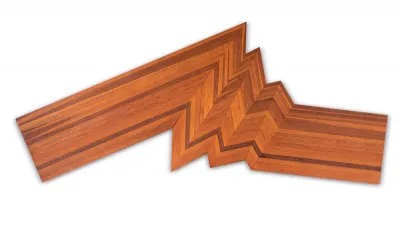
Since the beginning of his career, Ascânio MMM has opted for a constructive abstract language. He uses wooden slats—initially painted white—articulated around an axis, producing sinuous and harmonious forms. Later, the rhythm of the forms gives way to straight lines, and the sculptor begins to incorporate the color and texture of the wood, enhancing the material's specific visual qualities and further exploring the tension between matter and form.
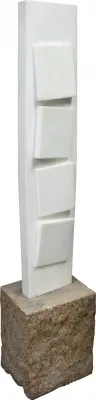
In other works, he uses bolted aluminum profiles (rectangular tubes), which articulate to form a play of solidity and void. In these works, the alternation between solidity and great lightness of the structures is noticeable. As critic Wilson Coutinho notes, in the Piramidais series, begun in the late 1980s, the symbolic character arising from form is further emphasized. In these sculptures, which reveal disturbing voids and unexpected cuts, the artist also displays greater rigor in structuring compared to his earlier works.
Critiques
"The aluminum profile sculptures are intended above all for the eye. Only the eye can perceive the alternation between solidity and lightness experienced as we move around them. Before them, we can see, retrospectively, that Ascânio's work begins on the surface of the forms (painted helical sculptures), goes beyond their skin (raw wood sculptures), and finally penetrates their entrails (aluminum pyramids). The surface, flesh, and entrails of the work are simultaneously revealed in a kind of synthesis of the sculptor's trajectory through deliberate constructive operations (choice of modular material, planning of the cut, articulation of the parts, etc.). Skin and upholstery exist only functionally, determined by the structure. The hollow modules equalize sets that, resistant to touch, appear vibrant to the eye, the only sense capable of traversing the body of the work, continuously and variedly. The pyramidal form, whose symbolic charge needs no comment, functions in Ascânio's sculptures as a paradigm of constructivism. The stone pyramids of ancient civilizations had no defined utilitarian function. The future filled them with mysteries hidden in the heavy stone blocks with which they were erected. The Piramidais also differ from their contemporary utilitarian counterparts, but in their constructed lightness, they do not intend to enclose any mystery other than that of their own presence".
Fernando Cocchiarale
COCCHIARALE, Fernando. Ascânio MMM. In: Ascânio MMM. n. p.
"'It's an act of construction: brick upon brick.' Ascânio defines his work as a sculptor with this phrase. The connection with the artist's architectural training couldn't be clearer. And, indeed, all of his work is based on architectural rigor. Thus, the creative cycle begins with the study of reduced-scale modules, the models, with which the sculptor designs and calculates the shape and size of each piece, leaving no room for any possible dispersion. Almost all of Ascânio's work is produced in wood. Aluminum was already used at one point—with it, clusters were made, honeycombs that repeated themselves, gradually decreasing in volume until reaching the apex, forming cross-sections of pyramids—with results quite different from what has been achieved so far in wood. (...) Without abstracting from any of the demands made until now—on the contrary, he increased them—and with the fatality of a true creator, he courageously reinvents all his conceptions and gives us a vigorous demonstration of what he is willing to accomplish: a full and complete work, rooted in reality and destined to influence man."
Francisco Bittencourt
BITTENCOURT, Francisco. Ascânio: tese e antítese. In: Ascânio MMM: obras. n. p.
"Ascânio then worked with a single element: the slat. With this minimal materiality, Ascânio created sinuous movements; he opened them (his works) to curves, semi-curves, sinuosities, volutes. A constructivism of torsion, of balance as suspension for flight, of the boldness of matter that goes into space as if to explode and, at the same time, produces tension and harmony. The calculated torsion disrupted the gaze, introducing the viewer to the interplay between rigor and order. From this arises Ascânio's strategy: a structural baroque. At the same time, such works are stripped down; they articulate their own rhythm; they are not bound by any illusionism. On the contrary, they are structural orders that generate the formal tension of his works. The work with sawn, drilled, and glued slats is done so that, due to their structuring, they create a space not previously determined. 'Space is not a ready-made order, in which objectives are gradually placed. On the contrary, it is the ordering of the work's elements that guides its structuring', analyzed the painter Ronaldo do Rego Macedo in 1981. Even what is optical in his reliefs depends on these ongoing structures, synthesized almost didactically in his famous playful boxes of 1968-1969, objects that, when manipulated by the viewer, generate complex forms."
Wilson Coutinho
COUTINHO, Wilson. Ascânio MMM. In: Ascânio MMM: piramidais. n. p.
"The sculptures by Ascânio MMM that have become best known, those most present in public spaces, seem to me like visual manifestations of scores by Terry Riley or Steve Reich. The white color, avoiding chromatic flourishes, the minimal offset of the angle in arithmetic progression, differentiating the successive superpositions of the elements—the slats—always maintaining the same displacement around the axis generating the helical torsion, the disciplined rigor of the structure, everything in its conception recalls the music of the pioneers of what came to be called minimalist music. Elegant in their curves, they cannot escape being defined as baroque. (Incidentally, a Brazilian vice: here, every time a critic sees a decent curve, he labels it with a strong historical connotation; and there would be no problem if the widespread use of the term didn't eclipse closer issues.) In fact, Ascânio's curves, in the sculptures of detached slats, are sumptuous and at the same time discreet, in the sense strict of the word, because they are contaminated by logical-mathematical reasoning and could perfectly well be represented in clear algorithms. They launch generous sinusoids into the air, seeking support on tangents to the ground. In other cases, they rise vertically, like totems of reason, starting from the initial helical twist to sometimes end in a more extended rectangular surface. They coexisted with a participatory experiment in the late 1960s, exceptional works made in boxes that allow the spectator to manipulate them. However, even in this case, the game and the playful aspect are subject to geometric asepsis, to a refined aesthetic averse to subjective excesses."
Paulo Sérgio Duarte
DUARTE, Paulo Sérgio. A razão como dogma poético. In: Ascânio MMM. Ascânio MMM. Rio de Janeiro, Andrea Jakobsson, 2005, p. 8.
Solo Exhibitions
1969 - Rio de Janeiro RJ - Solo, at Galeria Celina
1972 - Rio de Janeiro RJ - Solo, at Galeria Grupo B
1976 - Rio de Janeiro RJ - Solo, at Galeria Arte Global
1976 - Rio de Janeiro RJ - Solo, at MAM/RJ
1979 - São Paulo SP - Solo, at Skultura Galeria de Arte
1981 - Rio de Janeiro RJ - Solo, at Galeria Paulo Klabin
1981 - Rio de Janeiro RJ - Solo, at MAM/RJ
1984 - Rio de Janeiro RJ - Fitangulares, at MAM/RJ
1984 - Rio de Janeiro RJ - Solo, at Galeria Paulo Klabin
1986 - Rio de Janeiro RJ - Solo, at Petite Galerie
1986 - São Paulo SP - Solo, at Galeria Suzana Sassoun
1989 - Lisbon (Portugal) - Solo, at Galeria 111
1989 - Rio de Janeiro RJ - Solo, at IAB/RJ
1990 - Porto (Portugal) - Solo, at Galeria Zen
1991 - São Paulo SP - Piramidais, at Subdistrito Comercial de Arte
1994 - Belo Horizonte MG - Solo, at Palácio das Artes
1994 - Rio de Janeiro RJ - Solo, at MAM/RJ
1995 - Lisbon (Portugal) - Solo, at Galeria 111
1996 - Rio de Janeiro RJ - Atelier Finep, at Paço Imperial
1996 - São Paulo SP - Solo, at Masp
2000 - Rio de Janeiro RJ - Piramidais IV, at MAM/RJ
2005 - São Paulo SP - Solo, at Dan Galeria
Group Exhibitions
1966 - Rio de Janeiro RJ - 1st Salão de Abril [April Salon], at MAM/RJ
1966 - Brasília DF - 3rd Modern Art Salon, at Teatro Nacional
1966 - Rio de Janeiro RJ - 15th National Salon of Modern Art, at Palácio Gustavo Capanema
1967 - Rio de Janeiro RJ - 16th National Salon of Modern Art, at Palácio Gustavo Capanema
1967 - Rio de Janeiro RJ - 1st Visual Arts Salon, at FAU/UFRJ - 1st prize in sculpture and 1st prize in painting
1967 - São Paulo SP - 9th Bienal Internacional de São Paulo, at Fundação Bienal
1968 - Curitiba PR - 25th Paraná Salon, at Biblioteca Pública do Paraná
1968 - Rio de Janeiro RJ - 17th National Salon of Modern Art, at Palácio Gustavo Capanema
1968 - Rio de Janeiro RJ - 2nd University Art Salon, at PUC/RJ - 1st prize pesquisa
1968 - Rio de Janeiro RJ - 2nd Esso Salon, at MAM/RJ
1968 - Salvador BA - 2nd Bahia Biennial
1969 - Rio de Janeiro RJ - 18th National Salon of Modern Art, at Palácio Gustavo Capanema
1969 - Rio de Janeiro RJ - Pre-Paris Biennial, at MAM/RJ
1969 - Rio de Janeiro RJ - Salão da Bússola [Compass Salon], at MAM/RJ - acquisition prize
1970 - Belo Horizonte MG - 2nd National Salon of Contemporary Art
1970 - Rio de Janeiro RJ - 19th National Salon of Modern Art, at MAM/RJ - acquisition prize
1970 - Rio de Janeiro RJ - 8th JB Art Summary
1970 - São Paulo SP - 2nd Panorama of Current Brazilian Art, at MAM/SP
1971 - Rio de Janeiro RJ - Multiples Exhibition, at Petite Galerie
1971 - Rio de Janeiro RJ - 1st Eletrobrás Salon, at MAM/RJ - acquisition prize
1971 - Rio de Janeiro RJ - 20th National Salon of Modern Art, at Palácio Gustavo Capanema
1972 - São Paulo SP - 4th Panorama of Current Brazilian Art, at MAM/SP - grand prize in sculpture
1972 - São Paulo SP - Art/Brazil/Today: 50 Years Later, at Galeria da Collectio
1972 - São Paulo SP - Multiples Exhibition, at Galeria Múltipla de Arte
1973 - Belo Horizonte MG - 5th National Salon of Contemporary Art
1973 - Rio de Janeiro RJ - 5 Sculptors, at Galeria Ipanema
1973 - Rio de Janeiro RJ - 22nd National Salon of Modern Art, at Palácio Gustavo Capanema
1973 - Rio de Janeiro RJ - The Face and the Work, at Galeria Grupo B
1975 - São Paulo SP - 7th Panorama of Current Brazilian Art, at MAM/SP
1977 - Ouro Preto MG - National Meeting of Sculptors, at Secretaria de Cultura
1977 - Rio de Janeiro RJ - Open-Air Sculpture, at Galeria de Arte Sesc Tijuca
1978 - Rio de Janeiro RJ - 1st National Visual Arts Salon, at MNBA e Palácio Gustavo Capanema - foreign travel prize
1978 - São Paulo SP - The Object in Art: Brazil in the 1960s, at MAB/Faap
1979 - Rio de Janeiro RJ - Brazilian Sculptors, at Galeria Aktuell
1979 - São Paulo SP - 15th Bienal Internacional de São Paulo, at Fundação Bienal
1980 - Goiânia GO - 9 Sculptors, at Casa Grande Galeria de Arte
1981 - Rio de Janeiro RJ - From the Modern to the Contemporary. Gilberto Chateaubriand Collection, at MAM/RJ
1982 - Lisbon (Portugal) - Brazil 60 Years of Modern Art: Gilberto Chateaubriand Collection, at Centro de Arte Moderna José de Azeredo Perdigão
1982 - Lisbon (Portugal) - From the Modern to the Contemporary: Gilberto Chateaubriand Collection, at Centro de Arte Moderna José de Azeredo Perdigão
1982 - London (England) - Brazil 60 Years of Modern Art: Gilberto Chateaubriand Collection, at Barbican Art Gallery
1982 - São Paulo SP - A Century of Sculpture in Brazil, at Masp
1983 - Rio de Janeiro RJ - 6th National Visual Arts Salon, at MNBA e Galeria Sérgio Milliet - special room
1984 - London (England) - Portrait of a Country - Brazilian Modern Art, at Barbican Center
1984 - Rio de Janeiro RJ - Wood: Matter of Art, at MAM/RJ
1984 - São Paulo SP - Gilberto Chateaubriand Collection: Portrait and Self-Portrait of Brazilian Art, at MAM/SP
1985 - Niterói RJ - A Question of Order, at UFF. Galeria de Arte
1985 - Rio de Janeiro RJ - Encounters, at Petite Galerie
1985 - Rio de Janeiro RJ - Tribute to Maria Leontina, at Petite Galerie
1985 - São Paulo SP - 17th Panorama of Current Brazilian Art - Three-Dimensional Forms, at MAM/SP
1986 - Fortaleza CE - International Exhibition of Ephemeral Sculptures, at Fundação Demócrito Rocha
1986 - Rio de Janeiro RJ - Testimony of a Generation: 1969-70, at Galeria de Arte Banerj
1987 - Rio de Janeiro RJ - To the Collector, at MAM/RJ
1988 - Rio de Janeiro RJ - A Sculpture for the Sea of Angra, at EAV/Parque Lage
1989 - Lisbon (Portugal) - 2nd Contemporary Art Forum, at Forum Picoas
1989 - Rio de Janeiro RJ - Geometry without Manifesto, at Gabinete de Arte Cleide Wanderley
1992 - Rio de Janeiro RJ - Brazilian Contemporary Art, at EAV/Parque Lage
1992 - São Paulo SP - Brazilian Art in the Collection: 1970s/90s, at MAC/USP
1992 - São Paulo SP - Sculpture Only, at MAM/SP
1994 - Lisbon (Portugal) - 1st Commemorative Exhibition of the Gallery's 30th Anniversary, at Galeria 111
1996 - Brasília DF - Art and Urban Space: Fifteen Proposals - Ministry of Foreign Affairs, at Palácio do Itamaraty
1996 - Rio de Janeiro RJ - 3 Dimensions: Ascânio MMM, Eduardo Frota and Walter Guerra, at Funarte. Galeria Sérgio Milliet
1997 - Porto Alegre RS - 1st Bienal de Artes Visuais do Mercosul
1997 - Porto Alegre RS - Constructive Strand and Design, at Espaço Cultural Ulbra
1997 - São Paulo SP - Three-Dimensionality in 20th-Century Brazilian Art, at Itaú Cultural
1998 - Belo Horizonte MG - Three-Dimensionality in 20th-Century Brazilian Art, at Itaú Cultural
1998 - Brasília DF - Three-Dimensionality in 20th-Century Brazilian Art, at Galeria Itaú Cultural
1998 - Penápolis SP - Three-Dimensionality in 20th-Century Brazilian Art, at Galeria Itaú Cultural
1998 - São Paulo SP - Multiples, at Valu Oria Galeria de Arte
1998 - São Paulo SP - The Modern and the Contemporary in Brazilian Art: Gilberto Chateaubriand Collection - MAM/RJ, at Masp
2000 - Rio de Janeiro RJ - Situations: Brazilian Art of the 1970s, at Fundação Casa França-Brasil
2002 - Rio de Janeiro RJ - Paths of the Contemporary 1952-2002, at Paço Imperial
2003 - Rio de Janeiro RJ - Small Formats, at LGC Arte Hoje
2005 - Rio de Janeiro RJ - Chroma, at MAM/RJ
2006 - São Paulo SP - Homo Ludens: From Make-Believe to Vertigo, at Itaú Cultural
Source: Itaú Cultural