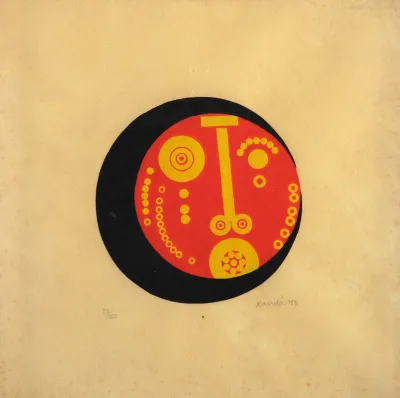
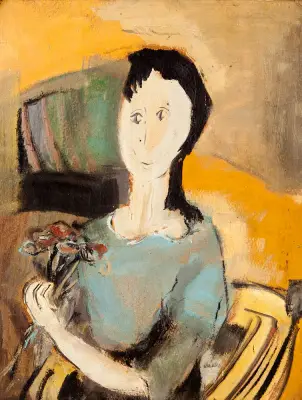
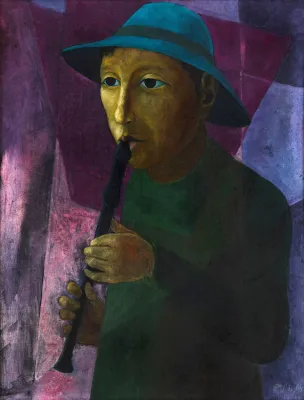
Arpad Szenes (Budapest, Hungary 1897 - Paris, France 1985)
Painter, printmaker, illustrator, designer and teacher.
Belonging to a family of intellectuals and artists, drawing has been part of his life since he was a child. In Budapest, he studies with József Rippl-Rónai (1861 - 1927) at the Free Academy. He moved to Paris in 1925, where he caricatures and portraits in bars and cafes, studies with André Lhote (1885 - 1962), Fernand Léger (1881 - 1995) and Roger Bissiere (1886 - 1964), attends the Académie de la Grande Chaumière and studies with Stanley William Hayter (1901 - 1988), with whom he learns engraving. In 1930, he married the Portuguese painter Vieira da Silva (1908 - 1992), his most frequent model. In 1940, after living for a period in Lisbon, the couple, fleeing Nazism, moved to Rio de Janeiro. He resides first in a mansion on Rua Marques de Abrantes, where the poet Murilo Mendes (1901 - 1975) also lived, and, later, in the chalets belonging to the former International Hotel, in Santa Teresa, a pension and stronghold of artists emigrated during the period. In the hotel's main building, Arpad sets up a studio where he receives his students. Among them, Frank Schaeffer (1917), Almir Mavignier (1925) and Polly McDonnell (1911). He also teaches classes at the hive of painters of Brazil, created by Levino Fanzeres (1884 - 1956). Between 1940 and 1947, he maintains contact with Murilo Mendes, Cecília Meirelles (1901 - 1964), Carlos Scliar (1920 - 2001) and Ruben Navarra (1917 - 1955). In 1943, he made 15 portraits of scientists, distributed in the classrooms of the National School of Agronomy, and collaborates in the panel made by Vieira da Silva, at the invitation of Heitor Grilo, to the same university. Arpad Szenes performs the illustration of the Brazilian translation by Weise von Liebe und tod des Cornets Christoph Rilke [the song of love and death of the Cristóvão Rilke standard-bearer Cristóvão Rilke] by Rainer Maria Rilke (1875 - 1926), made by Cecília Meirelles. In 1947, with the changes coming with the end of the war, they returned to France and continue their artistic lives. In Paris, Lygia Clark (1920 - 1988) and Teresa Nicolao (1928) have classes with Arpad Szenes.
Critical Comment
Arpad Szenes, from 1919 onwards, has contact with vanguard artistic currents, such as Dadaism, Cubism, Futurism and Constructivism. In 1925, he resides in Paris and meets the Portuguese painter Vieira da Silva (1908 - 1992), with whom he marries in 1930. He lives with intellectuals and artists such as Oskar. Kokoschka (1886 - 1980), Alberto Giacometti (1901 - 1966), Alexander Calder (1898 - 1976) and Jacques Lipchitz (1891 - 1973). In 1931, he works at Stanley William Hayter's Atelier 17 (1901 - 1988), with whom he studies engraving, and finds surrealists such as Joan Miró (1893 - 1983) and Max Ernst (1891 - 1976). In 1936, he paints large abstract canvases, such as L'Obstacle, Le Carrousel, Le Fléau and L'Enfant au Cerf-Volant.
With the beginning of the Second World War (1939-1945), the Couple moves to Portugal and then to Brazil. Szenes and his wife reside at the Hotel Internacional, in the Santa Teresa neighborhood, Rio de Janeiro, which brings together a circle of emigrated artists and intellectuals. He resumes figuration and is mainly dedicated to portraiture: he paints the group of friends who frequent the Hotel Internacional and, with the help of Cecília Meireles (1901 - 1964), receives an order to paint personalities for the National School of Agronomy (Call Kilometer 44), from Universidade Rural Fluminense. He makes illustrations for the works of Murilo Mendes (1901 - 1975), Mário de Andrade (1893 - 1945) and for the Brazilian translation of Weise von Liebe und tod des Cornets Christoph Rilke [The love song and the death of the standard-bearer Cristóvão Rilke], by Rainer Maria Rilke (1875 - 1926), whose studies give rise to the Banquets series.
In the painting O Casal, 1933, dialogues with Cubism, especially with Les Demoiselles d'Avignon, 1907, by Pablo Picasso (1881 - 1973). In this work, Szenes treats the faces of the protagonists as masks, and frontality and laterality are confused. In another work with the same title, from 1942, the hugging couple is surrounded by household objects: the jug with plants, the table with playing cards and the easel with the canvas, creating an intimate and loving scene.
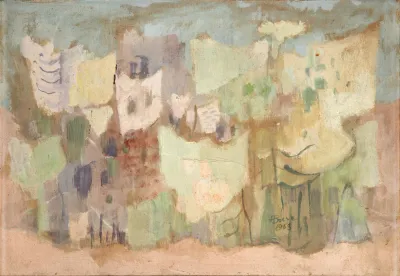
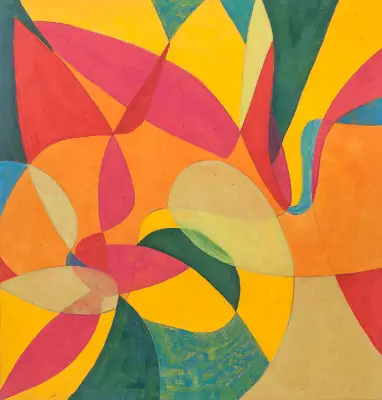
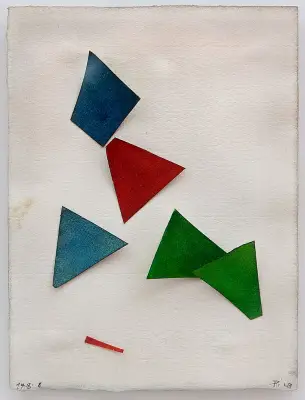
Returns to Paris in 1947. The following year, Szenes organizes a workshop where he teaches young painters. He paints the abstract series of banquets, parks and conversations, in which lines of force, tension and movement are their main pictorial concerns. From 1950 onwards, he also works with gouache and tempera. In 1956, with his wife, he obtained French nationality. He receives, for his work, several decorations of the French State. Makes illustrations for several books. Arpad Szenes is one of the main representatives of the Paris School in the 1940s. In Brazil, his presence and that of Vieira da Silva deeply mark the work of several artists with whom they live together, such as Burle Marx (1909 - 1994), Carlos Scliar (1920 - 2001) and Athos Bulcão (1918).
Criticism
"The painting of Szenes, of an abstract final character (a character that today, according to the Painter, it seems to be definitive and without further recurrences - and his first abstract studies date back to José Augusto França 1918), he has carried out successive cycles of evolution, always starting with an approximation of nature, to which he returns later. Cézanne's influence is visible in this Painting, as, more now, from 1957 onwards, that of Monet, then discovered, and thus verifying an underlying impressionist sensibility in the entire creation of the painter".
Roberto Pontual
Point, Robert. Dictionary of Visual Arts in Brazil. Rio de Janeiro: Civilização Brasileira, 1969.
"For the circle of artists and intellectuals that Arpad Szenes and Vieira da Silva naturally knew how to attract around them, for the creative work they carried out and showed to the public as a painters and the extent of the exchange to the domestic education of art (in the case of Arpad), the two, better than the other emigrations at the time, including the efficient Leskoschek, ended up planting a new and promising seed in the environment. brought, with the work produced or the reflection provoked, made them the head of the bridge for the passage and the irradiation of the abstractionism that the 1950s erected in hegemony. Atelier abstraction, in São Paulo, Maria Helena Vieira da Silva and Arpad Szenes cannot be refused the pioneering spirit of catalysts. breath, flourished and left fruits, both in the painting of both and of the many who, then and then, influenced."
Roberto Pontual
Pontual, Roberto. Between two centuries: 20th century Brazilian art in the Gilberto Chateaubriand collection. Rio de Janeiro: Jornal do Brasil, 1987.
"Szenes painting begins as a moral lesson. from outside who come to blackmail with the "pictured tropical". He locked himself for years until he accepted the advice of an exhibition. He surrounded himself with an invulnerable solitude. Had the strength to dodge the sophistication of order, the indulgence with the taste of snobs, the commercial vertigo that few Europeans resist in the new world, whether that of the north or the south. Refugees of war went through the fire of this harsh experience, it was thanks to their vocation for art and all the sacrifices it demands."
Ruben Navarre
Navarra, Ruben. [Text]. In: LEITE, José Roberto Teixeira. Critical Dictionary of Painting in Brazil. Rio de Janeiro: ArtLivre, 1988. [Text originally published in Jornal da Tarde. Campina Grande, 1966, p.179-186]
"(...) As for Arpad Szenes, teaches painting, drawing, art. It is a strange métier who teaches, it is so strange that strangers who They learned, for example, Ligia Clark or Almir Mavignier, they never forgot, even when what they started to do contradicts everything that Arpad conveyed. Mentale, it is mainly a thought that is not translatable but in painting. It was not by chance that whoever discovered it in Rio, who welcomed them, who lodged them in a singular pension of Russians in an old mansion in Flamengo, was a poet, and that poet, Murilo M, Mendes, and As you can see, a great critic too. But that's not all: he was the one who discovered twenty years before the genius of Ismael Nery."
Mário Pedrosa
Pedrosa, Mário. the Biennial from here to there. In: Pedrosa, Mário, Arantes, Otília Beatriz Fiori (Org.). Arts Policy: Chosen Texts I. São Paulo: EDUSP, 1995. p. 233-234. [Text originally written in 1970]
Testimonies
"For a painter I drew a lot. The drawing is direct. At least that's how I think. The drawing doesn't fool because it doesn't lie. Oil painting implies a long preparation, it requires patience. It takes a easel, a palette. The drawing is impatient, we have it in the hands or we have to grab it. Oil painting is a background work. The drawing is quick, it belongs to the moment. When I felt the war was approaching, I stopped being able to paint, because I couldn't abstract myself, but I was able to proceed with the drawing. !
More than a caress, drawing is an aggression. To go in search of the secret hidden in the flesh, under the bone, a certain cruelty is indispensable. Perhaps the dash is a scalpel: precision is necessary. The primitives ate those they loved, I devoured with their eyes the object of my love. He had the privilege of a permanent model. I drew it in a thousand different ways, and every time my interpretation varied. This is why, although in my drawings Vieira is always working: sitting or standing, attentive, obstinate -, they have very different appearances."
arpad szenes
Szenes, Arpad. Portraits of Vieira by Arpad Szenes. Lisbon: Centro de Arte Moderna, Calouste Gulbenkian Foundation, 1985.
Individual exhibitions
1933 - Lisbon (Portugal) - Individual, NA Gallery Up, directed by Antonio Pedro
1939 - Paris (France) - Individual, at Galerie Jeanne Bucher
1985 - Paris (France) - Individual, at Galerie Jeanne Bucher
1946 - Rio de January RJ - Individual, at IAB/RJ, with a presentation by Murilo Mendes
1957 - Basel (Switzerland) - Individual, at Galerie Betty Thomen
1958 - Paris (France) - Individual, Galerie Pierre
1960 - Paris (France) - Individual, at the Cahiers d'art
1965 - Paris (France) - Individual, at the Cahiers d'art
1969 - Paris (France) - individual, at the Cahiers d´art
1961 - Lausanne (Switzerland) - individual, at the Galerie Grand
1965 - Oslo (Norway) - Individual, in the gallery 27
1965 - Lausanne (Switzerland) - Individual, at the Galerie Alice Pauli
1968 - Lausanne (Switzerland) - Individual, at the Galerie Alice Pauli
1969 - France - Individual, at the Chateau de Ratilly
1970 and 1973 - France - Retrospective, at the museums of Rouen, Rennes, Lille, Nantes, Besançon, Dijon, Orleans and Reims
1972 - Lisbon (Portugal) - Individual, at the Calouste Gulbenkian Foundation
1974 - Paris (France) - Retrospective, at the Museum of Modern Art of the City of Paris
1975 - Montpellier (France) - Individual, at the Fabre
1977 - Budapest and Peces (Hungary) - Individual, at the National Museum of Fine Arts, Magyar Nemzeti Galeria and Vàrisi Tanàcs Kialliototerme
1983 - Dijon (France) - Individual, at the Museum of Fine Arts
1983 - Paris (France) - Individual, at the Calouste Gulbenkian Foundation
Collective exhibitions
1922 - Budapest (Hungary) - The artist's first press conference at the Ernst Museum
1932 - Paris (France) - Salon des Surindépendants
1938 - Paris (France) - Salon des Surindépendants
1944 - London (England) - Exhibition of Modern Brazilian Paintings, at the Royal Academy of Arts
1944 - Norwich (England) - Exhibition of Modern Brazilian Paintings, at Norwich Castle and Museum
1945 - Edinburgh (Scotland) - Exhibition of Modern Brazilian Paintings, National Gallery
1945 - Glasgow (Scotland) - Exhibition of Modern Brazilian Paintings, at Kelingrove Art Gallery
1945 - Baht (England) - Exhibition of Modern Brazilian Paintings, at the Victory Art Gallery
1945 - Bristol (England) - Exhibition of Modern Brazilian Paintings, at the Bristol City Museum & Art Gallery
1945 - Manchester (England) - Exhibition of Modern Brazilian Paintings, Manchester Art Gallery
1946 - Belo Horizonte MG Vieira da Silva, at the Municipal Library, at the invitation of Juscelino Kubitschek
1976 - Paris (France) - Shows, at the National Museum of Modern Art
1984 - Lisbon (Portugal) - Exhibition, with Vieira da Silva, of works of the decade 1930-40, at the EMI-Valentim de Carvalho Gallery
Posthetic Exhibitions
1985 - Lisbon (Portugal) - Individual, in the Center for Modern Art of the Calouste Foundation Gulbenkian
1986 - Paris (France) - Individual, at the Calouste Gulbenkian Foundation
1986 - Vézelay (France) - Individual, at the Lapidary Museum
1986 - Rio de Janeiro RJ - War Times: International Hotel, at the Banerj Art Gallery
1986 - Rio de Janeiro RJ - War Times: Pensão Mauá, at the Banerj Art Gallery
1987 - Aix-en-Provence (France) - individual, at the Granet Museum
1987 - Lisbon (Portugal) - Individual, at the Calouste Gulbenkian Foundation
1988 - Portugal - The President of the Republic, Mário Soares, gives him the Grand Cross of the Order of Sant'iago da Espada
1989 - Porto (Portugal) - Individual, at the Museu D'Arte Moderna, Casa de Serralves
1990 - Peróuges (France) - Individual, at Maison des Princes
1993 - Rio de Janeiro RJ - Brazil: 100 years of modern art, at MNBA
1998 - São Paulo SP - The modern and the contemporary in Brazilian art: Gilberto Chateaubriand Collection - MAM/RJ, MASP
2000 - Valencia (Spain) - From La Anthropophagia to Brasilía: Brazil 1920-1950, in Ivam. Center Julio Gonzáles
2000 - São Paulo SP - Arpad Szenes and Vieira da Silva: Brazilian period, at the Pinacoteca do Estado
2000 - Rio de Janeiro RJ - When Brazil was modern: Fine Arts in Rio de Janeiro from 1905 to 1960, at Paço Imperial
2002 - Rio de Janeiro RJ - Brazilian art in the Fadel collection: from the restlessness of the modern to the autonomy of language, in the CCBB
2002 - São Paulo SP - Brazilian art in the Fadel collection: from the restlessness of the modern to the autonomy of language, at the CCBB
2002 - São Paulo SP - From Anthropophagia to Brasília: Brazil 1920-1950, at the Museum of Art Brasileira
2003 - Brasília DF - Brazilian art in the Fadel collection: from the restlessness of the modern to the autonomy of language, in the CCBB
Source: Itaú Cultural