Aldo Locatelli (Villa d'Almè, Lombardy, Italy, 1915 - Porto Alegre RS 1962)
Painter, muralist, teacher.
At the age of ten, Aldo Daniele Locatelli came into contact with artists restoring the murals of the church in Villa d'Almè. In 1931, he enrolled in the decoration course at the Andrea Fantoni School of Free Courses in Technical Instruction. Between 1932 and 1935, he studied at the Accademia Carrara di Belle Arti [Carrara Academy of Fine Arts] in Bergamo, Italy, and received a scholarship to the School of Fine Arts in Rome. Interested in mural painting, he began studying the works of the Sistine Chapel in the Vatican. He returned to Villa d'Almè after his father's death in 1940. In 1946, he moved to Genoa to work on the vault of the Igreja Nossa Senhora dos Remédios. The following year, he studied works by artists such as Giovanni Battista Tiepolo (1696 - 1770), Leonardo da Vinci (1452 - 1519) and Michelangelo Buonarroti (1475 - 1564). He arrived in Brazil in 1948 to paint frescoes in the Pelotas Cathedral, Rio Grande do Sul, at the invitation of Bishop Dom Antônio Zattera. In 1949, the year he finished his work on the cathedral, Locatelli became one of the founders of the Escola de Belas Artes de Pelotas, where he introduced the study of the artistic nude. He began receiving commissions in other cities, such as Caxias do Sul and Porto Alegre, and decided to bring his wife to Brazil. In 1951, by then a naturalized Brazilian, he began the murals and paintings of the Church of São Pelegrino in Caxias do Sul, a work he completed in 1960.
Critical Commentary
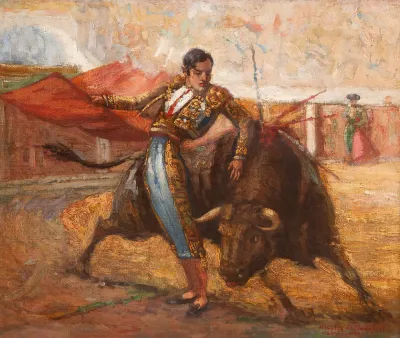
Although he also devoted himself to easel painting, Aldo Locatelli can be considered one of the most prolific fresco painters - especially of sacred subjects - active in Rio Grande do Sul in the 20th century. In his short career (he died at 47), Locatelli, in his native country, based the frescoes he painted on Renaissance art. In Brazil, notably in the project for the Church of São Pelegrino in Caxias do Sul, Rio Grande do Sul, he worked according to these standards in both the frescoes and the Stations of the Cross paintings: "Locatelli is undoubtedly a traditionalist; the iconographic and technical influences of the great masters of the Renaissance are visible in his work (...) But the artist's talent is such that it does not allow him to submit to them (...) being (...) capable of recreating them, precisely from what remained in them in a germinal state".1
The artist worked on the frescoes of the Church of São Pelegrino from 1951 to 1960, and on the 14 oils on canvas of the Stations of the Cross - painted in his studio in Porto Alegre - between 1958 and 1960. Locatelli had himself photographed in the positions of Christ to compose the work. He sought to express the pain of Jesus on the road to Calvary, the "determining element of the drama and expressiveness of the work (...) being, without any doubt, the book by Pierre Barbet, A Paixão de Nosso Senhor Jesus Cristo segundo o Cirurgião [A Doctor at Calvary: The Passion of Our Lord Jesus Christ as Described by a Surgeon], in which the physical sufferings of Christ's passion are described from a medical point of view".2
Notes
1 ZATTERA, Véra Stedile. Aldo Locatelli. Porto Alegre: Pallotti, 1995. p. 159.
2 FABRIS, Annateresa. Aldo Locatelli, o Cirineu em São Pelegrino. Insieme: Revista da Apiesp, São Paulo, nº 3, 1992, p. 21. According to Fabris's text, Father Giordani, parish priest of the Church of São Pelegrino, played a decisive role in the initial conception of the Stations of the Cross. The priest is said to have asked the artist to read Pierre Barbet's book, A Paixão de Nosso Senhor Jesus Cristo segundo o Cirurgião, "wishing to see portrayed 'the humanity of Christ massacred, as it really was'", as the author quotes. Locatelli, in turn, demanded creative freedom and time to execute the work (see page 20).
Critiques
"(...) His painting, full of energy, contrasts, movement, boldness and flashes of drama that often went as far as a theatrical exuberance of gestures and uncontrolled effects, retained much of the spirit and character of Baroque painting. (...) While he encouraged young artists along paths of expression different from his own, he himself, penetrating more deeply into the nature and meanings of artistic form, was also renewing himself, drawing from the vast resources of his talent a more robust, more concentrated formal expression and, therefore, one better suited to the austerity and character of mural painting. With these aims and the strength of a great faith in the enduring values of art and in the possibilities of his spirit, he gradually raised the consistency of his painting, purifying it, little by little, of superfluous elements and increasing its expressive power. This painting began to show a firm process of renewal from some of the superb panels of the Via Crucis series he painted for the Church of São Peregrino in Caxias do Sul, where he had already executed a vast Last Judgment on the ceiling, a depiction of the Supper and other themes".
Ângelo Guido
CAVALCANTI, Carlos; AYALA, Walmir, org. Dicionário brasileiro de artistas plásticos. Apresentação de Maria Alice Barroso. Brasília: MEC/INL, 1973-1980. (Dicionários especializados, 5).
Collections
Acervo Museu de Arte do Rio Grande do Sul Ado Malagoli - Margs - Porto Alegre RS
Igreja de São Pelegrino - Caxias do Sul RS
Pinacoteca Aldo Locatelli - Porto Alegre RS
Universidade Federal do Rio Grande do Sul - UFRGS - Porto Alegre RS
Group Exhibitions
1953 - Porto Alegre RS - 4th Instituto de Belas Artes do Rio Grande do Sul Salon
1954 - Porto Alegre RS - 5th Instituto de Belas Artes do Rio Grande do Sul Salon
1961 - Porto Alegre RS - Rio Grande do Sul Art Salon from the Past to the Present, at Galeria do Instituto de Belas Artes
Posthumous Exhibitions
1972 - Porto Alegre RS - Retrospective organized by the Museu de Arte do Rio Grande do Sul
1982 - São Paulo SP - Italian Painters in Brazil, at MAM/SP
1983 - Porto Alegre RS - From the Past to the Present: the Visual Arts in Rio Grande do Sul, at Cambona Centro de Artes
1999 - Porto Alegre RS - Exhibition of Paintings and Drawings: Tribute to Locatelli, at Espaço Arte Fiegas
2002 - Porto Alegre RS - Artist Teachers, at Museu da UFRGS
2002 - Porto Alegre RS - Drawings, Prints, Sculptures and Watercolors, at Garagem de Arte
Source: Itaú Cultural