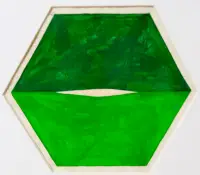
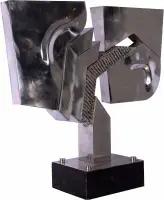
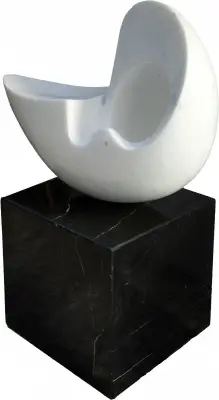
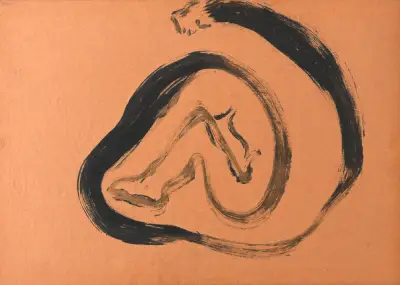
Zezão (São Paulo SP 1971)
Zezão, also known as José Augusto Amaro Handa, is a visual artist, graffiti artist and photographer. He stood out from the 1990s onward for taking graffiti to invisible and unusual places in the city: storm drains, sewers, abandoned factories and degraded urban spaces. Since 1995, he has carried out underground interventions in São Paulo, and is considered a pioneer of the practice.
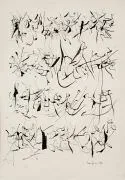
The most striking signature of his work is his graphic interventions in intense blue, known as flops: organic, calligraphic forms that spread like underground rivers or urban roots. These drawings, often made in hard-to-reach places invisible to the everyday gaze, reflect his aim of transforming marginality and abandonment into visual poetry. The first flops arose from the letters of the group "Vício Pif Dst", turning urban calligraphy into abstract gestures.
Over time, Zezão also began to occupy institutional spaces, exhibiting in galleries, museums and cultural centers in Brazil and abroad, establishing himself as one of the main representatives of contemporary urban art. His presence was further amplified in the 2000s thanks to Fotolog, a platform that helped spread his work and brought him closer to curators and gallerists.
Childhood and Youth
Zezão was born in São Paulo in 1971 and grew up amid the contradictions of Brazil's largest metropolis. Coming from a family of humble origins, he experienced firsthand the material and social hardships of São Paulo's outskirts. From an early age, he found in the streets a space of freedom and companionship, cultivating a spirit of resistance and creativity.
In his youth, skateboarding was his great passion. More than a sport, it was a form of expression and belonging that placed him in a universe of movement, speed and urban culture. However, at the age of 24, an accident abruptly interrupted this practice. Being unable to continue skateboarding led him to seek new ways to channel his creative energy.
This transition would be decisive for his life: just as the streets had been the space for skateboarding, they would now become the support for his art.
First Steps in Art
Graffiti entered his life in 1995, thanks to the encouragement of his friend Binho Ribeiro, a key figure in the São Paulo graffiti scene. Also inspired by the already recognized work of Os Gêmeos, Zezão began experimenting with painting on walls, initially in Binho's backyard, in collaborative and improvised productions.
Between 1995 and 1998, he devoted himself to traditional-style graffiti, inspired by the American aesthetic: tags, bomb letters and wildstyle. Although he practiced intensively and trained on his own, he still struggled technically with proportion, shading and perspective. This limitation, however, would become a creative trigger.
When he came into contact with the work of the New York artist Jean-Michel Basquiat, Zezão found the inspiration to break free from the formal constraints of classic graffiti. Through Basquiat, he realized that art could be made of emotion, instinct and freedom, without the need to obey rigid rules. It was at this moment that his work began to take on unique contours, with organic, gestural and open forms.
He himself described this process as a break: while painting a canvas on the floor with a broom, he realized he could express himself through emotion more than through technique. This liberating discovery was the beginning of his artistic identity.
The Moinho Matarazzo and Contact with Marginality
In the late 1990s, police repression of graffiti in São Paulo made it difficult to occupy the streets. In this context, Zezão sought refuge in abandoned, little-watched spaces. That is how he found the Moinho Matarazzo, an old disused factory in the city that had become home to transvestites, drug users and homeless people.
This decaying space, full of crumbling walls, offered the artist not only freedom to paint but also an atmosphere charged with stories and meanings. At the Moinho, Zezão developed a deep relationship with the marginal side of the city. There, he began to create his first flops, blue forms that emerged as a poetic counterpoint amid destruction and abandonment.
The Moinho was the laboratory in which his aesthetic matured, leading him to understand that his art was destined to occupy forgotten and invisible places, in dialogue with the reality of the excluded.
The Discovery of the Underground
In the early 2000s, his search for invisible territories led him down into São Paulo's underground storm drains. The first space he explored was the Cabuçu de Baixo stream, channeled beneath Avenida Inajar de Souza, in the North Zone.
The underground offered everything he was looking for: silence, untouched walls, an absence of surveillance and, above all, an atmosphere of abandonment and invisibility. There, Zezão began painting his blue forms, which came to symbolize an underground river running beneath the city.
At the same time, he realized he needed to share these works, which were inaccessible to the public. It was then that he devoted himself to photography as a means of documenting and expanding his art. He invested in equipment, learned lighting and composition techniques and, later, also moved into video. In this way, his underground incursions gained documentation and circulation, allowing the invisible art to be seen in exhibitions and publications.
For the artist, the underground was not just a setting but a metaphor. As a former motorcycle courier who knew the hardships of urban life firsthand, Zezão identified with the streams turned into garbage by uncontrolled urbanization. His graffiti was at once an aesthetic intervention and a way of giving voice to a neglected space.
Style and Artistic Language
Zezão's work became consolidated around the blue flops, organic forms that spread like abstract calligraphy, recalling rivers, roots or living organisms.
Blue, chosen as the main color, functions as a symbolic and poetic element. It contrasts with the gray of the dirt and decay of the underground, serving as a metaphor for life that resists where it is least expected. Zezão's blue is also a gesture of hope and transcendence, something that illuminates the dark and forgotten space.
His creative process is marked by improvisation and the use of unconventional tools, such as brooms and improvised brushes. Gesture, fluidity and spontaneity matter more than symmetry or formal technique.
For this reason, many critics classify his work as post-graffiti, an art that is born of hip hop culture but goes beyond it, approaching abstract painting, contemporary art and installation.
Career and Recognition
Zezão's recognition began in 2004, when he was invited to the opening exhibition of Galeria Choque Cultural in São Paulo. The group show Calaveras [Skulls], dedicated to the Day of the Dead, marked the beginning of his partnership with the gallery.
In 2005, he presented his first solo exhibition, Subterrâneos [Undergrounds], which consolidated his artistic identity. That same year, he also took part in the group show Cata Lixo [Trash Picker], expanding his visibility.
In 2006, he took part in the exchange between Choque Cultural and Galeria Fortes Vilaça, as well as in the exhibition Spray – o novo muralismo latino-americano [Spray - The New Latin American Muralism] at the Memorial da América Latina.
In 2007, he made his international debut at the Jonathan Levine Gallery in New York, in the show Ruas de São Paulo [Streets of São Paulo]. That same year, he took part in the exhibition Fabulosas Desordens [Fabulous Disorders] at Caixa Econômica Federal in Rio de Janeiro, presented his second solo show, Cidade Limpa [Clean City], and joined the project Coleções 8 at Galeria Luisa Strina, alongside names such as Adriana Varejão and Marepe.
In 2008, he further expanded his international presence, taking part in four important shows: Fresh Air Smells Funny (Hamburg), Namesfest (Prague), Psychedelic Brasil (London) and Festival della Creatività (Florence). That same year, he held his third solo show at Choque Cultural, Zezão Fotógrafo [Zezão Photographer].
In 2009, he took his work to Los Angeles, Bremen and Paris, as well as taking part in important group shows in Brazil. Since then, his international career has been consolidated, with participation in exhibitions and art residencies in different countries, while he continued to produce and exhibit in Brazil.
Photography and Assemblage
Photography became an inseparable part of his work. More than documentation, Zezão's images reveal the atmosphere of the underground, exploring light, shadow and composition in an authorial way.
He also began producing assemblage works, using objects found on his journeys through the underground and urban ruins. This practice reinforces his relationship with garbage and the idea of reuse, broadening his presence in contemporary art.
Legacy and Significance
Zezão is recognized as one of the pioneers of underground urban art. His work represents a dialogue between margins: between the visible and the invisible, the clean and the dirty, the center and the periphery, the street and the museum.
By transforming São Paulo's underground into true invisible art galleries, he questions the limits of exhibition space and proposes new ways of thinking about the city.
More than a graffiti artist, Zezão is a visual chronicler of the invisible metropolis. His blue forms function as poetic rivers flowing beneath the city, connecting memory, resistance and hope. His work, both on the streets and in galleries, continues to inspire new generations of urban artists and consolidate his position as one of the most relevant names in Brazilian contemporary art.
Solo Exhibitions
2005 - São Paulo SP - Subterrâneos [Undergrounds], at Choque Cultural
2007 - São Paulo SP - Cidade Limpa [Clean City], at Choque Cultural
2008 - São Paulo SP - Zezão Fotógrafo [Zezão Photographer], at Choque Cultural
Group Exhibitions
2003 - São Paulo SP - Collective mural on the building façade, at MAC/USP
2004 - Americana SP - Coletivo Rua [Street Collective], at MAC
2004 - São Paulo SP - Calaveras [Skulls], at Choque Cultural
2005 - São Paulo SP - Cata Lixo [Trash Picker], at Choque Cultural
2006 - São Paulo SP - Choque Cultural at Fortes Vilaça
2006 - São Paulo SP - Spray – o novo muralismo latino-americano [Spray - The New Latin American Muralism], at Memorial da América Latina
2007 - New York (United States) - Ruas de São Paulo [Streets of São Paulo], at Jonathan Levine Gallery
2007 - Rio de Janeiro RJ - Fabulosas Desordens [Fabulous Disorders], at Caixa Econômica Federal
2007 - Brighton (England) - Cor da Rua [Color of the Street], at OContemporary Gallery
2007 - São Paulo SP - Coleções 8 photography exhibition, at Galeria Luisa Strina
2008 - Hamburg (Germany) - Fresh Air Smells Funny, at Museu Kunsthalle Dominikanerkirche
2008 - Prague (Czech Republic) - Namesfest, at Trafkca
2008 - London (England) - Psychedelic Brasil, at Pure Evil Gallery
2008 - Florence (Italy) - Festival della Creatività, installation
2009 - Los Angeles (United States) - São Paulo, at Scion Space
2009 - São Paulo SP - Caligrafia [Calligraphy], at Galeria Choque Cultural
2009 - Bremen (Germany) - Urban-Art Collection, at Reinking Weserburg
2009 - Paris (France) - Une Estivale, at Galerie L.J