Veiga Valle (Pirenópolis GO 1806 - Goiás GO 1874)
Sculptor and gilder.
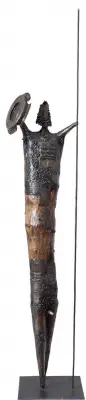
José Joaquim da Veiga Valle, of unknown artistic formation. Some historians suggest hypotheses about who would be their master; Others suggest that it is self-taught, which is contested by historian Heliana Angotti Salgueiro, author of the most complete study on the artist. Veiga Valle begins its production of sacred images in approximately 1830. It is true that in 1841 he transferred to the city of Goiás to gild the altars of the capital's headquarters at the invitation of the president of the province, with whose daughter he marries in the same year. There, it continues to produce until around 1870. Its most fertile period is the 1860s. It participates in the Brotherhood of the Blessed Sacrament, becomes a councilor, municipal judge, Major of the National Guard and Deputy. In 1940, the painter Rescála (1910-1986) rediscovered his work and began his studies on the craftsman and his work, holding an exhibition of 25 pieces in the city of Goiás. From then on, his images are included in Exhibitions on the Brazilian Baroque. In 1972, an exhibition and a symposium on it were organized in Goiânia. In 1978, the Art Museum of São Paulo Assis Chateaubriand (MASP) and the Palácio das Esmeraldas, in Goiânia, do a retrospective. The largest collection of his works belongs to the Museum of Sacred Art of Boa Morte, city of Goiás.
Critical Comment
The work of Veiga Valle highlights several questions in the history of art. First, the problem of attribution arises. As it is located in Goiás, in the interior of the country, after the gold cycle, its production is not studied directly after its death. Therefore, when it is rediscovered, it is necessary to establish the authorship of sacred images that, in addition to having their general coded characteristics, are impersonal, are not signed and are generally not the object of documentation. To get an idea of the difficulty, historian Elder Camargo de Passos cataloged 200 images, while historian Heliana Angotti Salgueiro admits only 60.1
another interesting point is the fact that his production dates from the 19th century, The height of academicism in Rio de Janeiro, but essentially presents characteristics of the Brazilian Baroque style. However, there are traces in the pieces by Veiga Valle that can be considered neoclassical.
A Nossa Senhora da Conceição, from the Matrix of Bom Jesus de Cuiabá, for example, presents, as baroqueism, the marked drawing and Floating from the dress and cover, the curls very curved and outlined in the hair, the richness of the prints and the twist. The same can be said of Santos as São José de Botas and São Joaquim, from the Museum of Sacred Art of Boa Morte, city of Goiás.
In the same sculptures, however, we can emphasize the delicacy of torsion and features, the sweetness of the expression of the face and smoothness of the lines, which avoid the tragic effect of the Brazilian Baroque, common in the images of Aleijadinho (1730-1814). Furthermore, the motifs that decorate the clothes include pearls, stylized lis, conchoid elements and bouquet flowers, typically rococos or neoclassicals.
In the words of Angotti Salgueiro: "Historically, however, the neoclassicim does not appear ready; it gradually overcomes the taste for baroque-rococo sinuosity, which, in isolated occurrences, perseveres during the century. Religious art becomes more slowly than secular art: if, in the river, Mestre Valentim (ca.1745-1813) is already neoclassical at the turn of the century and the French mission imposes the style shortly after, consolidating it in the Imperial Academy of Fine Arts, the Baroque image resists. Baianos, Pernambuco, Paulistas: the style of Veiga Valle is not anachronistic."2
Notes
1 Salgueiro, Heliana Angotti. The singularity of Veiga Valle's work. In: ÁVILA, Affonso (org). Baroque: theory and analysis. São Paulo: Perspectiva, 1997, p. 308.
2 willow, Heliana Angotti. The singularity of Veiga Valle's work. Goiânia: Catholic University of Goiás, 1983, p. 25-26.
Corves
Museum of Sacred Art of Good Death - Goiás GO
Posthetic exhibitions
1940 - Goiânia GO - Individual, in the building of the Liceu de Goiás
1954 - Goiânia GO - Individual, at the Goiás School of Fine Arts
1964 - Goiânia GO - Exhibition of the Baroque Goiano, at the Catholic University of Goiás
1968 - Salvador BA - 1st Baroque Festival
1972 - Goiânia GO - Retrospective, at the College of Application of the Federal University of Goiás
1974 - Goiás GO - Individual, at the Museum of Sacred Art Death
1976 - Pirenópolis GO - Art Week
1978 - São Paulo SP - The city of Goiás and the sculptor from Goiás, Veiga Valle, at Masp
2001 - Goiânia GO - Museum Collection of Sacred Art of Boa Morte with the largest collection of Veiga Valle, in the Art Gallery of the Jaime Câmara Foundation
Source: Itaú Cultural