Sérgio Sister (São Paulo SP 1948)
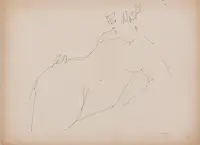
Sérgio Sister is a painter and draftsman. He studies painting at the Fundação Armando Álvares Penteado - Faap, in São Paulo, between 1964 and 1967, and drawing with Ernestina Karman (1915 - 2004), from 1965 to 1967. Between 1968 and 1975, he earns an undergraduate degree in social sciences and a graduate degree in political science at the Universidade de São Paulo - USP. During this period, he is imprisoned for political reasons. He spends 19 months, between 1970 and 1971, in the Presídio Tiradentes, in São Paulo, and attends the open studio of that institution. He becomes a member of the advisory board of the magazine Guia das Artes. In the 1980s, he produces abstract canvases and small-format paintings, and, at the end of the 1990s, he executes the Ripas [Slats] series in wood. In 2002, the book Sérgio Sister is published, with texts by Alberto Tassinari, Lorenzo Mammì, Rodrigo Naves and the artist himself, by Editora Casa da Imagem, of Curitiba. He also works as a journalist and illustrator, among others of the book O Senhor do Bom Nome [The Lord of the Good Name], by Ilan Brenman, published in 2004.
Critical Commentary
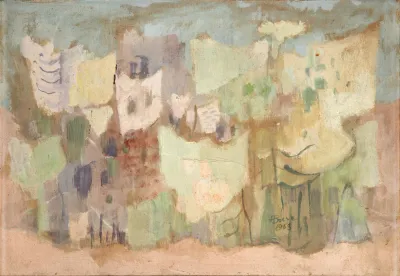
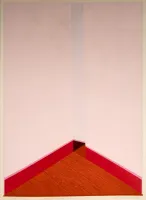
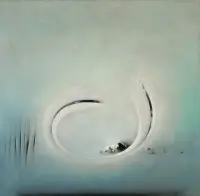
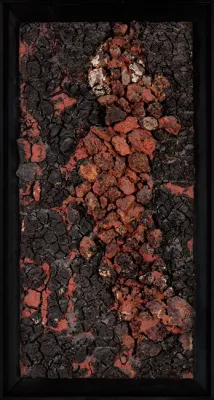
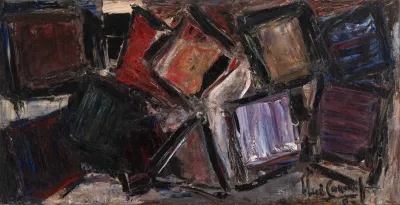
In the early 1980s, Sérgio Sister produces abstract canvases in which he combines geometric forms with patches of color. In Cave 1 (1986), the colored planes stand out from the black background, revealing a luminosity that seems to emanate from the areas of color. The artist explores the gestural quality of the brushstroke in rough textures, set against others of more impersonal facture. In the small-format canvases, made between 1988 and 1992, he works with bands of color in close tonalities, using short brushstrokes and metallic paints.
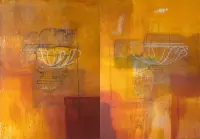
About his works, Sister states in a 1998 text: "For some years I have found it difficult to connect two different bodies of color without corrupting the power of each of them in a mere arrangement of bands. I tried to get around the problem in 1996 by seeking to bring distinct colors together through very similar tonal pigments".1 The artist frequently employs a dominant color, in opaque or sometimes milky tonalities. Through the brushstrokes, he produces a chromatic vibration that retains luminosity. As the critic Alberto Tassinari notes, between the grooves and vibrations that structure the paintings, light seems to find its environment. Light remains there, more than it illuminates, and becomes the central element in his work.
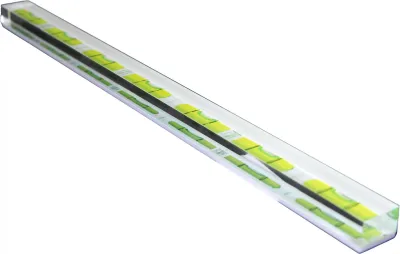
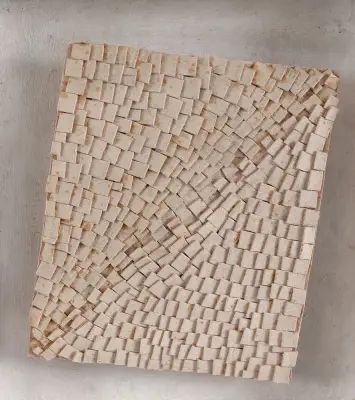
At the end of the 1990s, he produces the Ripas [Slats], in which colors are painted on elongated wooden structures. In these works, Sister seeks an integration with the surrounding space. Later, he seeks this integration of space and air in the relationship between colors. In canvases made from 2000 onwards, the paints have a more rarefied appearance, as in Coluna Vermelha [Red Column] (2000), Menos Horizontal [Less Horizontal] or Verde Luz [Light Green] (both from 2003).
For the critic Sônia Salzstein, Sister highlights the two-dimensional character of the support, making the viewer's gaze travel across the surface of the canvas, undecided between the deposits of paint left by the short brushstrokes and the purely visual impression of light on the metallic particles of the pigment. As the art historian Rodrigo Naves points out, the artist's canvases, with planes undecided as to their direction or depth, or with metallic pigments that barely turn into paint, do not seek the beautiful exteriority of acts, but rather their constitution.
Notes
1 Quoted in SISTER, Sérgio. Sérgio Sister: Programa de Exposições 1998 - artista convidado. São Paulo: Centro Cultural São Paulo, 1998, p. não numeradas.
Critiques
"(...) In the artist's recent canvases, black annihilates the residual film of the figure/ground order, but not - and note this - to allow materiality to emerge. Because these works have reached a degree zero of representation and also of matter. If there is a concern that painting be the precise modulation of a subjectivity, it only emerges in the exact measure of the delimitation of the pictorial field. This subjectivity manifests itself as a certain refined and almost laconic lyricism with which the pictorial matter is impregnated. And the support is not there simply to receive a qualification from subjectivity; it reacts, seems restless, refuses to settle on a possible truth of matter. (...) Here one arrives, paradoxically, at the evidence of the support not through the affirmation of materials, but through the recognition of the surface, over which the gaze wanders without being able to decide between the material appeal of the paint deposits left by the short brushstrokes and the purely visual impression of the discontinuous yet overflowing sliding of light on the metallic particles of the pigment".
Sônia Salzstein Goldberg
GOLDBERG, Sônia Salzstein. Questão de materialidade. Guia das Artes, São Paulo: Casa Editorial Paulista, v.3, n.11, p.42-46, 1988.
"Sérgio Sister's paintings seem to keep light. Opaque, sometimes milky, they are, paradoxically, luminous paintings. Although always painted with a dominant color, it is not so much color that they speak to us of, but, if one may put it this way, of a repose of light. Retained there, between the grooves and vibrations that structure the painting, light seems to find in color its environment more than its translation. Light remains there, more than it illuminates. It is hard to say how this happens. A matter would lend body to a color that would let itself be inhabited by light. Strange kind of stained glass of a time without cathedrals. When nothing transcends anymore, light will no longer be the spirit of space. And even space is then no longer overly transcendent. The most one could do would be to keep them. Quiet, but not inert. Magnetized in the skin of the paintings. But these paintings also seem to call for a positive interpretation. What is the transcendent, today? Perhaps a question without much place, which conversation and knowledge evade and discipline to the point that there are few occasions to pose it, except, here and there, in hybrid texts such as exhibition catalogs. Let the question then, at least to restrain grandiloquence, be put to the works themselves. At first, there would be no transcendence in them. They would be prosaic and banal. And yet there they are. Closed, opaque, they barely open up. But there they will be again, and in that there lies a mystery. One that does not let itself be lost, as much as it can".
Alberto Tassinari
ARTE brasileira: confrontos e contrastes. Londrina: Universidade Estadual de Londrina, 1995, p. 27.
Solo Exhibitions
1983 - São Paulo SP - Solo, at Paulo Figueiredo Galeria de Arte
1986 - São Paulo SP - Solo, at Paulo Figueiredo Galeria de Arte
1988 - São Paulo SP - Solo, at Galeria Millan Antonio
1989 - Rio de Janeiro RJ - Solo, at Projeto Macunaíma, Galeria FUNARTE
1989 - São Paulo SP - Solo, at Centro Cultural São Paulo
1990 - São Paulo SP - Solo, at Galeria Millan Antonio
1992 - São Paulo SP - Solo, at Capela do Morumbi
1993 - São Paulo SP - Solo, at Galeria Millan Antonio
1993 - Curitiba PR - Solo, at Casa da Imagem
1995 - São Paulo SP - Solo, at Galeria Millan Antonio
1996 - Curitiba PR - Solo, at Casa da Imagem
1996 - São Paulo SP - Solo, at Marília Razuk Galeria de Arte
2000 - São Paulo SP - Solo, at Galeria Marília Razuk
2000 - Ribeirão Preto SP - Solo, at Museu de Arte de Ribeirão Preto (Marp)
2000 - Rio de Janeiro RJ - Solo, at Paço Imperial
2000 - São Paulo SP - Solo, at Galeria São Paulo
2000 - Rio de Janeiro RJ - Solo, at Galeria Paulo Fernandes
2003 - Curitiba PR - Solo, at Galeria Casa da Imagem
2003 - São Paulo SP - Solo, at Galeria 10,20 x 3,60
2004 - São Paulo SP - Solo, at Galeria Millan Antonio
2005 - Rio de Janeiro RJ - Solo, at Silvia Cintra Galeria de Arte
2006 - São Paulo SP - Solo, at Centro Universitário Maria Antônia
2007 - São Paulo SP - Solo, at Instituto Thomie Ohtake
2008 - São Paulo SP - Solo, at Galeria Nara Roesler
Group Exhibitions
1965 - São Paulo SP - Salão Paulista de Arte Moderna [São Paulo Salon of Modern Art]
1966 - Campinas SP - Salão de Arte Contemporânea [Contemporary Art Salon]
1966 - São Paulo SP - 15º Salão Paulista de Arte Moderna [15th São Paulo Salon of Modern Art], at Galeria Prestes Maia
1967 - São Paulo SP - 9ª Bienal Internacional de São Paulo [9th São Paulo International Biennial], at Fundação Bienal
1967 - São Paulo SP - 1ª Jovem Arte Contemporânea [1st Young Contemporary Art], at MAC/USP
1967 - São Paulo SP - Jovens Artistas no Museu de Arte Brasileira [Young Artists at the Museu de Arte Brasileira], at MAB/Faap
1985 - São Paulo SP - Pequenas Insurreições [Small Insurrections], at CCSP
1989 - São Paulo SP - Arte Contemporânea São Paulo/Perspectivas Recentes [Contemporary Art São Paulo/Recent Perspectives], at CCSP
1989 - Rio de Janeiro RJ - Artistas Contemporâneos [Contemporary Artists], at FUNARTE
1990 - São Paulo SP - 21º Panorama de Arte Atual Brasileira [21st Panorama of Current Brazilian Art], at MAM/SP
1992 - São Paulo SP - Galeria Millan: mostra inaugural [Galeria Millan: Inaugural Show], at Galeria Millan
1993 - São Paulo SP - Encontros e Tendências [Encounters and Tendencies], at MAC/USP
1995 - Londrina PR - Arte Brasileira: confrontos e contrastes [Brazilian Art: Confrontations and Contrasts], at Pavilhão Internacional Octávio Cesário Pereira Júnior
1995 - Londrina PR - Semana de Arte de Londrina [Londrina Art Week], at UEL
1995 - São Paulo SP - Morandi no Brasil [Morandi in Brazil], at CCSP
1998 - Madrid (Spain) - Arco' 98, at Galeria Casa da Imagem
1998 - São Paulo SP - Programa Anual de Exposições de Artes Plásticas [Annual Visual Arts Exhibition Program], at CCSP
1999 - São Paulo SP - 26º Panorama de Arte Brasileira [26th Panorama of Brazilian Art], at MAM/SP
2000 - Fortaleza CE - 26º Panorama de Arte Brasileira [26th Panorama of Brazilian Art], at Centro Dragão do Mar de Arte e Cultura
2000 - Niterói RJ - 26º Panorama de Arte Brasileira [26th Panorama of Brazilian Art], at MAC/Niterói
2000 - São Paulo SP - Ao Redor do Desenho [Around Drawing], at Centro Cultural Maria Antônia
2000 - São Paulo SP - Desenho Contemporâneo [Contemporary Drawing], at CCSP
2000 - São Paulo SP - Fim de Milênio: os anos 90 no MAM [End of the Millennium: The 1990s at the MAM], at MAM/SP
2000 - São Paulo SP - With Rodrigo Andrade, at Galeria Nestlé
2001 - São Paulo SP - A Cor na Arte Brasileira [Color in Brazilian Art], at MAM/SP
2001 - Rio de Janeiro RJ - O Espírito de Nossa Época [The Spirit of Our Time], at MAM/RJ
2001 - São Paulo SP - O Espírito de Nossa Época [The Spirit of Our Time], at MAM/SP
2001 - São Paulo SP - Trajetória da Luz na Arte Brasileira [Trajectory of Light in Brazilian Art], at Itaú Cultural
2002 - São Paulo SP - 10 Anos Marília Razuk [10 Years of Marília Razuk], at Marília Razuk Galeria de Arte
2002 - São Paulo SP - 25ª Bienal Internacional de São Paulo [25th São Paulo International Biennial], at Fundação Bienal
2002 - São Paulo SP - 28 (+) Pintura [28 (+) Painting], at Espaço Virgílio
2002 - São Paulo SP - Ana Miguel, Elder Rocha, Ricardo Basbaum and Sérgio Sister, at Galeria de Arte São Paulo
2003 - Belo Horizonte MG - Fábio Miguez, Rodrigo de Castro, Sérgio Sister, at Celma Albuquerque Galeria de Arte
2003 - São Paulo SP - Construtivismo e a Forma como Roupa [Constructivism and Form as Clothing], at MAM/SP
2003 - São Paulo SP - Meus Amigos [My Friends], at MAM/SP
2004 - Rio de Janeiro RJ - Novas Aquisições 2003: Coleção Gilberto Chateaubriand [New Acquisitions 2003: Gilberto Chateaubriand Collection], at MAM/RJ
2004 - São Paulo SP - Arte Contemporânea no Acervo Municipal [Contemporary Art in the Municipal Collection], at CCSP
2006 - São Paulo SP - Ao mesmo tempo o nosso tempo [At the Same Time Our Time], at Museu de Arte Moderna de São Paulo
2006 - Rio de Janeiro RJ - Arquivo Geral [General Archive], at Casa Hélio Oiticica
Source: Itaú Cultural