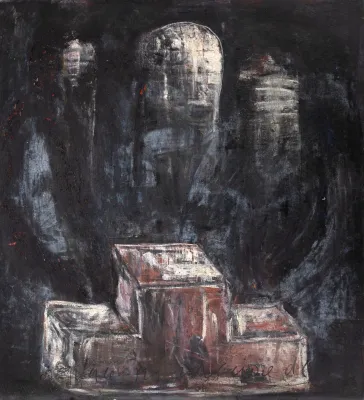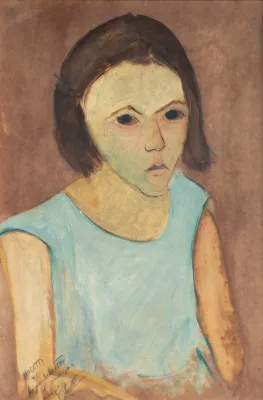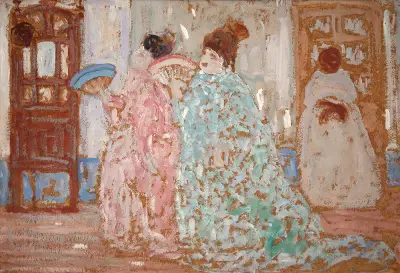
Pedro Figari (Montevideo Uruguay 1861 - Idem 1938)
Pedro Figari was a painter, lawyer, politician, writer and Uruguayan journalist. He was born in Montevideo, in 1861, the son of Juan Figari and Santa Margherita Ligure. In an attempt to emigrate to Buenos Aires, his ship sank and he managed to swim to Montevideo. He married Paula Solari, of the same origin, prospered and formed a large family.
During his adolescence, he frequented a farm located where the center of Tres Cruces is today, with a coastline in the bay, then a rural area. In this environment, he had contact with aspects of society that would later be recurring themes in his paintings, such as black communities, barracks and tenements.
In 1886, he graduated in law in a few hours and married Maria de Castro. The couple set out on a long honeymoon across Europe, a trip that had a great impact on their artistic training. Back in Montevideo, in 1887 his first daughter was born, followed by five other girls and two boys.
Figari practiced law in both the public and private spheres, worked in politics as a parliamentarian, in journalism and as an advisor to President José Batlle and Ordóñez. He stood out for his campaign for the abolition of the death penalty and, as a public defender, he gained notoriety for his performance in the case of Alérez Almeida, unjustly accused of murder. This defense, although it brought him financial and prestigious complications, resulted in victories in several judgments.
As director of the School of Arts and Crafts, later Industrial School, played an important role, but he left after being disappointed with the political disputes associated with the function.
She then began to dedicate herself to painting, which she had always practiced as an amateur. In 1921, he sent works for an exhibition in Buenos Aires. Despite the poor commercial performance — he sold only one painting — he was very well received in the cultural environment and took up residence in the city. In 1925, he sent works to Paris, where he had the best commercial result, which encouraged him to move there. He painted in Paris until 1933, returning to Montevideo the following year.
After his return, he did not repaint, although he still signed some old works. He continued, however, organizing exhibitions, including one in Buenos Aires a few hours before his death in Montevideo in 1938.
He was a compulsive writer, author of thousands of pages on various subjects:
- The case Almeida
- The treatise "art, aesthetic, ideal" (Essai of Philosophie biologique)
- "History Kiria" utopian treatise wonderfully illustrated with its own drawings
- "The Architect", fables and poetry in honor of Juan Carlos, his son and right-hand man, killed in Paris in 1927, aged 33. It also illustrates this book.
- Tales and theatrical plays
- A very large correspondence throughout his life with family members, politicians, artists, philosophers.
Godofredo Somavilla taught painting to Figari's wife, who took the opportunity to start technical learning. For years, Figari painted watercolors and oils of an academic and naturalistic character, based on photographs and copies for her children. He showed great skill as a draftsman, as shown by the illustrations in the judicial process of the Almeida case, full of expressive caricatures of those involved.
Laterly, he started a phase of oils on canvas, mostly landscapes — many of them nocturnal. In his last phases, his works no longer included human figures, except for rare exceptions, as in the series of “Venecias”, in which a gondolier appears. Figari's artistic maturity began around 1919, with works in oil on a cardboard, often with the background visible between the brushstrokes, and a wide variety of themes. There is a remarkable absence of sports and children scenes, except for a baby in the arms of a black mother. The scenes portray urban and rural life, in addition to evoking historical facts.
The titles of his works often include humor or irony, even when dealing with funeral or religious themes, always maintaining respect. In its trajectory, a spiritual evolution is observed: from a young atheist and anticlerical to someone who represents religious ceremonies with sensitivity. In his writings, as at the end of The Architect (1928), he reflects this change when referring to the deceased son: “... you have to find our cells again on the eternal path; and if they recognized, I hope.”
Evoked youth, customs and history with a sense of timelessness, treating events as everyday life. Its characters often do not cast shadows, which makes them look like spirits, except when illuminated by a specific light, such as a flashlight or candle.
The illustrations in their writings, although they seem like fruits of the imagination, clearly refer to the memories and experiences. Figari can be considered self-taught to some extent, but his artistic trajectory was built over almost six decades of preparation, before reaching maturity at age 58. He mastered the theory before reaching the height of practice — something recognized as early as 1911 by Barradas, which caricatured him as “Dr. Pedro Figari, art critic”, many years before he dedicate himself to painting seriously. Training included frequent meetings with artists such as Moretti-Catelli and Milo Beretta, whose collection included works by Van Gogh. His home in Montevideo, Buenos Aires and Paris was a meeting point for painters, sculptors, musicians, philosophers and writers, including several Argentines who followed his trajectory with enthusiasm.
His six surviving children They inherited about 2,400 works. Considering sales and donations in life, it is estimated that about 4,000 oil paintings have been produced.
Much of this information comes from the family tradition and remains open to reviews, especially in the light of recent studies on his life and work.
Source: Translation of the text by Fernando Saavedra Faget