
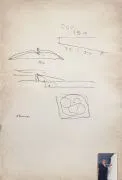

Oscar Niemeyer (Rio de Janeiro RJ 1907 - Idem 2012)
Oscar Niemeyer was one of the greatest urban planners in Brazil, his memorable life and work line that drew Brazil and the world. This confirms why it is followed and praised by many, but that it does not reveal the magic of resistance to time and the tireless will to project.
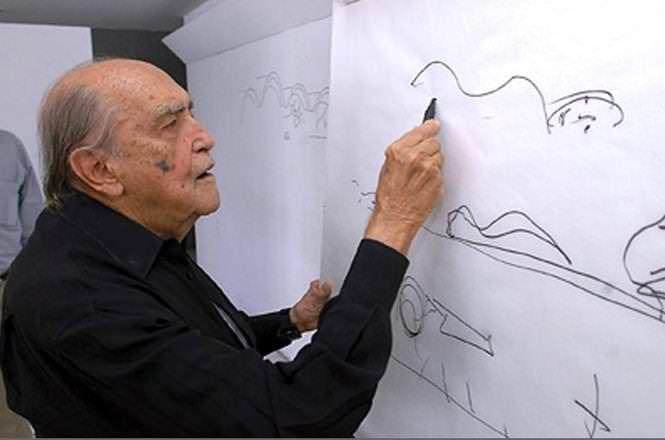
Oscar Niemeyer
Oscar Ribeiro de Almeida de Niemeyer Soares graduated in architecture at National School of Fine Arts (ENBA), in Rio de Janeiro, in 1934. That year, he started to attend the office of the architect and urban planner Lucio Costa (1902-1998). In 1936, he was part of the commission created to define the plans for the headquarters of the Ministry of Education and Health (MES), in Rio de Janeiro, under the supervision of the French-Swiss architect Le Corbusier (1887-1965), whom he attends, as a draftsman. Based on the architect's project, Niemeyer suggests changes that are adopted in the construction of the building. Between 1940 and 1944, he designs, by order of the then mayor of Belo Horizonte, Juscelino Kubitschek (1902-1976), the architectural complex of Pampulha, which is configured as a landmark of his work, as he breaks with The rigorous concepts of functionalism and uses a language of new forms, of curved surfaces, exploring the plastic possibilities of reinforced concrete.
In 1947, he was invited by the United Nations (UN) to participate in the commission of architects in charge of defining the plans for his future headquarters in New York. Its project, associated with that of Le Corbusier, is chosen as the basis of the definitive plan. In Rio de Janeiro, in 1955, he founded the Modulo Magazine and the following year, at the invitation of the President of the Republic, Juscelino Kubitschek, he began to collaborate in the construction of the new capital of Brazil, Brasília, whose urban plan is entrusted to Lucio Costa. In 1958, he was appointed chief architect of Brasília, where he moved and remains until 1960. Among Niemeyer's most important projects are the Ibirapuera Park, São Paulo, 1951 the headquarters of the French Communist Party, Paris, 1965 The School of Architecture of Algiers, Algeria, 1968 The headquarters of Editora Mondadori, Milan, Italy, 1968 and the headquarters of the newspaper L'Humanité, Saint-Denis, France, 1987.
Oscar Niemeyer's life
1907 - Oscar Niemeyer is born in Rio de Janeiro on December 15th.
“I was born in Laranjeiras, on Passos Manuel Street. A steep street, so steep that to this day, I still amaze me from top to bottom playing football”
Oscar Niemeyer, Época Magazine, 11/09/1998.
Years 20 - Rio, capital of Brazil
“In that golden age, the Rio de Janeiro was the capital of Brazil. Its night was a party, bars, cafes, cabarets, chorinhos, feet drag! And Niemeyer, in a thousand, loved a serenade…”
“When I left home and saw how unfair life was, I went to The Red Help. We arranged clothes and things to help the poorest.” (Jornal do Brasil, Caderno B, 12/11/2005) Socorro Vermelho was an organization to support the persecuted and political prisoners and their families, linked to the Brazilian Communist Party.
1928 - Marries Annita Baldo and the passion for drawing begins.
Annita was a descendant of Italian immigrants who came from the province of Padua. He lives a great love and generates his first daughter, Anna Maria Niemeyer. Even though she is an atheist, the bride takes him to church. As a family father, she will help her father in his typography.
1929 ~ 1934 - He enrolled at the National School of Fine Arts in Rio de Janeiro and graduated as an architect in 1934.
1932 - He begins his professional life in the office of Lúcio Costa (1902-1998), an architect with whom, years later, he would create Brasília.
1936 - Works with Le Corbusier and Gustavo Capanema and reveals himself Innovator.
As an intern of Lúcio Costa's team, Niemeyer works alongside the French-Swiss architect Le Corbusier (1887-1965) in the project of the new building for the Ministry of Education and Public Health, in Rio de Janeiro, A landmark of Brazilian modern architecture.
Despite being a beginner at that time, it was Niemeyer who suggested changing the height of the pilotis from four to ten meters to the team. His proposal was successfully accepted.
1937 - Designs the work of the cradle, in Rio de Janeiro, his first built project
1938 - Designs the house of Oswald of Andrade, São Paulo and a small hotel in the city of Ouro Preto-MG, with features very similar to those he would use in the Catetinho project years later.
1940 - Makes the project of the Pampulha Complex, Belo Horizonte
At the invitation of Juscelino Kubitscheck (1902-1976), then mayor of Belo Horizonte, makes the joint project of Pampulha, the first impact work of the inventive architect, with open areas and access roads, the works would take place around An artificial lake. The program involves a casino, a club, a dance hall, a church and a hotel, but the last one is not built. For the execution of the work, Niemeyer has the collaboration of the engineer of structures, and also a poet, Joaquim Cardoso (1897 – 1978) and the landscaper Burle Marx (1909 – 1994).
1942 - Casa da Lagoa Rodrigo de Freitas
1945 - is invited to design the United Nations (UN) building in New York, along with other architects and joins the Brazilian Communist Party.
In addition, at the time when the Americans and Russians beat Nazi Germany, Niemeyer joined the Brazilian Communist Party, close to the Russian political line, from which he will withdraw in 1990, together with Luiz Carlos Prestes.
1951 ~ 1955 - Parque do Ibirapuera, SP
Surge to celebrate the 400th anniversary of the city of São Paulo, symbol of Brazilian modernity, Niemeyer's second major project, commissioned by the São Paulo government. This project seeks to give the city a large green area, with places for exhibitions and leisure, bringing together modern architecture and landscaping. The use of the curves accentuates the “lightness” of the buildings. Both in the Ibirapuera Marquise as well as inside the Bienal building.
The construction of the iconic Casa das Canoas, where Oscar Niemeyer lived with his family for a long time, starts this year and is located in the Tijuca Forest, in the Rio de Janeiro.
“My concern was to project the residence with complete freedom, adapting it to the unevenness of the terrain, without modifying it, making it in curves, in order to allow the vegetation to penetrate it, without the separation ostensible from the straight line. And I created an area in shade for the living rooms, so that the glazed part would avoid curtains and the house would be transparent as I preferred.”
Oscar Niemeyer
>
1954 - Participates in the project of a set of buildings for the Hansa neighborhood, as part of the Berlin Reconstruction Program (Germany).
1955 - founds Modulo Magazine in Rio de Janeiro
1956 - Brasília: Niemeyer is invited by JK to create “the most beautiful capital in the world”.
Juscelino Kubitshek (JK) is elected president of Brazil. Its main will is to change the capital, then in Rio de Janeiro, from the coast to the center of the country, already provided for in the first Constitution of Brazil. 1956. Such a plan should propose all the urbanism of the city, but did not provide for the design of public buildings. Lúcio Costa is the winner of the contest.
“(…) When Juscelino became President of the Republic, he already had an architect in his pocket, he was Oscar Niemeyer. He was a previously chosen architect. City, the Plano Piloto. I developed the Plano Piloto. I did not intend to participate in the contest, but in the middle of the deadline, I had an idea, I thought it was worth it and competed.” (Lúcio Costa – Interview with Professor Ana Rosa de Oliveira, in 1992)
Niemeyer designed several works for the Brazilian capital, among them the following can be highlighted: the Planalto Palace, the Cathedral of Brasília, the National Congress, the Palácio da Alvorada, and the Palace of Itamaraty.
Brasília is like a “summary” of what the architect had already shown in his projects: the glass next to the concrete, the curve, the plumb lines, the pilotis and the free spans that make the buildings light.
“The monumentality never frightens me when a stronger theme justifies it. After all, what remained of the architecture were the monumental works, those that mark the time and the evolution of the technique. They still move us.”
Oscar Niemeyer
Opened the city, will then coordinate the School of Architecture at UnB.
1963 - receives the award Lenin of Peace, in the USSR. He is appointed Honorary Member of the American Institute of Architects of the United States.
1965 - The Military Gople. Niemeyer resigns from UnB and travels to Paris.
The dismissal together with 200 more teachers is caused by the military coup (1964) that makes it clear the difficulty in living and working in Brazil. He then travels to Paris to visit the exhibition Oscar Niemeyer, L’Architecte de Brasília, at the Museum of Decorative Arts at the Louvre Palace. Receives the Juliot-Curie Medal and the International Grand Prix for Architecture and Art, from L’Architecture d’Aujourd’hui, both in Paris.
1967 - Niemeyer goes into exile at France.
The military dictatorship lasts until 1985. During the exile, he works on different projects for several countries. For this, he wins from the then French president, Charles de Gaulle, a special license to be able to work in the country with all the rights of a French professional. My architecture is not functional. I made the headquarters of the French Communist Party and, ten years later, they came to ask me to design the headquarters of the Humanité. If it didn't work, they wouldn't call me again.” (On, O Estado de São Paulo, 8/11/98)
1972 - Opens its office in the Champs Elysées in Paris and designs the Bobigny Work Scholarship and the Le Havre Cultural Center in France.
The return to Brazil
80s - After more than a decade, the architect returns to Brazil. creates the JK Memorial (1980) and the Indian Museum (1982), both in Brasília, the Manchete de Televisão building (1983).
1983 - carries out the first retrospective of its work, at the Rio de Janeiro Art Museum. same year in which he projects with Darcy Ribeiro, the public school system called CIEPS (Integrated Center for Public Education).
1984 - Sambadrome of Rio de Janeiro
1985 - Project of the Pantheon of the Homeland at Praça dos Três Poderes in Brasília.
1987 - Year that projects the Latin America Memorial, in the city of São Paulo, and the headquarters building of the I'Humanité newspaper, in Paris.
1988 - In the city of Chicago, it receives the Pritzker Architecture Award.
1991 - Designs the Museum of Contemporary Art MAC, in Rio de Janeiro, and the Parliament of America Latina.
1996 - Designs the Monument Eldorado Memória, donated to the Landless Rural Workers Movement.
1996 - Museum of Contemporary Art of Niterói
“Sometimes a project is difficult to define. The terrain was narrow, surrounded by the sea, and the solution happened naturally, with the inevitable central support as a starting point. Architecture took place spontaneously like a flower. The view of the sea was beautiful and was able to take advantage of it. And I suspended the building and under it the panorama extended even richer. Then I defined the profile of the museum.
A line that rises from the ground and without interruption grows and unfolds, sensual, to the cover. The shape of the building, which I always imagined, was fixed and, inside, I stopped in love. Around the museum I created an open gallery for the sea, repeating it on the second floor, like a mezzanine over the large exhibition hall. And I worried about the interiors, wishing they were beautiful and varied, inviting visitors to get to know them better. On the ground, my idea was to accentuate the entrance to the museum, drawing the external ramp. A walk around the architecture. And I felt that the museum would be beautiful and so different from the others that rich and poor people would be happy to visit.”
Oscar Niemeyer
1999 Ibirapuera, and the cultural sector of Brasília.
2000 - Creates the Ravello auditorium, Italy. It also publishes its memoir in London.
2001 - Designs the Brazilian Cinema Museum in Rio de Janeiro, Oscar Niemeyer Museum in Curitiba and the Acqua City Palace in Moscow.
2002 - Inaugurates the Oscar Niemeyer Museum (MON) Museu do Olho, in Curitiba. Also the Ibirapuera Auditorium.
2003 - Designs the Serpentine Gallery Pavillon, in Hyde Park, London. The construction of the National Library and the National Museum begins in Brasília, both part of the cultural sector of Brasilia.
2004 - Designs the monument of peace in the city of Paris.
2005 - Designs the Potsdam Water Park, Germany, and the administrative complex of the Itaipu hydroelectric plant.
2006 - Designs the Principado de Asturia Cultural Center in Spain and the Leonel Brizola Memorial, in Rio de Janeiro and remarries again.
Niemeyer marries Vera Lúcia Cabreira (born in 1946), with whom she lives in an apartment in Ipanema, Rio de Janeiro. That same year, the Cultural Complex of the Republic was inaugurated, in Brasília, with the National Museum Honestino Guimarães and the National Library Leonel de Moura Brizola, forming one of the largest cultural centers in the country.
2007 - Year of Its centenary assumes, together with Governor José Roberto Arruda, the commitment to design the headquarters of the Public Archive of the Federal District and the Museum of Image and Sound, both in the city of Brasília. It designs the University of Science and Informatics in Cuba and the Cultural Center in Valparaíso, Chile.
2008 - Visit to the city of Brasília, and launches the third issue of its architecture magazine in the National Museum “Our Caminho”. Designs the Teatro Puerto de la Musica de Rosário, Argentina.
2010 - Administrative City of Minas Gerais. curves, reinforced concrete and the largest suspended building in the world. The administrative city is considered the most daring project of Oscar Niemeyer. The work, carried out in the Aécio Neves government, houses the secretariats and organs of the state and was inaugurated on March 4, 2010.
2012 - The architect's health status is casually worsened and e hospitalized several times by dehydration.
2012 - Dies aged 104 to December 5.
Testimonies
"I think to be a work of art, in the true meaning of the word, an architectural work must, this is a fundamental condition, contain a minimum of creativity, that is, a personal contribution from the architect. outdated".
Oscar Niemeyer
Petit, Jean. Niemeyer: poet in architecture. s.l. : Fidia Edizione d'Arte, C1995. p.61.
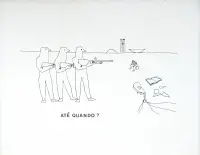
"I often wanted to make sculpture. 'You are the sculptor of reinforced concrete' told me, and I thought that one day this could happen. Time passed. in any square. Abstract, light, loose in the air. Perhaps surrealist, forcing those who saw them to think a little, surprised, trying to decipher them. I accept everything that is beautiful and well accomplished. Between a painting by Picasso and another by Matisse, for example, I meet always the common denominator of beauty and talent to characterize them. He liked the sculptures of Moore and Hepworth, the purity of Branchusi, the beautiful women of Despiau and Maillol, the slender figures of Gaiacometti, of the Greek and Egyptian sculptures, of the victory of Samothrace, all made of beauty and movement. One day I talked to my friend Honório Peçanha. He gave me a bag of clay and a square of wood with a large nail. I needed to get started.” I never used them.” A fierce self-criticism hindered me. But when the problem of the monument to JK arose and then the group Tortura never called me again, I didn't have the courage to refuse. Man follows his destiny, satisfied when his convictions and hopes with him coincide. To this day I only did protest sculpture. The first sculpture I created was the monument to JK. The high shaft that, ending in curves, protects and enhances its figure, carved by Honório Peçanha. The objective was to contest the existing dictatorship, the most reactionary forcing them to see him every day, smiling, victorious about the city that Lucius invented and he built. (...) The second sculpture I made, never again tortures, represents that long and black period of torture that weighed on us for 20 years. And I imagined it with the human figure pierced by the forces of evil. A 25-meter long curved spear. (...) The third was the big hand that I drew with the blood running to the fist, representing the Latin American continent, explored and oppressed. Sculpture that, at seven meters high, was to enrich the Memorial of Latin America, in São Paulo. The fourth was the monument requested by the Metalworkers' Union, remembering the three workers killed by the reaction. And I made him so contesting that they blew him up on the same day as his inauguration. (...) Despite the threats and letters received, I proposed that they set him on his feet again, with the fractures on display and this phrase that I wrote: 'Nothing, nor the bomb that destroyed this monument, will be able to stop those who fight for justice and freedom'. And the monument remains there, after being kept for three days by the metallurgical workers. The fifth sculpture is linked to the identical fact. workers from Ipatinga, killed in a public demonstration. And the sixth, requested by the government of Senegal, is a tribute to the thousands of black Africans sent from Gorée, where it will be built, for the captivity of Latin America. It will be a large concrete plate, 80 meters high, in which I cut the figure of the slave, disappeared in those times of unspeakable violence."
Oscar Niemeyer
Niemeyer, Oscar. of time: Memories 3. Ed. Rio de Janeiro: Pioneira, 1998. pp. 207-210.
Individual exhibitions
1964 - Brasília DF - Oscar Niemeyer, 90 days in Israel, at the Hotel Nacional
1964 - Rio de Janeiro RJ - Oscar Niemeyer, 90 days in Israel
1965 - Paris (France) - Oscar Niemeyer, L'Architite de Brasília, at the Musée des Arts Décoratifs
1969 - São Paulo SP - 70 most important projects by Oscar Niemeyer, at FAU/USP
1980 - Florence (Italy) - Santa-Croce Cloister
1980 - Paris (France) - Individual, at the Musée National d'Art Moderne. Palazzo Grassi
1983 - Rio de Janeiro RJ - Individual, at MAM/RJ
1986 - Brasília DF - Individual, at the National Congress
1987 - Curitiba PR - Oscar Niemeyer 80 years old, at Palácio do Iguaçu
1987 - Rio de Janeiro RJ - Oscar Niemeyer 80 years old, at MAM/RJ
1987 - Turin (Italy) - Oscar Niemeyer Architetto, at Palazzo Vela
1988 - Rio de Janeiro RJ - Oscar Niemeyer: some drawings, a monument and its most recent project, at the Anna Maria Niemeyer Gallery
1989 - Compenhagen (Denmark) - Individual, at the Dansk Arkitektur Center - Gammel Dok
1990 - Barcelona (Spain) - Individual, at Fundació La Caixa
1994 - Rio de Janeiro RJ - How architecture is born, at the Oscar Niemeyer Foundation
1995 - Rio de Janeiro RJ - Oscar Niemeyer: Drawings and sketches, at the Anna Maria Niemeyer Gallery
1997 - Niterói RJ - Oscar Niemeyer: Architecture and Life, at MAC/Niterói
1997 - Salvador BA - Oscar Niemeyer: Drawings and sketches, at the Federal University of Bahia. Faculty of Architecture
1997 - São Paulo SP - The Museums of Oscar Niemeyer, at MAM/SP
1997 - São Paulo SP - Oscar Niemeyer 90 years old, at the Memorial Foundation of Latin America
1999 - Niterói RJ - Oscar Niemeyer: Sculptures, at MAC-Niterói
2001 - Lisbon (Portugal) - Oscar Niemeyer 2001, at Parque das Nações. Portugal Pavilion
2003 - Rio de Janeiro RJ - Individual, at the Anna Maria Niemeyer Gallery
2004 - São Paulo SP - Oscar Niemeyer, at the Tomie Ohtake Institute
2005 - São Paulo SP - Homage to Niemeyer: Sketches of the Memorial, at the Latin America Memorial
2006 - Belo Horizonte MG - Oscar Niemeyer: The Architecture Poet, at the Clóvis Salgado Foundation
2007 - Belo Horizonte MG - Oscar Niemeyer: architect, Brazilian, citizen, at Galeria Alberto da Veiga Guignard
2007 - Belo Horizonte MG - Oscar Niemeyer: architect, Brazilian, citizen, at the Pampulha Art Museum
2007 - Rio de Janeiro RJ - Oscar Niemeyer 10/100: Contemporary production 1996-2006, at Paço Imperial
2008 - São Paulo SP - Niemeyer Collection, at MAC/USP
2008 - LAS Condes (Chile) - La Invención del Tiempo, at Espacio Arte Abierto
2008 - Rio de Janeiro RJ - Oscar Niemeyer: recent projects, at the Anna Maria Niemeyer Gallery
2008 - Santiago (Chile) - Poetics of La Forma, at the Museo Nacional de Bellas Artes de Santiago de Chile
2009 - Rio de Janeiro RJ - Oscar Niemeyer 1999-2009, at Galeria Anna Maria Niemeyer
Collective exhibitions
1979 - São Paulo SP - 15th São Paulo International Biennial, at the Biennial Foundation
1981 - Brasília DF - Plastic Arts Exhibition of Architects, Institute of Architects of Brazil. National Directorate
1983 - Chicago (United States) - from Aleijadinho to Niemeyer, at the Illinois Institute of Technology
1983 - New York (United States) - from Aleijadinho to Niemeyer, at the UN
1984 - São Paulo SP - Tradition and Rupture: Synthesis of Brazilian Art and Culture, at the Bienal Foundation
1986 - Havana (Cuba) - 2nd Havana Biennial, at Plaza de Weapons of Castillo de la Real Fuerza
1988 - São Paulo SP - From Gaudí to Niemeyer, at Traço Galeria de Arte
1988 - New York (United States) - Brazil Projects, at P. s. 1
1989 - Geneva (Switzerland) - Homage to the 40th anniversary of the Universal Declaration of the Rights of Man, at the Palace of Nations
1990 - Brasília DF - Brasília, 30 years old, at the Performance Galeria de Arte
1990 - São Paulo SP - Croquis - The creation of the architect, at the Institute of Architects of Brazil. Department of São Paulo
1991 - Rio de Janeiro RJ - is a river that flows in our lives, at the Institute of Architects of Brazil. Department of Rio de Janeiro
1992 - Rio de Janeiro RJ - Saudades do Brasil: the JK era, at MAM/RJ
1992 - São Paulo SP - Saudades do Brasil: the JK era, at Masp
1993 - LA Peace (Bolivia) - 3rd International Biennial of Architecture - 1st Prize
1993 - Rio de Janeiro RJ - Latin American Architecture Exhibition, at Rio Design Center
1993 - São Paulo SP - Latin American Architecture Exhibition, at the Museum of the Brazilian House
1993 - São Paulo SP - 2nd International Biennial of Architecture - Special Room at Oscar Niemeyer, at the Biennale Foundation
1996 - Venice (Italy) - 6th International Biennial of Architecture of Venice, Pavilion of Brazil at Jardins Giardini - Golden Lion Award
1997 - Brasília DF - 10 years of Brasilia: Cultural Heritage of Humanity, at the Cláudio Santoro National Theater
1998 - Rio de Janeiro RJ - O Rio Never Seen, at CCBB
1999 - São Paulo SP - daily life/art. the consumption. Paratodos, at Itaú Cultural
1999 - São Paulo SP - 50's and its involvements, at Jo Slaviero Arte Galeria
2000 - Valencia (Spain) - from La Anthropophagia to Brasilía: Brazil 1920-1950, at Ivam. Center Julio Gonzáles
2001 - Rio de Janeiro RJ - The image of the sound of Antônio Carlos Jobim, at Paço Imperial
2002 - Brasília DF - JK - An aesthetic adventure, in the cultural complex of the box
2002 - Niterói RJ - The recent MAC collection, at MAC/Niterói
2002 - São Paulo SP - From Anthropophagia to Brasília: Brazil 1920-1950, at MAB/FAAP
2003 - São Paulo SP - sculptors - sculptures, at Pinakotheke
2003 - São Paulo SP - Israel and Palestine: two states for two peoples, at Sesc Pompéia
2003 - São Paulo SP - Tomie Ohtake in the spiritual plot of Brazilian art, at the Tomie Ohtake Institute
2004 - Rio de Janeiro RJ - Tomie Ohtake in the spiritual plot of Brazilian art, at MNBA
2004 - Curitiba PR - The Poetics of Forma, At the Oscar Niemeyer Museum
2004 - Curitiba PR - Tomie Ohtake in the spiritual plot of Brazilian art, at the Oscar Niemeyer Museum
2005 - Niterói RJ - The poetics of the form, in the Mac/Niterói
2007 - Curitiba PR - Art in space and time, at the Oscar Niemeyer Museum
2007 - Curitiba PR - Oscar Niemeyer: architect, Brazilian, citizen, at the Oscar Niemeyer Museum
2009 - Plate (Italy) - After Utopia, at Centro Per l'Arte Contemporanea Luigi Pecci
2010 - São Paulo SP - 41st Chapel Art Show, at Chapel School
2010 - Rio de Janeiro RJ - Collection, at Galeria Anna Maria Niemeyer
2010 - Venice (Italy) - 50 years after Brasília, at Giardini della Biennale
2011 - São Paulo SP - 7th SP-Arte, at the Bienal Foundation
Sources: Official website of Oscar Niemeyer, Pritzker Prize, Arch Daily and Itaú Cultural.