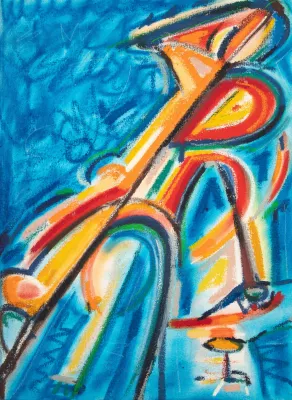
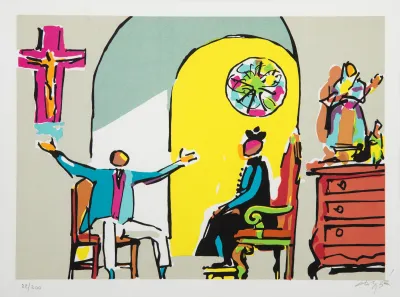
Millôr Fernandes (Rio de Janeiro RJ 19231 - Idem 2012)
Chargist, caricaturist, illustrator, writer, poet, playwright, translator.
Has his first drawing Published in O Jornal, in 1934. At the age of 13, he is hired by the magazine O Cruzeiro, where he performs various tasks of journalistic production: he writes subtitles, pagination and works as an office boy. In search of improvement, he frequents the Liceu de Artes e Ofícios in Rio de Janeiro, between 1938 and 1943. In 1939, after winning a short story contest promoted by the magazine A Cigarra, he is invited by Frederico Chateaubriand to write in the same magazine. Then create the post-written section, signing how Emmanuel Vai Gôgo. With the same pseudonym, he begins to write a column in the Night Diary. Subsequently, he assumes the direction of A Cicada for three years. He also directs Guri, a comic book, and the detective, from police tales. In 1945, he produced the PIF-PAF, a humorous section of the magazine O Cruzeiro, with texts of his authorship also signed as Emmanuel Vai Gôgo and initially illustrated by Péricles (1924 - 1961) and, later, with his own illustrations. In 1964, already removed from O Cruzeiro, he edited the journal Pif-PAF, with only eight editions. Between 1964 and 1974, he collaborates weekly in the newspaper Diário Popular, in Portugal. From 1969 to 1975, O Pasquim participates in the carioca weekly, alongside Jaguar (1932), Tarso de Castro, Sérgio Cabral (1937), Henfil (1944 - 1988), Paulo Francis (1930 - 1997), Ziraldo (1932), among others. In addition to his production in the print media, Millôr presents programs on TV Itacolomi, in Belo Horizonte, and, on TV Tupi, in Rio de Janeiro. He writes poems, texts, adaptations and translations for the theater and screenplays for cinema, publishing dozens of books.
Critical Comment
With his more than 50 continuous years of production, Milton Viola Fernandes, or simply Millôr Fernandes, became an icon of Brazilian humor. Coming from the generation that stands out in the 1950s in magazines such as O Cruzeiro, Millôr's graphic and literary humor witnesses, with an always sharp intelligence, the various cultural and political changes that Brazil goes through in the second half of the 20th century. His intense humorous verve knew how to express himself with mastery in different ways, so much so that Millôr is one of the few Brazilian comedians who does not stand out in one area only: he is a cartoonist, writer, poet, playwright, translator, screenwriter, composer, editor, etc.
But Millôr likes to be seen as a journalist.2 discovers the language of comics in the early 1930s, particularly with American classics of the genre such as Flash Gordon, and early, in 1938, began his career as a continuum and redesign in the then small magazine O cruise. Soon after, still as a student at the Lyceum of Arts and Crafts in Rio de Janeiro, he wins a chronicle contest from the magazine A Cigarra. In a short time, he is signing the magazine's written humor column, with the pseudonym Emmanuel Vai Gôgo. He returns to Cruzeiro and, in 1945, begins the publication of his works in the humor section O PIF-PAF, in a historical partnership with the graphic humorist Péricles (1924 - 1961). Ali publishes some of his most witty works, such as the series of kinetic, geometric and mathematical poems. In 1949, Launches Time and Contratempo, the first collection of his works still under the pseudonym Emmanuel Vai Gôgo.
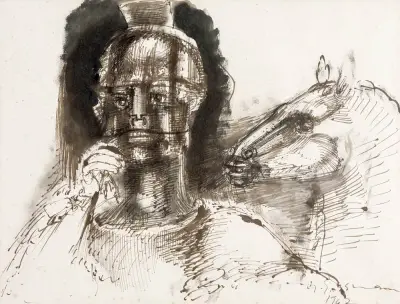
In 1950, the magazine began to stand out, anticipating the success of the entire decade. These years are very productive: in 1953, his first play, a woman in Três Atos, debuted in the Brazilian theater of comedy - TBC, São Paulo. In 1955, he shared the first prize at the International Exhibition of the Museum of Caricature of Buenos Aires with the American artist Saul Steinberg (1914 - 1999). It is noted that Steinberg, alongside the French André François (1915), exerts a strong influence on modern Brazilian humorists, mainly in Millôr Fernandes. As the American artist and caricaturist, Millôr understands drawing as a form of paper thinking and with it he mixes references from high and low culture in his creations. From a formal point of view, the synthetic line, the two-dimensional line as a structure of the three-dimensional form and the appreciation of the white spaces of Steinberg's drawings are elements found in the work of the Brazilian, which is considered one of the modernizers of the humor design among us. In 1956, Millôr began to illustrate all his texts in O Cruzeiro; In 1957, the Museum of Modern Art of Rio de Janeiro - MAM/RJ organizes the first exhibition of his drawings and he begins his series of Hai-Kais. At the end of the 1950s, the magazine O Cruzeiro reached the circulation of 750 thousand copies per week, being Millôr one of those responsible for such success.
The 1960s is marked by profound changes. In 1962, he started to sign Millôr in all the works published in O Cruzeiro. In 1963, he left the magazine in conflicting conditions. In October of this year, the magazine itself publishes The True History of Paradise, a volume that brings together a series of texts and illustrations by Millôr created since the late 1950s on the biblical version of the creation of the world. The story causes irritation to a group of Catholics and, pressured, director Leão Gondim de Oliveira orders the elaboration of an editorial against the artist, exempting himself from responsibility and alleging ignorance of the publication of the story. In Europe, Millôr feels outraged and on the way back he resigns from the magazine, filing a lawsuit in which he wins. It is important to note that at the time, the fact had a lot of repercussion in the artistic and press, with a dinner in solidarity with Millôr being organized.3 Under the episode, he declares: "I feel like a ship abandoning the rats". From then on, Millôr will work in the largest newspapers and magazines in the country, such as Correio da Manhã, Veja, ISTOÉ, Jornal do Brasil, O Dia, O Estado de S. Paulo, Folha de S.Paulo and the Portuguese Diário Popular. In 1964, he launched the weekly Humor Pif-PAF, considered a precursor of the alternative press in Brazil, closed due to financial problems after his eighth number. In the same vein, Millôr was co-founder, in 1969, of the humorous newspaper O Pasquim, whose performance was one of the most important in the fight against the military dictatorship.
closed to the theater, in the mid-1960s, Millôr writes, adapts, translates and participates in several plays, for example: Liberdade, Liberdade, Musical in partnership with Flávio Rangel (1934 - 1988), staged at Teatro Opinião (1965); Musical adaptation only with black actors of memories of a militia sergeant (1966); from the background of the blue of the world, with Elizeth Cardoso (1920 - 1990) and Zimbo Trio (1968); Moment 68, with the participation of Caetano Veloso (1942), among others (1968). His greatest theatrical success is the play É..., written for Fernanda Montenegro (1929) in 1976.
Millôr's vast work is the result of a mind attentive to everyday facts, and ready to interpret them with a humor refined, in which several times literary forms and references and historical facts are reinterpreted to give vent to the humorous discourse. In many cases, the comic effect is achieved by the exploration of one's own language, as in the priceless white paper of humor and in its collection of cretin questions. Time has not cooled its creative power and its cartoons and texts continue to this day almost daily and can be checked on the Millôr Online website, launched in 2000, in which you can also have contact with most of your production.
Notes
1 Millôr Fernandes was born on August 16, 1923, however it is registered on May 27, 1924. Therefore, in several places, the year of birth appears as 1924.
2 In an interview on his website Millôr Online.
3 At the dinner there are present figures such as Fernanda Montenegro, Glauber Rocha (1939 - 1981), Jaguar (1932), Jânio de Freitas, Mário Pedrosa (1900 - 1981), Paulo Francis (1930 - 1997), Rubem Braga (1913 - 1990), Sérgio Porto (1923 - 1968), Tom Jobim (1927 - 1994), Ziraldo (1932), among others.
Criticism
"The most important thing I have to say about Millôr Fernandes is the following: I know that his fame was built for his ability to make irony with style, for his high standards cultural, by the colloquialism used by him and which is more provocative for intelligence than language dead to the taste of academics. Even so, I find something in him that I don't see mentioned and it seems to me fundamental: it is about the revitalization of the Portuguese language resulting from his habit of making the reader read the same word twice, deepening his potential. Distracted, some scholars of their texts saw in this effort a mere taste for the pun (traditional form of humor). made a mistake. The old pun is just a joke, a superficial game, and Millôr uses the reinterpretation of a word to make the reader think. I give as an example the article What is the pasquim, where he talks about freedom of the press in Brazil at the time the pasquim was founded: ...press freedom - the strongest has every right to press the weakest".
Norma Pereira Rego
REGO, Norma Pereira Millôr Fernandes. In: ______. Pasquim: Laughant Pelejas. Rio de Janeiro: Relumá Dumará, 1996. p. 89.
"Admirer of Steinberg and André François, whose works he presented to his friends in Brazil, Millôr developed a drawing of remarkable creativity and virtuosity that deeply marked all the illustrators and caricaturists in the country since The 50's".
Pedro Corrêa do Lago
LAGO, Pedro Corrêa do. Millôr. In: ______. Brazilian caricaturists: 1836-1999. Rio de Janeiro: Sextante Artes, 1999. p. 148.
Individual exhibitions
1957 - Rio de Janeiro RJ - Drawings, NO MAM/RJ
1961 - Rio de Janeiro RJ - Drawings, at Petite Galerie
1975 - Rio de Janeiro RJ - Individual, at the graffiti gallery
Collective exhibitions
1955 - Buenos Aires (Argentina) - Collective, at the Buenos Aires Caricature Museum
1963 - Canada - Canadian Humor Show
1977 - Belo Horizonte MG - 5th Global Winter Hall, at Fundação Palácio das Artes
1977 - Brasília DF - 5th Global Winter Hall
1977 - Rio de Janeiro RJ - 2nd Art Now: Vision of the Earth, at MAM/RJ
1977 - Rio de January RJ - 5th Global Winter Salon, at MNBA
1977 - São Paulo SP - 5th Global Winter Hall, at MASP
1981 - Rio de Janeiro RJ - Pablo, Pablo!: An interpretation Brasileira de Guernica, at the National Art Foundation
1985 - Rio de Janeiro RJ - Velha Mania: Brazilian Drawing, at EAV/Parque Lage
1986 - Porto Alegre RS - Paths of Brazilian Drawing, at the Museum of ART OF RIO GRANDE DO SUL ADO MALAGOLI
1988 - SÃO PAULO SP - 63/66 FIGURE AND OBJECT, AT THE MILLAN GALLERY RJ - Memory Game, at Montesanti Galleria
1989 - São Paulo SP - Memory Game, at Montesanti Roesler Gallery
1997 - Belo Horizonte MG - The graphic humor in the 30s, 40s and 50s, in the Itaú Cultural
1997 - São Paulo SP - The graphic humor in the 30s, 40s and 50s, at Itaú Cultural
1998 - Brasília DF - The graphic humor in the 30s, 40s and 50s, in the Itaugaleria
1998 - Penápolis SP - The graphic humor in the 30s, 40s and 50s, at Itaugaleria
2001 - São Paulo SP - Brazilian caricaturists, at Instituto Cine Cultural
2002 - Austin (United States) - Brazilian Visual Poetry, at the Mexic-Arte Museum
2005 - São Paulo SP - Faces de Mário, at IEB/USP
Source: Itaú Cultural