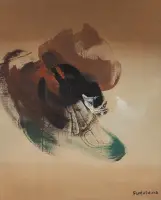
Lívio Abramo (Araraquara SP 1903 - Assunção, Paraguai 1992)
Lívio Abramo was a printmaker, illustrator and draftsman. He moved to São Paulo, where, in 1909, he studied drawing with Enrico Vio (1874-1960) at the Colégio Dante Alighieri. In the early 1920s, he began making illustrations for small newspapers and came into contact with the work of Oswaldo Goeldi (1895-1961) and the production of the German expressionist printmakers. He made his first prints in 1926. In the 1930s, he was influenced by the anthropophagic phase of Tarsila do Amaral (1886-1973). During the Getúlio Vargas government, he joined the Partido Comunista Brasileiro (PCB) [Brazilian Communist Party], from which he was expelled in 1932, and was arrested twice for political reasons. In this same period, he stopped making prints to devote himself to trade unionism. In 1935, he returned to printmaking, incorporating social themes into his work.
In 1947, he illustrated the book Pelo Sertão [Through the Backlands], by Afonso Arinos de Mello Franco, published in 1949 by the Sociedade dos Cem Bibliófilos do Brasil. With this series of illustrations, he took part in the Salão Nacional de Belas Artes (SNBA) [National Salon of Fine Arts], where he received the foreign travel prize. In 1951, he traveled to Europe, and in Paris he attended Atelier 17, refining his intaglio technique with Stanley William Hayter (1901-1988). Back in Brazil in 1953, he was awarded best national printmaker at the 2nd Bienal Internacional de São Paulo. He taught woodcut at the Escola de Artesanato of the Museu de Arte Moderna de São Paulo (MAM/SP), where his students included Maria Bonomi (1935) and Antonio Henrique Amaral (1935). In 1960, he founded the Estúdio Gravura with Maria Bonomi. In 1962, he was invited by Itamaraty [the Brazilian Ministry of Foreign Affairs] to join the Brazil-Paraguay Cultural Mission, later called the Centro de Estudos Brasileiros. He moved to Paraguay, where he headed the Visual Arts Sector until 1992 and was a founder of Paraguay's Institute of Historical and Artistic Heritage.
Critical Commentary
Lívio Abramo began studying drawing with Enrico Vio in 1909. Encouraged by his teacher, he pursued an artistic career, making his first illustrations for small newspapers in the 1920s. Self-taught in printmaking, he produced his works in 1926, working in a rudimentary way with broken blades on pieces of wood, and shortly afterward acquired his first gouges. In 1928 and 1929, he made linocuts for the newspaper Lo Spaghetto, in which he portrayed working-class life in highly simplified forms, in a cubist style. At the end of the decade, he came into contact with the prints of Oswaldo Goeldi and visited exhibitions of the German expressionists, which affected him through the strength and expressiveness of their art, full of color and feeling, embodying the desire for transformation the artist sought to define in his work.
In the early 1930s, Lívio Abramo's work was strongly influenced by the anthropophagy movement, showing broad, rounded forms in the style of Tarsila do Amaral, with stylized landscape elements and distorted figures. During the Vargas period, he entered politics and joined the Partido Comunista Brasileiro (PCB), from which he was expelled in 1932, accused of being a Trotskyist. He joined the Partido Socialista Brasileiro (PSB) [Brazilian Socialist Party] the following year and became a friend of the art critic Mário Pedrosa (1900-1981). In 1931, he began working at the Diário da Noite as a draftsman, but his cartoons, such as Inundação no Canindé [Flood in Canindé], c.1932, were considered too critical; he was then assigned to the post of headline writer for the international section, where he remained until 1962. At the same time, he devoted himself to trade unionism. In the mid-1930s, he incorporated social themes into his works, also as a result of his political engagement. In the works of his working-class phase as well as in those dealing with war, he followed the expressionist language, marked by the drama and monumentality of the scenes. Shaken by the Spanish Civil War (1936-1939), he produced the series Espanha [Spain], 1938, with forceful prints that reveal his opposition to the conflict.
In the 1940s, he met the German printmaking teacher Adolphe Köhler, who helped him bring technical refinement to his work, both in the treatment of the wood used for the blocks and in the use of more sophisticated, multi-lined burins, which cut the wood in several parallel lines with a single stroke, producing distinct and varied tones. In 1947, he illustrated the book Pelo Sertão, by Afonso Arinos de Mello Franco, published by the Sociedade dos Cem Bibliófilos do Brasil, with woodcuts on rice paper. For this work, he traveled to the caatinga region of Minas Gerais and Bahia and read Mário de Andrade (1893-1945) and Euclides da Cunha (1866-1909). He moved away from the expressionist aesthetic and sought a new formal solution, more spare and synthetic. The use of end-grain wood allows more delicate cuts, which, combined with new tools, serve to better express his conception of light, color and form in the Brazilian landscape.
In the following years, he began the drawings, gouaches and watercolors of the Macumba series, which show his interest in capturing rhythm and dance. He later made woodcuts on this theme, which achieved greater intensity, with the heightened sensuality of the lines in the alternation of areas of light and dense shadow.
He traveled to Europe in 1951, with the foreign travel prize from the Salão Nacional de Belas Artes. He attended the studio of Stanley William Hayter and perfected his intaglio technique. Returning from Europe, he produced the print series Rio, c.1953, Festa [Feast], c.1954, and Mandala, c.1955, with an abstracting tendency, in which he better crystallized his graphic language, enhanced by the diversity of tones and textures that articulate figures and planes. With the Rio series, he was awarded best national printmaker at the 2nd Bienal Internacional de São Paulo.
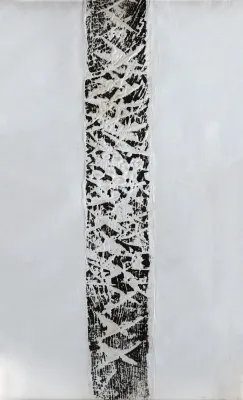
He taught woodcut at the Escola de Artesanato of the Museu de Arte Moderna de São Paulo (MAM/SP), and, in 1960, founded the Estúdio Gravura with Maria Bonomi. In 1962, he settled in Paraguay and worked at the Brazil-Paraguay Cultural Mission, later the Centro de Estudos Brasileiros. In the prints of his Paraguayan phase, he recreates the country's landscape, working with stippling and lines that resemble the very delicate local lace, ñandutí. The simplification of form intensifies; horizontal and vertical elements predominate, giving an intense, lyrical and at times dramatic rhythm to nearly abstract compositions, in which the artist does not lose his visual reference, seeking to translate the geometry of the house façades and villages.
Lívio Abramo's production lies between figuration and abstraction. His commitment to the modernist program was gradually altered by his openness to the non-figurative currents that began arriving in Brazil after World War II (1939-1945). The artist manages to reconcile these two opposing concepts in a singular way and, with technical refinement, presents in his work formal solutions of great aesthetic interest.
Critiques
"His art is characterized precisely by this deep identification between it and the artist. Hence its main mark is the impetus of the line, which only bends, only curves, either when exhausting itself in its initial impulse or on meeting another, greater force. The impetus of the line and also the breadth of his spatial sense betray the artist's Italian ancestry. The breath of his inspiration, however, comes entirely from the warmth and sensuality of tropical nature and from the nostalgic drama and monumental roughness of the urban landscape of São Paulo and Rio.
For a long time, Abramo was a truly, authentically social artist, for the immediate landscape in which his own life unfolded marked him indelibly with the drama of human misery and the everyday heroism - somber, impersonal, without romanticism and without rapture - of modern proletarian labor.
(...)
After the stylistic effort of the Pelo Sertão prints, Lívio devotes himself to the direct interpretation of the surrounding urban nature and of primary, global themes, such as macumba. In contrast to the preceding prints, we now have a magnificent series of drawings, truly 'freehand'. The artist has gained greater freedom within a discipline no longer so directly dictated by functional necessity, whether that of the gouge or burin or of the material he works in. Human and animal themes no longer bewitch the artist through their anecdotal or merely sentimental side. The pencil, ink and watercolor drawings he has given us more recently stand out above all for the more synthetic power of the lines, a greater economy of planes and a more refined and expressive construction, in which the dramatic and rigorously structured character of the whole stands out. His art reaches a higher plastic balance, at once more sober and richer. His macumba figures take on a Gothic verticality, a plastic vigor they never had in Brazilian art. Lívio Abramo's macumba is stripped of any anecdotal detail and any exotic primitivism, so that all that remains is a ritual of so hieratic, so plastic an order that it rises to the universality of a noble religious ceremony of high antiquity".
Mário Pedrosa
PEDROSA, Mário. Despedida de Lívio Abramo. In: ______. Acadêmicos e modernos: textos escolhidos III. Organização Otília Beatriz Fiori Arantes. São Paulo: Edusp, 1998. p. 225-226
"Against, but at times concurrent with, this anthropophagic strand that was beginning to take shape in Lívio Abramo's then barely begun career, there would clash his need to bring into the sphere of his graphic production a political discourse explicitly aimed at denouncing the struggles, ills and demands of the socially subordinate classes, in Brazil and abroad.
For this social commitment to gain strength and gradually displace - at least temporarily - the need Abramo always felt to produce a modern and at the same time 'Brazilian' iconography, his visits to three exhibitions of German art held in São Paulo were fundamental. (...)
It was through these direct contacts with impressive examples of a printmaking committed to unmasking the injustices of capitalist society, as a first step toward a definitive push toward socialism, that Abramo gained enough stimulus to set out more decisively on translating his ideological concerns into printmaking. This direction would gradually cause the Matissean treatment of the support, as well as the initial mythical themes, to give way to an iconography revealing the need to conceive a figuration of a more analogical nature. Some prints in the Espanha series (above all the most emblematic, from 1937) retain a dramatically engaged tone, very much in keeping with the verist proselytism that expressionist realism took on in the work of some artists.
As the explicit commitment to denouncing the ills of capitalism and the suffering caused by wars gradually wore out, a very great conflict, already mentioned, can be seen in Lívio Abramo's career: on the one hand, a desire to take up again the need to create an iconography both current and typically Brazilian; on the other, to open up to or oppose the challenge that the international non-figurative currents posed to local artists.
The need to maintain the program of early modernism and, at the same time, the pressure to open up to the non-figurative manifestations arriving forcefully in Brazil in the immediate postwar period would become the great dilemma for a significant number of local artists tied to the commitments of the modernism of the first half of the 20th century.
Faced with these two options, in theory mutually exclusive, Brazilian artists would take different positions. While some sought to remain faithful to the original figurative nationalism, becoming caustic opponents of non-figuration, others would at first unconditionally embrace the new wave, while still others would seek intermediate plastic positions, in some way problematically conciliatory from a formal point of view, resulting in works of strong artistic and aesthetic interest. Lívio Abramo would clearly be placed in this third situation.
In the transition from the 1940s to the following decade, the concern with the technical and formal refinement of his prints gained greater relevance, while the need to take up again his old concern with creating a genuinely Brazilian work clashed with the challenges posed by non-figuration.
In his production of the early 1950s, in which the landscape of Rio de Janeiro served as a stimulus for creating a new iconography, a strong abstracting character can be seen. Neither figurative nor abstract, yet bringing into the field of the work - through the contiguity of stylistic procedures from these conflicting origins - the debate that was becoming ever more intense in Brazil, these prints by Abramo are already the first important signs of this problematic reconciliation of opposites present in Brazilian art of the immediate postwar period".
Tadeu Chiarelli
MATRIZES do expressionismo no Brasil: Abramo, Goeldi e Segall. São Paulo: MAM, 2000 p.16.
Testimonials
"For a long time O Jornal, in Rio de Janeiro, published every Saturday - or Sunday, I do not remember exactly - in a Literary Supplement, a print by Oswaldo Goeldi, who had arrived from Europe in 1919. Goeldi came from that group of expressionist printmakers formed during World War I in Europe, which included great artists, from Kokoschka to Kubin. (...) I saw his work and liked it very much. Around the same time, in 1927 or 1928, I once happened to walk into the German Trade Office that existed on Rua José Bonifácio. In an enormous hall I saw an exhibition of fabulous German printmakers, and of the Bauhaus in its first phase. There was a magnificent collection of original prints by all the German expressionist printmakers - Heckel, Schmidt-Rottluff, Barlach, Lyonel Feininger, Käthe Kollwitz -; of Käthe Kollwitz alone there were more than ten fabulous prints. All the German expressionists were there, each print better than the last. Well, after that exhibition, I decided: 'That is what I want to do!' It was Goeldi's prints and the German ones that awakened in me the desire to make prints. Leaving that exhibition, I went home, took a razor blade and a piece of wood and made my first print; then I got a gouge, then two, and that is how I began to make prints.
I went back to drawing in 1947, 1948, when the Sociedade dos Cem Bibliófilos do Brasil commissioned me to illustrate the book Pelo Sertão, by Afonso Arinos. Then I set about studying the life and landscape of the Brazil of northern Minas Gerais, southern Bahia, the caatinga region, the real sertão, in order to illustrate this book. It deals with stories of the sertão, and it was the first Brazilian book to treat these typically Brazilian stories in novella form. I made 37 end-grain woodcuts and more than 20 or 30 linoleum vignettes. In this work I changed my style; I tried to change my language.
I only made lithographs in 1979, in an exhibition at Graphus [art gallery], with eleven lithographs. I am now making a series of six lithographs at Elcio Motta's studio.
In 1931, when I began working for newspapers, I was still influenced by the anthropophagy movement, more intellectually than in form, but in 1933 I was influenced by the tropical, plump, rounded forms of Tarsila do Amaral's style (...). Later, in the working-class phase, and also in the works on the Spanish Civil War and on the wartime bombings, I followed the expressionist manner, because it is a passionate, forceful, very strong way of saying things, and I think that for these situations in which passion and feeling come in, expressionism was the most fitting language. With the defeat of Spain, of Poland, of France, we all felt defeated, and we thought we would all end up lost. There was a sense of emptiness that put an end to all the dreams of a generation. Then I stopped making prints; I spent years and years doing nothing. When later I was offered that proposal to illustrate Afonso Arinos's book, I was already another person. So I devoted myself to studying photographs; (...) I saw that Brazil offered me other formal solutions that did not suit the expressionist manner. (...) There was a great deal of realism in that book by Afonso Arinos, very little romanticism, so I sought a sparer form, ever more synthetic, greatly stylizing the figures".
Lívio Abramo a Vera D'Horta Beccari
BECCARI, Vera D'Horta. A busca de uma nova linguagem formal para a gravura. In: ABRAMO, Lívio. Xilogravuras. São Paulo: Centro Cultural São Paulo, 1983. p. 13-25.
Solo Exhibitions
1944 - São Paulo SP - Solo, at Ateliê de Clóvis Graciano
1948 - Rome (Italy) - Solo, at Studio D'Arte Palma
1950 - São Paulo SP - Lívio Abramo: Retrospective, at MAM/SP
1951 - São Paulo SP - Lívio Abramo: Drawings and Watercolors, at Galeria Domus
1955 - Montevideo (Uruguay) - Lívio Abramo, at Salão Municipal de Montevidéu
1955 - São Paulo SP - Lívio Abramo: Drawings and Prints, at MAM/SP
1956 - Asunción (Paraguay) - Solo, at Instituto Cultural Brasil-Paraguai
1956 - Buenos Aires (Argentina) - Lívio Abramo, Prints and Drawings, at Galeria Bonino
1956 - Montevideo (Uruguay) - Solo, at Salón Municipal de Montevidéu
1957 - Rio de Janeiro RJ - Lívio Abramo: Print, Drawing and Gouache, at MAM/RJ
1960 - São Paulo SP - Lívio Abramo: Drawings and Prints, at Centro Cultural Brasil-Israel
1967 - Asunción (Paraguay) - Lívio Abramo: Retrospective of Drawings and Prints, at Galeria da Missão Cultural Brasileira
1970 - São Paulo SP - Lívio Abramo: Retrospective, at Galeria Ars Mobile
1972 - São Paulo SP - Lívio Abramo: Retrospective, at MAM/SP
1974 - Asunción (Paraguay) - Lívio Abramo: Prints and Drawings, at Galeria da Missão Cultural Brasileira
1974 - Brussels (Belgium) - Lívio Abramo: Printmaking, at Palais Royal
1974 - Washington (United States) - Solo, at Centro de Estudos Brasileiros
1976 - São Paulo SP - Lívio Abramo: Retrospective, at Fundação Bienal
1977 - Asunción (Paraguay) - Lívio Abramo: Prints and Drawings, at Galeria Sanos
1977 - Rio de Janeiro RJ - Lívio Abramo: Retrospective, at MAM/RJ
1979 - Asunción (Paraguay) - Drawings by Lívio Abramo, at Galeria Graphus
1982 - Asunción (Paraguay) - Drawings by Lívio Abramo, at Galeria da Missão Cultural Brasileira
1983 - São Paulo SP - Solo, at Biblioteca Municipal Mário de Andrade
1983 - São Paulo SP - Lívio Abramo: Woodcuts, at CCSP
1984 - São Paulo SP - Lívio Abramo: Records of a Journey, at MAM/SP
1986 - Asunción (Paraguay) - Lívio Abramo: Watercolors, at Centro de Estudos Brasileiros
1987 - Asunción (Paraguay) - Lívio Abramo: Lithograph, Prints and Watercolors, at Centro de Estudos Brasileiros
1989 - Mexico City (Mexico) - The Parthenon Friezes, at Museo de Arte Moderno
1990 - Rio de Janeiro RJ - Lívio Abramo: Woodcuts, at MNBA
1990 - San José (Costa Rica) - Lívio Abramo: Prints, at Embaixada do Brasil
1990 - São Paulo SP - Lívio Abramo: Woodcuts, at Museu Lasar Segall
1991 - Porto Alegre RS - Lívio Abramo: Woodcuts, at Espaço Cultural BFB
Group Exhibitions
1935 - São Paulo SP - 2nd São Paulo Fine Arts Salon
1935 - São Paulo SP - 3rd São Paulo Fine Arts Salon
1937 - São Paulo SP - 1st Salão de Maio, at Esplanada Hotel
1938 - São Paulo SP - 2nd Salão de Maio, at Esplanada Hotel
1939 - São Paulo SP - 3rd Salão de Maio, at Galeria Itá
1939 - São Paulo SP - 5th Salon of the Visual Artists' Union, at Galeria Prestes Maia
1941 - São Paulo SP - 1st Art Salon of the National Industries Fair
1944 - Belo Horizonte MG - Modern Art Exhibition, at Edifício Mariana
1944 - London (England) - Exhibition of Modern Brazilian Paintings, at Royal Academy of Arts
1944 - Norwich (England) - Exhibition of Modern Brazilian Paintings, at Norwich Castle and Museum
1944 - São Paulo SP - Brazilian-North American Modern Painting Exhibition, at Galeria Prestes Maia
1945 - Bath (England) - Exhibition of Modern Brazilian Paintings, at Victory Art Gallery
1945 - Bristol (England) - Exhibition of Modern Brazilian Paintings, at Bristol City Museum & Art Gallery
1945 - Edinburgh (Scotland) - Exhibition of Modern Brazilian Paintings, at National Gallery
1945 - Glasgow (Scotland) - Exhibition of Modern Brazilian Paintings, at Kelvingrove Art Gallery
1945 - Manchester (England) - Exhibition of Modern Brazilian Paintings, at Manchester Art Gallery
1945 - São Paulo SP - Galeria Domus: Inaugural Exhibition, at Galeria Domus
1948 - Rio de Janeiro RJ - 54th National Salon of Fine Arts - Modern Division, at MNBA - silver medal
1949 - Salvador BA - 1st Bahia Fine Arts Salon, at Hotel Bahia
1950 - Rio de Janeiro RJ - 56th National Salon of Fine Arts - Modern Division, at MNBA - foreign travel prize
1950 - Venice (Italy) - 25th Venice Biennale
1951 - São Paulo SP - 1st Bienal Internacional de São Paulo, at Pavilhão do Trianon - special room
1952 - Feira de Santana BA - 1st Feira de Santana Modern Art Exhibition, at Banco Econômico
1952 - Rio de Janeiro RJ - Exhibition of Brazilian Artists, at MAM/RJ
1952 - Tokyo (Japan) - International Art Exhibition, at Mainichi Newspapers
1952 - Venice (Italy) - 26th Venice Biennale
1953 - São Paulo SP - 2nd Bienal Internacional de São Paulo, at Pavilhão dos Estados - best national printmaker prize
1954 - Geneva (Switzerland) - Brazilian Printmakers, at Museu Rath
1954 - Salvador BA - 4th Bahia Fine Arts Salon, at Hotel Bahia
1954 - São Paulo SP - Contemporary Art: Exhibition of the Collection of the Museu de Arte Moderna de São Paulo, at MAM/SP
1954 - Venice (Italy) - 27th Venice Biennale
1955 - Lugano (Switzerland) - Incisioni e Disegni Brasiliani, at Villa Ciani
1955 - Salvador BA - 5th Bahia Fine Arts Salon, at Belvedere da Sé
1955 - São Paulo SP - 3rd Bienal Internacional de São Paulo, at MAM/SP
1955 - São Paulo SP - 4th São Paulo Salon of Modern Art, at Galeria Prestes Maia
1956 - Rome (Italy) - Disegni di Aldemir Martins, Xilografie di Livio Abramo
1956 - São Paulo SP - 50 Years of Brazilian Landscape, at MAM/SP
1957 - São Paulo SP - 4th Bienal Internacional de São Paulo, at MAM/SP
1958 - Venice (Italy) - 29th Venice Biennale
1959 - Leverkusen (Germany) - First Group Exhibition of Brazilian Artists in Europe
1959 - Munich (Germany) - Brazilian Modern Art in Europe, at Kunsthaus
1959 - Rio de Janeiro RJ - 30 Years of Brazilian Art, at Galeria Macunaíma/Diretório Acadêmico da Escola Nacional de Belas Artes
1959 - Vienna (Austria) - First Group Exhibition of Brazilian Artists in Europe
1960 - Hamburg (Germany) - First Group Exhibition of Brazilian Artists in Europe
1960 - Jerusalem (Israel) - 12 Brazilian Artists, at Bezalel Museum Jerusalem
1960 - Madrid (Spain) - First Group Exhibition of Brazilian Artists in Europe
1960 - Paris (France) - First Group Exhibition of Brazilian Artists in Europe
1960 - São Paulo SP - 12 Brazilian Artists, at Bezalel Museum Jerusalem
1960 - São Paulo SP - Leirner Collection, at Galeria de Arte da Folha
1960 - Utrecht (Netherlands) - First Group Exhibition of Brazilian Artists in Europe
1961 - Rio de Janeiro RJ - The Face and the Work, at Galeria Ibeu Copacabana
1961 - São Paulo SP - 6th Bienal Internacional de São Paulo, at Pavilhão Ciccillo Matarazzo Sobrinho - special room
1961 - São Paulo SP - Ateliê Abramo Bonomi
1962 - São Paulo SP - Selection of Brazilian Artworks from the Ernesto Wolf Collection, at MAM/SP
1963 - São Paulo SP - 7th Bienal Internacional de São Paulo, at Fundação Bienal - best Brazilian printmaker prize
1965 - São Paulo SP - 8th Bienal Internacional de São Paulo, at Fundação Bienal
1966 - Ribeirão Preto SP - 40 Brazilian and Foreign Prints from the MAC Collection, at Escola de Artes Plásticas de Ribeirão Preto
1966 - São Paulo SP - 40 Brazilian and Foreign Prints from the MAC Collection, at MAC/USP
1967 - Goiânia GO - Printmaking Educational Exhibition, at Museu Estadual Zoroastro Artiaga
1968 - Piracicaba SP - 40 Brazilian and Foreign Prints from the MAC Collection, at Esalq/USP
1970 - Olinda PE - 40 Brazilian and Foreign Prints from the MAC Collection, at MAC/PE
1970 - Penápolis SP - 40 Brazilian and Foreign Prints from the MAC Collection
1970 - São Paulo SP - Brazilian Printmaking, at Paço das Artes
1971 - São Paulo SP - 11th Bienal Internacional de São Paulo, at Fundação Bienal
1972 - São Paulo SP - 2nd International Printmaking Exhibition, at MAM/USP
1973 - São Paulo SP - 12th Bienal Internacional de São Paulo, at Fundação Bienal
1974 - São Paulo SP - Brazilian Printmaking Exhibition, at Fundação Bienal
1976 - São Paulo SP - The Salons: Família Artística Paulista, Salão de Maio and the São Paulo Visual Artists' Union, at Museu Lasar Segall
1978 - São Paulo SP - Art and Its Processes: Paper as Support, at Pinacoteca do Estado
1979 - São Paulo SP - 15th Bienal Internacional de São Paulo, at Fundação Bienal
1980 - Rio de Janeiro RJ - Tribute to Mário Pedrosa, at Galeria Jean Boghici
1981 - Belo Horizonte MG - Hilton Printmaking Highlights, at Palácio das Artes
1981 - Brasília DF - Hilton Printmaking Highlights, at ECT Galeria de Arte
1981 - Curitiba PR - Hilton Printmaking Highlights, at Casa da Gravura Solar do Barão
1981 - Florianópolis SC - Hilton Printmaking Highlights, at Museu de Arte de Santa Catarina
1981 - Porto Alegre RS - Hilton Printmaking Highlights, at Margs
1981 - Recife PE - Hilton Printmaking Highlights, at MAM/PE
1981 - Rio de Janeiro RJ - Hilton Printmaking Highlights, at MAM/RJ
1981 - Salvador BA - Hilton Printmaking Highlights, at Teatro Castro Alves
1981 - São Paulo SP - Hilton Printmaking Highlights, at MAM/SP
1982 - Penápolis SP - 5th Noroeste Visual Arts Salon, at Fundação Educacional de Penápolis. Faculdade de Filosofia, Ciências e Letras de Penápolis
1982 - São Paulo SP - From Modernism to the Bienal, at MAM/SP
1982 - São Paulo SP - Six Expressionist Printmakers of Brazil: Segall, Goeldi, Abramo, Renina, Poty, Grassmann, at Museu Lasar Segall
1983 - Olinda PE - 2nd Exhibition of the Abelardo Rodrigues Visual Arts Collection, at MAC/PE
1983 - Olinda PE - Exhibition of the Abelardo Rodrigues Visual Arts Collection, at MAC/PE
1983 - Rio de Janeiro RJ - 6th National Visual Arts Salon, at MAM/RJ
1984 - Curitiba PR - 6th Woodcut in the History of Brazilian Art, at Casa Romário Martins
1984 - Curitiba PR - 6th Prints from the Oriental Republic of Paraguay, at Centro Cultural São Lourenço
1984 - Curitiba PR - 6th Curitiba City Printmaking Show, at Fundação Cultural de Curitiba
1984 - Ourinhos SP - Tribute to the Art of Printmaking in Brazil, at Itaugaleria
1984 - Porto Alegre RS - Printmaking: A Journey Through Time, at Centro de Arte Cambona
1984 - Ribeirão Preto SP - Brazilian Printmakers of the 1950s/60s, at Galeria Campus - USP-Banespa
1984 - Rio de Janeiro RJ - Woodcut in the History of Brazilian Art, at Funarte. Galeria Sérgio Milliet
1984 - São Paulo SP - Tradition and Rupture: A Synthesis of Brazilian Art and Culture, at Fundação Bienal
1985 - Rio de Janeiro RJ - 8th National Visual Arts Salon, at MAM/RJ
1985 - São Paulo SP - 100 Itaú Works, at MAM/SP
1985 - São Paulo SP - 18th Bienal Internacional de São Paulo, at Fundação Bienal
1985 - São Paulo SP - Highlights of Brazilian Contemporary Art, at MAM/SP
1986 - Curitiba PR - Collection of the Museu Nacional da Gravura - Casa da Gravura, at Museu Guido Viaro
1986 - Rio de Janeiro RJ - Seven Decades of Italian Presence in Brazilian Art, at Paço Imperial
1987 - Brasília DF - Missions 300 Years: The Artist's View, at Teatro Nacional de Brasília
1987 - Paris (France) - Modernity: 20th-Century Brazilian Art, at Musée d'Art Moderne de la Ville de Paris
1987 - Rio de Janeiro RJ - Rio de Janeiro, February, March: From Modernism to the 1980s Generation, at Galeria de Arte Banerj
1987 - São Paulo SP - The Biennials in the MAC Collection: 1951 to 1985, at MAC/USP
1988 - Lisbon (Portugal) - Pioneers and Disciples, at Centro de Arte Moderna José de Azeredo Perdigão
1988 - Porto Alegre RS - Missions 300 Years: The Artist's View, at Centro Cultural da Universidade Federal do Rio Grande do Sul
1988 - Ribeirão Preto SP - Lívio Abramo, Iberê Camargo and Amilcar de Castro, at Casa da Cultura de Ribeirão Preto
1988 - Rio de Janeiro RJ - Missions 300 Years: The Artist's View, at EAV/Parque Lage
1988 - São Paulo SP - MAC 25 Years: Recent Acquisitions and Donations, at MAC/USP
1988 - São Paulo SP - Missions 300 Years: The Artist's View, at Masp
1988 - São Paulo SP - Modernity: 20th-Century Brazilian Art, at MAM/SP
1989 - Rio de Janeiro RJ - Brazilian Printmaking: 4 Themes, at EAV/Parque Lage
1990 - Goiânia GO - 20 Years of the Museu de Arte de Goiânia, at Museu de Arte
1990 - São Paulo SP - The Art Collection of the City of São Paulo, at Masp
1991 - Curitiba PR - Museu Municipal de Arte: Collection, at Museu Municipal de Arte
1991 - São Paulo SP - 21st Bienal Internacional de São Paulo, at Fundação Bienal
1991 - São Paulo SP - Records and Impressions: Seminal Artists, at Casa das Rosas
1992 - Curitiba PR - 10th Curitiba City Printmaking Exhibition/America Exhibition, at Museu da Gravura
1992 - Rio de Janeiro RJ - Fine Art Printmaking in Brazil: A Proposal for Mapping, at CCBB
1992 - São Paulo SP - Sérgio's View of Brazilian Art: Drawings and Paintings, at Biblioteca Mário de Andrade
Posthumous Exhibitions
1992 - Rio de Janeiro RJ - 1st On the Way to Niterói: João Sattamini Collection, at Paço Imperial
1992 - Santo André SP - Lithography: Methods and Concepts, at Paço Municipal
1993 - Curitiba PR - Lívio Abramo: Woodcuts, at Museu da Cidade de Curitiba
1993 - João Pessoa PB - Woodcut: From Cordel to the Gallery, at Funesc
1993 - Rio de Janeiro RJ - Brazil, 100 Years of Modern Art, at MNBA
1993 - São Paulo SP - Works for Illustrating the Literary Supplement: 1956-1967, at MAM/SP
1993 - São Paulo SP - Representation: Decisive Presences, at Paço das Artes
1994 - Poços de Caldas MG - Unibanco Collection: Exhibition Celebrating Unibanco's 70th Anniversary, at Casa da Cultura de Poços de Caldas
1994 - Rio de Janeiro RJ - Trenches: Art and Politics in Brazil, at MAM/RJ
1994 - São Paulo SP - Bienal Brasil Século XX, at Fundação Bienal
1994 - São Paulo SP - Brazil-Paraguay, at Galeria do Memorial da América Latina
1994 - São Paulo SP - Prints: Subtleties and Mysteries, Printing Techniques, at Pinacoteca do Estado
1994 - São Paulo SP - Poetics of Resistance: Aspects of Brazilian Printmaking, at Galeria de Arte do Sesi
1994 - São Paulo SP - Woodcut: From Cordel to the Gallery, at Metrô
1995 - Rio de Janeiro RJ - Unibanco Collection: Exhibition Celebrating Unibanco's 70th Anniversary, at MAM/RJ
1995 - São Paulo SP - Unibanco Collection: Exhibition Celebrating Unibanco's 70th Anniversary, at Instituto Moreira Salles
1996 - São Paulo SP - Ex Libris/Home Page, at Paço das Artes
1997 - Barra Mansa RJ - Contemporary Lines: Tribute to Brazilian Printmaking, at Centro Universitário de Barra Mansa
1998 - São Paulo SP - Impressions: The Art of Brazilian Printmaking, at Espaço Cultural Banespa Paulista
1998 - São Paulo SP - The Collector, at MAM/SP
1998 - São Paulo SP - The Modern and the Contemporary in Brazilian Art: Gilberto Chateaubriand Collection - MAM/RJ, at Masp
1998 - São Paulo SP - The Collectors - Guita and José Mindlin: Matrices and Prints, at Galeria de Arte do Sesi
1999 - Rio de Janeiro RJ - Mostra Rio Gravura. Armando Sampaio Collection: Brazilian Printmaking, at Centro de Artes Calouste Gulbenkian
1999 - Rio de Janeiro RJ - Mostra Rio Gravura. Brazilian Modern Printmaking: Museu Nacional de Belas Artes Collection, at MNBA
1999 - Rio de Janeiro RJ - Mostra Rio Gravura. Lívio Abramo, at Espaço Cultural dos Correios
1999 - São Paulo SP - Everyday/Art. Consumption - Metamorphosis of Consumption, at Itaú Cultural
1999 - São Paulo SP - Lithography: Fidelity and Memory, at Espaço de Artes Unicid
1999 - São Paulo SP - On Paper, Graphite and India Ink, at Banco Cidade
2000 - Florianópolis SC - Lívio Abramo: Drawings, Prints and Watercolors, at Museu Victor Meirelles
2000 - Lisbon (Portugal) - Brasil-brasis: cousas notaveis e espantosas [Brazil-Brazils: Notable and Astonishing Things]. Modernist Views, at Museu do Chiado
2000 - Lisbon (Portugal) - 20th Century: Art of Brazil, at Fundação Calouste Gulbenkian
2000 - Rio de Janeiro RJ - Matrices of Expressionism in Brazil: Abramo, Goeldi and Segall, at Paço Imperial
2000 - São Paulo SP - Brasil + 500 Rediscovery Exhibition. Modern Art, at Fundação Bienal
2000 - São Paulo SP - Release of the video Gravura e Gravadores [Printmaking and Printmakers], a documentary directed by Olívio Tavares de Araújo and produced by Itaú Cultural, with statements by the artist and other printmakers
2000 - São Paulo SP - Investigations. Brazilian Printmaking, at Itaú Cultural
2000 - São Paulo SP - Matrices of Expressionism in Brazil: Abramo, Goeldi and Segall, at MAM/SP
2000 - São Paulo SP - The Role of Art, at Galeria de Arte do Sesi
2000 - São Paulo SP - São Paulo: From Village to Metropolis, at Galeria Masp Prestes Maia
2000 - Valencia (Spain) - De la Antropofagia a Brasília: Brasil 1920-1950, at IVAM. Centre Julio González
2001 - Brasília DF - Investigations. Brazilian Printmaking, at Itaú Cultural
2001 - Penápolis SP - Investigations. Brazilian Printmaking, at Itaú Cultural
2001 - Rio de Janeiro RJ - Blind Mirror: Selections from a Contemporary Collection, at Paço Imperial
2001 - Rio de Janeiro RJ - The Spirit of Our Time, at MAM/RJ
2001 - Santo André SP - 1st Santo André Printmaking Biennial
2001 - São Paulo SP - Blind Mirror: Selections from a Contemporary Collection, at MAM/SP
2001 - São Paulo SP - Museu de Arte Brasileira: 40 Years, at MAB/Faap
2001 - São Paulo SP - The Spirit of Our Time, at MAM/SP
2002 - Niterói RJ - Collection on Paper, at MAC/Niterói
2002 - Niterói RJ - Sattamini Collection: Moderns and Contemporaries, at MAC/Niterói
2002 - Rio de Janeiro RJ - Brazilian Art in the Fadel Collection: From the Restlessness of the Modern to the Autonomy of Language, at CCBB
2002 - São Paulo SP - Brazilian Art in the Fadel Collection: From the Restlessness of the Modern to the Autonomy of Language, at CCBB
2002 - São Paulo SP - Art and Politics, at MAM/Higienópolis
2002 - São Paulo SP - From Anthropophagy to Brasília: Brazil 1920-1950, at MAB/Faap
2002 - São Paulo SP - Wild Mirror: Modern Art in Brazil in the First Half of the 20th Century, Nemirovsky Collection, at MAM/SP
2002 - São Paulo SP - Modernism: From the Week of '22 to Sérgio Milliet's Art Section, at CCSP
2003 - Brasília DF - Brazilian Art in the Fadel Collection: From the Restlessness of the Modern to the Autonomy of Language, at CCBB
2003 - Rio de Janeiro RJ - Brazilian Art: From the 1930 Revolution to the Postwar Period, at MAM/RJ
2003 - São Paulo SP - Printmaking Is Doing Well, Thank You: Historical and Contemporary Brazilian Printmaking, at Espaço Virgílio
2003 - São Paulo SP - Art and Society: A Controversial Relationship, at Itaú Cultural
2003 - São Paulo SP - Lívio Abramo: 100 Years, at MAM/SP
2003 - São Paulo SP - Lívio Abramo: Art for Architecture, at Fundação Maria Luisa e Oscar Americano
2004 - Belo Horizonte MG - Pampulha, Collected Works: 1943-2003, at MAP
2004 - Niterói RJ - Transitive Modernity, at MAC/Niterói
2004 - São Paulo SP - Paper Cabinet, at CCBB
2004 - São Paulo SP - New Acquisitions: 1995 - 2003, at MAB/Faap
Collections
Acervo Banco Itaú S.A. (São Paulo, SP)
Acervo da Pinacoteca do Estado de São Paulo/Brasil
Coleção de Artes Visuais do Instituto de Estudos Brasileiros - USP (São Paulo, SP)
Coleção Museu de Arte Moderna de São Paulo - SP
Museus Castro Maya - IPHAN/MinC (Rio de Janeiro, RJ)
Source: Itaú Cultural