
Karl Plattner (Valle Venosta Itália 1919 - Milão Itália 1986)
Karl Plattner was a painter, draftsman and teacher. He began his art studies in Florence in 1946, moving to Milan the following year. In 1948, he attended the Académie de la Grande Chaumière in Paris, where he studied with André Lhote (1885 - 1962). In 1952, he exhibited at the 1st National Salon of Modern Art (SNAM) in Rio de Janeiro. He held solo exhibitions at the Museu de Arte Moderna de São Paulo (MAM/SP) in 1952, 1953 and 1954. He took part in the São Paulo International Biennial in 1953, 1955, 1957 and 1959 and, in 1956, was part of the Brazilian delegation to the 28th Venice Biennale, in Italy. While living in Brazil, he taught Maria Bonomi (1935), Gisela Eichbaum (1920 - 1996) and Wesley Duke Lee (1931 - 2010).
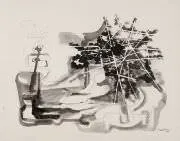
He returned to Italy in 1954 after winning a prize to create a mural in the city of Bolzano. In 1956, back in Brazil, he was awarded a silver medal at the São Paulo Salon of Modern Art and worked on a mural for the newspaper Folha de S. Paulo, whose unveiling was accompanied by a solo exhibition. That same year, one of his drawings appeared on the cover of the first issue of the Suplemento Literário of O Estado de S. Paulo; in 1993, this work was included in an exhibition of illustrations from that supplement at MAM/SP. In 1957, he held a solo exhibition at the Museu de Arte Moderna do Rio de Janeiro (MAM/RJ). From 1958, settling permanently in Europe, he went on to paint murals in Italy, France and Austria.
Critical Commentary
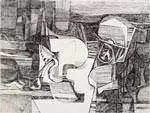
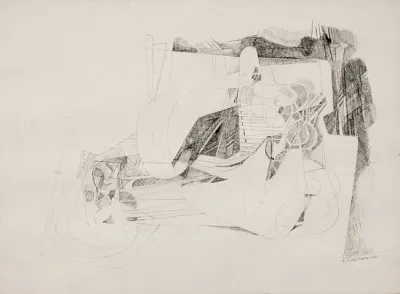
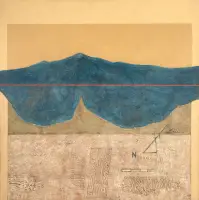
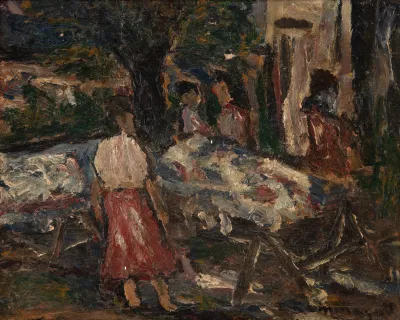
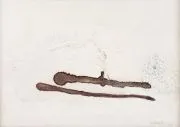
During the 1950s, the work of Karl Plattner, then living in São Paulo, retained an expressionist streak, particularly in his treatment of the human figure, as well as a certain geometrization in his landscapes. The 1950s and early 1960s were a period in which abstraction, both geometric and informal, became firmly established in the country through the São Paulo Biennials. In particular, the 1957 and 1959 Biennials, in which Plattner took part, caused controversy because of the massive presence of Concrete and informal or Abstract Expressionist artists. The Italian artist, however, remained figurative, though at times he flirted with abstraction, mainly in his landscape compositions.
Rio de Janeiro (1952) is an example of this urban geometrization, in which the city is represented by geometric solids forming a whole in the foreground; in the background, contrasting with the foreground, Corcovado is suggested in black, with areas of subdued color behind it. In Paesaggio Urbano [Urban Landscape] (1953), Plattner presents an abstracting solution that nonetheless refers to reality through the stylization of utility poles and power lines; the landscape seems to be seen through a window frame that divides it, creating relationships between vertical and horizontal lines. Here too the tones are subdued, but there are no geometric solids, only planes filled with color.
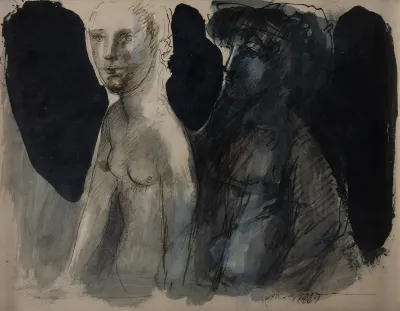
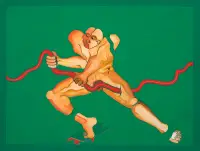
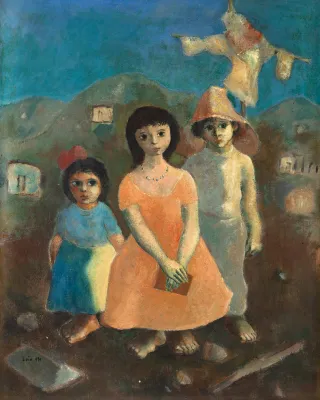
Plattner's expressionist streak appears in his female figures, which at times recall the tradition of Byzantine painting - a stillness, a certain tilt of the head, elongated fingers, an evident two-dimensionality. The traditional theme of the maestà appears in Donna con Bambino e vaso [Woman with Child and Vase] (1957 - 1958) and Donna con Bambino [Woman with Child] (1955). Women set in geometrized urban settings are a common subject, and the frequent juxtaposition of different visual solutions creates a sense of strangeness: the organic lines and fine contours that define the female figures; the areas of color that seem to define the buildings, as in Balcone [Balcony] (1958 - 1959). His time in Brazil appears in the subject matter of works from this period, as shown by the mural he painted for the newspaper Folha de S. Paulo, among other works.
Critiques
"(...) The painter Plattner, who arrived in São Paulo with the almost medieval 'denrée' of canvases steeped in museological feeling, as a worthy representative of the mural and the panel, strove to settle into a reality, our own. A complex and multiple reality. He could not go on drawing and painting within his severe pragmatics. The new world would set about absorbing him anthropophagically."
Manuel Germano
PONTUAL, Roberto. Dicionário das artes plásticas no Brasil. Apresentação de Antônio Houaiss. Textos de Mário Barata et al. Rio de Janeiro: Civilização Brasileira, 1969.
Solo Exhibitions
1948 - Bolzano (Italy) - Solo
1951 - Merano (Italy) - Solo, at Galeria Del Corso
1952 - São Paulo SP - Solo, at MAM/SP
1952 - Vienna (Austria) - Solo, at Galeria Wuerhle
1954 - São Paulo SP - Solo, at MAM/SP
Group Exhibitions
1952 - Rio de Janeiro RJ - 1st National Salon of Modern Art
1953 - São Paulo SP - 2nd São Paulo International Biennial, at Pavilhão dos Estados
1955 - São Paulo SP - 3rd São Paulo International Biennial, at Pavilhão das Nações
1956 - Venice (Italy) - 28th Venice Biennale
1956 - Paris (France) - Exhibition, at Galerie de Seine
1957 - Rio de Janeiro RJ - Exhibition, at MAM/RJ
1957 - Rio de Janeiro RJ - Exhibition, at Galeria Contemporânea
1957 - São Paulo SP - 4th São Paulo International Biennial, at Pavilhão Ciccillo Matarazzo Sobrinho
1959 - São Paulo SP - 5th São Paulo International Biennial, at Pavilhão Ciccillo Matarazzo Sobrinho
1960 - São Paulo SP - Coleção Leirner [Leirner Collection], at Galeria de Arte das Folhas
1962 - São Paulo SP - Seleção de Obras de Arte Brasileira da Coleção Ernesto Wolf [Selection of Brazilian Artworks from the Ernesto Wolf Collection], at MAM/SP
Posthumous Exhibitions
1993 - São Paulo SP - Obras para Ilustração do Suplemento Literário: 1956 - 1967 [Works for Illustration of the Suplemento Literário: 1956 - 1967], at MAM/SP
Source: Itaú Cultural